
When you're thinking about returning to education, you want to know exactly what you're getting for your time and effort. That's where learning outcomes come in. They're not just jargon; they're your roadmap to success.
So, what are they?
Think of it like this: a course description might list the topics it covers, a bit like a recipe lists its ingredients. But a learning outcome tells you what you’ll actually be able to bake at the end. It’s the difference between knowing what goes into a cake and being able to confidently bake a delicious one from scratch.
Learning outcomes are clear, powerful statements about the new skills and knowledge you will walk away with. They shift the focus from what the tutor teaches to what you can do.
What Are Learning Outcomes a Simple Guide

For anyone jumping back into studying, especially busy adults, clarity is everything. Learning outcomes provide that. They act as a transparent promise between you and your course provider, showing you the tangible skills you'll gain before you even enrol.
Let's say you're looking at a module on academic writing. The goal isn't just to "go over" essay structures. A proper learning outcome would be something like, "You will be able to construct a well-argued academic essay using critical analysis and appropriate referencing." See the difference? One is a topic; the other is a skill.
A well-defined learning outcome isn't just a goal; it's a guarantee of a new capability. It transforms your learning from a passive experience into an active process of skill acquisition, giving you clear evidence of your progress and readiness for university.
This is a massive confidence booster. It helps you see the real-world value of your studies from day one, which makes all the difference when you're balancing education with life's other commitments.
The Core Idea of Learning Outcomes
To really nail this down, let’s stick with our baking analogy. This simple table breaks it all down, showing you how the different parts of a course come together to create a real result for you.
| Concept | The Analogy (Baking a Cake) | What It Means for You |
|---|---|---|
| Learning Activities | The ingredients and recipe steps. | The lessons, readings, and assignments you will complete. |
| Learning Outcome | The ability to bake a delicious, perfect cake. | The specific, provable skill you gain (e.g., 'Analyse historical texts'). |
By focusing on the outcome, you can be sure that every assignment and every bit of reading is building towards something practical. You're not just collecting random facts; you're building a toolkit of abilities—like analysis, evaluation, and synthesis—that universities and employers value.
These are the very skills that form the bedrock of higher education. In fact, developing these is so important that we’ve put together a whole guide on how to develop critical thinking skills to give you a head start.
Ultimately, getting to grips with learning outcomes helps you choose an Access to HE Diploma that truly aligns with your ambitions. It gives you a clear map for your journey, ensuring the path you take leads directly to your university and career goals.
Why Learning Outcomes Guide Your University Path
Think of learning outcomes as the official currency of your qualification. They're much more than just a list of course topics; they are the compass that points you directly towards your chosen university degree, giving your application a serious edge.
University admissions tutors lean on them heavily. When they look at your Access to HE Diploma, they’re scanning the learning outcomes to confirm you have the specific foundational knowledge to hit the ground running on their degree course. These statements are the proof they need that you’re ready for the challenge.
For instance, a highly competitive Nursing degree needs applicants who already have a solid grasp of scientific principles and ethical reasoning before day one. Your Access to HE Diploma in Nursing is designed to deliver exactly that.
The Proof Is in the Outcome
So, what does this look like in practice? A key learning outcome for a Nursing diploma might state that by the end of the course, you will be able to 'evaluate principles of professional accountability in healthcare'.
This isn’t just academic jargon. It’s a specific, measurable skill that admissions tutors for healthcare degrees are actively looking for. They know that a student who has ticked this box has wrestled with complex ethical dilemmas, understands the legal side of patient care, and can think critically about professional standards.
Your diploma is basically a portfolio of these proven abilities. Each learning outcome you achieve acts as a powerful testament to your university-readiness, making your application stand out from the crowd.
Learning outcomes translate your hard work into a language that universities understand and respect. They confirm that your qualification has prepared you not just with knowledge, but with the practical, analytical, and critical thinking skills required to excel in your chosen field.
This system takes the guesswork out of the equation for everyone involved—you and the university. It creates a clear, standardised way to measure your capabilities, ensuring your Access to HE Diploma is a trusted and valuable stepping stone to your future. Grasping this connection is a huge part of planning your next move, as it helps you see exactly how to choose the university course that aligns perfectly with the skills you're building.
Building Confidence for Your Journey
Beyond impressing admissions tutors, clear learning outcomes are a massive confidence booster for you. The thought of returning to education can feel a bit daunting, but these goals give you a structured and empowering path to follow.
They let you see and measure your progress in a very real way. Every time you master a skill outlined in an outcome, you have concrete proof that you’re moving forward and growing. This creates a brilliant sense of achievement that keeps you motivated.
Instead of staring at a huge syllabus and feeling overwhelmed, you can focus on mastering one clear skill at a time. This bite-sized approach makes the whole learning process feel much more manageable and rewarding, turning your return to study into an empowering and successful experience.
Learning Outcomes Versus Learning Objectives
When you start digging into different courses, you'll quickly come across two terms that sound very similar: 'learning outcomes' and 'learning objectives'. They're often thrown around as if they mean the same thing, but for you, as a prospective student, knowing the difference is crucial. It’s what separates a good course choice from a great one.
Think of it like this: a learning objective is the instructor's lesson plan, while a learning outcome is the new skill you walk away with. One is the 'what I will teach you' list, and the other is the 'what you will be able to do' guarantee.
For instance, a tutor’s objective might be: "To introduce students to the key principles of cell biology." That's their goal for the session. But the learning outcome focuses on you: "Explain the functions of the major organelles within a cell." One is about the teaching process; the other is about your proven ability.
Instructor-Focused Versus Student-Focused
At its heart, the difference is all about perspective. Objectives are written from the tutor’s point of view, outlining the topics they plan to cover and the activities they'll run. They’re all about the process of teaching.
Learning outcomes, on the other hand, are all about you. They are written from the student’s perspective, spelling out the tangible skills and knowledge you'll be able to demonstrate when you’re done. This is precisely why universities care so much about them – they're proof of what you can actually do.
Objectives describe the journey the instructor has planned. Outcomes describe the destination you will reach and the skills you'll have when you get there. As a student, your focus should always be on the destination.
This isn’t just a case of wording. A course might have an objective "to discuss key historical events," but if the outcome is "to analyse primary source documents to form a historical argument," you know you're signing up for much more than a history lecture. That course is designed to build a practical, high-level skill that universities value.
For a deeper dive into how educators create these, it can be useful to understand how to write objectives for lesson plans, as it highlights this instructor-first perspective.
Outcomes vs Objectives: What Is the Difference?
Let's break it down side-by-side to make the distinction crystal clear.
| Focus | Learning Objective (The Instructor's Plan) | Learning Outcome (Your New Ability) |
|---|---|---|
| Perspective | Tutor-focused | Student-focused |
| Purpose | Describes the content to be taught. | Describes what you will be able to do. |
| Example (Nursing) | "To cover the anatomy of the human heart." | "You will be able to label a diagram of the human heart and explain the function of each part." |
| Example (Business) | "To discuss various marketing strategies." | "You will be able to develop a basic marketing plan for a small business." |
This table shows how the focus shifts from the instructor's intentions to your concrete, demonstrable skills.
Why This Matters for Your Choice
Focusing on outcomes turns you into a smart educational consumer. When you're weighing up two different diplomas, don't just skim the list of topics (the objectives). Dive straight into the learning outcomes. This is where you'll discover which course truly delivers the skills that align with your dream degree and future career.
Ask yourself these questions as you read them:
- Will I be able to analyse, evaluate, or create? Keep an eye out for those strong, active verbs.
- Do these outcomes match what my target university course is looking for in applicants?
- Can I picture myself using these skills in my future job?
Looking at a course through this lens ensures you choose a qualification that doesn't just fill your head with facts, but genuinely equips you for the challenges and opportunities ahead.
See Your Future Career in Today's Learning Outcomes
So far, we’ve talked about what learning outcomes are and why universities pay such close attention to them. But let’s bring it closer to home and connect them to something even more tangible: your future career.
Learning outcomes aren’t just academic hoops to jump through. Think of them as the building blocks of the professional skills you'll be using every single day in your chosen field. They take an abstract course title and turn it into a concrete list of what you can actually do.
When you look at the outcomes for an Access to HE Diploma, you’re essentially getting a sneak peek of the professional you’re training to become. Each one describes a skill that employers in your target industry are actively searching for. Realising this makes the journey so much more motivating – every assignment is a direct step towards not just a university place, but a successful and fulfilling career.
From Classroom Skill to Career Capability
Thinking about learning outcomes in a career context makes their value crystal clear. They’re designed to mirror the real-world tasks and challenges you’ll face in a profession. At the end of the day, an employer wants to know what you can do, and your diploma's outcomes provide a detailed, verified answer.
Let’s look at how this plays out across a few popular career paths. Each example below draws a straight line from a specific learning outcome on an Access to HE Diploma to an essential skill needed on the job.
Nursing and Healthcare Professions
A career in healthcare is built on a foundation of trust, clinical knowledge, and solid ethical judgement. The learning outcomes on a Nursing diploma are specifically designed to build these core competencies from day one.
- Learning Outcome Example: "Evaluate the principles of professional accountability in healthcare settings."
- Real-World Application: This isn't just about writing an essay. As a nurse, you’ll constantly make decisions that directly impact a patient's safety and wellbeing. This outcome proves you can think through complex ethical situations, understand your legal responsibilities, and uphold the high professional standards required on a busy hospital ward or in a local clinic.
Computer Science and Technology
The tech industry moves fast and it needs practical problem-solvers. An Access to HE Diploma in Computer Science focuses on outcomes that build your ability to think logically and create things that work – skills that tech companies value above all else.
- Learning Outcome Example: "Design and implement a basic algorithm to solve a computational problem."
- Real-World Application: This is the heart of what a developer or programmer does. Whether you're building a new app, creating a website, or working on complex software, your job boils down to breaking big problems into smaller, manageable steps and writing code to solve them. This outcome shows you have that fundamental, practical skill.
The best learning outcomes act as a bridge between academic theory and professional practice. They ensure that what you learn in your course is directly relevant and immediately applicable to the challenges you'll face in your future workplace.
Business and Management
Success in the business world relies on being able to look at data and make smart, strategic decisions. A business diploma gets you ready by focusing on the analytical skills you’ll need to figure out how healthy and successful an organisation really is.
- Learning Outcome Example: "Analyse financial statements to assess business performance."
- Real-World Application: Any manager, analyst, or entrepreneur has to be able to read a balance sheet or income statement and understand what the numbers are saying. This outcome proves you can go beyond simple bookkeeping to interpret financial data, spot trends, and make informed recommendations that could help drive a company forward.
When you start seeing your course through this lens, it becomes obvious how each module adds another tool to your professional toolkit. This perspective gives your studies a real sense of purpose, ensuring you’re building the exact skills you need to not only get into university but to thrive in your profession for years to come.
How Tutors Measure Your Success with Assessments
Every assignment you complete on your Access to HE Diploma is far more than just another task to tick off. Think of it as a purpose-built tool designed to prove you’ve mastered a specific learning outcome. Tutors don’t set assessments simply to test your memory; they want to see your new skills in action.
This approach completely demystifies the marking process. Imagine an assessment is the stage, and the learning outcome is the performance you’ve been practising for. If an outcome is to "Critically evaluate sociological theories," your assessment will be an essay asking you to do just that, maybe by looking at a current social issue. It makes every piece of coursework a meaningful chance to show what you can do.
For adults returning to education, this transparency is incredibly reassuring. It proves the grading process is fair, objective, and entirely focused on building the practical skills you’ll need for university. Each assignment becomes a confident step forward.
Connecting Assessments to Your Goals
Assessments are the bridge between your course activities and the skills you can proudly list on your university application. They provide solid evidence that you’ve met the course’s promises. Your tutor will use different methods to give you plenty of opportunities to demonstrate your knowledge in various ways.
This is how your diploma, the skills you gain (which are proven through your assessments), and your future career all slot together.
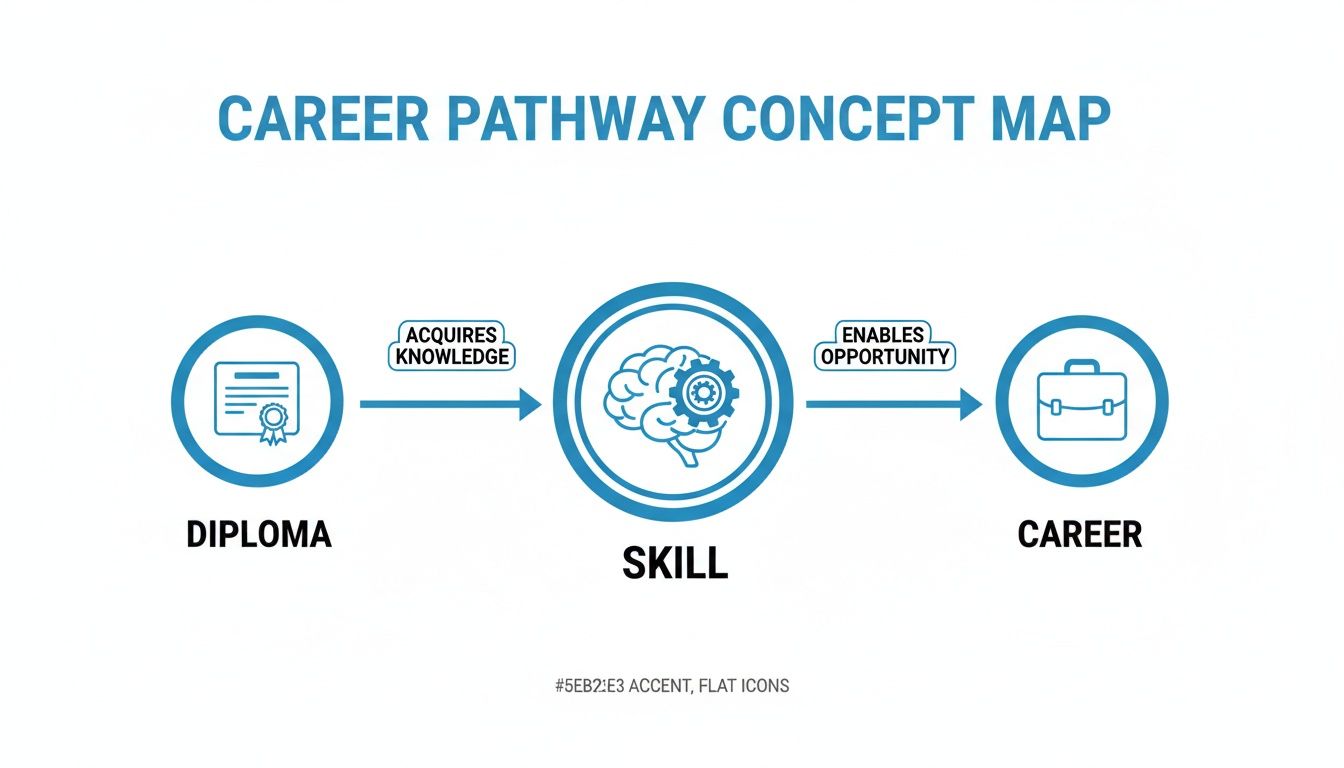
As you can see, completing your diploma and its assessments directly translates into the professional skills needed for your target career.
For example, you might come across different types of assignments, each aligned with a specific outcome:
- Written Essays to check your ability to build a coherent, persuasive argument.
- Presentations to showcase your communication and synthesis skills.
- Lab Reports to prove you’ve grasped scientific methods and data analysis.
- Timed Assessments to test how you apply knowledge under pressure.
To get a clearer picture of what to expect, you can find out more about whether Access courses have exams in our detailed guide.
Tutors use assessments to give you structured opportunities to prove your abilities. Each completed assignment is a validated achievement, building a strong portfolio of evidence that confirms you are fully prepared for the rigours of higher education.
Ultimately, this whole assessment model is designed for your success. It ensures that by the time you finish your course, you won't just feel ready for university—you'll have a collection of marked work that proves it.
How to Choose Your Course Using Learning Outcomes
Now that you know what learning outcomes are, you can start using them as your secret weapon for picking the perfect Access to HE Diploma. It’s about looking past the course title and digging into what you’ll actually be able to do by the end of your studies.
Think of it this way: choosing a course based only on its name is like buying a book just for its cover. Instead, treating learning outcomes as your main guide lets you read the first chapter. You’re not just hoping it’s the right fit; you’re making sure it delivers the exact skills you need to get into university and build the career you want. This simple shift in approach puts you firmly in control of your future.
Your Practical Decision-Making Checklist
As you start comparing different diplomas, let the learning outcomes answer the big questions for you. You’ll usually find them listed on the course description page on the provider's website. If they’re not immediately obvious, don’t hesitate to ask!
Here’s what you should be looking for:
- Do these outcomes match my target university’s entry requirements? Hop onto the websites of your dream degree courses. They often spell out the kind of skills and knowledge they expect applicants to have.
- Are these the skills I need for my dream career? Keep an eye out for strong action words like ‘analyse’, ‘evaluate’, ‘create’, and ‘critically assess’. These are clues that you’ll be developing the high-level abilities employers are desperate for.
- Can I see a clear path from these outcomes to my goals? Does the list of skills feel like a solid, logical stepping stone to where you see yourself in five years?
Using learning outcomes to vet your options ensures you choose a course based on its substance, not just its name. It’s about matching the proven skills you will gain with the exact requirements of your future path, removing guesswork and building your confidence.
This method is brilliant for comparing courses that seem similar on the surface. You might find two diplomas with almost identical names, but a quick look at the learning outcomes reveals one is a much better launchpad for your specific ambitions.
Making an Informed Choice
As you get into the details, remember that every learning outcome is linked to an assessment. Tutors design assignments, exams, and projects specifically to check that you've mastered each skill. The precision here really matters. For anyone interested in the statistical side of this, an article on understanding Type I and Type II errors in hypothesis testing gives a fascinating glimpse into how educators measure success accurately.
By taking this strategic approach, you’re no longer just another applicant. You’re someone who knows exactly where they’re going and has a plan to get there. You're not just picking a course; you’re investing in a toolkit of skills that will open all the right doors.
Your Questions on Learning Outcomes Answered
Dipping your toes back into education can bring up a lot of questions. Don't worry, that's completely normal! This final section is all about tackling some of the most common queries we hear from students about learning outcomes, with clear and simple answers.
What if I Do Not Meet a Learning Outcome on My First Try?
First off, don’t panic. This is a very common part of the learning process. Your tutors know you're building new skills, and nobody expects you to get everything perfect on the first go. It's all part of the journey.
If an assessment doesn't quite hit the mark, your tutor will give you detailed feedback, pinpointing exactly where you can improve. You’ll then get the chance to take that feedback on board, revise your work, and resubmit it. It’s a supportive system designed to make sure you truly grasp the material and can confidently show what you know.
Are Learning Outcomes for Online Courses the Same as In-Person Ones?
Yes, they are identical. A nationally recognised qualification like an Access to HE Diploma has standardised learning outcomes right across the board. This means an online provider is held to the exact same high academic standards as a brick-and-mortar college.
Whether you’re studying in a classroom or at your kitchen table, the skills you are certified to have gained are the same. This guarantees your online diploma holds the exact same weight with universities and employers, giving you a flexible but credible route to your degree.
How Can I Use Learning Outcomes in My University Personal Statement?
This is a fantastic tip for making your personal statement truly shine. Instead of just listing the modules you studied, you can use the language from the learning outcomes to showcase the specific, university-level skills you’ve developed. It’s so much more powerful.
For instance, you could frame your experience like this:
- "My coursework developed my ability to critically evaluate sociological theories, preparing me for the analytical demands of a sociology degree."
- "I have learned to design and implement basic algorithms, giving me a practical foundation for studying computer science."
This approach instantly shows admissions tutors that you’re not just ready for university – you already understand what’s expected and have the skills to hit the ground running.
At Access Courses Online, we build all our diplomas around clear, career-focused learning outcomes to give you the strongest possible start on your path to university. Ready to find the course that will unlock your future?