

An essay plan template is your roadmap to a higher grade. Think of it as a structured outline that organises your arguments, evidence, and ideas before you even start writing. It’s the key to ensuring your final piece is clear, logical, and persuasive.
Why An Essay Plan Is Your Secret Weapon for Success

Let's be honest, staring at a blank page can feel pretty daunting. For many Access to HE students, the temptation is to just dive straight into writing to get something—anything—down on paper. But trust me, this is often a strategic mistake that leads to rambling arguments, writer's block, and a whole lot of unnecessary stress.
A well-structured essay plan is probably the single most effective tool you can use to boost your grades. It transforms the writing process from a chaotic, last-minute sprint into a calm, organised journey. By mapping out your essay first, you make sure every single paragraph has a clear purpose and contributes directly to your main argument.
Building a Foundation for Clarity
Think of an essay plan as the architectural blueprint for a house. You wouldn't start laying bricks without one, right? The same logic applies to your academic writing. The core parts of your plan are what give your essay its strength and structure:
- Thesis Statement: This is your foundation—a clear, concise summary of your main argument.
- Key Arguments: These are the walls—the main points that will hold up and support your thesis.
- Supporting Evidence: This is the wiring and plumbing—the facts, quotes, and data that bring your arguments to life.
- Conclusion: And finally, the roof—a solid summary that ties everything together and powerfully reinforces your thesis.
For example, if you were writing a nursing essay on patient-centred care, your plan would outline separate paragraphs on communication, shared decision-making, and ethical considerations. Each of these sections would then be backed up by specific case studies or clinical guidelines. This structure stops you from getting lost halfway through and ensures a coherent flow from start to finish.
Finding the drive to get started can sometimes be the hardest part, but our guide on how to get motivated to study can give you the push you need to take that first crucial step.
An essay plan isn't just about organisation; it's a critical thinking tool. It forces you to engage deeply with the question, evaluate your evidence, and refine your argument before you commit a single word to the final draft.
The Proven Link to Higher Marks
The benefits aren't just something we've imagined. University writing-centre data consistently shows that students who use a planning template are 20–30% more likely to achieve a first-class or upper-second grade.
Why? It's simple. A plan makes sure your essay directly answers the question, presents a logical argument, and uses evidence effectively—all key criteria your tutors are looking for.
Of course, the foundation of any great essay plan is gathering your information effectively in the first place. Taking the time to improve note taking skills will make this whole process much, much easier.
Deconstructing a Winning Essay Plan Template
Think of an effective essay plan not as a simple to-do list, but as the architectural blueprint for your argument. It’s the secret to breaking down a huge, often intimidating, assignment into small, manageable chunks. This gives you a feeling of control and clarity right from the very beginning.
A winning template goes way beyond generic headings. It’s built with specific, functional sections that guide your thinking. To get a better handle on how these structured documents work, you can explore the general concept of a template and its uses. For your academic writing, this kind of structure is precisely what turns a jumble of ideas into a coherent, high-scoring essay.
The Core Components Of Your Template
Every solid essay plan is built around a handful of essential elements. These are the non-negotiables, the absolute must-haves that form the skeleton of your arguments and make sure everything flows logically from one point to the next.
A truly practical essay plan template will always have dedicated space for these key areas:
- Essay Question Breakdown: A spot to really pull apart the question, identifying and defining the crucial command words (like 'analyse', 'discuss', or 'evaluate') and the main topic words.
- Thesis Statement: This is your anchor. It's a single, powerful sentence that states your main argument and gives a direct answer to the essay question.
- Introduction Outline: Just a few bullet points covering your opening hook, some background context, and a quick preview of the main points your essay will cover.
- Body Paragraphs (using PEEL): Separate sections for each of your main arguments, already structured to make the actual writing process much smoother.
- Conclusion Outline: Bullet points to help you summarise your arguments and restate your thesis in a fresh, impactful way.
Taking this structured approach makes sure you've addressed every single part of the question. It also helps you map out a rough word count for each section, which is a lifesaver for avoiding that classic student mistake of a massive introduction and a rushed, weak conclusion.
Great planning starts with great information. That's why having a solid note-taking system is so important. If you need a refresher, we've got a guide on how to take effective notes to help you get your research in order.
Let's take a closer look at what goes into each part of the plan. Below is a simple table breaking down the anatomy of a plan, showing you what each component is for and what you should aim to include.
Anatomy Of An Effective Essay Plan
| Component | Purpose | What To Include |
|---|---|---|
| Essay Question Breakdown | To ensure you fully understand and address all parts of the question. | Key command words (e.g., compare, contrast) and topic words. |
| Thesis Statement | To present your central argument clearly and concisely. | A single, debatable sentence that answers the essay question directly. |
| Introduction Outline | To map out the opening paragraph and grab the reader's attention. | Hook, brief background, and a sentence outlining your main points. |
| Body Paragraphs | To structure the main arguments with supporting evidence. | A PEEL (Point, Evidence, Explain, Link) structure for each paragraph. |
| Conclusion Outline | To summarise the essay and leave a lasting impression. | A summary of key points and a final restatement of your thesis. |
With these building blocks in place, you’re not just writing; you’re building a strong, persuasive argument from the ground up.
Structuring Body Paragraphs With The PEEL Method
The main body of your essay is where the magic happens—it’s where you really dig in and develop your argument. This is where the PEEL method becomes your best friend. By framing each paragraph plan around this structure, you pretty much guarantee clarity, depth, and solid evidence.
PEEL is a simple acronym that stands for:
- Point: The main idea of the paragraph. This should be a clear topic sentence that introduces your argument.
- Evidence: The proof. This is where you bring in the facts, stats, quotes, or examples from your research to back up your point.
- Explain: Your analysis. How does your evidence actually prove your point? What does it mean? This is where you get to show off your critical thinking.
- Link: The wrap-up. A final sentence that connects the paragraph's point back to your main thesis statement, keeping your whole argument cohesive.
Let’s imagine you’re planning an essay on the impact of social media on adolescent mental health. A PEEL paragraph plan might look something like this:
Point: Over-exposure to highly curated online content contributes to lower self-esteem among teenagers.
Evidence: Cite a recent study that shows a clear correlation between the number of hours spent on Instagram and negative body image.
Explain: This evidence suggests that the constant comparison with idealised, often unrealistic, images creates standards that are impossible to live up to.
Link: This directly reinforces the central thesis that social media has a detrimental effect on adolescent psychological well-being.
Building Your Custom Essay Plan From Scratch
Theory is one thing, but putting it into practice is where the magic really happens. Creating your own essay plan isn't just a box-ticking exercise; it's an active thinking process that kicks off the second you get your assignment. The aim here is to build a personal roadmap that makes writing feel faster, clearer, and a whole lot less daunting.
It all starts with one crucial first move: breaking down the essay question itself. Tutors choose their words carefully, so it’s your job to play detective. You need to identify the core parts of the question to make sure your answer is laser-focused and hits every single point.
Deconstructing The Essay Question
Before a single idea pops into your head, you need to know exactly what's being asked of you. A classic mistake is to skim the question and just start writing about the general topic. Instead, pause and pinpoint the different types of words your tutor has used.
- Command Words: These are the verbs telling you how to answer. Words like 'analyse', 'evaluate', 'compare', or 'discuss' each need a different approach. 'Analyse' means breaking a topic into its component parts, while 'evaluate' demands that you make a judgment on its value or importance.
- Topic Words: These spell out the specific subject of your essay. If the question is "Evaluate the impact of austerity on social care services in the UK," your topic words are 'austerity' and 'social care services in the UK'. Simple enough.
- Limiting Words: These create the boundaries for your essay. In that same example, 'in the UK' is a limiting phrase. It’s a clear signal not to start discussing how austerity has played out in other countries.
Once you’ve got a handle on the task, you can start getting your initial thoughts down. This is the time to let ideas flow freely without any judgment. You're just creating the raw material for your plan.
This initial deconstruction phase is non-negotiable. Misunderstanding a command word is one of the fastest ways to lose marks, even if your knowledge of the topic is brilliant. Your plan is what keeps you on the right track from the very beginning.
This is a core academic skill, but it’s one that many students find tricky. National surveys have shown a surprising gap: while 62% of A-level students feel confident producing written arguments, only 34% can consistently create a solid plan that links evidence to an argument before they start writing.
Brainstorming and Structuring Your Ideas
With the question properly unpacked, it’s time to brainstorm. A fantastic technique for this is mind mapping. Pop the central essay topic in the middle of a page and draw branches for every related idea, fact, or question that springs to mind. Don't censor yourself—just get it all down on paper.
Once your mind map is looking full, step back and look for patterns. Can you group certain ideas together? These little clusters are the foundations of your main body paragraphs. Each cluster should stand for a distinct point that backs up your overall argument. For instance, ideas about funding cuts, staff shortages, and service closures could all be neatly grouped under a single theme.
This simple flow is what your essay structure should aim for, moving from a clear thesis to well-supported points and a powerful conclusion.
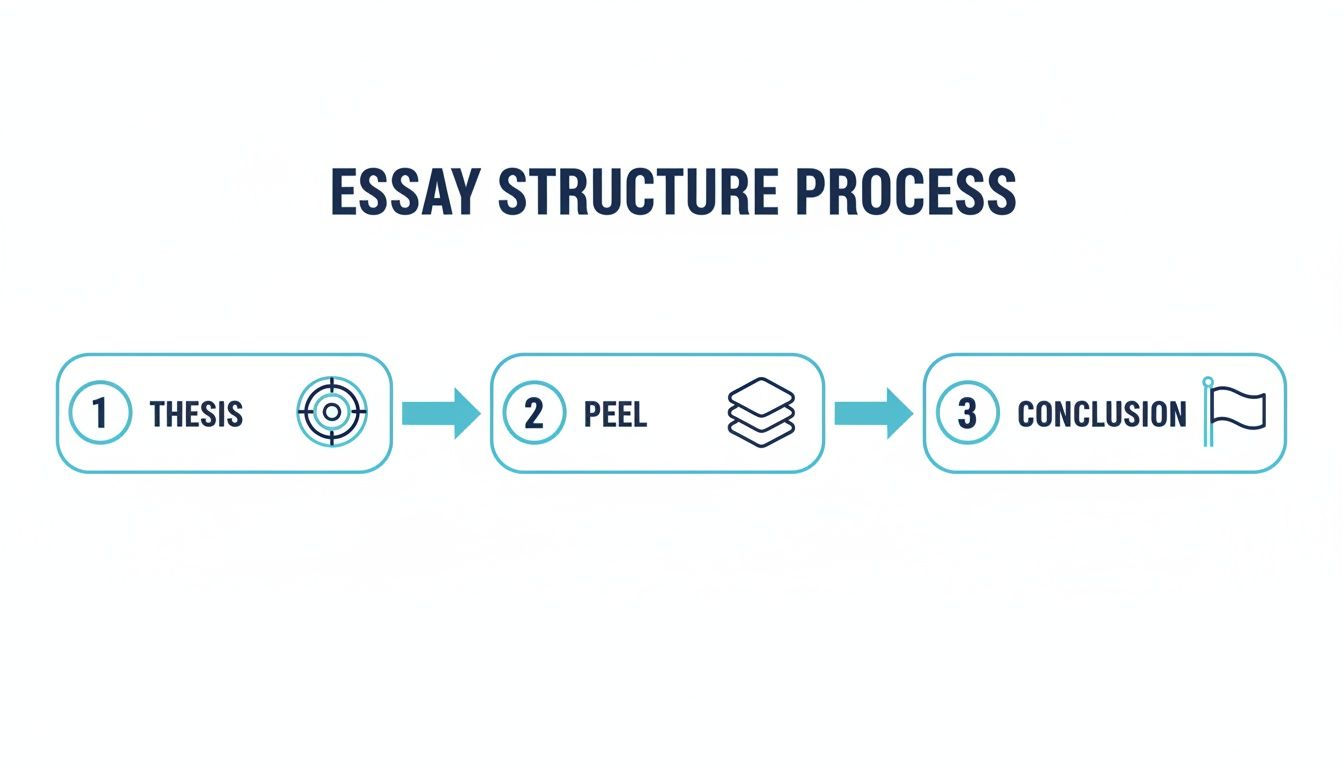
The image above reinforces it perfectly: a strong thesis is your starting block, followed by structured paragraphs (like the PEEL method), all leading to a decisive finish.
Now you can start filling in your template. For each theme you've identified, draft a topic sentence that clearly states the point of that paragraph. Then, using bullet points, list the specific evidence from your research—quotes, stats, or case studies—that you’ll use to prove it. Squeezing this planning stage into a busy week can be tough, which is why we have a guide on creating a study schedule that actually works.
How To Adapt Your Template for Different Subjects
A standard essay plan template is a fantastic starting point, but let’s be honest, it’s not a one-size-fits-all solution. An essay for a science module demands a very different structure and tone from one for a literature course. This is where the real skill comes in.
Customising your template is absolutely crucial for meeting the specific expectations of your tutors and, ultimately, scoring those higher marks. One of the most common mistakes I see students make is treating every essay as if it requires the same kind of argument. It just doesn't work that way.
For science-based subjects, your argument is often built around empirical evidence and a clear, logical progression. Think of it as laying out the facts. In contrast, humanities essays are all about interpretation, textual analysis, and engaging with different theoretical perspectives.
Planning for Scientific and Health Subjects
When you’re tackling subjects like Biology, Psychology, or Health Studies, your essay plan needs to mirror the scientific method. The structure is typically more rigid and focused on objectivity.
Think of your plan in these terms:
- Hypothesis/Problem: Start by clearly stating the problem or the hypothesis your essay will explore. What question are you trying to answer?
- Methodology/Evidence: Dedicate sections to the methods, studies, or data you will analyse. What evidence will you use to support your points?
- Analysis/Results: Plan how you will present and interpret the findings from your evidence. Don't just list the facts; explain what they mean.
- Implications/Conclusion: Wrap it up by explaining the significance of these results, linking everything back to your initial hypothesis.
For instance, if you were writing a Health Studies essay analysing the effectiveness of a public health campaign, your plan would need to map out sections on the campaign's aims, the data on its impact (e.g., vaccination rates), and a balanced evaluation of its successes and failures.
Structuring for Humanities and Social Sciences
Essays in subjects like Literature, History, or Sociology require a different kind of flexibility. Here, the focus shifts from proving a hypothesis to developing a nuanced, persuasive argument supported by interpretation and critical theory.
Your template should adapt to prioritise:
- Thematic Arguments: Instead of a single hypothesis, your plan will centre on 2-3 core thematic arguments that support your main thesis.
- Textual/Source Analysis: Each section must have a plan for a close analysis of primary sources, whether that’s a poem, a historical document, or a sociological study.
- Theoretical Frameworks: It's a good idea to include a section to outline which critical theories (e.g., Marxism, feminism) you will use to frame your analysis.
For a Sociology essay on social mobility, your plan would have distinct sections for discussing theoretical frameworks like functionalism, then move on to analysing statistical evidence, and perhaps finish by exploring specific case studies that bring your argument to life.
The real skill in academic writing is showing you understand the unique conventions of your discipline. Adapting your essay plan template is the first and most important step in demonstrating that understanding to your tutor.
This discipline-specific approach is something universities actively teach. In fact, most UK higher-education institutions see it as a core academic skill. They often provide detailed sample plans with recommended word counts for different sections, a practice which helps students grasp the unique expectations of their chosen field. You can learn more about how universities approach essay structure to see how this works in practice.
Turning Your Plan Into a Polished Final Draft

With a solid essay plan in hand, you've already conquered the hardest part. That intimidating blank page is gone, replaced by a clear, manageable roadmap for your argument. The next step is to bring that structure to life, transforming your notes into a flowing, persuasive piece of academic writing.
Remember, your plan is a guide, not a set of rules carved in stone. Some of the best writing happens when you let new ideas and deeper insights emerge as you draft. A great plan gives you the confidence to explore these tangents without getting completely lost.
From Plan to First Paragraph
Your introduction is your first impression, and your plan makes it so much easier to get right. Use the outline you've already created to draft a powerful opening that does three things quickly and efficiently.
- Set the Scene: Briefly introduce the topic and explain why it's important.
- State Your Thesis: Present your main argument clearly and directly, pulling it straight from your plan.
- Signpost Your Points: Give the reader a quick preview of the key arguments you'll cover in the essay.
This approach ensures your introduction is sharp, focused, and directly answers the essay question from the very first sentence. It immediately tells your tutor you know exactly where you're going.
Writing With Flexibility
As you move into the main body, follow the points you've laid out in your template, paragraph by paragraph. This keeps your argument logical and stops you from wandering off-topic. But don't be afraid to make adjustments on the fly.
You might find that as you're writing, one point feels stronger than you first thought, or two pieces of evidence connect in a way you hadn't noticed before. That’s a brilliant sign of deep thinking! When it happens, just pause and tweak your plan. This small step keeps your final essay coherent, even as your argument evolves and becomes more sophisticated.
Think of your essay plan as a satnav. You have a destination and a planned route, but if you spot a better, more scenic road along the way, you should feel free to take it—as long as you still arrive at the correct destination.
Avoiding Common Pitfalls
Even with the best plan in the world, a few common mistakes can trip students up when it's time to write. Knowing what they are can be the difference between a good essay and a great one.
A frequent issue is a plan that's just too vague. Bullet points like "discuss theory" aren't going to help you much when you're staring at the screen. Make sure your plan has specific evidence and topic sentences to guide you. Another classic pitfall is failing to link evidence back to your main point, which turns paragraphs into simple lists of facts. Your plan should have space for the 'Explain' and 'Link' parts of the PEEL method to stop this from happening.
Finally, use your plan as a final checklist before you hit submit. Reread the essay question one last time, then go through your plan to make sure you’ve hit every point, used all your evidence, and concluded by directly answering the question you started with.
Got Questions About Essay Planning?
Even with a brilliant template in hand, it’s completely normal for a few questions to pop up. Nailing down your planning process is what separates a good essay from a great one, so let’s walk through some of the most common worries I hear from Access to HE students.
One of the biggest concerns is that a plan might feel too restrictive. Will it box you in and kill your creativity? Honestly, it’s quite the opposite. A solid plan actually frees up your mind to get creative with your arguments and language, because you’re not constantly stressing about what comes next.
Think of it like a roadmap. You know your destination (the conclusion) and the main motorways you need to take (your key points), but you can still decide to take a scenic detour if you spot something interesting. The plan is there to make sure you don't get completely lost.
How Much Detail Should I Actually Put in My Plan?
This is the golden question, isn't it? The goal is to find that perfect sweet spot between a vague to-do list and basically writing the entire essay twice. A good rule of thumb is to create a plan detailed enough that someone else could read it and understand the exact journey your argument is going to take.
Your essay plan template should always include:
- Your full, finalised thesis statement. This is your essay's north star.
- A clear topic sentence for each main body paragraph.
- Bulleted points covering the specific evidence, examples, or data you’ll use, complete with citations.
For your evidence points, stick to keywords and short phrases instead of full-blown sentences. This keeps the plan easy to scan and stops you from getting bogged down in the writing phase before you’ve even started.
What Happens If I Get a Brilliant New Idea While I'm Writing?
First of all, congratulations! This is a fantastic sign. It means you’re properly getting stuck into the topic and thinking critically. An essay plan is a living document, not a contract you’ve signed in blood. When inspiration strikes, don’t just ignore it.
Take a moment to pause your writing and hop back to your plan. Ask yourself where this new idea fits. Does it make one of your existing points even stronger? Or is it big enough to need its own paragraph? Maybe it even changes your main thesis slightly.
Whatever the answer, tweak the plan first. This tiny step ensures your final essay stays coherent and well-structured, even when your thinking evolves.
A good rule of thumb is to dedicate 10-15% of your total assignment time to planning. For an essay you expect will take 10 hours, spending 60-90 minutes on your plan is a smart investment that saves you hours of redrafting later.
This upfront effort is what transforms a stressful, last-minute panic into a focused, confident process. It makes the path to a great grade so much clearer.
Ready to take the next step towards your degree? At Access Courses Online, we provide accredited online Access to HE Diplomas that fit around your life, helping you get to university. Discover your course today.