
Have you always dreamed of a career supporting families through one of life’s biggest moments? To become a midwife in the UK, you’ll need to complete a university degree approved by the Nursing and Midwifery Council (NMC). This usually means having specific qualifications like GCSEs and a Level 3 qualification, such as an Access to HE Diploma.
Your Roadmap to a Midwifery Career
Choosing to become a midwife isn't just a career change; it’s a decision to provide skilled, compassionate care during pregnancy, birth, and the crucial postnatal period. This guide is your personal roadmap, designed for UK-based adults who might be switching careers or don't have traditional A-Levels. We’ll cut through the jargon and show you the practical, achievable steps thousands of people take every year to join this incredible profession.
In the UK, "midwife" is a protected title. That means you absolutely must be registered with the NMC to practise. Getting that registration is the final step after you've successfully completed an approved pre-registration midwifery degree. These courses are intense, blending serious academic work with hundreds of hours of hands-on clinical placements. The goal is to make sure you’re competent and confident from your very first day on the job.
Understanding the Journey Ahead
There's no single "right way" to become a midwife. Your own circumstances, what qualifications you already have, and how you prefer to learn will all shape your unique path. This guide is here to help you navigate those choices with real-world advice you can actually use.
We’ll walk you through the key stages:
- Finding Your Entry Route: Exploring everything from direct-entry degrees to flexible Access to HE Diplomas that fit around your life.
- Meeting the Requirements: Breaking down the exact academic and experience prerequisites that universities are looking for.
- Crafting a Winning Application: Creating a personal statement that stands out and preparing for those competitive interviews.
- Securing Funding and Final Checks: Navigating student finance, NHS grants, and all the essential background checks.
Becoming a midwife is about blending clinical expertise with genuine empathy. It’s about advocating for your patients, respecting their choices, and providing evidence-based care in all sorts of settings—from a busy hospital ward to the quiet intimacy of a home birth.
This role demands resilience, brilliant communication skills, and the ability to stay calm when things get intense. Midwives are autonomous practitioners, responsible for the wellbeing of both mother and baby. You'll make critical decisions and collaborate with a wider healthcare team when needed.
By understanding the full scope of the role and the dedication it requires, you can take your first steps with clarity and confidence. Think of this guide as your playbook for starting a fulfilling new chapter.
Choosing Your Midwifery Entry Route
Deciding you want to become a midwife is a massive moment. But figuring out how to get there can feel overwhelming. The good news? The journey isn't a single, rigid path. In the UK, there are several well-trodden routes to registration, each designed for different life stages, academic backgrounds, and learning styles.
Your options are probably more flexible than you imagine. Whether you’ve just finished school with a clutch of A-Levels, you're a graduate in another field searching for a more fulfilling career, or you're an adult returning to education after years away, there's a pathway for you. The key is to understand how each one works so you can choose the one that fits your life.
The Direct Entry University Degree
This is the most traditional route: a full-time, three-year Bachelor of Science (BSc) in Midwifery. It’s an intense but rewarding blend of university lectures and extensive hands-on placements in hospitals and community settings.
This path is perfect if you can commit to full-time study and already have the typical entry requirements, which usually include A-Levels in subjects like Biology. You’ll be completely immersed in midwifery from day one, building your theoretical knowledge and clinical skills side-by-side.
The Postgraduate Midwifery Course
Already have a degree in a relevant subject, like nursing or another health science? A postgraduate course could be your fastest way to qualify. These programmes are much shorter, often taking around 18 months to two years to complete.
They recognise the academic skills you already have and build on them, focusing intensely on midwifery-specific knowledge and practice. It’s a brilliant option for qualified nurses who want to specialise and become dual-qualified, as it really does fast-track the process.
The Midwifery Degree Apprenticeship
For those who need to earn while they learn, the Midwifery Degree Apprenticeship is a game-changer. This route mixes on-the-job training with academic study, meaning you get to work in a healthcare setting and gain your degree at the same time.
Apprenticeships are a fantastic way to get stuck in with practical experience from the very beginning, embedding you within a clinical team. Competition can be fierce, and you’ll need an employer to sponsor you, but it’s a practical, hands-on way to qualify without racking up the same level of student debt.
Before you jump in, it’s worth taking a moment to plan. This flowchart breaks down the first few crucial steps, from checking in with your passion to making sure you're truly ready to go.
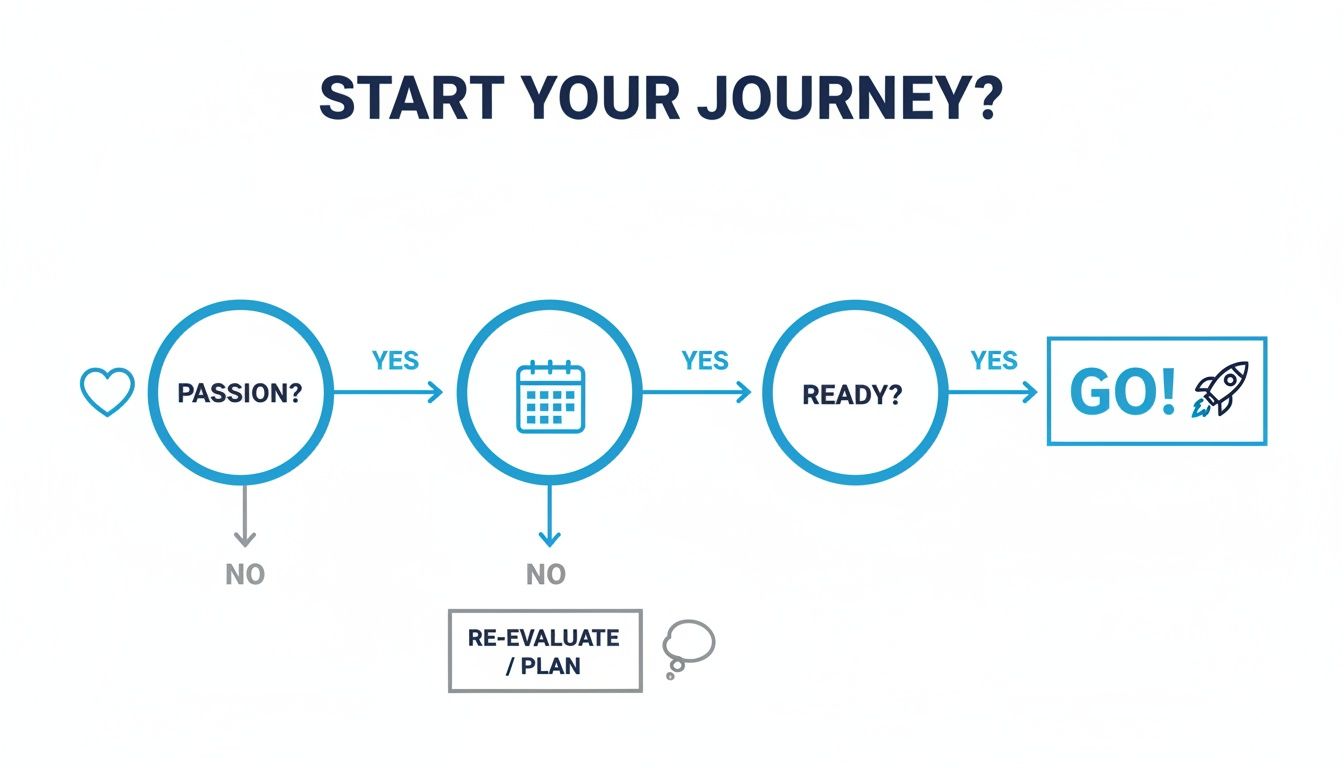
As you can see, the path to midwifery starts with some honest self-reflection and solid planning long before you even think about applications.
The Access to Higher Education Diploma
But what if you don't have A-Levels or the right science background? This is where the Access to Higher Education (HE) Diploma in Midwifery becomes your most powerful tool. It’s a nationally recognised Level 3 qualification specifically created for adults who are ready to get back into education.
An Access to HE Diploma is not just about earning UCAS points; it's about building the academic confidence, study skills, and foundational knowledge you need to thrive in a demanding university degree.
This qualification is designed to be finished in about a year, and many providers, like us at Access Courses Online, offer fully online courses. This incredible flexibility lets you fit your studies around work or family, making a career change feel genuinely achievable. Take a look at a dedicated midwifery access course to see how the curriculum is built to prepare you for the challenges of a degree.
This pathway has become absolutely vital for so many aspiring midwives. Imagine standing at the start of a career where you help guide new life into the world. It's more achievable than ever, especially for adults. In fact, as of September 2023, the Nursing and Midwifery Council (NMC) Register had a record 47,481 midwives across the UK—a 1.9% increase in just six months, showing a steady growth in the workforce. You can dig into the numbers yourself in the NMC's latest data report.
Comparing UK Midwifery Entry Routes
To help you see everything at a glance, we've put together a simple comparison of the main pathways. This should help you figure out which route best suits your background, lifestyle, and goals.
| Route | Best For | Typical Duration | Key Entry Requirement |
|---|---|---|---|
| BSc Midwifery Degree | School leavers or those with A-Levels who can study full-time. | 3 Years | Specific A-Levels (e.g., Biology) and GCSEs. |
| Postgraduate Course | Graduates with a relevant degree (e.g., Nursing). | 18-24 Months | An existing undergraduate degree in a related field. |
| Degree Apprenticeship | Individuals who need to earn while learning and prefer hands-on training. | 3-4 Years | Employment with a sponsoring healthcare provider. |
| Access to HE Diploma | Adults without A-Levels or the right subjects, seeking a university place. | 9-12 Months | Typically GCSEs in English and Maths. |
Ultimately, choosing the right entry route is about being honest with yourself about your personal, financial, and academic situation. Each path leads to the same incredible destination: a career as a registered midwife.
Building a Standout University Application

Let's be honest: getting into a midwifery degree programme is tough. The competition is fierce, but a thoughtfully prepared application can make you stand out from the crowd. It’s about more than just ticking boxes; it’s your chance to tell a compelling story about why you have the academic grit, real-world understanding, and personal values to flourish in this incredible profession.
Universities are searching for a special blend of head and heart. They need to see you can handle the academic rigour, but they also want to know you’ve got the compassion, resilience, and a genuine passion for midwifery care. Let’s break down exactly how to build an application that shows you have both.
Mastering the Academic Foundations
Before you can share your passion, you need to prove you’ve got the academic basics covered. These are the non-negotiables that form the bedrock of your application for every university.
First up, you’ll need your foundational qualifications in English and Maths. This is usually a GCSE at grade C/4 or above. If you don’t have these, don't worry. It’s a common hurdle, and many aspiring midwives study for Functional Skills Level 2 qualifications, which are widely accepted alternatives.
Next, you’ll need a solid Level 3 qualification to get the UCAS Tariff points required for entry. For most adults returning to education, this will be an Access to Higher Education Diploma in Midwifery. This course is specifically built to give you the scientific knowledge (like biology and physiology) and academic writing skills that are essential for success at degree level.
A strong performance in your Access to HE Diploma sends a clear signal to admissions tutors. It proves you're not only capable of handling degree-level work but that you are also dedicated, self-motivated, and ready for the academic challenges ahead.
It’s a well-trodden path that helps level the playing field. In England, as of September 2023, there were 39,227 registered midwives. While the workforce is growing, the NHS is always looking for new talent from diverse backgrounds who bring a wealth of life experience to the role, making the Access route more vital than ever.
Gaining Relevant and Reflective Experience
Your academic qualifications get your foot in the door, but it’s your experience that really makes your application shine. Universities don’t just want a list of jobs you’ve had; they want to see what you’ve learned from them.
Simply saying you volunteered at a children's centre isn’t enough. You need to connect that experience back to the core values of midwifery. How did you show compassion? When did you use your communication skills to help someone? Did you advocate for a family?
Here are some brilliant ways to get the right kind of experience:
- Maternity Support Worker (MSW) or Healthcare Assistant (HCA): These roles are gold dust. Working alongside midwives and nurses gives you a realistic, boots-on-the-ground understanding of the pressures and immense rewards of the job.
- Volunteering with Relevant Charities: Organisations like NCT, La Leche League, or local breastfeeding support groups are fantastic places to learn. You'll chat with new parents, listen to their worries, and really hone your communication skills.
- Working in a Care Setting: Any role that involves caring for vulnerable people is relevant. This could be in a care home, a special needs school, or a community project. It’s all about showing your empathy and commitment.
As you pull your application together, looking into the best practices when submitting nursing school applications can be incredibly helpful, as so many of the same principles apply.
Demonstrating the Core NHS Values
Your entire application, from your personal statement right through to your interview, should scream the core values of the NHS Constitution. These aren’t just buzzwords; they’re the principles that every single healthcare professional lives by.
Admissions tutors will be looking for clear evidence that you embody:
- Compassion: Can you describe a time you provided care with genuine kindness and respect? Think of a moment you really listened to someone's fears or offered comfort without judgement.
- Commitment to Quality of Care: How have you shown you’re dedicated to doing things well? Maybe you asked for feedback to improve in a previous job or went the extra mile for someone in your care.
- Courage: Midwifery means being an advocate. Talk about a time you spoke up for someone's needs or challenged a situation you felt wasn't right, even when it was difficult.
- Working Together for Patients: No midwife is an island. Give examples of how you’ve worked well in a team to reach a goal, showing respect for what others bring to the table.
Weaving these values into the stories of your experiences is what takes an application from good to great. It shows you don't just want the title of 'midwife'; you truly understand what it means to be one.
How to Ace Your UCAS Personal Statement and Interview

This is where your journey to become a midwife really gets personal. Moving past the qualifications on paper, your UCAS application and interview are your chances to show the admissions tutors who you are. It’s your moment to weave your passion, experience, and understanding of the role into a story they won’t forget.
Forget the clichéd openings about wanting to help people since you were five. A truly powerful personal statement is a reflective, evidence-based piece of writing that proves you have the makings of a fantastic future midwife.
Crafting a Compelling Personal Statement
Your personal statement is quite possibly the most important 4,000 characters you’ll ever write. It needs a clear, logical flow that guides the reader through your journey, showing them precisely why you are a perfect fit for their midwifery programme.
A brilliant place to start is the "ABC" method: Action, Benefit, and Course.
- Action: What have you actually done? Talk about your relevant work experience, volunteering, or even academic studies. Instead of a flat "I volunteered at a breastfeeding clinic," try something more active like, "I actively supported new mothers at a local breastfeeding clinic."
- Benefit: So what? What did you learn from it? This is the crucial reflective part. From that action, what did you gain? For instance, "This taught me the importance of active listening and providing non-judgemental support during what can be very vulnerable moments."
- Course: Tie it all back to midwifery. Connect what you learned directly to the profession. Something like, "This skill is fundamental to building trust and empowering women to make informed choices, a core tenet of midwifery practice."
By using this structure for each experience you share, you build a powerful, undeniable argument for your suitability. For a deeper dive, you might find our expert tips on how to write a personal statement that truly stands out really helpful.
Navigating the Midwifery Interview
Getting an interview invitation means your application has already made a great impression. Now, they want to meet the person behind the words and see your passion and communication skills up close. Be aware that many UK universities now use the Multiple Mini Interview (MMI) format to select their midwifery students.
Unlike a traditional panel interview, an MMI is made up of several short, timed "stations," with each one focusing on a different scenario or question. This format is cleverly designed to test a whole range of skills that go far beyond your academic knowledge.
You might come across stations focusing on:
- Ethical Scenarios: You could be given a situation involving patient confidentiality or a conflict between a family's wishes and clinical advice. They want to see your thought process, not a "perfect" answer.
- Communication Skills: This could involve a role-playing exercise with an actor, where you might have to break some difficult news or explain a complex procedure calmly and clearly.
- Problem-Solving: You may be asked how you'd prioritise tasks in a hectic clinical setting or discuss how you would handle a disagreement with a senior colleague.
The real key to acing an MMI is to think out loud. Talk them through your reasoning, step-by-step. They are assessing your ability to think critically under pressure, your empathy, and your grasp of the professional values that underpin midwifery.
Preparing for Numeracy and Literacy Tests
Alongside the interview, many universities include short numeracy and literacy tests. Try not to panic—these aren't designed to catch you out. They're simply there to ensure you have the foundational skills needed to succeed in a demanding healthcare degree.
The numeracy test often involves drug calculations, which is a vital, non-negotiable skill for a midwife. Expect questions on addition, subtraction, multiplication, division, fractions, and converting units (like milligrams to grams). Getting some regular practice in during the weeks before your interview is the best way to build your confidence.
The literacy test usually checks your comprehension and writing skills. You might be asked to read a short article on a healthcare topic and then summarise it or answer a few questions. The goal is to see if you can understand information and communicate it clearly and concisely.
Pre-Interview Checklist
To walk in feeling prepared and confident on the day, make sure you've covered these bases:
- Re-read Your Personal Statement: Be ready to talk about anything you mentioned, because they will ask!
- Research the University: Get to know their specific course structure and the values of their midwifery department. Why them?
- Understand the NMC Code: Familiarise yourself with the professional standards of practice and behaviour for nurses and midwives. It's your future rulebook.
- Practise Timed Questions: Rope in a friend or family member to time you while you answer practice MMI questions out loud.
- Prepare Your Questions: Have a few thoughtful questions ready to ask the interviewers about the course, placements, or student support.
Ultimately, your application and interview are about showing them the real you. Your life experience, your resilience, and your deep-seated passion for supporting families are your greatest assets. Let them shine through.
Managing Your Finances and Final Checks
Getting that university offer is a massive moment. It’s the culmination of months, maybe even years, of hard work and focus. But before you can really celebrate, there are a few final, but absolutely crucial, administrative hurdles to clear.
Think of these checks and financial arrangements as the last pieces of the puzzle. They’re not just box-ticking exercises; they are vital safeguarding measures and support systems that ensure you’re ready for the course. Getting them sorted early means you can start your degree feeling confident and ready to dive straight into your studies.
Clearing the Mandatory Background Checks
Before you can set foot on a clinical placement, every UK university will require a couple of standard checks. This is the norm for any role that involves working with vulnerable people, and for healthcare students, they are non-negotiable.
First up is the Disclosure and Barring Service (DBS) check. This is simply an official criminal record check to ensure there's nothing in your past that would make you unsuitable for a position of trust. Your university will walk you through the process, but it’s really important to get it done as soon as they ask.
You’ll also have an occupational health screening. This is a health assessment to make sure you're physically and mentally ready for the demands of a midwifery course and its placements. It also confirms your immunisation status, which is essential for protecting both you and the patients you'll be looking after.
Securing Your Student Funding
With the checks underway, it’s time to focus on financing your degree. For most students in England, this means applying for a student loan from Student Finance England. This will cover your tuition fees and provide a maintenance loan to help with living costs.
The amount you get for your maintenance loan varies depending on your household income and where you’ll be living while you study. It’s a good idea to apply for this as early as you can, as it can take a few weeks to process. If you're a mature student, we know it can sometimes feel a bit complicated; our guide on https://accesscoursesonline.com/blogs/news/student-finance-for-mature-students has some really helpful advice.
The NHS Learning Support Fund is a game-changer for midwifery students. It is not a loan you have to repay; it's a grant designed to support you financially throughout your demanding degree.
Eligible students can receive at least £5,000 per academic year through this fund. This is a significant amount of money that can genuinely ease the financial pressure while you study.
Understanding the NHS Learning Support Fund
The brilliant thing is, the support from the NHS doesn't stop there. The Learning Support Fund (LSF) also offers extra payments for specific circumstances, acknowledging that many students have other responsibilities.
- Parental Support: If you have at least one dependent child under 15 (or under 17 if they have special educational needs), you can apply for an extra £2,000 a year.
- Travel and Dual Accommodation Expenses (TDAE): Placements can sometimes mean a bit of a commute. This part of the fund helps reimburse you for extra travel and temporary accommodation costs you might face.
- Exceptional Support Fund: If you find yourself in serious financial difficulty, you may be able to apply for a grant of up to £3,000 per academic year from this fund.
Applying for the LSF is a separate process from your main student finance application and is done directly via the NHS Business Services Authority website. And while you're getting your finances organised, it's never too early to think about what happens after graduation. Taking a look at some smart student loan repayment strategies can help you plan for a secure financial future.
Common Questions About Becoming a Midwife
Thinking about becoming a midwife is exciting, but it naturally brings up a lot of practical questions. You’ve got the passion, but what about the nitty-gritty details? We’ve put together the questions we hear most often from aspiring midwives to give you clear, straightforward answers and bust a few common myths along the way.
Can I Become a Midwife Without A-Levels?
Yes, you absolutely can. This is probably the biggest misconception for adults thinking about returning to education. While A-Levels are the typical route for school leavers, they are definitely not the only path to a midwifery degree.
The most popular and respected pathway for adults is the Access to Higher Education (HE) Diploma. This is a Level 3 qualification specifically designed to get you ready for the rigours of university. It gives you the UCAS points and the essential knowledge that universities are looking for in their midwifery applicants.
Of course, you’ll still need those all-important GCSEs in Maths and English at grade 4/C or above. If you don’t have them, don’t panic! You can study for equivalent qualifications like Functional Skills Level 2, often at the same time as you’re working on your Access course.
How Much Work Experience Do I Really Need?
This is a brilliant question. The truth is, universities care far more about the quality and relevance of your experience than the number of hours you’ve put in. They want to see that you have a realistic, eyes-wide-open understanding of what the profession actually involves—the highs and the lows.
Your experience needs to show that you have the core values of a midwife baked in: compassion, advocacy, and brilliant communication. It’s all about what you learned and how you can talk about it.
It’s not about having two years as a Healthcare Assistant versus six months. It’s about being able to talk about what you learned from comforting an anxious patient, how you handled working in a busy team, or the time you supported a family through a tough moment.
Think about experiences like these:
- Volunteering with organisations that support new mothers, like local breastfeeding support groups or children’s centres.
- Working in any care setting, which shows your ability to provide compassionate care to vulnerable people.
- Getting a job as a Maternity Support Worker (MSW). This gives you invaluable, direct insight into the world of midwifery.
What Is the Timeline from an Access Course to Qualifying?
From the day you start your Access to HE Diploma to the day you qualify as a registered midwife, you’re looking at a timeline of about four years. It’s a real commitment, but the path is very clear and achievable when you plan it out.
Here’s a rough breakdown of how it works:
- Access to HE Diploma: A flexible online course usually takes between 9 and 12 months to complete.
- UCAS Application: You'll complete your university applications while studying for your Access course. The main deadline is usually the end of January for courses starting the following autumn.
- Midwifery Degree: Your BSc (Hons) Midwifery degree is a three-year, full-time course packed with both academic learning and clinical placements.
So, if you start your Access course in September, you could be a fully qualified and registered midwife in just over four years.
Are Midwifery Jobs Hard to Find After Graduating?
The career prospects for newly qualified midwives in the UK are fantastic. Midwives are in high demand across the country, especially within the NHS, which is the UK’s largest employer of midwives.
Most graduates find a job within six months of finishing their degree. One of the huge advantages of studying midwifery is the amount of clinical placement experience you get over the three years.
These placements aren't just for learning—they're your chance to network and build professional connections. It's very common for students to make a great impression and get offered a job by one of the trusts where they trained, sometimes before they've even officially graduated.
Ready to take the next step and turn your ambition into a reality? At Access Courses Online, we provide the flexible, accredited Access to HE Diploma in Midwifery that universities respect. Start your journey with us today. Find out more at https://accesscoursesonline.com.