
Let's get straight to the point. Yes, you can absolutely get into university without A-levels. If you didn't follow the traditional school-to-uni pipeline, don't for a second think that door is closed. It's not. Every single year, thousands of people just like you start degree courses using different, equally valid routes.
Your Guide to University Without A-Levels
Thinking about a degree can feel intimidating if your qualifications don't look like the 'standard' set of A-levels. But the reality of university entry today is far more flexible and welcoming than you might imagine. A-levels are just one way in; universities now recognise and value a whole range of other qualifications that open the very same doors.
Institutions are actively looking for students with diverse backgrounds and, just as importantly, real-life experience. They know that adult learners bring a focus, motivation, and a worldly perspective that can be a huge asset in a seminar room. This has led to a whole host of established, respected pathways designed specifically for people returning to education.
Understanding Your Options
This guide is your practical map to finding the right route for your specific goals. Whether you dream of becoming a nurse, launching a career in tech, or starting your own business, there's a path for you. We'll explore several powerful alternatives, including:
- Access to Higher Education (HE) Diplomas: Often seen as the most direct university route for adults, these are specifically designed to get you ready for degree-level study.
- BTECs: Hands-on, vocational qualifications that focus on practical skills for specific industries.
- Foundation Years: An extra year at the start of a degree course to help you build the academic foundations you'll need to succeed.
The idea that you've "missed your chance" is a complete myth. In fact, it's the opposite of what's happening. The number of people taking non-traditional routes to uni is growing every year. For the 2025 UCAS cycle, a record-breaking 439,180 applicants of all ages were accepted into UK universities—a big jump from the previous year.
The crucial part? That number includes 50,880 mature students aged 21 and over. This proves that universities are more open than ever to life experience, not just exam certificates. These figures show that pathways like an Access to HE Diploma are helping thousands achieve their goals.
This shift means your journey, your experience, and your determination are now seen as genuine assets. You aren't at a disadvantage; you just have a different story to tell and a different path to walk. This guide will show you exactly how to navigate it, step-by-step, putting you in control of your future and your ambitions.
Exploring The Main Alternatives To A Levels
Thinking about getting into uni without A-levels can feel like staring at a locked door with no key. But what if I told you there are several other keys that fit the lock perfectly? The good news is, universities don't just accept other routes—they actively welcome them. These pathways are built for people with different life experiences, career goals, and ways of learning.
This flowchart gives you a simple map of the options available, whether you've got A-levels or you're looking for another way in.
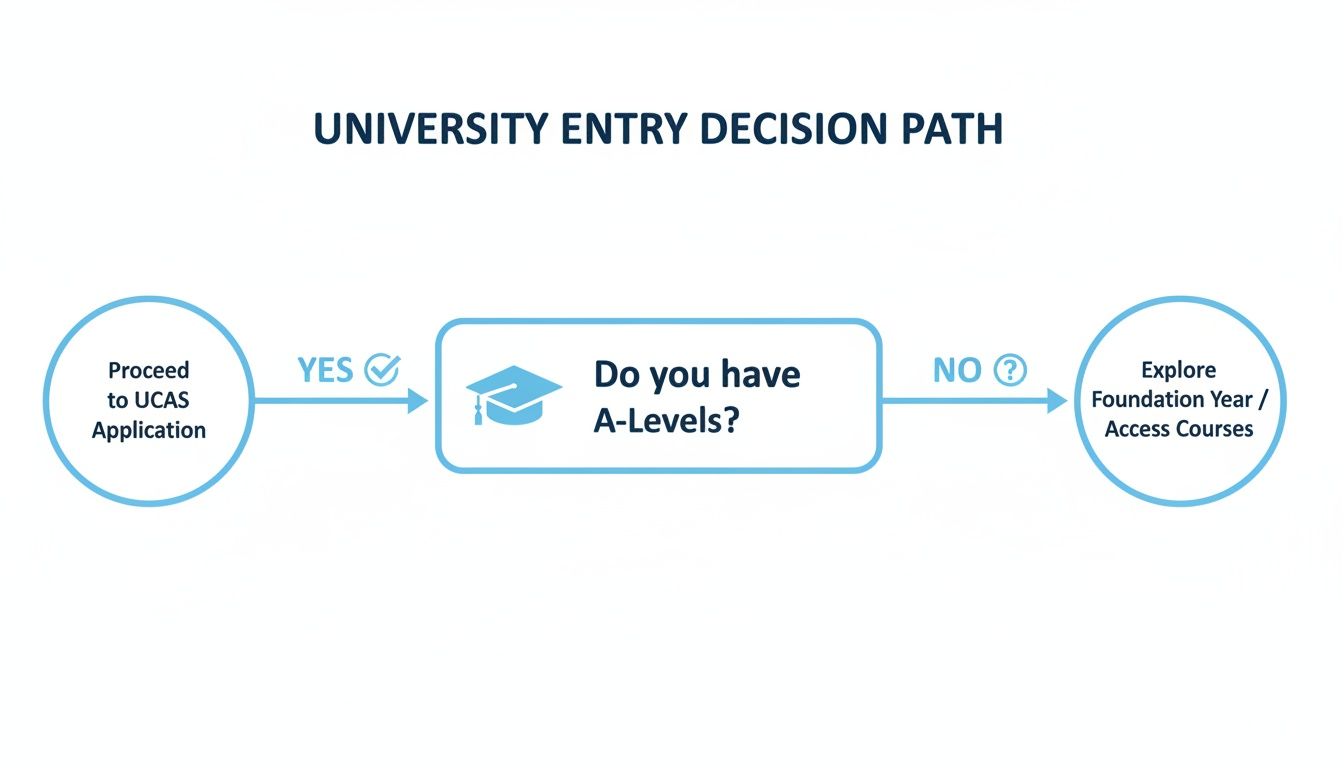
As you can see, not having A-levels just means you're on a different—but equally valid—path towards your degree. Let's take a closer look at what those paths are.
To give you a quick overview, here’s a table comparing the most common alternatives. It’s designed to help you see at a glance which route might be the best fit for your goals and lifestyle.
A Level Alternatives At A Glance
| Qualification | Best For | Typical Duration | Study Method |
|---|---|---|---|
| Access to HE Diploma | Adults returning to education with a specific degree in mind. | 9-12 months | Online or in-person, flexible. |
| BTEC Nationals | Hands-on learners who prefer coursework over exams. | 2 years | College-based, practical. |
| T-Levels | Students wanting a mix of classroom study and real work experience. | 2 years | Classroom and industry placement. |
| Foundation Year | Those who need an extra year of prep within a university setting. | 1 year | On-campus at a university. |
| Degree Apprenticeship | Earning a salary while studying for a degree part-time. | 3-6 years | Work-based with university study. |
| The Open University | Maximum flexibility for learners with complex commitments. | Varies | Remote, self-paced distance learning. |
Each of these qualifications offers a solid route to higher education. The best one for you really depends on your personal circumstances, learning style, and what you want to achieve in the long run.
Access To Higher Education Diploma
The Access to Higher Education (HE) Diploma is pretty much the gold standard for adults getting back into education. Think of it as a university prep course, fine-tuned for the exact degree you want to study. If A-levels are a set of general keys, an Access to HE Diploma is a master key cut specifically for the university door you want to unlock.
These diplomas are a Level 3 qualification, equivalent to three A-levels, and they even carry UCAS Tariff points just like them. They're perfect if you:
- Have been out of the classroom for a while.
- Know exactly what you want to study, like Nursing, Computing, or Social Science.
- Need to build up your academic skills and subject knowledge fast.
The real beauty of an Access to HE Diploma is its focus. Instead of juggling three completely different subjects, your entire course is geared towards one career path. It's this laser-focused approach that explains why over 90% of UK universities accept Access to HE Diplomas for entry into a huge range of degree programmes.
BTEC Nationals
BTEC Nationals are all about practical, career-focused learning. They brilliantly blend hands-on skills with the theory to back it up. If you're someone who learns best by doing rather than just sitting exams, this could be an excellent choice for you.
BTECs are ideal for anyone who prefers coursework and ongoing assessment over the pressure of final exams. They’re offered in a massive range of subjects, from Engineering and Health and Social Care to Business and Media. Universities widely accept BTECs, and they'll usually specify the grades they're looking for (e.g., Distinction, Merit, Pass).
T-Levels
As a newer alternative, T-Levels are equivalent to three A-levels and cleverly mix classroom learning with a serious amount of time in an industry placement. They're designed to give you the skills and experience to walk straight into a skilled job, an apprenticeship, or higher education.
A T-Level is roughly 80% classroom learning and 20% on-the-job experience, which means you get a real taste of your chosen industry before you even start your degree.
This makes them a really strong option if you want a direct link between what you're studying and a specific career sector, like Digital Production or Health.
Foundation Years
A foundation year is basically 'Year 0' of a full university degree. It's an integrated preparatory year designed for students who have the potential to succeed but don't quite meet the direct entry requirements for a degree course.
Once you successfully complete the foundation year, you automatically progress to Year 1 of your chosen degree, all at the same university. It’s a brilliant route if you feel you need to build your confidence and academic skills while already being in a supportive university environment from day one.
With so many routes available, it's really important to figure out how to choose the right training course for your career goals to make sure it lines up with where you want to go.
Degree Apprenticeships
For anyone who wants to earn while they learn, a degree apprenticeship is a fantastic opportunity. This pathway combines a full-time job with part-time university study, and you come out with a full bachelor's or even master's degree. The best part? Your employer and the government cover your tuition fees, so you graduate with a degree, years of relevant work experience, and zero student debt.
They are very competitive, but they offer an incredible way to launch your career while getting a top-tier qualification at the same time.
The Open University
Finally, there’s The Open University, which offers a uniquely flexible path to higher education. It has an open-entry policy for most of its undergraduate courses, which means there are often no formal academic qualifications needed to get started. You can study from anywhere, fitting your learning around your life.
This makes it the perfect choice for anyone who needs ultimate flexibility because of family, work, or other responsibilities. When you understand all these options, the question changes from "can I get into uni without A levels?" to "which of these fantastic routes is the right one for me?"
Your Fast Track To A Degree With The Access To HE Diploma
If you're an adult thinking about university but don't have A-levels, the Access to Higher Education (HE) Diploma is your most direct route. It's not a general qualification; think of it as a key, specifically cut to unlock the exact degree course you have in mind. It's built from the ground up to bridge the gap for anyone who’s been out of the classroom for a while, giving you the academic skills and UCAS points you need to get in.
Unlike A-levels, where you might juggle three completely different subjects, an Access to HE Diploma is laser-focused. Want to become a nurse? Your entire curriculum will revolve around health, biology, and the skills needed for a caring profession. Got your sights set on a computing degree? You'll dive straight into modules on programming and data. This singular focus is its biggest advantage.
This targeted approach makes the diploma incredibly efficient. In just 9-12 months, you can earn a Level 3 qualification that’s equivalent to three A-levels and is recognised by over 90% of UK universities.
How The Diploma Is Structured For Success
The way an Access to HE Diploma is put together is what makes it so perfect for adult learners. The whole course is designed not just to teach you about a subject, but to rebuild your confidence and academic muscle.
You’ll earn credits as you complete different modules, needing a total of 60 credits to pass. Out of these, 45 are graded (Pass, Merit, or Distinction) and go towards your UCAS points total. This continuous assessment style means you aren't putting all your eggs in one basket with a few stressful final exams.
This structure helps you build momentum and actually see your progress, which is a massive boost when you’re trying to fit studying around everything else life throws at you. For a closer look at the nuts and bolts, you can learn more about the Access to HE Diploma and how it paves the way to university.
The Power Of Flexible Online Study
One of the best things about modern Access to HE Diplomas is the ability to study completely online. For adults juggling work, family, and other commitments, this is an absolute game-changer.
Online learning puts you in the driver's seat. You create a study schedule that actually works for you, accessing your materials and lectures whenever you find a spare hour. That could be first thing in the morning or late at night after the kids are in bed. This flexibility removes one of the biggest hurdles that used to stop people from returning to education.
An online Access to HE Diploma puts you in control of your learning journey. It empowers you to pursue your academic ambitions without having to put the rest of your life on hold, making it a truly practical solution for career changers and aspiring professionals.
Studying this way also naturally develops your independent learning and time management skills—abilities that universities love to see and that will be essential once you start your degree.
Direct Progression To Your Chosen Degree
The whole point of the diploma is to get you into uni, and the path is clear and well-trodden. Universities have specific entry requirements for Access to HE students, usually asking for a certain number of credits at Merit or Distinction.
Here’s a rough idea of what that looks like for popular degrees:
- Nursing & Midwifery: Universities will want to see a diploma in a relevant subject (like Nursing or Health Professions). They’ll often ask for a specific number of credits at Distinction and Merit, especially in biology-focused modules.
- Social Work & Psychology: A Social Science diploma is the perfect prep. Entry requirements will likely focus on getting high grades in the core sociology and psychology units.
- Computing & Business: For these fields, a diploma in Computing or Business and Management gives you the crucial foundation you need. Universities will be looking for strong performance in the key modules to make sure you’re ready to hit the ground running.
By picking the right diploma, you're building your own tailored pathway straight to your dream university course, proving that you absolutely can get into uni without A levels.
How Universities Really View Alternative Qualifications
One of the biggest worries for anyone returning to education is whether universities genuinely respect qualifications that aren't A-Levels. It’s a completely fair question, but thankfully, it’s one you can put to rest. UK universities don't just accept alternative qualifications; they actively look for the students who hold them.
Think of an admissions team like a casting director. They aren't looking to fill every single role with the exact same type of actor. They want a diverse cast, full of different strengths, backgrounds, and life experiences. That's what mature students bring to the table—a unique energy, motivation that’s been tested by the real world, and a serious commitment to their studies.
This isn’t just a nice thought; it’s the reality on the ground. Universities know that a student who has completed an Access to HE Diploma or a BTEC has already proven they have immense dedication and the specific skills needed to hit the ground running in their chosen degree.
The Proof Is in the Acceptance Rates
Far from being some kind of niche backdoor, getting into uni without A-levels is a mainstream path for thousands every year. You'd be surprised how many institutions have incredibly high acceptance rates for applicants with these qualifications, especially in fields that truly value life experience.
- Health Professions: Degrees in Nursing, Midwifery, and Paramedic Science are hugely popular routes for Access to HE students. Universities in these fields absolutely value the maturity and focus that adult learners bring.
- Business and Management: A BTEC in Business gives you a solid, practical foundation that is well-respected for entry into business-related degrees.
- Social Sciences: Courses like Social Work, Criminology, and Sociology often welcome applicants with Access to HE Diplomas in Social Science, because they recognise the rich perspectives they offer.
Many universities have built their entire reputation on being accessible and welcoming to students from all walks of life. For instance, London Metropolitan University actively welcomes applicants with BTECs and Access Diplomas for courses in health and business. Beyond that, data shows several UK universities offering places to over 90% of applicants, including institutions like Nottingham Trent (90.1%) and the University of South Wales (89.4%), many of whom prioritise alternative qualifications. You can find more details about universities with flexible entry requirements online.
"Universities recognise the value of a range of qualifications… Access to HE Diplomas are a well-established and recognised route to higher education, providing students with the knowledge and skills they need to succeed." – UCAS (Universities and Colleges Admissions Service)
Coming straight from UCAS, the central body that manages all university applications, this statement confirms just how credible these routes are. It’s not a secret entrance; it’s a main door.
Why Your Experience Is an Asset
Never, ever underestimate the power of your life experience. An 18-year-old might have fresh A-level grades, but you have something they don't: years of navigating challenges, managing responsibilities, and developing a work ethic that simply can't be taught in a classroom.
Admissions tutors see this as a massive plus. When you sit down to write your personal statement, you can draw on real, concrete examples of resilience, problem-solving, and commitment. This real-world perspective makes you a much more compelling and well-rounded applicant. In fact, many people discover that an Access course is not just a route to university, but also a way to see if they can get into a top university with an Access course.
At the end of the day, universities want students who will not only succeed but also contribute positively to campus life. Your journey and your chosen qualification are powerful proof that you are exactly that kind of student.
Your Step-By-Step Plan To Prepare Your Application
Knowing you can get into university without A-levels is one thing; having a solid plan to make it happen is another. This isn't just about filling in forms. It’s about building a strong application that shows universities exactly what you're capable of.
Let's break it down into a clear, manageable roadmap that will take you all the way from that first spark of an idea to confidently hitting 'submit' on your UCAS application.
1. Define Your Career And Degree Goals
First things first, you need to get crystal clear on your 'why'. What career are you aiming for, and what degree will get you there? This isn't just a vague notion; it's the North Star that will guide every decision you make from here on out.
For example, if your heart is set on becoming a paediatric nurse, your degree choice is simple: a BSc (Hons) in Children's Nursing. This instantly tells you what kind of Access to HE Diploma you’ll need (most likely Nursing and Midwifery) and which universities to start researching.
2. Research University Entry Requirements
With your degree goal locked in, it’s time to do a bit of detective work. Head over to the websites of a few universities you like the look of and find the course page for your chosen degree. You're specifically looking for a section called "entry requirements for mature students" or "alternative qualifications."
This is where you'll often see specific requirements for Access to HE Diplomas.
A university might say something like: "Access to HE Diploma (Nursing) with 45 credits at Level 3, of which 30 must be at Distinction and 15 at Merit." This gives you a precise target to aim for in your studies.
Pay close attention to any mention of GCSEs, especially for Maths and English. If you don't have these, you'll need to factor in getting a GCSE-equivalent qualification, like Functional Skills Level 2, into your plan.
3. Choose Your Ideal Pathway
Now you know what you need, you can confidently pick the right course to get you there. For most adults, an Access to HE Diploma is the most direct route. It’s a qualification specifically designed to get you into university and can be completed in less than a year.
Find a provider that offers the exact diploma your target universities are asking for. Online providers, like us at Access Courses Online, offer the flexibility to fit your studies around your job and family life. Many students even fund their course using an Advanced Learner Loan, which often gets written off by the government once you complete your degree.
4. Enrol And Develop Strong Study Habits
Once you've enrolled, your success really comes down to discipline and good habits. Create a realistic study schedule that you can actually stick to. It's far better to manage one focused hour every day than to plan for five hours you'll never find the time for.
Use tools like calendars and to-do lists to keep yourself organised. When an assignment seems huge, break it down into smaller, bite-sized tasks. Most importantly, never be afraid to ask your tutors for help when you're stuck—that’s what they're there for!
5. Craft A Compelling Personal Statement
Your personal statement is your chance to really shine. As a mature student, your life experience isn't just a footnote; it's your biggest asset. Don't just list what you've done—reflect on what you've learned from it.
Connect your work history, volunteering, or even personal challenges to the skills needed for your chosen degree. A former hospitality manager has incredible communication and problem-solving skills, perfect for a business degree. A parent has demonstrated immense patience and organisational ability—both vital for a social work course. For a deep dive, check out our guide on how to write a personal statement that really stands out from the crowd.
6. Navigate The UCAS Application
The UCAS application is the final hurdle. It's mostly straightforward, but it's important to take your time and get it right. You’ll need to fill in your personal details, your qualifications (including your in-progress Access to HE Diploma), and, of course, your personal statement.
For many courses, especially the competitive ones, an interview is a key part of the process. It's so important to prepare for this. Practising well-thought-out responses is vital, including mastering the 'tell me about yourself' question for interviews. This preparation allows you to confidently explain why you're the right person for the course, linking your unique journey directly to your ambitions for the future.
Success Stories From Students Without A-levels
It's one thing to read about the theory, but it’s the real-life stories that make you believe a goal is actually within reach. Hearing from people who have walked the same path you're considering is often the best motivation you can get. These aren't just abstract ideas; they're real people who decided that not having A-levels wasn't going to be the end of their story.

Picture a retail manager who felt completely stuck, dreaming of a career in nursing but seeing no way forward. They enrolled in an online Access to HE Diploma in Nursing and started studying in the evenings after their shifts. Just one year later, they were accepted into their first-choice university and are now thriving on the ward, giving the kind of patient care they'd always felt passionate about.
From A Career Crossroads To A Degree
Or think about the young parent who wanted to start a business but didn't have any formal qualifications. By choosing an Access to HE Diploma in Business and Management, they could fit their learning around naps and school runs. That single step gave them both the UCAS points and the confidence they needed to go for a business degree, turning a vague dream into a solid plan.
These stories all share a common thread:
- The Challenge: A strong desire for change, blocked by a lack of traditional qualifications.
- The Solution: Finding a flexible, targeted pathway like an Access to HE Diploma.
- The Result: A life-changing university place and the start of a brand-new career.
And these aren't just one-off miracles. Every single year, mature students and career-changers are successfully rewriting the rulebook on how to get into university. In 2025, an incredible 50,880 mature students (aged 21 and over) in the UK secured a spot at university. It was part of a record-breaking year for acceptances, proving that unis are valuing experience alongside qualifications more than ever.
This trend shows a real shift in how institutions are thinking, with many now prioritising practical qualifications over A-levels for a whole range of courses. If you want to dig into the numbers yourself, you can explore the latest UCAS admissions data.
These stories prove that your goals are not just possible; they are being achieved by people just like you every single day. The path exists, and it is well-trodden.
Every one of these students started by asking the same question: can I get into uni without A levels? Their journeys give a resounding "yes" and provide a clear blueprint for how you can follow in their footsteps.
Your Questions Answered
Working out the practicalities of getting to university can feel a bit overwhelming, but don't worry. This final section tackles some of the most common questions we hear from adult learners, giving you quick, clear answers to help you move forward.
Am I Too Old To Go To University Without A-levels?
Absolutely not. Let’s get this one out of the way first: there is no upper age limit for higher education in the UK. In fact, universities actively welcome mature students because of the unique perspectives and valuable life experience they bring to the classroom.
Last year alone, over 50,000 mature students aged 21 and over started a degree. Many of them proved they could get into uni without A-levels by using qualifications specifically designed for them, like the Access to HE Diploma. Your age is a real asset, not a barrier.
Do I Need GCSEs In Maths And English?
For most university courses, you will typically need a GCSE at grade 4/C or above in both Maths and English. This is a standard requirement, especially for competitive fields like nursing or teaching.
But if you don't have them, don't panic. You can study for Functional Skills Level 2 qualifications instead. These are widely accepted by universities as GCSE equivalents and can often be studied flexibly online alongside your main Access course, neatly filling that gap in your application.
Gaining these core skills is a crucial step for many degree paths. Think of them not as a hurdle, but as a foundational part of your university preparation, making sure you have the literacy and numeracy skills to succeed.
How Can I Afford To Study An Access To HE Diploma?
This is a big one, but there's excellent support available. Most students finance their Access to HE Diploma with an Advanced Learner Loan from the UK government.
And here’s the best part: if you go on to successfully complete a university degree after your Access course, Student Finance England will completely write off the outstanding balance of your loan. This means your Access to HE Diploma effectively becomes free. Many providers also offer interest-free payment plans to make studying more manageable from the get-go.
Ready to take the next step towards your degree? At Access Courses Online, we provide accredited online diplomas designed to get you there. Explore our courses today and find your path to university.