

Thinking about a career in technology can sometimes feel like trying to learn a whole new language, but a future in computer science is much closer than you might think. A degree in this field doesn't just lead to one job; it unlocks a huge range of computer science career paths. You could be building the apps on your phone as a software developer or defending businesses from online threats as a cybersecurity analyst. This guide is your map to navigating this exciting world.
Your Starting Point in Computer Science

It’s a common myth that you need to be a maths genius to make it in tech. That's just not true. At its heart, computer science is really all about creative problem-solving. It’s about using logic and code to build tools that make life easier, more connected, and more secure. The demand for these skills has exploded, creating a massive variety of specialised roles.
This guide is designed to demystify these roles and show you that a rewarding tech career is genuinely achievable, even if you don't have traditional qualifications like A-Levels. For adult learners and career changers, non-traditional routes into university are powerful launchpads.
A Snapshot of UK Computer Science Career Paths
To give you a clearer picture of where you might fit in, let's look at the main career domains. Each path requires a different mix of skills, but they all start from the same foundation of computational thinking.
Here's a quick summary to get you started:
| Career Path | Core Function | Typical Degree Specialism |
|---|---|---|
| Software Development | Building apps, websites, and systems. The architects of our digital world. | Computer Science, Software Engineering |
| Data Science | Finding insights and patterns in data to guide business strategy. | Data Science, Statistics, Mathematics |
| AI & Machine Learning | Teaching computers to learn, reason, and make smart predictions. | Artificial Intelligence, Computer Science (AI specialism) |
| Cybersecurity | Protecting networks, systems, and data from digital threats and attacks. | Cybersecurity, Ethical Hacking, Computer Forensics |
| DevOps & Cloud | Automating and managing the infrastructure that powers applications. | Cloud Computing, Computer Science, IT Management |
| Systems Engineering | Designing and maintaining complex computing systems and networks. | Network Engineering, Systems Administration |
| Research & Academia | Pushing the boundaries of computing through research and teaching. | PhD in Computer Science or a specialised field |
| Product/UX | Focusing on the user's experience and guiding the product's development. | Human-Computer Interaction, UX Design |
| Quality Assurance (QA) | Testing software to find bugs and ensure it works perfectly. | Often a specialism within a broader CompSci degree |
This is just a taster, of course. We'll be diving much deeper into what each of these roles involves throughout this guide.
Finding Your Fit
Choosing a direction can feel a bit overwhelming at first, but it all starts with a little self-reflection. Do you love building things and seeing a project come to life? Software development might be your calling. Or maybe you're the kind of person who enjoys spotting trends and solving puzzles with data? If so, data science could be a perfect match.
The most successful people in tech are those who align their natural curiosity with a specific area. You don't need to know everything at once; you just need a starting point and a willingness to learn.
This guide will walk you through each of these computer science career paths, breaking down the day-to-day responsibilities and the skills you'll need to succeed. More importantly, we'll cover the practical steps for getting started, from building a portfolio to choosing the right educational path. For many adult learners, understanding how Access courses prepare you for a future in computer science can be the crucial first step toward university and a brilliant new career.
Exploring the Top Computer Science Career Paths
Diving into the world of computer science opens up a whole spectrum of exciting and varied roles. It’s about so much more than just tapping away at a keyboard; it's about building, protecting, and making sense of the digital world we all live in. Each career path offers its own unique set of challenges and rewards, appealing to different strengths and interests.
Let's move beyond the job titles and unpack what these professionals actually do day-to-day. Think of a Software Developer as a digital architect, meticulously designing and building the apps you use every day. A Cybersecurity Analyst, on the other hand, is like a digital security guard, constantly on watch to protect valuable information from online threats.
This exploration will give you a real feel for each role, helping you match your own personal strengths to a career that’s genuinely fulfilling.
Software Development: The Digital Architects
At the very heart of almost every digital interaction is a software developer. These are the creative minds and builders who write the instructions that make our computers, phones, and smart gadgets work. They are the architects and construction workers of the digital age, turning abstract ideas into tangible, working applications.
Their work involves a full cycle of creation, from understanding what users actually need, to designing a program’s structure, writing clean and efficient code, and then testing it for bugs before launching the final product. It’s a role that demands both razor-sharp logical thinking and a creative spark. If you love building things from scratch and seeing your efforts come to life, this is a fantastic path to consider.
For a deeper look into this specialism, you can explore the differences between computer science and software engineering in our detailed guide.
Data Science and AI: The Digital Detectives and Brain Builders
Data is absolutely everywhere, and data scientists are the detectives who find the meaning hidden within it. They sift through massive datasets to uncover trends, make predictions, and deliver the insights that guide huge business decisions. Imagine a retailer using data to predict which products will fly off the shelves next season—that’s the handiwork of a data scientist.
This field is a fascinating blend of statistics, programming, and business savvy. You'll spend your time cleaning up messy data, building predictive models using machine learning, and then communicating your findings to people who aren’t data experts. It’s the perfect fit for anyone who is naturally curious and loves solving complex puzzles.
Closely related is the exciting world of Artificial Intelligence (AI) and Machine Learning (ML).
An AI Engineer doesn’t just analyse data; they build systems that can learn from it. They design the intelligent algorithms behind everything from voice assistants and recommendation engines to self-driving cars.
The core responsibilities of an AI/ML engineer include:
- Developing Models: Creating and training complex neural networks and other machine learning algorithms to perform specific tasks.
- System Integration: Plugging these AI models into larger software applications so they can function in the real world.
- Performance Optimisation: Constantly tweaking algorithms to make them faster, more accurate, and more efficient.
Cybersecurity: The Digital Guardians
In a world where data is one of the most valuable assets, cybersecurity professionals are its essential guardians. These experts protect computer systems, networks, and sensitive information from theft, damage, and prying eyes. They are on the front lines, defending organisations against a constant barrage of digital threats.
A cybersecurity analyst's day might involve scanning networks for suspicious activity, investigating security breaches, and putting protective measures like firewalls and encryption in place. It’s a high-stakes field that requires a proactive and deeply analytical mindset. You have to learn to think like an attacker to anticipate and block their next move.
The demand for these skills is incredibly high. With cyberattacks becoming more sophisticated every day, the need for talented defenders is projected to grow by 29% through to 2034, creating thousands of new roles every single year.
Cloud and DevOps Engineering: The Digital Infrastructure Experts
Ever wondered how services like Netflix or Spotify can stream content to millions of users at the same time without crashing? The answer lies in cloud engineering and DevOps. Cloud Engineers design and manage the vast, scalable infrastructure on platforms like Amazon Web Services (AWS) or Microsoft Azure.
They make sure that applications have all the resources they need to run smoothly and reliably, no matter the demand. DevOps, on the other hand, is a culture and set of practices that closes the gap between software development (Dev) and IT operations (Ops). A DevOps Engineer automates the processes of building, testing, and deploying software, helping companies release updates faster and more reliably than ever before.
This path is ideal for problem-solvers who enjoy optimising systems and making processes more efficient. It’s less about building the app itself and more about creating the powerful, automated foundation it runs on. For a wider perspective, you can delve into the Top 12 Global Careers For Computer Science Degree Graduates.
UX and UI Design: The User Champions
Finally, not all computer science career paths are purely about code or infrastructure. User Experience (UX) and User Interface (UI) Designers are laser-focused on the human side of technology. A great app isn't just functional; it has to be intuitive, accessible, and genuinely enjoyable to use.
- UX Designers are researchers at heart. They study user behaviour to understand their needs and frustrations, mapping out a user's journey to ensure an app’s flow makes perfect sense.
- UI Designers are the visual artists. They choose the colours, fonts, and layouts to create an interface that is both beautiful and easy to navigate.
These roles are perfect for creative individuals who have a strong sense of empathy and a real passion for making technology work better for people. It’s a field where psychology meets design, ensuring that the end product isn’t just powerful, but also a pleasure to use.
How to Start Your Career in Tech
Breaking into the tech industry might feel like a massive jump, but the good news is there’s no single "right" way to do it anymore. The traditional route of going straight from school to university isn't the only option on the table. Today, you’ll find several flexible paths designed for people at all stages of life, especially for adult learners juggling work, family, and other commitments.
Choosing the right starting point comes down to your personal situation – your budget, how much time you can realistically commit, and the way you learn best. Getting to grips with the pros and cons of each pathway is the first step to making a decision you can feel confident about.
Comparing Your Entry Options
For anyone serious about building a career in technology, there are three main educational routes that stand out: a traditional university degree, an intensive coding bootcamp, or a structured apprenticeship. Each one offers a completely different approach to learning and getting your foot in the door.
-
University Degree: This is the most in-depth route, giving you a strong theoretical foundation in computer science. A degree offers a well-rounded education covering everything from algorithms and data structures to software engineering principles. It's the ideal choice if you want a deep understanding of the 'why' behind the 'how' and the broad career opportunities that a formal qualification unlocks.
-
Coding Bootcamp: Think of these as short, intense, and incredibly practical programmes laser-focused on teaching you job-ready skills for a specific role, usually in web or software development. Bootcamps are perfect if you want to get into the workforce quickly, but they often trade theoretical depth for immediate practical application.
-
Apprenticeships: By combining on-the-job training with part-time study, apprenticeships let you earn while you learn. You’ll be gaining invaluable real-world experience from day one. The only catch is that they can be competitive to get and are often geared towards younger people just starting out.
This decision tree can help you visualise which path might click with your natural inclinations, whether you're a builder, a problem-solver, or a creative thinker.
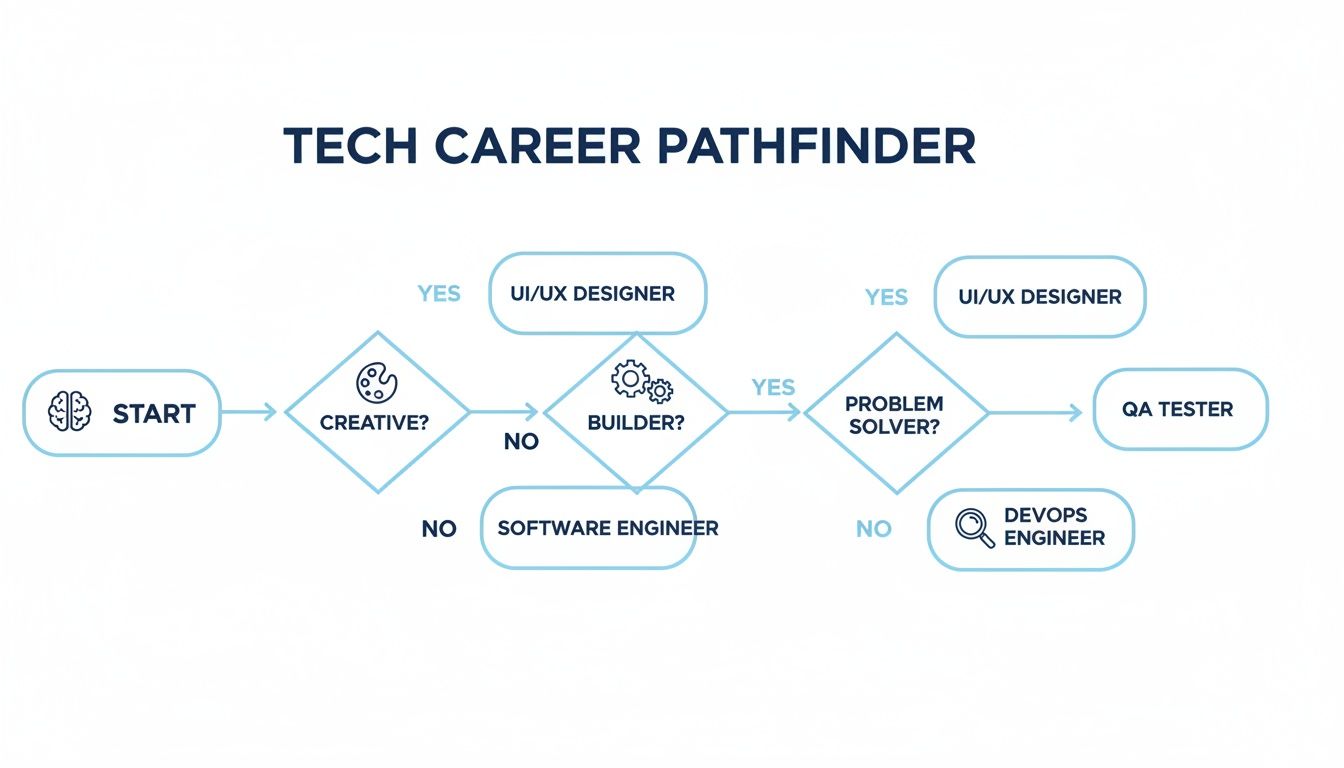
As the flowchart shows, different starting points—whether it's creativity, building, or problem-solving—can all lead to diverse and rewarding computer science career paths.
The Bridge to University for Adult Learners
So, what happens if you want the depth a university degree offers, but you don't have the standard entry qualifications like A-levels? This is a really common situation, and it’s exactly where an Access to Higher Education (HE) Diploma comes into play.
Think of an Access to HE Diploma as a purpose-built bridge connecting you directly to a university education. It’s specifically designed for adults returning to study, giving you both the foundational knowledge and the UCAS points needed for a computer science degree.
This pathway is built for flexibility, letting you study online and at your own pace. That makes it a genuinely practical solution for anyone trying to fit their education around their existing life. It focuses on building the essential academic skills you’ll need for degree-level work, ensuring you're not just qualified to get into university, but fully prepared to succeed once you’re there. If you're wondering about the specifics, you can learn more about how to get into university without A-levels in our dedicated guide.
Making the Right Choice for You
At the end of the day, the best pathway is the one that fits your life and your long-term goals. To help you decide, have a think about these key factors:
-
Time Commitment: Can you dedicate three years to a full-time degree, or do you need a much faster route like a bootcamp? An Access to HE Diploma offers a great middle ground, typically taking about a year to complete online.
-
Cost and Funding: University degrees come with tuition fees (though student finance is available). Bootcamps can require a big upfront investment, while apprenticeships actually pay you a salary. Access courses provide a more affordable route to gaining the qualifications you need for university.
-
Learning Style: Do you thrive in a structured, academic environment with a focus on theory? Or do you prefer a hands-on, project-based approach? Your answer will point you towards either a degree or a more vocational option like a bootcamp.
By weighing these options carefully, you can figure out the computer science career path that not only excites you but also realistically fits into your life. The most important thing is to just take that first step, whether it’s enrolling in a course, attending a taster day, or simply doing a bit more research.
UK Tech Salaries and Job Market Realities
Let’s talk about the money. Choosing one of these computer science career paths isn’t just about finding a job you enjoy; it’s a big financial decision, and you need to know what you’re getting into. The good news is that the UK's tech sector is not only thriving but also offers competitive salaries and genuine long-term prospects, making it an incredibly rewarding field to jump into.
You might have seen headlines about shake-ups in the global tech industry, but don't let that fool you. Here in the UK, the demand for skilled tech professionals is as strong as ever. Every company, from high-street banks to the NHS, is going digital, and they all need developers, data scientists, and cybersecurity experts to make it happen. This creates a level of job security that’s hard to find anywhere else.
What Can You Expect to Earn?
Salaries in tech can swing quite a bit depending on your specific role, how much experience you have, and—crucially—where you’re based. Of course, entry-level jobs start at the lower end, but one of the most exciting things about a tech career is how quickly your salary can grow. As you build your skills and start to specialise, your earning potential shoots up.
Geography plays a huge role in your pay packet. Tech hubs, especially London, offer a significant premium to make up for the higher cost of living. While you’ll still earn a great wage outside the capital, it's something to keep in mind as you plan your next move.
The numbers look pretty good for UK computer science graduates. An impressive 81% find a job within just 15 months of graduating. The average salary for a computer scientist in the UK sits around £43,386 a year, but that figure hides a lot of variation. For example, if you're working in London, the median salary jumps to a massive £85,000. You can find more insights into UK computer science salaries on Coursera.
A Look at Different Roles
To give you a clearer idea, here’s a breakdown of what you might earn in some of the most popular tech roles. These are just estimates, of course, and the final figure will depend on the company, industry, and your unique skills.
- Junior Software Developer: You can expect to start somewhere between £28,000 and £40,000. After just a few years, you could easily be earning over £55,000.
- Data Scientist: An entry-level data scientist typically earns between £35,000 and £50,000. With experience and specialised skills, senior data scientists can pull in well over £75,000.
- Cybersecurity Analyst: This field is in high demand, so starting salaries are strong, usually from £30,000 to £45,000. Experienced pros can earn upwards of £70,000.
- Cloud Engineer: Another red-hot area. Junior roles often start around £35,000, while senior engineers can easily clear £80,000.
It's clear that while the entry point is competitive, the pathway to a high-earning career is much faster in technology than in many traditional professions. Your skills directly translate into financial value for a company, which is reflected in your pay packet.
Long-Term Career and Financial Security
Beyond that first paycheque, a career in computer science offers brilliant long-term security. The skills you’ll learn aren’t just in demand today; they’re the foundation for the future of business and society. As technology keeps pushing forward, your ability to adapt and pick up new skills will make sure you’re always a valuable asset in the job market.
This long-term relevance is a huge plus for anyone thinking about changing careers. You're investing your time and effort into a field that's set for sustained growth, which gives you peace of mind and a stable foundation for your future. The constant need for innovation means the demand for skilled tech professionals isn't going away anytime soon.
Building a Standout Tech Portfolio and CV

While a qualification is what gets your foot in the door for an interview, it’s your portfolio and CV that will actually land you the job. Think of these as your personal showcase, giving employers tangible proof that you can take what you’ve learned and solve real problems.
For anyone starting out on one of the many computer science career paths—especially if you're changing careers—a strong portfolio is your single most powerful tool.
It’s what transforms you from a candidate with theoretical knowledge into a hands-on practitioner with skills they can see. A great portfolio doesn’t just list what you know; it tells the story of your problem-solving process, your coding style, and your genuine passion for tech. It's your chance to show, not just tell, what you’re capable of.
What Tech Recruiters Really Want to See
When a recruiter or hiring manager looks at your application, they’re searching for more than just technical ability. They want to see a blend of coding prowess and the soft skills needed to work in a team and deliver a finished product.
Here’s what they’re really looking for:
- Practical Projects: They want to see what you’ve actually built. This speaks volumes more than a list of courses you’ve taken.
- Clean, Readable Code: Your code should be well-organised and commented. It shows you can create software that’s easy for others to understand and maintain.
- Your Thought Process: Documentation explaining why you made certain choices is invaluable. A simple README file on GitHub that outlines the problem, your approach, and the final outcome is a massive plus.
- A Hunger to Learn: Highlighting projects where you taught yourself a new technology or framework demonstrates initiative and a growth mindset—qualities every employer loves.
A portfolio isn’t just a gallery of finished work; it’s a documented history of your learning journey. It demonstrates resilience, curiosity, and the practical application of computer science principles.
Crafting Projects from Scratch, Even as a Beginner
You don’t need to build the next big social media app to impress anyone. The secret is to start small with manageable projects that solve a real problem, even if it’s just one of your own.
Start by looking for a simple challenge in your daily life. Could you build a small web app to track your spending? Or a script to automatically organise your downloads folder?
- Define a Clear Goal: Keep it simple. For example, "Create a webpage that shows the weather forecast for my city using a free public API."
- Break It Down: Chop the project into tiny, achievable steps. Start with setting up the project, then figure out how to fetch the data, and finally, work on displaying it.
- Document Everything: Use a platform like GitHub to host your code. Write clear commit messages as you go and maintain a detailed README file explaining what the project is and how it works.
This structured approach not only helps you finish the project but also creates the exact kind of clear, professional documentation that recruiters love to see.
Translating Past Experience for Career Changers
If you’re moving into tech from a completely different field, your previous experience is a huge asset, not something to hide. The trick is to reframe your old responsibilities and achievements in the language of technology and problem-solving.
Did you manage projects in a past life? Then you have experience with deadlines, communicating with stakeholders, and managing resources—all vital skills for a role like an IT Project Manager. Did you work in customer service? You have fantastic communication and empathy skills, which are the bedrock of great UX design.
This table shows how easily skills can translate:
| Previous Role Skill | Tech Role Application |
|---|---|
| Retail Management (Inventory tracking) | Data Analysis (Understanding data patterns, database logic) |
| Healthcare Administration (Handling patient data) | Cybersecurity (Appreciation for data privacy and security protocols) |
| Teaching (Creating lesson plans) | Software Development (Logical thinking, breaking down complex topics) |
By explicitly connecting your past skills to your new computer science career path on your CV, you position yourself as a well-rounded candidate with unique insights. To really stand out, it's worth looking into guides on topics like personal branding for consultants; many of the principles for making an impact apply right across the professional world.
Your Next Step into a Tech Career
We’ve covered a lot of ground. You've had a look at the different computer science career paths out there, from the creative problem-solving of software development to the vital watchdog role of cybersecurity. You’ve seen the impressive salaries and the job security that comes with them, and you know there are several different ways to get your foot in the door.
If there’s one thing to take away, it’s this: a rewarding career in tech isn’t some exclusive club. It’s an achievable goal for anyone with the curiosity and drive to learn. Your background, what you did before, or the qualifications you have right now don’t define what you can do next. The tech world cares about practical skills, a problem-solving attitude, and a willingness to keep learning. So, the question isn't if you can make this change, but what your next step should be.
Turning Ambition into Action
It’s easy to get lost in the research phase, endlessly reading about different roles. But real progress starts when you commit to a clear path that’s designed to get you where you want to go. For many adult learners, the biggest hurdle is simply getting into university without the traditional A-levels.
This is where a specialised programme can change everything. Think of it as your launchpad, giving you the essential knowledge and, just as importantly, the UCAS points you need for a computer science degree.
The way forward isn’t about having all the answers right now. It's about finding a starting point that builds your confidence, gives you the right skills, and opens that door to university.
An Access to HE Diploma in Computer Science from Access Courses Online is built for exactly this purpose. It’s designed with the flexibility adults need, letting you study online around your work and family commitments. This course doesn't just tick a box for university entry; it genuinely prepares you to do well once you’re there by building your core academic and technical skills from scratch.
Take the First Step Today
We’ve talked about the ‘what’ and the ‘why’ – now it's time for the ‘how’. Don’t let uncertainty hold you back from a field that needs your unique perspective. Your journey into one of the many exciting computer science career paths starts with the decision to invest in yourself.
Enrolling in an Access to HE Diploma is that decisive first step. It is the most direct and supportive route to the university degree that will unlock your future. Explore the course, get in touch with any questions, and take that step today.
Your Questions Answered
Stepping into the world of computer science can feel like learning a new language, and it’s natural to have a few questions. We hear a lot from people considering a change, so let’s clear up some of the most common concerns.
Do I Need to Be a Maths Genius?
Honestly? No. You absolutely don’t need to be a mathematical prodigy to build a fantastic career in tech.
While a solid understanding of logic is key, many roles—especially in software development and user experience—lean far more on creative problem-solving and collaboration than they do on advanced calculus. The specific maths you do need is almost always taught as part of the course, right when you need it.
Is It Too Late for Me to Switch to a Tech Career?
It's never too late. The tech industry is one of the few places where what you can do matters more than your age or where you’ve worked before.
In fact, career changers are often in high demand. You bring a unique perspective and a wealth of soft skills from your previous life that are incredibly valuable. It’s that different way of thinking that helps build better, more innovative products.
Many of the most successful people in technology did not start there. They bring a unique blend of experience that enriches their teams and leads to better products.
Will AI Make These Jobs Disappear?
This is a big one, and it’s a valid concern. The reality, though, is more of an evolution than an extinction.
AI is set to become an incredibly powerful assistant, not a replacement. Think of it as a tool that can handle the repetitive, boring bits of coding, which frees you up to focus on the bigger picture: system architecture, creative solutions, and understanding what users really need. Those are things that still require a human touch.
Instead of getting rid of jobs, AI is actually creating entirely new ones, like AI Ethicists and Prompt Engineers. A good computer science foundation is exactly what you’ll need to manage these new systems, keeping your skills valuable for years to come.
Ready to take that first concrete step towards a new career? At Access Courses Online, our accredited, flexible online Access to HE Diploma is designed to be your bridge to a university degree in computer science. Find out more and start your journey today at https://accesscoursesonline.com.