
A distance learning degree UK gets you the very same prestigious qualification as an on-campus programme, but with one massive advantage: the flexibility to study from literally anywhere. Think of it less as a second-best option and more as a modern, digital campus that fits around your life, whether you're juggling a career, raising a family, or living on the other side of the world.
What A UK Distance Learning Degree Really Means

The idea of studying remotely might conjure up images of old-fashioned correspondence courses with papers sent through the post. Let's get that idea out of our heads right now. Today’s reality is a world away from that. A modern UK distance learning degree is a dynamic, interactive experience, all delivered through slick online platforms.
Instead of sitting in a lecture hall, you’ll be in a virtual classroom, joining live seminars or catching up with recorded lectures on your own time. Forget trekking to a physical library; you get 24/7 access to huge digital archives packed with academic journals, e-books, and research databases. It’s a world-class education, made accessible.
This entire model is built on one simple but powerful idea: removing geographical barriers to top-tier education. You get a respected UK university qualification without having to uproot your life and move, which makes it a genuinely practical choice for so many people.
A Growing Trend in Higher Education
It's this flexibility that has made remote study so incredibly popular. In the 2022/23 academic year alone, there were over 220,000 students enrolled in distance learning programmes at UK universities. That’s a huge number, representing a jump of roughly 15% since the 2018/19 academic year. It's a clear signal that people are shifting towards more adaptable ways of learning.
The core principles behind this educational model are what make it work so well. If you want to get into the nitty-gritty of it, our guide that asks what is distance learning breaks down exactly how it all comes together.
Key Differences Compared to Campus Study
While the qualification you earn at the end is identical, your day-to-day experience as a student will be quite different. The main distinction is how you engage with your course materials, your tutors, and your fellow students.
A distance learning degree puts you in the driver's seat of your schedule. You decide when and where you study, fitting lectures and assignments around your life, rather than arranging your life around a fixed university timetable.
To paint a clearer picture, let's look at the key features of each study mode side-by-side. This helps show what you can realistically expect from both paths.
Distance Learning vs On-Campus Degrees at a Glance
| Feature | Distance Learning Degree | On-Campus Degree |
|---|---|---|
| Location | Study from anywhere with an internet connection. | You must be physically present at the university. |
| Schedule | Highly flexible, with self-paced deadlines. | A fixed timetable of lectures and seminars. |
| Interaction | Mainly through online forums, email, and video calls. | Face-to-face interaction with tutors and classmates. |
| Costs | Lower overall (no commuting or relocation costs). | Higher costs (tuition, accommodation, living). |
| Learning Style | Needs strong self-discipline and time management. | A structured environment with direct supervision. |
| Resources | Digital libraries, online portals, and virtual labs. | Physical libraries, labs, and campus facilities. |
Ultimately, neither option is better than the other; they just suit different people with different circumstances. What matters most is choosing the path that genuinely works for you and your goals.
Choosing Your Online Study Model
Not all distance learning degrees are built the same way. The real beauty of online education is its variety, which gives you the freedom to find a structure that genuinely fits into your life. Getting to grips with the different delivery models is the first step in picking a distance learning degree UK programme you can actually thrive in.
Think of it like choosing a gym membership. Some people want 24/7 access to use the equipment whenever the mood strikes, while others need scheduled classes to keep them on track. Online degrees offer similar choices, so let’s break down the most common ones.
Fully Online Asynchronous Learning
The most flexible setup by far is the fully online, asynchronous model. This is basically the digital version of having your own key to the university campus. All your lectures, reading materials, and assignments are sitting there waiting for you on an online portal.
This means you can study at two in the morning or squeeze in a lecture on your lunch break. You work through everything on your own schedule, as long as you hit the assignment deadlines in your syllabus. This model is perfect for anyone with unpredictable work shifts, young kids, or other big commitments that demand a high degree of adaptability. It does, however, put a huge emphasis on self-discipline and organisation.
Blended or Hybrid Learning
Next up is the blended learning model, which offers a happy medium. Think of it like a modern hybrid work setup where you split your time between home and the office. Most of your coursework is done online, but the programme has mandatory in-person components you have to attend.
These on-campus bits could be anything from intensive weekend workshops and lab sessions to practical assessments or clinical placements. This approach is really common in hands-on subjects like nursing or science, where you just can't replace practical experience. It gives you the flexibility of online study while making sure you get that invaluable face-to-face interaction and skill development.
Full-Time vs Part-Time Commitment
Beyond how the course is delivered, you also need to decide on the intensity of your study. This choice between full-time and part-time is arguably one of the most critical decisions you'll make.
A full-time online degree mirrors the workload of a student on campus, usually demanding 35-40 hours of study per week. It’s an intense commitment designed to get you qualified much faster.
A part-time route, on the other hand, offers some crucial breathing room. It spreads the exact same course content over a longer period, typically halving the weekly workload. This makes it a far more manageable option for anyone trying to juggle a degree with a job or family life.
Opting for a part-time distance learning degree isn't about taking an "easier" path; it's about making your education sustainable. It allows you to integrate learning into your life without putting everything else on hold, reducing the risk of burnout.
For many people, this flexibility is what makes higher education possible in the first place. If you're weighing the benefits, you can learn more about how a part time degree can be tailored to fit around a busy life. Choosing the right model is all about being realistic about what you can handle and setting yourself up for long-term success.
How Employers View Your Online Degree
Let's cut straight to the chase and tackle the biggest question on your mind: is a distance learning degree really as valuable as one earned on campus? The answer is a resounding yes, as long as it comes from a reputable, accredited UK university. The old stigma around online qualifications has well and truly faded.
These days, what really matters to employers is the quality and reputation of the institution, not how you studied. When you graduate, your degree certificate is identical to an on-campus student's. There’s no asterisk, no footnote saying "online" – it simply states your qualification and the university that awarded it.
The Hallmark of Quality and Recognition
So, what gives an online degree this equal footing? It all comes down to accreditation. Higher education in the UK is held to incredibly high standards, and independent bodies like the Quality Assurance Agency for Higher Education (QAA) make sure of it. They regularly review universities to guarantee a top-quality academic experience, whether you’re in a lecture hall or your living room.
On top of that, many UK universities operate under a Royal Charter. This is a prestigious seal of approval that guarantees their academic integrity and power to award degrees. It means a distance learning degree UK programme from a chartered university carries the exact same academic weight as its campus-based courses. Employers know and respect this system.
This infographic breaks down the most common study models you'll come across, from fully online to blended learning.
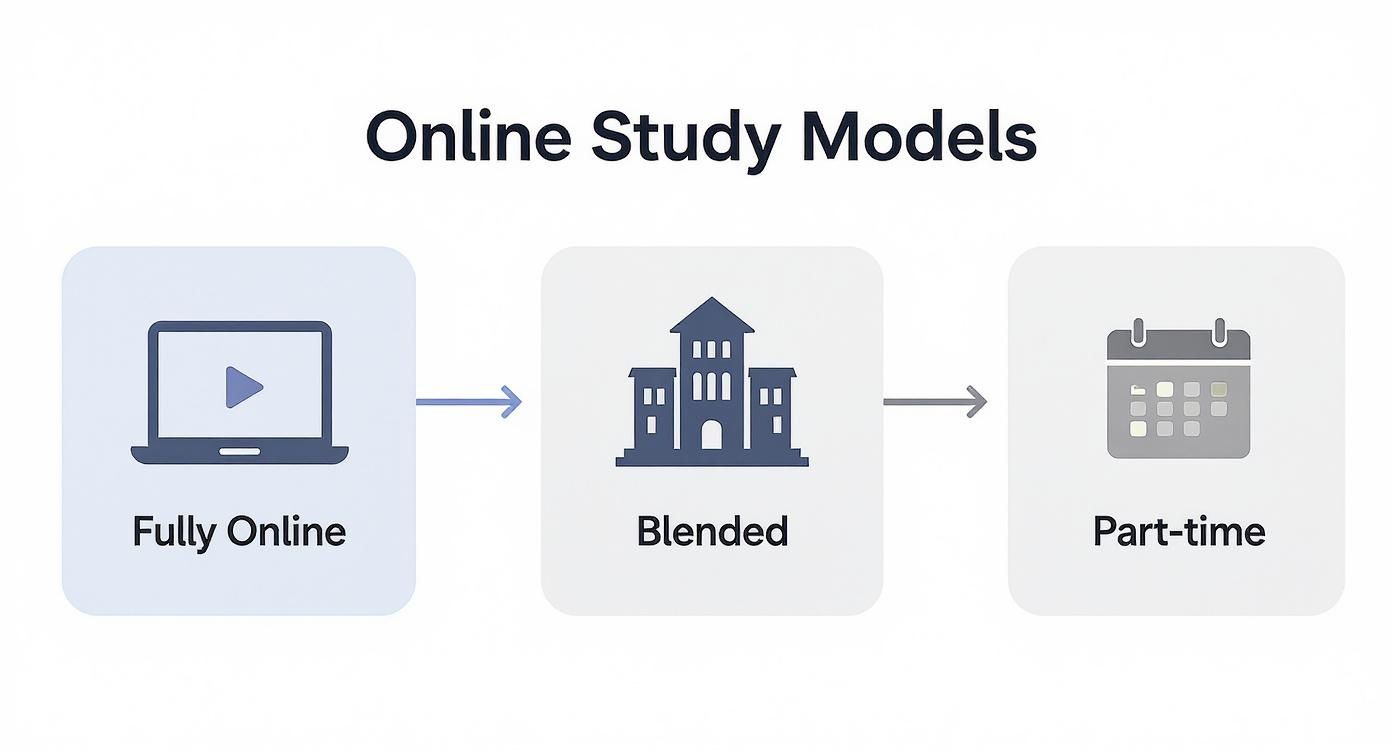
As you can see, each model caters to different needs, offering everything from the complete flexibility of fully online study to the hands-on benefits of a blended approach.
Showcasing Skills Employers Actively Seek
Beyond the piece of paper, completing your degree remotely arms you with a set of skills that are gold dust to modern employers. Successfully navigating an online degree is powerful proof that you’ve got what it takes to succeed in today's workplace.
These aren't just vague "soft skills"; they're tangible assets that show you’re ready for the professional world.
- Exceptional Self-Discipline and Motivation: You’ve already proven you can manage your own learning and hit deadlines without someone constantly looking over your shoulder.
- Advanced Digital Fluency: You’re naturally comfortable with online platforms, collaborative tools, and digital communication – skills that are non-negotiable in almost any modern role.
- Expert Time Management: Juggling studies with work, family, or other commitments shows you can prioritise like a pro and handle pressure effectively.
Instead of thinking of your online study as something you need to explain, frame it as a key selling point. You can confidently tell a potential employer that your degree didn’t just give you academic knowledge; it also sharpened your ability to work independently, solve problems, and thrive in a remote setting.
Strong Graduate Outcomes and Career Prospects
The numbers back all of this up. Graduate outcomes for distance learners in the UK are on the rise, with employment rates that easily rival their on-campus peers.
Take the latest Graduate Outcomes survey from HESA, for example. It showed that an impressive 92.6% of postgraduates from the University of Nottingham's distance learning MSc in Statistical Science found graduate-level jobs or went into further study within 15 months. You can find more insights about these graduate outcomes from the University of Nottingham.
This shows that employers genuinely value the qualification and the skills gained through a distance learning degree UK programme. It’s a solid investment in your future career.
Getting Your Foot in the Door: Entry Requirements and Applications
Getting a place on a distance learning degree UK programme isn't as rigid as you might think. While the traditional route of A-levels and college qualifications is still very much alive, universities are now far more open to different kinds of experience, especially for mature students. It's a welcome change.
Your journey begins with a quick check of what a specific course asks for. For most undergraduate degrees, you'll see A-levels or their equivalents listed. For postgraduate study, a relevant bachelor's degree is usually the key. But that's just scratching the surface.
Thankfully, many universities have thrown the doors open with alternative routes, making higher education a real possibility for people who didn't take the straight-from-school path.
Traditional vs. Non-Traditional Routes
If you're applying straight from school or college, the entry requirements are pretty straightforward. It’s all about hitting specific grades in your A-levels, BTECs, or the International Baccalaureate. This is the most direct path onto an undergraduate course.
For everyone else, the picture is much more flexible and, frankly, more interesting. Universities are now looking for your potential and your readiness to learn, which can be shown in ways that go far beyond old exam results. This is where non-traditional routes come in, offering a structured way back into education.
Think of these alternative pathways not as a plan B, but as a dedicated bridge for those with life experience. They are designed to get you to the same destination—a university degree—by recognising that the journey there looks different for everyone.
The Power of an Access to HE Diploma
One of the most popular and effective non-traditional routes is the Access to Higher Education (HE) Diploma. This qualification is tailor-made for adults who want to go to university but don't have the usual entry qualifications. Universities across the UK see it as a direct equivalent to A-levels.
These diplomas are a brilliant way to get you ready for degree-level work. They let you specialise in an area relevant to your future degree, like Nursing, Social Science, or Business. Finishing one sends a clear message to admissions tutors: you have the academic skills, knowledge, and motivation to succeed.
- Focused Learning: The course content is designed specifically to prepare you for your chosen degree field.
- Skill Development: You’ll learn essential skills in academic writing, research, and critical thinking that you'll use from day one at university.
- Proven Readiness: It shows admissions teams you can handle the demands of higher education, which is exactly what they need to see.
Using Your Work Experience to Your Advantage
For many mature students, their professional life is their biggest strength. Universities often place a high value on the practical skills and knowledge you've picked up in the workplace. In some cases, especially for courses like business or management, this experience can even be considered in place of formal qualifications.
The trick is to clearly explain how your work life has prepared you for academic study. For instance, managing projects at work is solid proof of your time management skills, while writing reports showcases your ability to communicate clearly. If you can draw a direct line between your job and the demands of the degree, you’ll build a very strong case.
How to Put Together a Winning Application
Here’s a key difference: unlike on-campus undergraduate applications that almost always go through UCAS, you’ll often apply for a distance learning degree UK programme directly to the university. This is a huge advantage, as it gives you a direct line to the admissions team and a better chance to make a memorable impression.
Your application will really boil down to two things: your qualifications (both academic and professional) and your personal statement.
- Get Your Paperwork in Order: Start by gathering all your certificates and qualification documents. If you’re leaning on your work experience, get your CV updated to highlight relevant responsibilities and achievements.
- Write a Personal Statement that Stands Out: This is your moment to shine. Explain why you want to study this particular course, what you hope to get out of it, and why distance learning is the right fit for you. Make sure you highlight your self-motivation, organisational skills, and genuine passion for the subject.
- Submit and Follow Up: Use the university’s online portal to submit your application. Keep an eye on the deadline, and don't be shy about contacting the admissions office if you have any questions. They're there to help.
Understanding Costs and Funding Your Education

When you're planning for a distance learning degree UK programme, sorting out your finances is just as crucial as your study schedule. The thought of university fees can be a bit daunting, but for online students, the reality is often far more manageable than you might think. Getting a clear picture of the costs and funding routes early on is the key to a stress-free experience.
One of the biggest financial wins is that tuition fees for distance learning are often much more competitive than their on-campus equivalents. This is a game-changer for international students, who can sidestep the higher fee brackets and the huge living costs that come with moving to the UK.
But the most significant savings often come from what you don't have to pay for. By studying from home, you can wave goodbye to a long list of expenses that on-campus students face, like accommodation, daily travel, and other campus-life costs.
Breaking Down The Main Tuition Fees
The headline figure you'll see on any course page is the tuition fee. Think of this as the core cost of your education—it covers everything from your lectures and tutor support to access to the university's digital library and online learning platforms.
These fees can vary quite a bit, depending on the university's reputation, the subject you’re studying, and whether you're a UK or international student. A brilliant perk for distance learners, especially those studying part-time, is that most universities let you pay in manageable instalments, often on a module-by-module basis.
Exploring Your Student Funding Options
The good news is, you don't have to face these costs alone. There's a whole range of support available to make your degree affordable, and eligibility for distance learners has improved massively over the years.
Here are some of the most common avenues to explore:
- Student Loans: UK students on an eligible undergraduate or postgraduate course can often apply for a tuition fee loan from Student Finance. This loan covers your course fees directly, and you only start repaying it once you've graduated and are earning above a certain salary.
- University Scholarships and Bursaries: Many universities are keen to attract online students and offer scholarships specifically for them. These can be based on academic merit or designed to help students from particular backgrounds or circumstances.
- Employer Sponsorship: If your degree will help you in your current job, don't be afraid to talk to your employer. Many companies are happy to invest in their staff's professional development and might agree to cover some—or even all—of your course fees.
For many mature students, getting to grips with student finance can feel like a whole new world. Our detailed guide on student finance for mature students breaks it all down with practical, easy-to-follow advice.
Understanding your financial options is empowering. It transforms the question from "Can I afford this?" to "How will I fund this?"—a much more proactive and achievable mindset.
To help you get a clearer picture, here’s a quick summary of the main funding sources available.
Funding Options for Your UK Distance Learning Degree
| Funding Type | Description | Typically Available For |
|---|---|---|
| Tuition Fee Loan | Covers the cost of your course fees. Repayments only begin after you've graduated and are earning above a set threshold. | UK students on eligible undergraduate and postgraduate courses. |
| Maintenance Loan | Helps with living costs. Eligibility for distance learners can be more limited than for on-campus students, but it's worth checking. | Some UK students, often depending on course intensity and personal circumstances. |
| Scholarships & Bursaries | Non-repayable funds awarded based on academic merit, financial need, or specific criteria set by the university or an external body. | UK and international students. Many universities have specific scholarships for distance learners. |
| Employer Sponsorship | Your company pays for part or all of your course fees, often in exchange for a commitment to stay with them for a set period after graduating. | Employees whose degree is relevant to their job role. |
| Self-Funding | Paying for your degree yourself, often in instalments. This is a common and flexible option for many part-time distance learners. | All students. |
This table is just a starting point, so always check the specific details with your chosen university to see what support you might be eligible for.
The Growing Market and Available Support
The sheer scale of online education in the UK shows just how important it has become. The online university education market is on track to hit £10.75 billion in revenue by 2025, growing at a steady clip of around 7% each year. This growth means universities are more motivated than ever to provide fantastic support and funding to attract talented students like you.
To give your search a head start, it's well worth looking into scholarships available for online application that could provide a welcome financial boost. By exploring all the avenues, you’ll find that a world-class education is more accessible than you ever imagined.
Your Next Steps to Earning a UK Degree Online
So, you've got a much clearer picture of how a distance learning degree UK programme works, from finding the funds to figuring out the entry routes. That's fantastic. You're now in the perfect position to start making things happen.
The journey from being curious to actually enrolling is just a series of small, straightforward steps. Let's walk through a simple roadmap to get you there, so you feel confident and ready for what’s ahead. It all starts with a bit of honest reflection before you even think about looking at university websites. What subject genuinely gets you excited? How will this degree help you get where you want to be in the long run? Nail these questions down first, and your search will be so much easier.
Your Action Plan for Enrolment
Once you know what you’re aiming for, it's time to get practical. Think of this as a checklist to work through, turning a massive decision into a set of manageable tasks. Each one builds on the last, getting you that little bit closer to day one of your course.
Here’s a simple plan to get you moving:
- Nail Down Your Course Choice: Start by shortlisting subjects that match your career goals. Don’t just look at the title – dig into the specific course modules to make sure they cover topics you’re actually interested in.
- Research Universities: Make a list of UK universities offering your chosen course through distance learning. Pay close attention to their reputation, what they ask for in terms of entry requirements, and the kind of support they offer online students.
- Check You’re Eligible: Have a really good look at the entry requirements for your favourite courses. If you don’t have the usual A-Levels, now’s the time to look seriously at alternatives like an Access to HE Diploma.
- Plan Your Finances: Get a handle on the tuition fees and start exploring all the funding options out there. It's always worth contacting the universities directly to ask about any scholarships or payment plans you might qualify for.
- Get Your Application Ready: Start pulling together all your documents, give your CV a polish, and begin drafting your personal statement. This is your chance to really sell yourself and show why you’re a great fit for the course.
Setting Yourself Up for Success
Getting accepted is one thing, but succeeding in your studies is another. It’s all about creating a study routine you can actually stick to. Getting ready for this new chapter is just as vital as the application itself.
This means thinking practically about how learning will fit into your life. Where will you set up your study space? When can you block out time for lectures and coursework? Getting these habits sorted early on will make a world of difference.
Embarking on a distance learning degree is a commitment to yourself and your future. The key is to start with a clear, organised approach, transforming your ambition into a structured plan that you can follow with confidence.
To make your study time even more effective, it’s worth looking into helpful digital tools. For instance, many students find that using speech-to-text software designed for students can help them capture notes or draft assignments much faster.
By breaking the process down and preparing both your application and your mindset, you can navigate the path to earning your UK degree online with total clarity. The flexibility and opportunity that a distance learning degree UK programme offers are well within your reach—and taking these next steps is how you turn that possibility into a reality.
Your Questions, Answered
Thinking about studying online can bring up a lot of questions. It's a big decision, after all! To help you get a clearer picture, we've put together some straightforward answers to the questions we hear most often about distance learning degrees in the UK.
Is a UK Distance Learning Degree Recognised Internationally?
Yes, absolutely. A degree you earn through distance learning from an accredited UK university is just as valuable and internationally recognised as one earned by studying on campus.
The UK's higher education system is held in high regard across the globe for its tough quality standards. Employers and universities worldwide know that the way you study doesn't change the quality of the qualification. Your degree certificate will look exactly the same as an on-campus student's.
Can I Get a Student Visa for an Online Course?
No, student visas generally aren't an option for fully online distance learning courses. This is because these visas are specifically for students who need to be physically present in the UK to attend classes.
For many international students, this is actually one of the biggest benefits. You can earn a prestigious UK degree from a world-class university without the huge expense and hassle of moving country. It means you can fit your studies around your life, right from home.
The real beauty of a distance learning degree is getting that UK qualification without needing a visa or having to relocate. It opens the door to British higher education for people all over the world in a way that’s both practical and affordable.
How Do Exams and Assessments Work?
How you're assessed on an online degree is designed to fit perfectly with remote study. Universities use a mix of methods to check your progress and understanding as you go.
The exact methods will depend on your specific course, but you can generally expect a combination of the following:
- Online Exams: These are usually timed and invigilated remotely using special software to make sure everything is fair and secure.
- Coursework and Assignments: Think essays, reports, case studies, and practical projects that you'll submit through your university's online learning portal.
- Dissertations or Major Projects: Most degrees wrap up with a large, independent research project on a topic you're passionate about.
- In-Person Exams: In some rare cases, for very specific courses, you might need to sit a final exam at an approved test centre in your own country.
Will I Have Access to University Support?
Definitely. UK universities see their distance learning students as full members of the university community. You get access to a whole range of resources designed to help you succeed.
These services are all delivered online and shaped to meet the needs of students who aren't on campus. You can typically expect dedicated academic tutors for one-to-one help, massive online libraries with millions of digital articles and e-books, and solid tech support for any platform issues. Plus, you can often use career services, wellbeing support, and join online student forums to connect with classmates.
Ready to take the first step towards university without the traditional entry requirements? Access Courses Online provides accredited Access to HE Diplomas that are your proven pathway to a degree. Find out more at Access Courses Online.