

Taking great notes isn't just one action; it’s a simple, three-part cycle: you Prepare before a session, Capture information during it, and Review afterwards to really make it stick. Getting this Prepare-Capture-Review rhythm down is what turns note-taking from a passive chore into an active learning process. Honestly, it’s the secret to better grades and a lot less stress.
Why Effective Note-Taking Is a University Superpower
Stepping into university, especially if you’re an adult returning to education, can feel like you're trying to drink from a fire hose. The amount of information thrown at you in lectures and readings is massive.
A common trap many students fall into is trying to write down every single word. It feels productive, right? But just transcribing what a lecturer says is one of the least effective ways to learn. Your brain gets so caught up in the frantic typing or writing that it has no time left to actually process, understand, or connect any of the ideas.
This is where effective note-taking comes in. It’s the skill that bridges that gap. The goal isn’t to create a perfect script of the lecture; it’s about creating a powerful tool for your future self to study from. It’s all about shifting from being a passive listener to an active participant in your own learning. This mental shift is what truly separates the students who thrive from those who struggle.
The Modern Student's Toolkit
The way we learn is always changing. A recent study from the University of Bristol really highlighted this, showing that while 94% of students take notes in lectures, a huge majority—over 69%—now prefer digital tools like laptops and tablets. Students pointed out that going digital was faster, neater, and easier to organise. You can read more about it in the full study on student note-taking habits. This doesn’t mean pen and paper are dead; it just means you’ve got more options than ever to find a system that clicks for you.
More Than Just a Study Aid
Learning to take great notes is a foundational skill that pays off far beyond your next exam. It’s a key part of being ready for academic life, just as crucial as managing your time or understanding what an assignment requires. In fact, many of the skills you build on courses designed to get you university-ready directly support better note-taking. You can explore more about how Access courses can help you prepare for university and build these essential abilities.
The real power of great notes is that they force you to think critically in the moment. You're constantly asking yourself: What's the main point here? How does this connect to last week's topic? What is the key takeaway I need to remember?
This process of summarising, questioning, and connecting ideas is where the real learning happens. It seriously boosts your memory, deepens your understanding, and ultimately cuts down the time you need to spend revising. By mastering this superpower, you're not just preparing for an exam; you’re building a lifelong skill for thinking, learning, and succeeding.
Preparing for Success Before the Lecture Begins
Powerful note-taking doesn't actually start when the lecture does. The real magic happens long before you step into a lecture hall or open your textbook. Just a little groundwork can completely change how much you absorb, turning a lecture from a one-way information dump into an active learning session. It’s all about setting the stage for your brain to make meaningful connections.
If you walk in cold, you’re always playing catch-up. You're trying to grasp basic concepts while the lecturer is already moving on to more complex ideas. The best notes come from a prepared mind—one that already has a mental framework to hang new information on. The good news is this prep doesn't need to take hours; even 15-20 minutes beforehand can make a world of difference.
By preparing in advance, you shift your role from a passive scribe to an active investigator. You're not just receiving information; you're seeking answers and connecting dots in real time, which is the key to how to take effective notes that actually stick.
This simple routine primes your brain, making it far easier to spot the key themes and filter out the fluff during the session itself.
Your Pre-Lecture Checklist
To make this easy, think of it as a quick checklist. Each step builds on the last, giving you a solid foundation of understanding before the teaching even begins.
- Review Previous Notes: Quickly scan your notes from the last lecture on this topic. This simple act refreshes key concepts and terminology, reminding you where you left off and teeing you up for what’s next.
- Complete Assigned Readings: Lecturers assign reading for a reason—it introduces the core ideas they'll build on. Arriving with this context means you'll be picking up on the lecture's nuances instead of just struggling with the basics.
- Formulate Questions in Advance: Based on the reading or the lecture topic, jot down two or three questions. If the lecture is on "The Causes of the Industrial Revolution," you might ask, "What was the single most important invention?" or "How did life change for ordinary people?" This turns you into an active hunter for information.
Having these questions in your mind gives your listening a real purpose. You’ll be actively searching for the answers, which keeps you far more engaged than passively letting the information wash over you.
Set Up Your Workspace for Focus
Your physical or digital environment plays a huge part in your ability to concentrate. A cluttered desk or a desktop full of notifications is the enemy of good note-taking. Take a moment to set up your space for deep focus.
Close those unnecessary browser tabs, put your phone on silent and out of sight, and make sure your tools—whether it's a notebook and pen or an app like Notion or OneNote—are open and ready to go. Having everything organised from the start stops you from losing your train of thought with last-minute scrambles.
This preparation is a core part of building a strong study routine, just as crucial as structuring your time. For more on that, check out our guide on creating a study schedule that actually works.
This simple act of tidying your space sends a clear signal to your brain: it’s time to focus. By taking these proactive steps, you arrive at every lecture, meeting, or study session fully prepared to engage, question, and learn effectively.
Choosing Your Tools: Digital Vs Paper Notes
The age-old debate: is it better to stick with a trusty pen and notebook, or go all-in with a sleek laptop or tablet? This is one of the most personal choices you’ll make on your academic journey, and honestly, there's no single right answer.
The best method really depends on the lecture, your learning style, and what you’re trying to achieve at that moment. Forget trying to find a definitive winner; the real goal is to understand the strengths of each and build a flexible system that genuinely works for you.
Lots of students jump straight to digital tools, and you can see why. Typing is fast, which feels essential when a lecturer is talking a mile a minute. The organisational power is also a massive plus. You can search for a keyword from a lecture weeks ago, drag and drop entire sections, and pop in links or images right where you need them. Digital tools like notie: A Digital Note-Taking Solution are built to streamline exactly this kind of workflow.
This ability to organise and search everything is a huge advantage when it comes to revision. You can build a master document for an entire module, keeping all your knowledge in one easy-to-access place. But there's a well-known catch: the temptation to just transcribe everything word-for-word. This can trick you into thinking you're learning, when you’re really just passively listening.
Digital vs Paper Notes: A Quick Comparison
To help you weigh your options, here’s a straightforward breakdown of what each method brings to the table. Think about which features align best with how you learn and the demands of your Access to HE course.
| Feature | Digital Notes (Laptop/Tablet) | Paper Notes (Pen/Notebook) |
|---|---|---|
| Speed & Volume | Excellent. Great for fast-paced lectures where lots of information is covered quickly. | Slower. Forces you to be selective and summarise, which can be a good thing. |
| Organisation | High. Easy to edit, tag, rearrange, and search. Everything can be stored in one place. | Requires Effort. Needs a consistent system (e.g., binders, indexing) to stay organised. |
| Searchability | Instant. Find any keyword or topic across all your notes in seconds. | Manual. Relies on your memory or a well-maintained index. |
| Multimedia | Seamless. Easily embed links, images, audio clips, and lecture slides. | Limited. You can sketch diagrams, but that's about it. |
| Cognitive Engagement | Can be passive. The ease of typing can lead to mindless transcription without real processing. | Highly active. The physical act of writing forces you to process and summarise information. |
| Distractions | High risk. The internet, notifications, and other apps are just a click away. | Minimal. It’s just you, your pen, and the paper. No pop-ups here. |
| Cost | Higher initial cost for the device and potentially software subscriptions. | Very low cost. A good notebook and pen are all you need. |
Ultimately, neither method is perfect, but understanding these differences allows you to make an informed choice for any given situation. You might even find a blend of both works best.
The Case for Pen and Paper
On the other side, you have the classic combination of pen and paper. It might feel slower, but the physical act of writing has a powerful effect on your brain that typing just can't match.
Because you can't possibly write as fast as someone speaks, you’re forced to listen more actively. You have to process the information on the spot and summarise the key ideas in your own words. That’s where the real learning kicks in. It forces you to engage with the material on a much deeper level from the very beginning.
In fact, the limitations of paper are its greatest strength. It encourages you to be thoughtful about what you jot down, focusing on the core concepts rather than getting bogged down trying to capture every single detail.
The friction of handwriting is a feature, not a bug. It slows you down just enough to force your brain to switch from passive transcription to active synthesis, which is the cornerstone of effective learning.
Finding Your Ideal Workflow
The most successful students I've seen don't pick one side and stick to it. Instead, they use a hybrid approach, letting the context decide the tool.
Here are a few scenarios to think about:
- Fast-Paced Lectures: Digital might be your best bet for capturing a high volume of information, especially if the lecturer provides slides you can annotate directly.
- Dense Textbook Readings: This is where pen and paper shine. You can slow right down, create summaries, and use methods like the Cornell system to pull out key themes and questions.
- Brainstorming and Mind Mapping: The freedom of a blank page is fantastic for visual thinking. You can draw connections and explore ideas in a non-linear way that feels restrictive on a screen.
- Seminars and Group Discussions: Using a notebook can feel less intrusive in a collaborative setting. It avoids putting a laptop screen up as a barrier between you and your peers.
A popular hybrid solution is a tablet with a stylus. This can give you the best of both worlds—the cognitive benefits of handwriting with the unbeatable organisation of digital tools. You can write, draw diagrams, and still have everything searchable and backed up to the cloud.
Ultimately, the key is to experiment. Try different methods in different classes. See what helps you understand and, more importantly, remember the information. The best system is simply the one you’ll stick with.
Proven Techniques for Capturing Information
Right, you’ve done your prep and picked your tools. Now comes the real challenge: actually getting the information down in a way that makes sense later. The trick isn't just to scribble down everything the lecturer says. If you do that, you'll end up with pages of random facts and you won't have actually listened to the lecture.
Instead, you need a system. A proper method turns note-taking from a passive chore into an active learning session. The techniques below are tried-and-tested ways to structure information. Have a look through and see which one feels right for you and the subject you're studying. Finding a good fit is a game-changer.
The Cornell Method for Active Recall
This one’s a classic for a reason. Developed at Cornell University, this system is an absolute powerhouse for making your notes work for you. It’s built to force you to engage with the material after the lecture, which is vital for getting information to stick in your long-term memory. It works for pretty much any subject, from dense science modules to abstract social theories.
Here’s how you set it up. Before the lecture starts, divide your page into three sections:
- Main Notes Area (Right): This is the big section on the right. During the lecture, this is where you capture everything. Don't worry about perfect sentences—use bullet points, abbreviations, and shorthand. Just get the ideas down.
- Cues Column (Left): Keep this smaller column (about 2.5 inches wide) on the left completely blank during the lecture itself. Straight after, go back through your main notes and pull out keywords, main ideas, or potential exam questions. Jot these down in the cues column.
- Summary Section (Bottom): Leave a couple of inches of space at the very bottom of the page. Within 24 hours, write a quick one or two-sentence summary of that page's contents.
The genius is in the layout. When it's time to revise, you just cover the main notes area and try to explain the concepts or answer the questions you wrote in the cues column. This is a form of active recall—you're forcing your brain to retrieve the information, not just passively read it over and over again.
The Outlining Method for Logical Structure
If your lecturer is one of those wonderfully organised people who presents everything in a clear, logical order, then the outlining method will be your new best friend. It uses indentation to show the hierarchy and relationship between main topics, sub-topics, and all the supporting details. This is brilliant for subjects like history, law, or biology where concepts are built on top of each other.
You start with the main topic on the far left. Any sub-topics get indented underneath it, and then specific details or examples get indented even further.
For example, in a Sociology module on Social Class, it might look like this:
- I. Theories of Social Stratification
- A. Functionalist Perspective (Davis & Moore)
-
- Society must fill important positions.
-
- Some positions are more important than others.
-
- Greater rewards are needed for more important positions.
-
- B. Conflict Perspective (Karl Marx)
-
- Society divided into two classes (bourgeoisie & proletariat).
-
- Class conflict is the engine of social change.
-
- A. Functionalist Perspective (Davis & Moore)
This method forces you to think about how all the information connects, giving you a really clear overview of the whole lecture. It's not just a feeling, either. Studies have shown that students using outlines capture about 25% more complete ideas than those just taking free-form notes.
Mind Mapping for Visual Connections
For those subjects that are more conceptual and less linear—think literature, marketing, or even just brainstorming essay ideas—mind mapping is a fantastic technique. It's a visual approach that helps you see the web of connections between ideas in a way that straight lines of text just can't.
You begin with the central theme of the lecture right in the middle of a blank page. As the lecturer introduces new concepts, you draw branches radiating out from the centre for each main idea. From those, you can add smaller sub-branches for details, examples, or your own thoughts.
A mind map is great because it mirrors how our brains naturally link ideas. It’s less about capturing every single word and more about understanding the bigger picture and how everything fits together.
Don't be afraid to use colours, keywords, and little doodles to make the connections more memorable. This is an absolute gift for visual learners and can simplify a really complex topic into a diagram you can understand at a glance. It's also super flexible – you can always add new branches or link different parts of the map as your understanding grows.
This infographic gives a good side-by-side look at digital versus paper notes, which can help you decide which medium best supports these different styles.
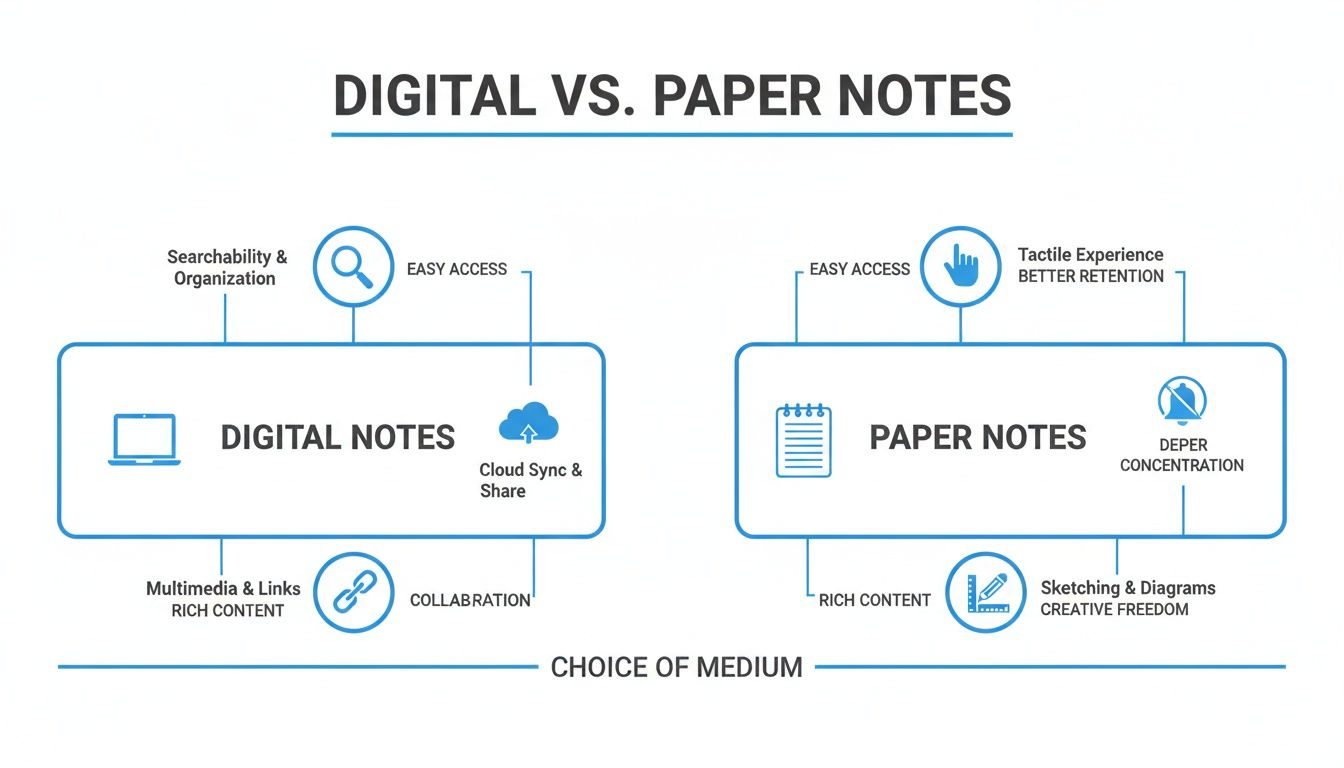
As you can see, it really boils down to the trade-offs between the convenience of digital tools and the powerful cognitive benefits of actually writing things out by hand.
Ultimately, there’s no single "best" technique. The most successful students I know mix and match. They might use the Cornell method for a dense biology reading and then switch to a mind map for a creative writing seminar. And don't forget your readings—learning how to take smart notes for textbook study is another vital skill. The key is to experiment and find what helps you not just write things down, but truly understand them.
Turning Your Notes into Retained Knowledge
Taking detailed notes during a lecture is a great start, but it’s only half the battle. If they just sit in a notebook or a digital folder, unread and gathering dust, then all that effort was for nothing. The real magic happens when you actively transform those raw scribbles into lasting knowledge locked away in your brain.
This is the crucial final step: the review. It’s not about mindlessly re-reading your notes until your eyes glaze over. It’s about using proven strategies that force your brain to actually engage with the material, making your study sessions shorter, smarter, and way more effective.
Master Active Recall to Beat Passive Reading
One of the most powerful learning techniques you can adopt is active recall. This is simply the act of pulling information out of your memory, rather than just passively looking at it on a page. When you just re-read your notes, you create a false sense of security; you recognise the words, so you trick yourself into thinking you know the material.
Active recall, on the other hand, is like a mini-test for your brain. It forces you to retrieve the information, which strengthens the neural pathways and makes it much easier to remember later on—especially under exam pressure. Think of it as the difference between recognising a face in a crowd and actually remembering that person’s name and how you know them.
If you’ve used the Cornell Method, you’ve already done the hard work. Here’s how to put it into practice:
- Cover the main notes section on the right-hand side of your page with a piece of paper or your hand.
- Look only at your cues—the keywords and questions you wrote in the left-hand column.
- Try to explain the concept out loud. Answer the question or define the keyword in your own words.
- Check your answer. Uncover your notes to see how you did. Pay close attention to anything you forgot or got wrong, then cover it up and try again until it sticks.
This process feels harder than just re-reading, but that feeling of effort is a sign that you are genuinely learning. It’s a core part of any routine focused on how to study effectively at home.
Use Spaced Repetition to Remember for Longer
Our brains are designed to forget information they don't think is important. It’s a survival mechanism known as the "forgetting curve." You might remember most of a lecture right after it finishes, but a huge chunk of that information disappears within a day. Even more is gone by the end of the week.
Spaced repetition is the perfect antidote. It works by interrupting the forgetting curve at just the right moment. The idea is simple: you review new information at increasing intervals. By revisiting the material just as you're about to forget it, you send a powerful signal to your brain that this knowledge is important and needs to be kept for the long term.
Spaced repetition isn't about cramming; it's the total opposite. It’s a strategic, long-term approach that makes learning feel almost effortless over time because it works with your brain's natural rhythms, not against them.
Building a simple spaced repetition schedule can have a massive impact on what you remember. You don’t need any fancy software; a basic system using your phone's calendar reminders is all it takes to get started.
A practical schedule might look something like this:
- Review 1: Within 24 hours of taking the notes.
- Review 2: 3 days later.
- Review 3: 1 week later.
- Review 4: 2-3 weeks later.
Each review session after the first should be incredibly quick—often just five or ten minutes—because you are just reinforcing knowledge you already have. By combining the power of active recall with a spaced repetition schedule, you create an unbeatable system for turning fleeting lecture notes into deep, lasting understanding.
Your Top Note-Taking Questions, Answered
Even with the perfect method, you’re bound to hit a few snags. Knowing how to handle these common hurdles is the difference between feeling swamped and feeling in control of your studies. Let’s tackle some of the most frequent questions that trip students up.
Getting these practical issues sorted will help you build a note-taking system that’s robust, organised, and actually helps when revision time rolls around.
What Should I Do If My Lecturer Talks Too Fast?
This is probably the most common frustration out there. Your first instinct might be to panic and try to scribble down every single word, but trust me, that’s a losing battle. The moment you accept you can’t capture everything, you can switch to a much smarter strategy.
Instead of trying to be a transcriber, think of yourself as a master listener. Your goal is to grab the key ideas, not the entire script.
- Embrace Abbreviations and Shorthand: Develop your own system on the fly. For example, 'w/' for with, 'b/c' for because, and symbols like '+' for and, or '→' for 'leads to.' This will save you precious seconds.
- Leave Gaps! If the lecturer moves on before you finish a point, just leave a space. Don't try to finish it, or you'll miss the next three points. You can always fill it in later by asking a classmate or checking the lecture recording.
- Listen for the Signposts: Tune your ears for phrases like "The most important point is…", "To summarise…", or "There are three main reasons for this…". These are massive clues telling you what’s about to be said is important.
The key is to shift your mindset. You're not a court reporter; you're an intelligence analyst. Your job is to identify and pull out the most valuable information.
How Can I Organise My Notes for Multiple Modules?
Juggling several modules at once can turn your desk—and your hard drive—into a chaotic mess. A disorganised system is a useless one. The secret is to decide on a consistent organisational structure right from day one and stick to it.
It doesn’t matter if you’re using physical notebooks or a digital app like Notion; the principles are exactly the same. You need a clear hierarchy that keeps each module completely separate.
Your future self will thank you for the time you spend organising now. A logical system means you can find exactly what you need in seconds during a stressful exam period, rather than wasting hours digging through a jumble of notes.
Here’s a simple, effective structure to get you started:
- Top-Level Separation: Use a different physical binder or a main digital folder for each module (e.g., "Sociology," "Biology," "Academic Writing").
- Weekly Sub-Folders: Inside each module, create sections for each week of the term (e.g., "Week 1," "Week 2"). This keeps everything in perfect chronological order.
-
Consistent File Naming: If you're digital, get into the habit of using a standard naming convention. Something like:
[Module Code]_[Week No]_[Lecture Topic].docx. This makes your files easy to sort and identify at a glance.
This structure stops your notes from different subjects blurring into one another and makes finding specific information incredibly simple.
Should I Take Notes on Readings or Just the Lecture?
The short answer? Both. But they serve very different purposes.
Think of notes on pre-lecture readings as priming your brain. You’re building the foundational knowledge so you can walk into the lecture ready to engage on a much deeper level. These notes should be about the big-picture concepts, key definitions, and any questions that pop into your head as you read.
Lecture notes, on the other hand, are for capturing the lecturer’s unique insights. They highlight the topics your lecturer thinks are most important and reveal connections you might not find in a textbook.
After the lecture, the real magic happens. Your final job is to synthesise the two sets of notes. This means creating a single, consolidated "master" set of notes for that topic, weaving together what you learned from the reading with the new insights from the lecture. This act of merging and re-organising is a powerful form of active learning that will cement your understanding far better than just re-reading one set of notes.
Ready to take the next step on your academic journey? The skills you build with Access Courses Online are designed to help you succeed at university from day one. Discover how our accredited online Access to HE Diplomas can help you reach your goals. Explore our courses at https://accesscoursesonline.com.