

So, what exactly is Functional Maths Level 2? Think of it as a practical maths qualification, built from the ground up to give you the real-world skills you need for work, study, and everyday life. It's widely recognised by UK universities as equivalent to a GCSE grade 4 or C, making it a fantastic stepping stone for adults looking to get back into education.
Understanding the Purpose of Functional Maths

Have you ever sat in a maths class wondering, "When am I ever going to use this?" Well, Functional Skills Maths Level 2 is the answer to that question. It’s been designed specifically for adults who need a practical, relevant maths qualification to unlock that next big step, whether it’s a new career or a place at university.
It’s less about abstract theories and more about the kind of maths you’ll genuinely use day-to-day. You can almost think of it as a 'maths for life' toolkit.
To give you a clearer picture, here’s a quick overview of what the qualification is all about.
Functional Maths Level 2 At a Glance
| Feature | Description |
|---|---|
| Qualification Level | Level 2 (equivalent to a GCSE grade 4/C) |
| Focus | Practical, problem-solving maths for real-world scenarios |
| Ideal For | Adults returning to education or needing a GCSE equivalent |
| Key Use | Meeting university entry requirements, especially with Access to HE Diplomas |
| Assessment | Typically two exams: one non-calculator and one calculator paper |
This table shows just how focused the qualification is on helping you get where you need to go.
Who Is This Qualification For?
This qualification is an absolute game-changer for adults who need a GCSE equivalent to get into university, especially if you're applying with an Access to Higher Education Diploma. It’s particularly suited for:
- Career changers needing to upskill for fields like nursing, social work, or business management.
- Adults returning to learning after a long break who want a focused, no-nonsense maths course.
- Anyone who struggled with school maths and wants a more practical, confidence-building approach.
The entire course is structured to build your confidence by linking maths concepts to tasks you can actually picture yourself doing. You won't just be memorising formulas; you'll be learning how and when to apply them.
The core idea behind Functional Skills is to equip learners with the essential abilities needed to succeed in all aspects of life. It’s not just about passing an exam; it’s about gaining the confidence to handle numbers effectively, whether you're at home, at work, or in further study.
A Respected Pathway to University
One of the biggest worries for adult learners is whether their qualifications will be taken seriously. Let me put your mind at ease: Functional Maths Level 2 is a respected and widely accepted route into higher education.
Universities across the UK, particularly for demanding courses like Nursing and Midwifery, see it as a solid sign that you can handle the numerical side of degree-level study. For a deeper dive, check out our guide on what Functional Skills qualifications are.
While government reports have shown dips in enrolment numbers—with Level 2 participation falling by 22.7% in one recent academic year—the qualification remains absolutely vital for adult learners. It continues to be a crucial key for those on Access to HE programmes who are looking for a direct path to their dream university degree.
Breaking Down the Functional Maths Syllabus
To really get what functional maths level 2 is all about, you need to look beyond a simple list of topics. It’s better to think about what you’ll actually learn and how those skills will give you real-world confidence with numbers. This isn't about head-scratching algebra; it's about mastering the maths you need every single day.
The whole curriculum is built on three main pillars. Each one is designed to give you the mathematical tools to solve practical problems, from sorting out your finances to making sense of charts and graphs.
Mastering Numbers and Calculations
This is the bedrock of the course, where you get comfortable with the numbers that make the world go round. It kicks off with the basics, making sure you have a solid handle on integers, fractions, decimals, and percentages. But it doesn't stop there. It quickly moves on to using these ideas in genuinely useful ways.
For example, you won't just learn the definition of a percentage. You’ll learn how to calculate a 20% discount on a new pair of trainers, figure out the interest on a car loan, or see what a pay rise actually looks like in your bank account. This part of the course makes numbers click.
Key skills you'll build include:
- Fractions and Percentages: Fluently switching between fractions, decimals, and percentages to spot the best deal or understand news headlines.
- Ratio and Proportion: Using ratios to scale up a recipe for a party or correctly read a map legend on a hike.
- Positive and Negative Numbers: Applying your knowledge to understand bank statements, changes in temperature, or the profit and loss of a small business.
This relentless focus on real-world situations is what makes the qualification so effective. It connects the rules of maths to things you can actually see and do, which helps the concepts stick.
A core principle of the functional maths level 2 syllabus is that every skill learned must have a clear, identifiable use in an everyday or workplace scenario. It’s designed to be immediately useful.
Think about managing a household budget. You need to calculate what percentage of your income goes on rent, how to split bills with a flatmate using ratios, and track your spending with positive and negative numbers. This is precisely the kind of problem-solving you’ll master.
Understanding Common Measures, Shape, and Space
The second pillar takes maths off the page and into the physical world. This area is all about measurement, geometry, and spatial reasoning—skills that are vital for everything from a bit of DIY to planning a trip.
You'll get to grips with different units of measurement for length, weight, capacity, and time. This means you’ll be able to convert between metric and imperial systems, which is a common task here in the UK. For instance, you might need to convert kilograms to pounds when following an online recipe or metres to feet when buying a new carpet.
This section covers:
- Measurement Conversions: Effortlessly moving between units like grams and kilograms, or millilitres and litres.
- Area and Perimeter: Calculating the perimeter of a garden to buy the right amount of fencing or finding the area of a room to get enough paint.
- Volume: Working out the capacity of a fish tank or a packing box.
A great practical example is planning a new room layout. You’d need to measure the space, calculate the area to see if that new sofa will actually fit, and maybe even draw a simple scale plan. These are the functional skills that bring geometry to life.
Handling Information and Data
The final core area is arguably one of the most important in our modern world. It’s all about learning how to handle, interpret, and present data. This isn't about complicated statistics; it's about making sense of the charts, graphs, and tables you see every single day.
You'll learn how to pull out key information from different sources, like a utility bill, a performance chart at work, or a bus timetable. It also involves understanding basic concepts like mean, median, mode, and range to analyse sets of numbers properly.
On top of that, you’ll learn to calculate probabilities to understand risk and likelihood. This could be as simple as working out the chances of your train being on time based on past performance data. By the end, you'll feel confident not just reading data but drawing real conclusions from it—a skill that employers love and is essential for university.
How the Functional Maths Level 2 Exam Really Works
The thought of sitting a formal exam can be a bit nerve-wracking, especially if you’ve been out of the classroom for a while. But knowing exactly what to expect from the Functional Maths Level 2 assessment can make all the difference, turning that anxiety into confidence. This exam isn’t designed to catch you out with trick questions; it’s a fair and practical test of your real-world problem-solving skills.
The assessment is neatly split into two parts, both of which you'll take on the same day, usually with a short break in between. Each paper is designed to test a different side of your mathematical ability.
The Non-Calculator Paper
First up is the shorter paper, which usually takes around 25-30 minutes. The whole point of this section is to check your core numeracy skills – the kind of mental maths you need when a calculator isn't handy.
You'll be asked to tackle problems using addition, subtraction, multiplication, and division. It will also cover the basics of working with fractions, decimals, and percentages. The questions are straightforward, designed to confirm you've got a solid grasp of the fundamentals before you move on to more complex scenarios.
The Calculator Paper
The second part of the exam is longer, giving you about 90 minutes to work through it. As the name suggests, you're allowed to use a calculator here. This section isn't about testing your mental arithmetic; it's about seeing if you can interpret information, figure out the right mathematical approach, and solve problems that have a few different steps.
The questions are all grounded in realistic situations you might actually face at work or in daily life. For instance, you could be asked to:
- Plan a budget: Work out expenses, income, and savings from a given scenario.
- Interpret data: Look at a chart showing company sales figures and calculate the mean average.
- Solve a practical problem: Figure out how much paint is needed to decorate a room based on its measurements.
These tasks are all about reading the question carefully, pulling out the key numbers, and applying your skills in a logical order. It’s your chance to show you can use maths as a practical tool to find answers.
Understanding the Grading System
Unlike GCSEs with their 9-to-1 grading scale, Functional Skills Maths Level 2 keeps things simple: you either pass or fail. This straightforward approach takes the pressure off chasing a specific grade. Your only goal is to show you have a competent level of practical maths.
So, what does it take to pass? While the exact pass mark can change slightly between papers to keep things fair, it generally sits somewhere between 50% and 60%. This means you don’t need to be perfect to succeed; you just need to show that you can consistently apply the core skills.
The goal of the assessment isn't to catch you out. It's designed to confirm that you have the necessary mathematical skills to manage everyday situations and progress confidently to higher education or a new career.
This achievable benchmark is why the qualification has such a strong track record. In 2022-23, data from Further Education settings showed that the success rate for Functional Skills mathematics was 5 percentage points higher for learners aged 17-19 than for GCSE Maths. You can explore the latest insights on Functional Skills pass rates to learn more. This really highlights how the qualification's practical focus helps people succeed, even if they've struggled with maths in the past.
Functional Maths Versus GCSE Maths Which Is Right for You
Picking the right maths qualification can feel like a huge decision, especially when you’ve got your sights set on university. The two main paths you’ll see are Functional Maths Level 2 and the classic GCSE. While both are well-respected, they’re built for very different purposes and click with different kinds of learners.
The easiest way to get your head around it is to think of it as practical skills versus abstract theory. A Maths GCSE covers a massive, theoretical curriculum. It gets deep into algebra, trigonometry, and abstract ideas that give you a broad mathematical foundation.
On the other hand, Functional Maths Level 2 is laser-focused on the real-world skills you actually need day-to-day. It takes maths principles and puts them straight into practical scenarios, like managing a budget, making sense of a workplace report, or figuring out measurements for a DIY project.
The Core Philosophical Difference
The real distinction is in their approach. GCSE Maths often asks, "What's the rule?" while Functional Skills asks, "How can I use this rule right now?". This makes Functional Skills a fantastic fit for adult learners who want to see the immediate point of what they’re studying.
If you found the abstract side of school maths a bit of a struggle, the practical, problem-solving vibe of Functional Skills could be a game-changer for your confidence.
University Acceptance and Progression
This is the big one for most adult learners: will universities actually accept it? The answer is a massive yes. Universities across the UK widely recognise Functional Maths Level 2 as equivalent to a GCSE grade 4/C.
It's particularly valued for students applying with an Access to Higher Education Diploma. Why? Because it proves you have the specific numeracy skills essential for demanding degrees like Nursing, Midwifery, and Social Work. If you need a refresher on the GCSE route, we've got a detailed guide on retaking maths GCSE for adults.
For learners on an Access to HE Diploma pathway, Functional Skills isn't just an alternative; it's often the most direct and relevant route to meeting university entry requirements for practical, people-focused careers.
This decision tree gives a clear visual on which qualification might be the best match for your goals.
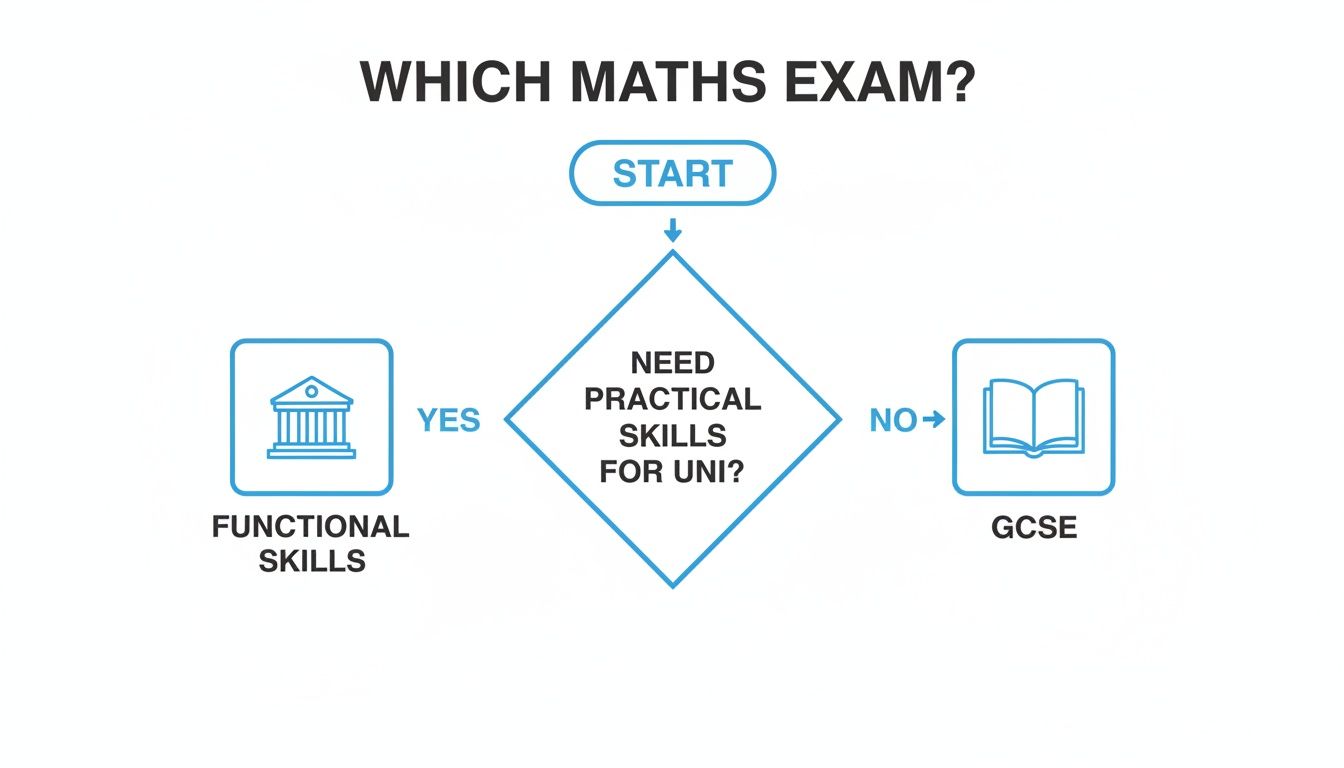
As the flowchart shows, if your main goal is getting the practical skills needed for uni, especially via an Access course, Functional Skills is the recommended path.
Making the Right Choice for Your Future
Ultimately, the best qualification for you comes down to your personal situation and where you want to go next. Here’s a quick comparison to help lay it all out.
Comparing Functional Maths Level 2 and GCSE Maths
This table breaks down the key differences between the two main maths qualifications for university entry.
| Aspect | Functional Skills Maths Level 2 | GCSE Maths (Grade 4/C) |
|---|---|---|
| Main Focus | Applying maths to solve practical, real-world problems. | Understanding a broad range of theoretical mathematical concepts. |
| Learning Style | Ideal for hands-on learners who prefer context-based learning. | Suited to learners who enjoy abstract thinking and theoretical rules. |
| Assessment | Problem-solving scenarios based on everyday and work situations. | A mix of theoretical questions and some applied problems. |
| University Entry | Widely accepted, especially with an Access to HE Diploma. | Universally accepted as the standard school-leaver qualification. |
Choosing Functional Maths Level 2 is a smart, strategic move. It lets you earn a respected, university-accepted qualification by zeroing in on the maths skills that will genuinely matter in your future career and studies, without getting bogged down in abstract theory you might never use.
Your Practical Study Plan for Passing the Exam
Passing your Functional Maths Level 2 exam is entirely achievable, even if you’re juggling a job, family, or other commitments. The secret isn't about cramming for hours on end; it's about having a smart, consistent study plan that works for you. A little bit of focused preparation each week is far more effective than a last-minute panic.
This roadmap is designed for adult learners, helping you build both your skills and your confidence step-by-step. By breaking the syllabus down and connecting it to real-life situations, you can get to grips with the concepts without feeling overwhelmed. Let's build a plan that gets you exam-ready.
Step 1: Break Down the Syllabus
First things first, let's demystify the curriculum. Instead of seeing it as one huge, intimidating subject, divide it into the three core areas we've talked about: numbers, measures, and data.
Try dedicating a week or two to each major topic. For instance, you could focus entirely on percentages one week, then move on to area and perimeter the next. This approach stops you from feeling swamped and helps you see clear progress as you tick each topic off your list.
Here’s a simple weekly structure you could follow:
- Monday: Watch a video or read through the learning materials for a new topic. Get a feel for the basics.
- Wednesday: Complete practice questions specifically on that topic to help the new information sink in.
- Friday: Try a couple of mixed-topic questions to keep older concepts fresh in your mind.
This steady rhythm makes studying a manageable habit rather than a daunting task.
Step 2: Make It Real with Practical Exercises
Functional maths is all about application, so your revision should be too. Go beyond the textbook and look for ways to use your new skills in your everyday life. This kind of active learning really makes the concepts stick.
Give these real-world exercises a go:
- Budgeting Challenge: Create a detailed weekly budget for your household. Calculate what percentage of your income goes towards bills, food, and savings.
- DIY Project Plan: Planning some decorating? Measure a room, calculate the area of the walls, and work out exactly how much paint you’ll need to buy.
- Mobile Phone Contract Analysis: Compare two different phone contracts. Use your data handling skills to figure out which one offers the best value over 24 months.
The most effective way to prepare for a functional skills exam is to think like a problem-solver in your daily life. The more you connect the maths to real situations, the more natural it will feel in the exam.
Step 3: Use Practice Papers Strategically
Past papers are your most powerful tool for exam preparation. They don't just test your knowledge; they get you familiar with the style of the questions, the time pressure, and the layout of the real exam.
Start using practice papers about halfway through your study plan. At first, complete them without a time limit, focusing simply on understanding what each question is asking you to do. As you get closer to the exam date, start timing yourself to build up your speed and confidence.
After each paper, take the time to review your answers carefully. Don't just look at what you got wrong—make sure you understand why it was wrong. This is where tutor support can be a game-changer. A good tutor can walk you through tricky questions and help you pinpoint any gaps in your knowledge, ensuring you're fully prepared for exam day.
To really get the most out of your preparation, it’s worth exploring guides on how to study smarter not harder. A structured course with dedicated tutor support provides the perfect environment to build your confidence and master the skills needed to pass your functional maths exam with flying colours.
How to Enrol and Fund Your Maths Qualification
Taking the plunge and deciding to go for a qualification is a big step. The good news is, understanding how to enrol and pay for it makes the whole process feel much less daunting. Getting started with Functional Maths Level 2 is surprisingly straightforward, especially with flexible online courses that fit around your work and family life. This way, you’re in the driver's seat from day one.
The process itself is designed to be simple. Often, you can just add the Functional Skills qualification to your study plan when you sign up for an Access to Higher Education Diploma. This bundles everything together, giving you a clear, direct route to meeting your university entry requirements. Our admissions team is always on hand to give you personalised advice and make sure you pick the right combination for your goals.
Flexible Online Learning
Let's be honest, traditional classroom learning doesn't work for everyone. Modern online courses offer a level of flexibility that just can't be beaten. You can study from home at your own pace—whether that’s first thing in the morning, on your lunch break, or late at night after the kids are asleep.
This is a massive plus for adult learners. There's no stressful commute to a college or a rigid timetable to stick to. All your learning materials are right there whenever you need them, letting you fit your studies around your life, not the other way around.
The sheer convenience of online learning is a game-changer for so many adult learners. It removes huge barriers like travel and scheduling conflicts, empowering you to finally take control of your education.
Recent statistics really bring home how important these qualifications are. In a single academic year, a massive 497,870 adults were enrolled in Level 2 courses. While this number saw a slight dip, it highlights just how many people rely on these qualifications as a stepping stone, especially for getting into university. You can read more about trends in further education and skills if you're curious.
Making Your Qualification Affordable
Cost should never stand in the way of your ambitions. One of the biggest worries for adult learners is how to fund their studies, but there are fantastic options available to make it affordable and completely stress-free.
Many providers, including us here at Access Courses Online, offer financial support to help you manage the cost. One of the most popular choices is an interest-free payment plan, which lets you spread the course fees over a set period, usually around 12 months.
This approach has some real benefits:
- No big upfront cost: You can get started right away without having to find the full fee in one go.
- Predictable monthly payments: The cost is broken down into smaller, manageable chunks that you can easily budget for.
- Totally interest-free: You only ever pay the course fee. There are no extra charges or hidden interest to worry about.
These payment plans make gaining a crucial qualification like Functional Maths Level 2 a realistic and achievable goal. To find out more about managing the costs of your education, check out our detailed guide on funding your Access to HE Diploma. It’s all part of the support system we have in place to help you succeed, from your very first enquiry to your final exam.
Got Questions About Functional Maths Level 2?
Thinking about your next steps is a big deal, and it's totally normal to have a few questions. Getting straight answers is the best way to feel confident you're making the right move. Let's walk through some of the most common things people ask us about the functional maths level 2 qualification.
Is Functional Maths Easier Than GCSE?
This is the big one we hear all the time, but "easier" isn't quite the right word. A much better way to put it is that it's different and, for many people, a lot more practical.
GCSE Maths often dives deep into abstract theories that can feel a bit disconnected from real life. Functional Skills, on the other hand, is built around the kind of maths you actually use.
Instead of getting bogged down in complex algebra you might never touch again, you'll be solving problems you can genuinely picture. Think working out the best mobile phone contract or figuring out a budget for a home renovation project. For a lot of adult learners, this hands-on approach just clicks, making the whole experience feel more relevant and a lot less intimidating.
How Long Does the Course Take?
One of the best things about tackling Functional Maths online is the flexibility. There are no rigid term times or strict deadlines breathing down your neck. Most of our learners find they can comfortably complete the qualification in about 3-6 months, fitting it in around work, family, and everything else.
But here’s the key: you set the pace. If you’ve got the time and motivation to power through, you could be done much sooner. If life gets in the way, you can ease off and take a little longer. It's designed from the ground up to work for busy adults, not the other way around.
Will Universities Actually Accept This Qualification?
Yes, absolutely. A Functional Maths Level 2 qualification is widely recognised by UK universities as an equivalent to a GCSE at grade 4 (the old grade C). It's especially valued when you're applying with an Access to Higher Education Diploma for practical, career-focused degrees.
In fact, you'll see it listed as a standard entry requirement for courses like:
- Nursing and Midwifery: Where you'll need practical maths for things like drug calculations and monitoring patient stats.
- Social Work and Paramedic Science: Requiring sharp skills in interpreting data and analysing reports.
- Business and Management: Where a solid grasp of budgeting and financial concepts is non-negotiable.
For anyone who's been out of the classroom for a while, this qualification is a real game-changer. It’s built for people returning to education, focusing on building your confidence with the kind of real-world skills that universities and employers are crying out for. It’s your way of proving you have the numeracy skills to succeed at degree level.
The course itself—from the way it's taught and supported to how it's assessed—is all geared towards helping you get that pass, no matter how long it's been since you last sat an exam.
At Access Courses Online, we specialise in helping adults just like you get the qualifications they need to get into university. Our flexible, tutor-supported courses are designed to fit your life.
Ready to take that next step towards your degree? Explore our courses and start your journey today.