
Thinking about getting a maths GCSE for adults? For many, it’s the single most important step towards unlocking a university place, switching careers, or even just feeling more confident with numbers day-to-day. It’s the key that opens doors you might have thought were locked for good.
Why a Maths GCSE Is a Career Game Changer
Let's be honest, the thought of going back to maths can be a bit daunting. School wasn't a great experience for everyone, and the idea of tackling algebra or geometry again can feel like a huge mountain to climb.
But what if you reframed that mountain as a stepping stone? A Maths GCSE isn't just about passing an exam; it's a powerful investment in yourself and your future, opening up real, tangible opportunities. It’s about moving past the "I just need this piece of paper" mindset and into a space of genuine progress.
Unlocking Higher Education and New Careers
For countless adults, a Grade 4 (what used to be a Grade C) in GCSE Maths is the non-negotiable ticket into higher education. It’s the gatekeeper for Access to Higher Education Diplomas, which are the main route to university for people without A-Levels. If you’re an aspiring nurse, midwife, social worker, or teacher, you’ll find this qualification is an essential first step.
Just look at these real-world examples:
- The Aspiring Nurse: Sarah, a healthcare assistant for ten years, dreamed of becoming a registered nurse. Every single university nursing degree she looked at required a Maths GCSE. By completing an adult course, she met the entry criteria for an Access to HE Diploma in Nursing and is now well on her way.
- The Career Changer: Joshua, a 34-year-old carpenter, felt his career had hit a ceiling. He decided to retake his Maths GCSE just to prove to himself he could do it. The experience was so positive it inspired him to pursue a career in teaching—a path that was completely closed off to him before.
These aren't just one-off stories; they're common pathways. Getting a Maths GCSE has a direct impact on your opportunities. In fact, having this qualification can increase your earning potential by an average of £2,000 per year compared to those without an equivalent.
Building Everyday Confidence and Skills
Beyond the formal requirements, getting a Maths GCSE can have a massive impact on your day-to-day confidence. It’s about feeling capable when you’re helping your kids with their homework, managing the household budget without stress, or just making sense of the stats you see on the news.
This newfound numeracy is empowering. The skills you build—problem-solving, logical thinking, and analysis—are exactly what employers are looking for in every sector. It shows you’re determined, you can learn, and you have the solid foundations needed to succeed. This journey isn't a chore; it's an achievable and empowering step forward.
Finding The Right Adult Maths Qualification
Choosing the right way to get a maths qualification as an adult can feel like a minefield. It’s not like being back at school; you have a job, a family, and a whole life to juggle. The goal is to find a path that fits into your world, not the other way around.
Before jumping into course options, it’s worth taking a moment to understand how you learn best and what challenges you might face. Looking into something like an adult learning disability assessment can offer incredible insight, helping you pick the best route and figure out what support you might need to succeed. With that self-awareness, you can look at the options with real confidence.
This handy decision tree is a great starting point to see which path might suit you, based on where you want to go and how you feel about maths right now.
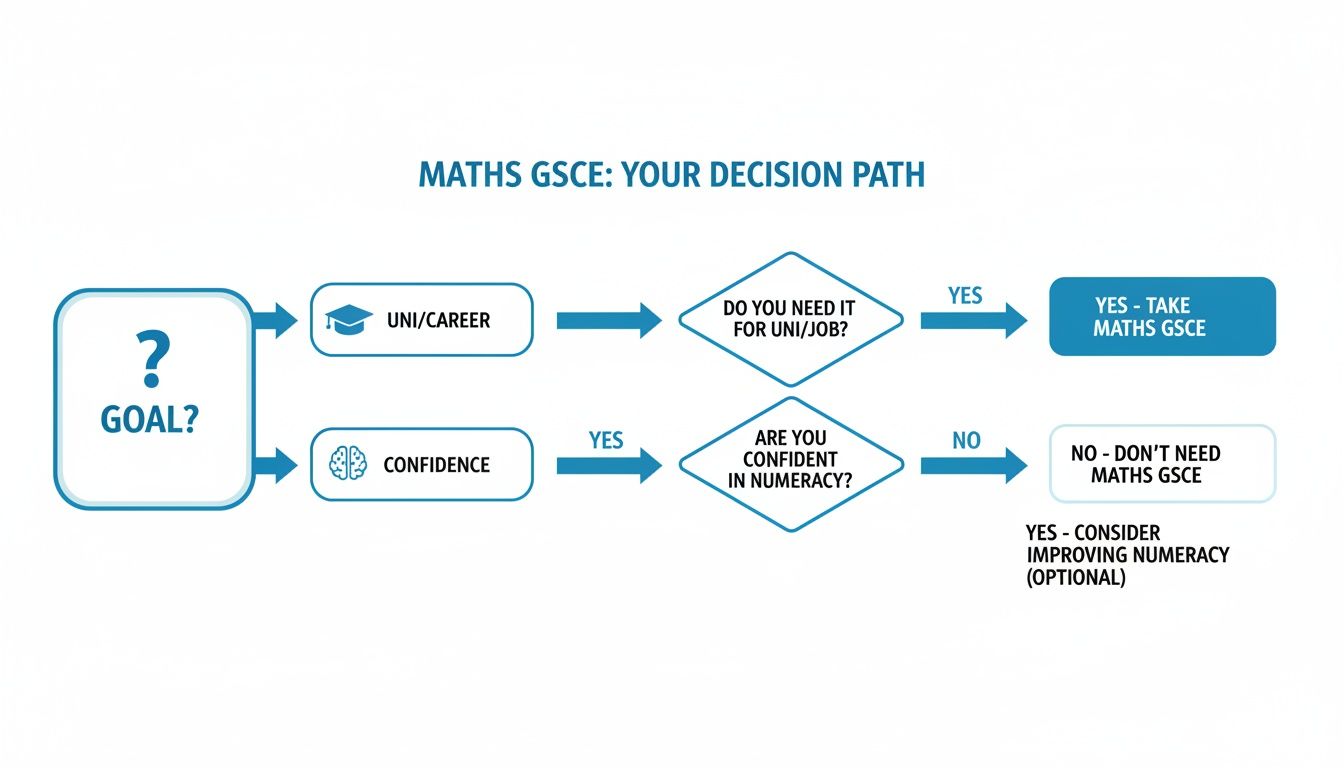
As the flowchart shows, what you need the qualification for—whether it’s a specific university course or just to open more doors in your career—is the single biggest factor in your decision.
Traditional College Resits
Going to a local further education college is a popular choice for many adults. Courses are often part-time, usually just one evening a week, so they’re designed to slot around a typical working day.
The classroom gives you structure and a tutor you can talk to face-to-face. If you thrive on that kind of interaction and enjoy learning alongside other people, this is a fantastic option. Many adults find the shared experience really motivating.
Of course, a fixed schedule isn’t for everyone. Official figures show a massive jump in adults taking a maths GCSE, with a staggering 206,732 entries from learners aged 17 and over in just one summer. But success isn't guaranteed, and interestingly, older adults (20+) have a grade 4 pass rate more than double that of the 17-19 age group.
Flexible Online GCSE Courses
If a rigid college timetable just won’t work, online GCSE courses offer total flexibility. You can study from anywhere, at any time—whether that’s late at night when the house is quiet or on your lunch break at work.
This route is perfect for self-starters who need to fit learning around a busy life. You get all the course materials you need, online support from tutors, and the freedom to go at your own pace. The main thing to remember is that you'll need to sort out your own exams as a 'private candidate' at an approved centre.
Functional Skills Level 2: An Accepted Equivalent
Let’s be honest, not everyone needs a full GCSE. For many jobs and even a lot of university courses, a Functional Skills Level 2 in Maths is a widely accepted—and often much quicker—alternative.
This qualification cuts to the chase, focusing on the practical, real-world maths skills you actually use day-to-day. The courses are usually shorter, and the content feels far more relevant to adult life. Better yet, the assessment is often a single exam you can take online from home, which takes a lot of the stress out of the process. If your main goal is to tick a box for an entry requirement quickly, this is an excellent route to explore. You can find out more in our detailed guide on Functional Skills Level 2 Maths.
GCSE Equivalency Tests
In some very specific cases, like getting into teacher training (a PGCE course), you might be asked for a GCSE Equivalency Test. These aren’t qualifications in their own right. Instead, they’re designed purely to prove to a particular university that your maths knowledge is up to the required GCSE standard.
Think of it as a focused, intensive test rather than a full course. This makes it a fast-track option if you’re already pretty confident with the maths syllabus and just need to prove it to meet a deadline. Always, always check with your chosen university first to make sure they accept the specific test you plan to take.
Comparing Adult Maths Qualification Routes
With several paths available, it can be tricky to see the wood for the trees. This table breaks down the key features of each route to help you see which one might be the best fit for your life and your goals.
| Qualification | Best For | Typical Cost | Study Format | Assessment |
|---|---|---|---|---|
| GCSE Resit (College) | Adults who prefer structured, in-person learning and peer support. | Often free if you don't have a grade 4/C. | Part-time evening or day classes. | Two or three final exams in person. |
| GCSE (Online Course) | Self-starters needing maximum flexibility to study around work and family. | £300-£500 + exam fees. | Self-paced online learning with tutor support. | Final exams taken as a private candidate. |
| Functional Skills L2 | Learners needing a practical, faster alternative for university or career. | Varies; can be funded. Often cheaper than GCSE. | Flexible online or blended learning. | A single, often online, on-demand exam. |
| Equivalency Test | Aspiring teachers who need to meet a specific entry requirement quickly. | £150-£300 per attempt. | Self-study or short preparation course. | A single, intensive test. |
Ultimately, the best choice depends entirely on your lifestyle, your end goal, and how you prefer to learn. Whether you need the discipline of a set schedule or the complete freedom of online study, there’s a route that will get you the qualification you need.
Creating a Study Plan That Actually Works
Let's be honest, life is busy. When you're juggling work, kids, and everything else, adding a GCSE to the mix can feel impossible. But here’s the secret: the biggest challenge for adult learners isn't the maths itself. It's finding the time and sticking to a plan without burning out.
So, forget those long, draining revision sessions. To succeed with a maths GCSE for adults, you need a smart, realistic plan that weaves studying into the life you already have.
It's all about ditching the "all or nothing" approach. Instead of blocking out a whole Sunday afternoon, start looking for the hidden pockets of time in your week. That twenty-minute commute? Perfect for running through formulas on a flashcard app. Waiting for the kettle to boil? That's enough time to watch a two-minute explainer video on a tricky topic.
Find Your Hidden Study Time
First things first, you need to know what you’re working with. Take a moment to audit a typical week. Be ruthless and honest about where your time actually goes, from the moment your alarm rings to when you finally go to bed.
You’ll almost certainly find small but consistent gaps that are perfect for short, sharp bursts of learning. This method is far more effective for long-term memory than trying to cram everything in at once.
- Your Commute: Stick a podcast on or work through a few problems on your phone.
- Lunch Breaks: Can you spare 15-20 minutes at your desk with a textbook before you eat?
- While Doing Chores: Pop a maths tutorial on in the background while you’re cooking or cleaning.
- Dead Time: That half-hour you lose scrolling social media before bed? It could easily become your most productive study slot.
This bite-sized approach, sometimes called micro-learning, makes the syllabus feel manageable. It turns a massive goal into small, achievable steps, helping you avoid the overwhelm that stops so many adult learners in their tracks. For a deeper dive, check out our guide on creating a study schedule that actually works.
Build a Weekly Schedule You Can Stick To
Once you've found those pockets of time, you can start building a routine. The goal here is consistency, not intensity. Aim for 30-45 minutes of focused study four or five times a week, rather than one huge, painful session.
Here’s what that might look like for someone working a 9-to-5 with family commitments:
| Day | Study Slot 1 (30 mins) | Study Slot 2 (15 mins) |
|---|---|---|
| Monday | Algebra practice on the train to work | Review notes during lunch break |
| Tuesday | Watch a Corbettmaths video on ratios | Rest Day |
| Wednesday | Complete a BBC Bitesize quiz | Practice questions on commute home |
| Thursday | Topic revision with a study group | Rest Day |
| Friday | Past paper questions at lunchtime | Quick formula review before bed |
| Saturday | 1 hour dedicated to a new topic | Rest Day |
| Sunday | Review the week's learning | Plan for the week ahead |
Notice this plan has built-in rest days and keeps the sessions short. Consistency is what really matters. While 71.9% of 16-year-olds get a grade 4 or above in maths, the pass rate for learners aged 17 and over is just 17.1%. This isn't because adults can't do it; it's because they need a different, more structured approach that fits around their lives.
Your Go-To Free Resources
You really don't need fancy, expensive software to get started. Some of the very best resources for the maths GCSE syllabus are completely free and give you a brilliant structure to follow.
Pro Tip: Don't just watch videos passively. Get involved! Take notes, pause the video to try examples yourself, and test what you’ve just learned straight away.
Here are two absolute must-haves for your study toolkit:
- BBC Bitesize: This is the gold standard. It breaks the entire syllabus down into clear topics with simple explanations, short videos, and mini-tests to check you've got it.
- Corbettmaths: An incredible library of thousands of free videos, practice questions (with answers!), and brilliant "5-a-day" worksheets for daily practice.
Using a structured resource like BBC Bitesize means you can work through the curriculum methodically, one topic at a time, without being intimidated by a massive textbook. A good plan is one you can actually follow, so start small, build that momentum, and be proud of your consistency.
Funding Your Studies and Finding Support
Let's be honest, one of the first things that comes to mind when you think about returning to education is the cost. It’s a huge worry for most adults. But the good news is, when it comes to getting a maths GCSE for adults, those financial hurdles often aren't as high as you might imagine.
We’ll break down how the funding works and, just as importantly, where you can find the support network you'll need to see this through. For many people, this journey could even be completely free.
Government Funding for GCSE Maths
Here in England, the government is keen to help adults get their core qualifications sorted. This means that if you're aged 19 or over and don't already have a GCSE in maths at grade 4 (what used to be a grade C) or higher, you can usually take the course for free at a local further education college.
This funding is a real game-changer, making a traditional classroom course incredibly accessible. It generally covers all your tuition fees, so the only things you might have to pay for are small items like a textbook or a specific calculator.
So, how do you get it?
- First, find a local college offering adult GCSE courses.
- Then, get in touch with their admissions team to chat about your eligibility for the funding.
- You'll likely need to provide some evidence of your previous qualifications (or show that you don't have them).
What If You Don't Qualify for a Free Course?
Okay, so what if you already have a grade 4 but want a better one? Or maybe you just prefer the flexibility of an online provider that fits around your life? In these cases, you probably won't be eligible for that government funding. But that absolutely doesn't mean you’re out of options.
Plenty of adults in this situation choose to self-fund their studies. Yes, it’s an investment, but it also gives you total control over when and how you learn. Another path to explore is getting your employer on board.
Why not build a clear case for your manager? Explain exactly how you getting a maths GCSE will directly help the company – maybe through better skills, improved efficiency, or by allowing you to take on more complex responsibilities. Lots of employers have training budgets set aside for this exact kind of professional development.
Beyond the course fees themselves, it’s worth looking into wider financial help. Our guide on student finance for mature students has much more detail on other types of support that might be available as you move forward.
Building Your Personal Support System
Money is one thing, but the right people in your corner can make all the difference. Success as an adult learner often comes down to your support network. Juggling studies with work, family, and everything else is tough, and you’ll need a solid crew to keep you going.
Start by having an open conversation with your family and friends. Let them know what you’re taking on. Explain how they can help, whether that’s by giving you a quiet hour to study or just by being a friendly ear when you're feeling stuck on a topic.
Here are a few practical steps to build out that network:
- Find a Tutor: If certain topics are really tripping you up, a private tutor can be a lifesaver. Even just a handful of sessions can do wonders for your confidence and help things finally click into place.
- Join an Online Study Group: Have a look for Facebook groups or forums for adults studying for their maths GCSE. Sharing tips, asking questions, and celebrating the small wins with people who get it is incredibly motivating.
- Talk to Your Course Provider: Whether you're at a college or studying online, your tutors are there to help you. Never be afraid to reach out when you need a bit of guidance or something isn't clear.
Returning to study is a big step, but it’s an achievable and rewarding one. With the right financial plan and personal support in place, you’ve got this. You don't have to do it alone.
How to Register and Sit the Exam
If you're studying online or on your own, the idea of the actual exam day can feel a bit abstract and confusing. Unlike being at a college where everything is handled for you, you’ll need to sort out the logistics yourself. It might sound like a lot, but it's a pretty straightforward process once you know what to do.
Think of this as your practical checklist for a smooth exam experience. We’ll cover everything from finding a place to sit the exam to what you’ll need on the day, making sure there are no last-minute panics.
You're a "Private Candidate" – What Does That Mean?
When you study for a maths GCSE for adults outside of a traditional school, you become what’s known as a private candidate. All this really means is that you're responsible for finding an approved exam centre and booking your exam slot.
The centre’s role is purely administrative. They're not there to teach you; they just provide the secure exam papers, the hall, and the invigilators. You're essentially just hiring them to let you sit the exam under official conditions.
How to Find an Approved Exam Centre
First things first: you need to find a school or college that actually accepts private candidates. Not all of them do, and those that do often have limited spots, so it's vital to start your search early. The main exam boards in the UK have tools on their websites to make this much easier.
Your online course should tell you which exam board they follow (like AQA, Edexcel, or OCR). Once you know that, you can use their dedicated search function:
- AQA: Has a specific search tool for private candidates on their website.
- Pearson Edexcel: Offers a similar lookup feature to find approved venues.
- OCR: Also provides a directory of centres you can filter by qualification.
Pro Tip: Don't just rely on the online lists. Pick up the phone and have a chat with the exams officer at the centres you find. A quick conversation can often get you clearer information and help secure your place much faster.
Contacting Centres and Booking Your Place
With a shortlist of potential centres, it's time to get in touch. When you contact them, be really clear that you’re looking to register as a private candidate for the GCSE Mathematics exam. Make sure you specify the exam board and the tier you’re taking (Foundation or Higher).
You'll probably be asked for a few key things:
- Proof of Identity: A copy of your passport or driving licence will do the trick.
- Unique Candidate Identifier (UCI): If you've sat any UK public exams in the last few years, you’ll already have one. If not, don't worry – the centre will sort one out for you.
- Exam Entry Codes: These are specific codes for the papers you'll be sitting. Your course provider should give you these, but you can also find them on the exam board's website.
Be prepared for the cost. As a private candidate, you’ll have to pay the centre’s administration fee on top of the exam board's entry fees. All in, this can range from £150 to over £250, depending on the centre.
Critical Deadlines You Absolutely Cannot Miss
This is the most important part of the whole process: the registration deadlines. They are set nationally by the exam boards and are completely non-negotiable. If you miss them, you simply won't be able to sit your exams that year.
The main entry deadline for summer exams is typically around mid-February. However, many centres set their own internal deadline a few weeks earlier to get their own admin sorted, so it really pays to be organised. The best approach is to start contacting centres in the autumn of the year before your exam.
Getting Ready for the Big Day
Once your registration is confirmed, you can put all your focus back on your studies. As exam day gets closer, make sure you have everything you need to feel prepared and confident.
Your Essential Equipment Checklist:
- A Scientific Calculator: This is non-negotiable. Check the exam board’s list of approved models, but most standard scientific calculators like the Casio fx-83GTX or fx-85GTX are perfect.
- Black Pens: Bring a spare. And then another spare, just in case. All your answers must be in black ink.
- Pencils, a Ruler, a Protractor, and a Pair of Compasses: These are essential for any questions involving diagrams, graphs, or geometric drawings.
- Photo ID: The exam centre needs to verify who you are, so bring your passport or driving licence with you.
Finally, a bit of last-minute prep can do wonders for your nerves. The evening before, pack your bag and put it by the door. Plan your journey to the exam centre and allow loads of extra time for any unexpected delays. Getting there calm and collected is half the battle won.
Your Questions Answered
Deciding to go back and get your maths GCSE as an adult is a big step, and it’s completely natural to have a few questions swirling around. It's a real commitment, after all, and you want to be sure you're heading in the right direction. Let's tackle some of the most common queries we hear from people just like you.
How Long Does It Take to Get a Maths GCSE as an Adult?
This is the big one, isn't it? The honest answer is: it depends entirely on the route you choose.
If you go down the traditional path of an evening class at a local college, you’re usually looking at one academic year. That means starting in September and sitting your exams the following May or June.
Online courses, on the other hand, offer a whole lot more flexibility. Most are built to be completed in around nine months to a year, but you're in the driver's seat. If you're feeling motivated and can carve out the study time, you could find yourself ready for the exams much sooner. But if life throws you a curveball, you have the breathing room to slow things down without the pressure.
Is the Maths GCSE Syllabus Different for Adults?
Nope, not at all. The curriculum is exactly the same for everyone, no matter their age. You'll be tackling the same topics and sitting the very same exam papers as the 16-year-olds in every secondary school up and down the country.
What is different is the way it's taught. Tutors who work with adults are fantastic at making the content click for learners who've been out of the classroom for a while. They get that you're not a teenager anymore and can help connect the dots in a way that feels supportive and relevant to your life now.
Key Takeaway: The content itself is standard, but the learning environment for adults is often far more focused and encouraging than what you might remember from school. Being in a group of other adults on the same mission can be a huge motivator.
Can I Still Take the Exam if I Failed Before?
Absolutely, one hundred percent. There’s no limit on how many times you can resit your GCSE Maths. Plenty of successful adult learners didn't get the grade they wanted at school, and that experience has zero bearing on what you can achieve now.
In fact, coming back to study as an adult often gives you a real advantage. You have clearer goals, more life experience under your belt, and a much stronger reason to succeed. The trick is simply finding a study method that clicks with you this time around.
What Happens if I Have Special Educational Needs?
If you have a diagnosed condition like dyslexia or dyscalculia, you can apply for what are called access arrangements for your exams. This is all about levelling the playing field and making sure you’re not at an unfair disadvantage.
These arrangements can include things like:
- Extra Time: This is typically an additional 25% on top of the standard exam duration.
- A Reader: Someone can be provided to read the questions out loud to you.
- A Scribe: If writing is a challenge, someone can write down your answers for you as you say them.
To get these sorted, you'll need an up-to-date assessment from a qualified professional. The best thing to do is speak to your course provider or the exams officer at your chosen exam centre as early as you possibly can to get the ball rolling. For more detailed answers, many educational platforms also have a frequently asked questions (FAQ) section that can provide extra clarity.
At Access Courses Online, we specialise in helping adults get the qualifications they need to progress to university and achieve their career goals. Our flexible, accredited online courses are designed to fit around your life, with dedicated tutor support every step of the way. Find out how we can help you start your journey today.