

Deciding to go back and get your GCSE Maths as an adult is one of the smartest moves you can make for your career and future goals. Forget what you remember about school – modern courses are built for people like you, with busy lives and big ambitions. It’s more achievable than ever to get that all-important qualification and start opening some serious doors.
Is It Really Worth Retaking GCSE Maths?
The thought of tackling maths again can bring anyone out in a cold sweat, especially if school wasn't your favourite place. But things are completely different now. Getting your GCSE Maths qualification today isn’t about sitting in a stuffy classroom; it’s about finding a flexible path that fits around your life.
Whether you need it to climb the ladder at work, get into university, or just to prove to yourself you can do it, the rewards are huge. This single qualification is a non-negotiable requirement for thousands of careers and almost all higher education courses.
Your Pathways to GCSE Maths Success
It can feel a bit confusing trying to figure out the best way forward. To make it simple, we've broken down the main options available for adults. Each one is designed for different learning styles, schedules, and end goals. Have a quick look at the summary below to see which route might be the best fit before we dive into the details of each.
| Pathway | Best For | Typical Duration |
|---|---|---|
| Local College | Structured learning, face-to-face support, and a set timetable. | 9-10 months |
| Online Course | Maximum flexibility, self-paced study around work and family. | 3-12 months |
| Functional Skills | Practical, real-world maths skills; a direct GCSE equivalent. | 2-6 months |
| Equivalency Test | Fast-track qualification for university entry if you're confident. | 1-2 months' revision |
This table gives you a clear snapshot, but remember the best choice is the one that works for you. Think about how you learn best and what your timeline looks like.
The Advantage of Being an Adult Learner
There's a common myth that going back to study later in life is much harder. The reality? Adult learners often have a massive advantage: you’re more mature, more focused, and you have real-world reasons motivating you. You’re not just studying because you have to; you’re making a deliberate investment in your own future.
Many adults who return to education find they do better the second time around. They can approach it with a fresh, mature perspective, completely free from the social pressures of secondary school.
The numbers back this up, too. Over 206,000 learners aged 17 or older sat their GCSE maths exam in England. While the overall pass rate was 17.1%, the results for older learners tell a powerful story. Learners aged 20 and above achieved a pass rate of 34% – more than double that of their younger peers. This proves that older, more determined learners often find incredible success. You can discover more insights about these pass rates and what they mean for your journey.
Finding a Learning Path That Fits Your Life
Deciding to tackle GCSE Maths as an adult is a brilliant move. The next, and equally important, step is figuring out how you're going to learn. There's no single "best" way to do it; the right path is simply the one that slots into your life, around your job, family, and everything else you have going on.
It’s a path more and more adults are taking. You're not alone in this. Recent figures show that GCSE entries in English and maths from post-16 students shot up by 16% in just one year, from around 299,000 to 346,000. It just goes to show how many people are returning to education to open up new doors. You can see the full breakdown on the FFT Education Datalab website.
Local Colleges and Adult Learning Centres
For a lot of people, the idea of a proper classroom is reassuring. Local further education (FE) colleges and adult learning centres are set up for this, offering scheduled classes—often in the evenings—that are specifically designed for people returning to study.
The big win here is having a tutor right there in front of you and learning alongside others who get it. That sense of shared experience can be a huge motivator. The flip side, of course, is that you have to commit to being in a certain place at a certain time every week. That can be a real juggle if you work shifts or have unpredictable family commitments.
The Flexibility of Online Courses
If your schedule is already bursting at the seams, an online course could be a game-changer. This route gives you complete control. You can study whenever and wherever you like – on your lunch break, after the kids are asleep, or during a quiet Sunday morning.
This self-paced approach is perfect if you're good at managing your own time and staying motivated. The best online providers give you a proper structure with modules, video tutorials, and access to tutors via email or messaging, so you're never left completely on your own. We've got a great guide on how online learning fits into your busy lifestyle that digs into this a bit more.
Choosing your path really comes down to being honest with yourself. Do you need the structure and social side of a classroom, or do you crave the freedom to squeeze learning into the gaps in your day?
Functional Skills as a Practical Alternative
It's also worth knowing about Functional Skills Level 2 Maths. This qualification is widely accepted by employers and universities as being equivalent to a GCSE grade 4 (what used to be a C).
The main difference is its focus. Functional Skills is all about practical, real-world maths you can actually use, rather than more abstract concepts. If your main goal is to tick a box for a job or another course, and you prefer maths that feels relevant to daily life, this could be an excellent fit.
This little decision tree might help you see which route lines up best with what you're trying to achieve.
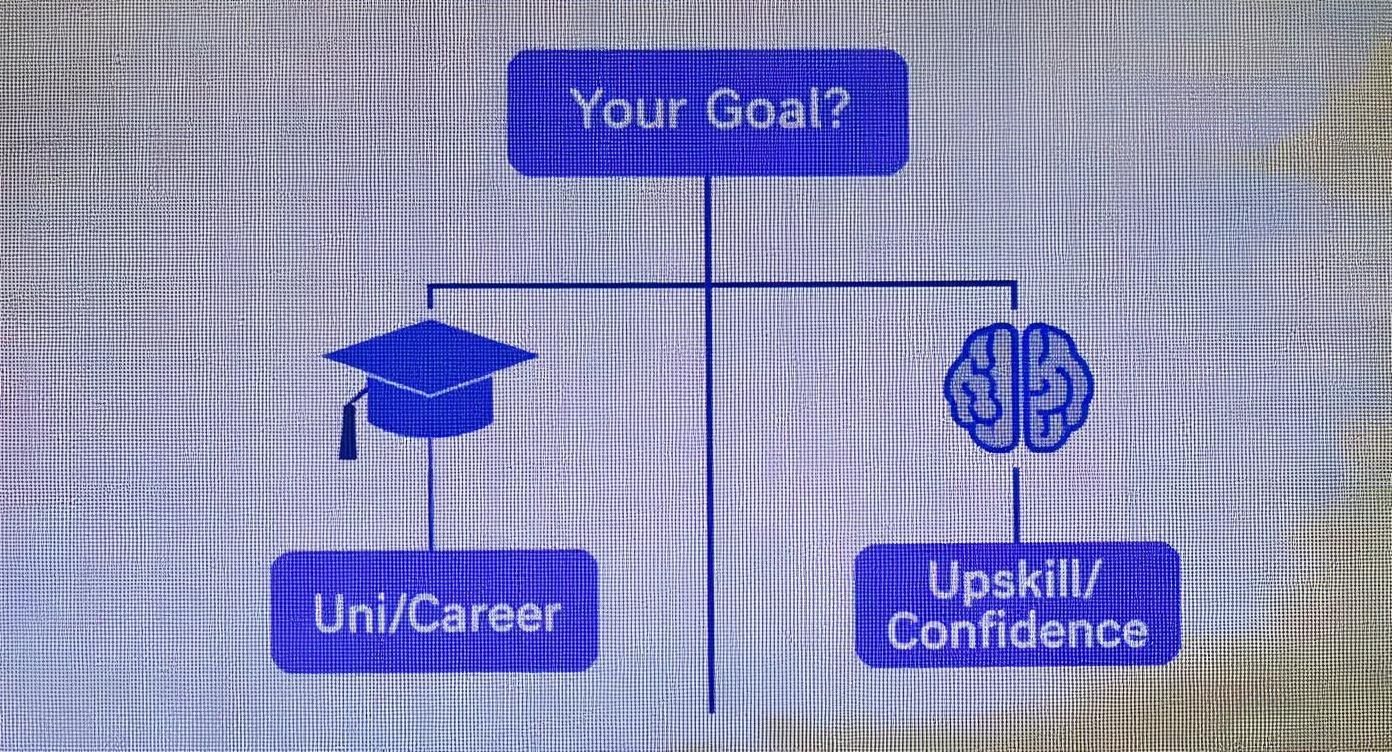
By starting with your "why"—whether it's for your career or just for yourself—you can make a much more confident decision about the "how." It really helps to simplify the choice and point you in the right direction from the very beginning.
How to Get Your GCSE Maths Course Funded
Thinking about the cost of a course shouldn't be what holds you back from achieving your goals. For adults in the UK looking to get their GCSE in Maths, there's a surprising amount of financial support out there—meaning you might not have to pay a single penny for your tuition.
The big one you need to know about is the government's free course offer. If you're 19 or over and don't already have a GCSE in Maths at grade 4 (or the old grade C), it's very likely you can get your course fees completely covered. This scheme was set up specifically to help adults get the qualifications they need for work or to move on to higher education.
Checking if You Can Get a Free Course
Figuring out if you're eligible for a free GCSE Maths course is usually pretty straightforward. It all comes down to your age and what qualifications you already have.
The college or provider you choose will actually handle the funding application for you, so your first step is simply to ask them about it when you enquire or enrol. They'll walk you through a quick check to confirm you meet the criteria. It helps to have any previous certificates on hand, but don't panic if you can't find them—providers can often look up your records.
Before you sign up for any course, make it a point to ask this question first: "Am I eligible for government funding?" It's the one thing that could save you from missing out on the chance to study for free.
And it's worth knowing that even though there was a small dip in the number of adults taking these courses recently, the pass rates are actually getting better. While 210,710 adults enrolled in maths courses last year, the overall number of people achieving qualifications has gone up. It shows that the people who do sign up are succeeding. You can read the full government skills report if you want to dig into the details.
What if You Don't Qualify?
Okay, so what happens if you aren't eligible for the free course? Maybe you already have a grade 4, or you're studying a different type of qualification. Don't worry, you still have solid options.
An Advanced Learner Loan is a government-backed loan designed to help with course fees at colleges and training providers in England.
As the official page shows, this loan helps learners aged 19 and over pay for approved courses from Level 3 up to Level 6. The best part? You only start repaying it once you’ve finished your course and are earning over a certain amount, which makes it a much more manageable route. For a more detailed look at this, our guide on student finance for mature students breaks down everything you need to know about managing your finances while you study.
Don't Forget the Hidden Costs
Even when your tuition is completely covered, it's really important to ask about any other potential expenses. These are the little things that can sometimes catch people by surprise.
Before you commit, get a clear answer from your provider on these points:
- Exam Fees: Are these included in the funding, or is that a separate cost you'll need to cover?
- Textbooks and Materials: Will you need to buy specific books or pay for access to online resources?
- Essential Equipment: Does the course require a particular model of scientific calculator?
Getting a full picture of the total cost right from the start means you can budget properly and focus on what really matters—acing your studies.
Building a Study Plan That Actually Works
The secret to passing GCSE Maths as an adult isn’t about stressful, last-minute cramming. It’s about building a study plan you can actually stick with. When you're juggling work, family, and everything else life throws at you, consistency is far more powerful than intensity.
Forget trying to find four spare hours for a marathon session at the weekend. The most effective approach is 'little and often'. Aiming for just 30 focused minutes a day is much more achievable and keeps the information fresh in your mind. This method builds momentum and prevents that dreaded burnout.
Identify Your Golden Hours
We all have a time of day when our brains are switched on. Are you a morning person who could get up 30 minutes earlier, or do you get a second wind in the evening after the kids are in bed? These are your 'golden hours'.
Scheduling your study time during these peak periods of concentration makes a huge difference. Trying to force yourself to study when you’re exhausted is a recipe for frustration and painfully slow progress. Be honest with yourself about your energy levels and plan your maths sessions around them.
As you start mapping out your week, it can be helpful to look at some effective time management and productivity tips to make the most of the limited time you have.
Break the Syllabus into Manageable Chunks
Looking at the entire GCSE Maths syllabus at once can feel overwhelming, to say the least. The trick is to break it all down into small, manageable topics. Don't just write "study maths" in your diary – get specific.
There are some fantastic free resources out there to help you structure your learning. BBC Bitesize is one of the best, organising the whole curriculum into clear topics with simple explanations and practice questions.
This lets you focus on one specific skill at a time. For example, you could tackle "solving linear equations" on Monday and "calculating the area of a circle" on Wednesday. This approach makes your progress feel real and builds your confidence piece by piece. For a deeper dive, our guide on creating a study schedule that actually works has even more strategies to help.
Create a Flexible Weekly Template
A study plan needs to be a guide, not a prison. Life happens, so your template needs to have flexibility built in from the start. A simple grid can help you visualise your week and slot in study sessions where they genuinely fit.
Here’s a sample weekly timetable to give you an idea.
Sample Weekly Study Timetable
| Time Slot | Monday | Tuesday | Wednesday | Thursday | Friday | Weekend |
|---|---|---|---|---|---|---|
| Morning | Review Notes | Past Paper | ||||
| Lunch | Practice Qs | Practice Qs | ||||
| Evening | Algebra | Off | Geometry | Off | Off | Review |
This is just a starting point – adapt it to your own life and commitments.
Remember, the goal is consistency, not perfection. If you miss a session, don't let it derail your entire week. Just pick up where you left off the next day. A good plan always allows for life's little interruptions.
Finally, make sure to schedule breaks and proper time off. Your brain needs time to rest and process what you’ve learned. A balanced plan that includes downtime is a plan you’re much more likely to follow all the way to exam day.
Mastering Exam Day and Planning Your Next Move

As you get closer to finishing your studies, your attention will naturally turn to the final hurdle: the exam itself. But smart preparation is about more than just knowing your algebra from your geometry; it’s about getting the logistics sorted and building the confidence to perform at your best when it really matters.
If you're studying independently with an online course, one of the most important things you'll need to do is register as a private candidate. This just means you need to find an approved exam centre that will let you sit the official GCSE papers. It's a good idea to book your place several months ahead of time, as spots for private candidates can fill up surprisingly fast.
Getting Ready for the Big Day
I can't stress this enough: consistent practice with timed past papers is the single best way to prepare. This approach is brilliant because it does two things at once—it gets you completely comfortable with the exam format and question styles, and it trains you to manage your time effectively under pressure.
Treat every practice paper like it's the real deal. Find a quiet space, set a timer, and work through it without any distractions. Going through these motions helps massively with exam day nerves because the whole experience starts to feel familiar and routine.
Remember, the point of practice isn't just about getting every question right. It's about spotting your weaker areas so you can focus your final revision on where it'll make the biggest difference.
When the day finally arrives, be prepared. Get all your equipment ready the night before. You'll need a clear pencil case with black pens, pencils, a ruler, a protractor, a pair of compasses, and—most importantly—the scientific calculator you've been using all along.
Turning Your Qualification into Opportunity
Once the exam is done and you have your results, the real excitement can begin. That new grade on your CV is a key that can unlock so many doors for your future. This is the time to start actively planning what's next and putting your hard-earned qualification to good use.
For a lot of people, the next step is higher education. A grade 4 or above in GCSE Maths for adults is a standard entry requirement for most UK universities. It's also essential for getting a place on an Access to Higher Education Diploma course, which is a fantastic route to a degree.
The screenshot below from the National Careers Service shows just one of the tools available to help you explore different career paths and see which qualifications you need.
This resource is brilliant for connecting your new qualification to specific jobs and understanding the different routes you can take. It closes the gap between your academic achievement and your professional ambitions, showing you exactly how your hard work can lead to a more fulfilling and rewarding career. This is your chance to move forward with real confidence.
Answering Your Top Questions About Adult GCSE Maths
Thinking about heading back to the classroom (even a virtual one!) can bring up a lot of questions. That’s completely normal. Deciding to get your GCSE Maths as an adult is a big move, and you want to be sure you have all the facts before you jump in.
Let's walk through some of the most common questions we get from learners just like you, so you can feel confident about your next steps.
How Long Does It Take to Get a GCSE in Maths as an Adult?
This really comes down to which route you take. If you sign up for a traditional evening class at a local college, you'll likely follow the school year, starting in September and taking your exams in June. It's a tried and tested method.
But the game has changed a lot in recent years. Online courses now give you complete control. You set the pace, which means if you have the time and drive, you could be ready for your exam much quicker. Some ‘fast-track’ courses are even designed to get you exam-ready in just a few months – perfect if you're working towards a deadline for a university application.
Is Functional Skills Level 2 Really the Same as a GCSE?
Yes, for almost all intents and purposes, it is. A Functional Skills Level 2 in Maths is widely accepted as equivalent to a GCSE grade 4 (what used to be a grade C). Universities, employers, and apprenticeship schemes all recognise it.
The real difference isn't in its value, but in what you learn. Functional Skills is all about practical, real-world maths – the kind you actually use day-to-day. A lot of adults find this approach much more engaging and less daunting than the more abstract, theory-heavy GCSE syllabus.
Can I Still Pass If I Have Severe Maths Anxiety?
Absolutely, and you wouldn't be the first. Maths anxiety is incredibly common, and it usually goes back to a bad experience at school. The brilliant thing is, adult education is a whole different world.
Tutors who work with adults are experts at creating a supportive atmosphere where you can build your confidence step-by-step. It’s not about being rushed or feeling foolish. It's about understanding why things work, not just memorising formulas. Many people find they finally 'get' maths as an adult because they can approach it with a fresh perspective, free from the old classroom pressures.
Can I Take the Official GCSE Maths Exam Online?
This is a really important detail to get right. While you can do 100% of your learning online, the official GCSE exam itself has to be sat in person. It's a formal, invigilated exam that takes place at a registered exam centre.
Don't worry, though – your online course provider will walk you through the whole process. They'll have a list of approved centres and will help you find and book a place near you. The key is to get this sorted out well in advance. Spots for private candidates can fill up fast, especially around the main exam season in May and June.
Ready to take the next step towards university without the stress of traditional exams? Access Courses Online provides accredited Access to HE Diplomas that are fully online and designed to fit around your life. Find out how you can start your journey today at https://accesscoursesonline.com.