
Becoming a business analyst means being the person who translates business needs into technical solutions. You're the crucial link between the big-picture thinkers and the tech teams who build the future. It’s a career built on problem-solving, sharp communication, and analytical thinking, giving you a direct say in how a company grows and innovates. The journey starts with understanding what the role is really about and then building the right skills.
What Does a Business Analyst Actually Do?

Before we jump into the "how," it's vital to get a real feel for the day-to-day. Forget the vague corporate job titles for a moment. A business analyst (BA) is a problem-solver, a communicator, and a strategic thinker all rolled into one. Think of them as the essential bridge between a company's ambitious ideas and the technical teams that make them a reality.
Let’s say a high-street retailer wants to launch a new loyalty app to keep customers coming back. A BA gets involved right from the start. Their job isn't to code the app, but to figure out exactly what it needs to do to be a success.
The Analyst as an Investigator
The first phase is all about investigation. The BA will run workshops and sit down for one-on-one chats with everyone involved—from the marketing execs who want to run promotions to the finance team worried about transaction security. They're there to ask the critical questions:
- What’s the main business goal here?
- Who are we building this for, and what do they really want?
- Which specific features are going to deliver the most value?
- How will we know if the app is actually working?
This whole process is called requirements elicitation. It's about uncovering the real needs, not just what people say they want. It means digging deeper to find the root of a business problem and identifying the best way forward.
Translating Vision into Action
Once those needs are crystal clear, the BA's job is to translate them into actionable requirements for the development team. This isn't just a quick email; it involves creating detailed documents like user stories ("As a customer, I want to see my loyalty points so I can track my rewards") and process flow diagrams that map out every single click and interaction.
This translation step is absolutely crucial. Without a BA, developers might build a technically brilliant app that completely misses the point of what the business or its customers actually needed. BAs prevent costly mistakes and make sure the final product delivers genuine business value.
A great business analyst doesn’t just gather requirements; they challenge them. They ensure that every feature built is tied directly to a strategic business objective, preventing project bloat and focusing resources where they matter most.
A Rewarding and In-Demand Career
The tangible impact a BA has on business success is why the role is not only fulfilling but also financially rewarding. The demand for skilled analysts is consistently high right across the UK. In fact, the median annual salary for a business analyst was £55,000 as of early 2026. There are also strong opportunities outside of London, where the median is still a very competitive £50,000. You can explore the latest salary trends on IT Jobs Watch to see how the market is performing.
This blend of meaningful work and strong career prospects makes it an excellent choice, particularly if you're looking for a new direction. If you're still exploring your options, our guide on how to find the career that’s right for you can offer some extra perspective.
Building Your Foundational BA Skillset
Becoming a great business analyst isn't about having a specific degree or ticking boxes on a job application. It's really about developing a particular way of thinking and a practical set of skills. The best part? You probably have a lot of these abilities already from your past experiences.
The trick is learning to spot them, sharpen them up, and apply them in a business analysis context. This isn't about memorising fancy jargon; it’s about building a solid, practical toolkit that will help you succeed. Let's break down the core skills into three main areas that all work together.
Analytical and Critical Thinking Skills
At its heart, business analysis is all about digging into problems and figuring out the best way to solve them. This demands a sharp, analytical mind and a natural curiosity. You need to be the person who is always asking "why?" to get to the real root of an issue, not just the surface-level symptoms.
Imagine a scenario where the marketing team is pushing for a flashy new website feature, but the IT team insists it's impossible with the current system. This is where a BA shines. Using critical thinking, you'd investigate both sides, find the core business goal, and work to find a middle ground—a solution that delivers real value without causing a technical meltdown.
If you feel this is an area you want to strengthen, our guide on how to develop critical thinking skills is packed with practical exercises you can start using straight away.
Communication and Stakeholder Management
You could come up with the most brilliant, game-changing solution in the world, but if you can’t get other people to understand and support it, it’s completely worthless. Effective communication is so much more than just being a good talker or writer.
It’s a mix of different practices:
- Active Listening: This means truly hearing what people are saying, and just as importantly, what they're not saying. You have to pick up on their underlying concerns and assumptions.
- Facilitation: Your job is to lead meetings and workshops that are actually productive. You need to guide conversations, encourage everyone to contribute, and steer the group towards a clear outcome.
- Clear Documentation: You’ll be translating complex business needs into clear, simple requirements that a development team can understand and build from. Getting good at this is non-negotiable, and looking at examples of user stories with acceptance criteria is a great way to learn.
Managing stakeholders is all about building trust and strong relationships. You'll be the bridge between senior executives and junior developers, and you need to know how to adjust your language for each audience, making sure everyone feels heard and is on the same page.
A great analyst is a master translator. They can chat about high-level business strategy with the CEO in the morning and then dive into technical details with the software team in the afternoon, ensuring nothing gets lost in translation.
Technical and Business Acumen
While nobody expects you to be a pro coder, having a decent grasp of some technical concepts will give you a huge advantage. Understanding the basics of how software is made, what a database does, or how APIs connect different systems will help you earn respect from the technical folks and propose solutions that are actually realistic.
The flip side of this is business acumen—basically, understanding how a company works and makes money. You need to get your head around concepts like profit margins, operational costs, and what customers truly value. This commercial awareness ensures that the solutions you propose don't just fix a small problem but actually add real value to the business's bottom line.
To help you focus your efforts, here’s a breakdown of the core skills every aspiring business analyst should have in their toolkit.
Core Skills for Aspiring Business Analysts
| Skill Category | Core Skill | Why It Matters for a BA |
|---|---|---|
| Technical Skills | Process Modelling (e.g., using BPMN) | It helps you visually map out how a business works, making it easy to spot bottlenecks and find areas for improvement. |
| Technical Skills | Data Visualisation (e.g., using Power BI) | You can turn mountains of confusing data into simple charts and graphs that help leaders make smarter, faster decisions. |
| Business Skills | Requirements Elicitation | This is the art of drawing out the real needs from stakeholders through interviews, workshops, and observation. |
| Business Skills | Financial Literacy | Understanding basic financial ideas helps you build a strong business case for a project and prove its value. |
Developing these skills is a journey, not a destination. Start by picking one or two areas where you feel you could improve and look for free online tutorials or small personal projects to practise. Building this foundation is the most important step you can take towards a successful career as a business analyst.
Your Smartest Educational Path to a BA Career
One of the biggest myths holding people back is the idea that you need a specific university degree from day one. If you’re an adult looking to switch careers, the thought of starting from scratch without the right A-levels can feel like hitting a brick wall.
But what if there was a route designed specifically for you? A path that acknowledges your life experience and provides a direct, accredited way forward. This is where finding the right course, not just any course, becomes your most powerful tool to bridge the gap between where you are and where you want to be.
Overcoming the University Entry Barrier
For many people without traditional qualifications, the main hurdle is simply meeting university entry requirements. It's easy to assume you're out of the running, but that just isn't true. The key is to find a qualification that universities recognise and respect as an alternative to A-levels.
This is exactly what an Access to Higher Education Diploma is for. These are Level 3 qualifications—the same level as A-levels—created for adult learners who’ve been out of formal education for a while. They are a well-established and trusted pathway onto a university degree course.
The Access to HE Diploma in Business and Management
For anyone with their sights set on a BA career, the Access to Higher Education Diploma in Business and Management is a particularly smart choice. This diploma doesn't just get you the UCAS points you need; it immerses you in the foundational knowledge that underpins the entire business world.
You'll get to grips with topics that are directly relevant to a business analyst’s daily work, including:
- Business Strategy: Understanding the high-level goals that drive projects.
- Marketing Principles: Learning what customers want and how businesses meet those needs.
- Financial Accounting: Gaining the business acumen to build a solid business case.
- Organisational Structures: Seeing how different departments work together to achieve common goals.
This isn’t just about memorising theory. The course is designed to build the analytical and critical thinking skills we talked about earlier, preparing you for the rigours of both university study and a professional role. Think of it as the perfect launchpad for a degree in Business Analytics, Business Management, or a related field.
An Access to HE Diploma is more than just a qualification; it's a confidence builder. It proves to you, and to university admissions tutors, that you have the academic ability and determination to succeed at a higher level.
Studying online offers incredible flexibility, allowing you to fit your learning around your current job, family commitments, or other responsibilities. With support from experienced tutors and the ability to learn at your own pace, you stay in complete control of your journey. Many providers, like Access Courses Online, even offer interest-free payment plans to make it financially manageable. You can get a full breakdown by reading your guide to the Access to Higher Education Diploma.
Why This Is Your Most Strategic First Step
Choosing an Access to HE Diploma is a strategic move. Instead of taking a scattergun approach with random short courses, you're building a solid, recognised foundation that opens up the maximum number of doors. It's an investment that provides a clear, structured progression route.
This visual shows the simple decision path: if you don't have the skills yet, the first step is always to focus on developing them.
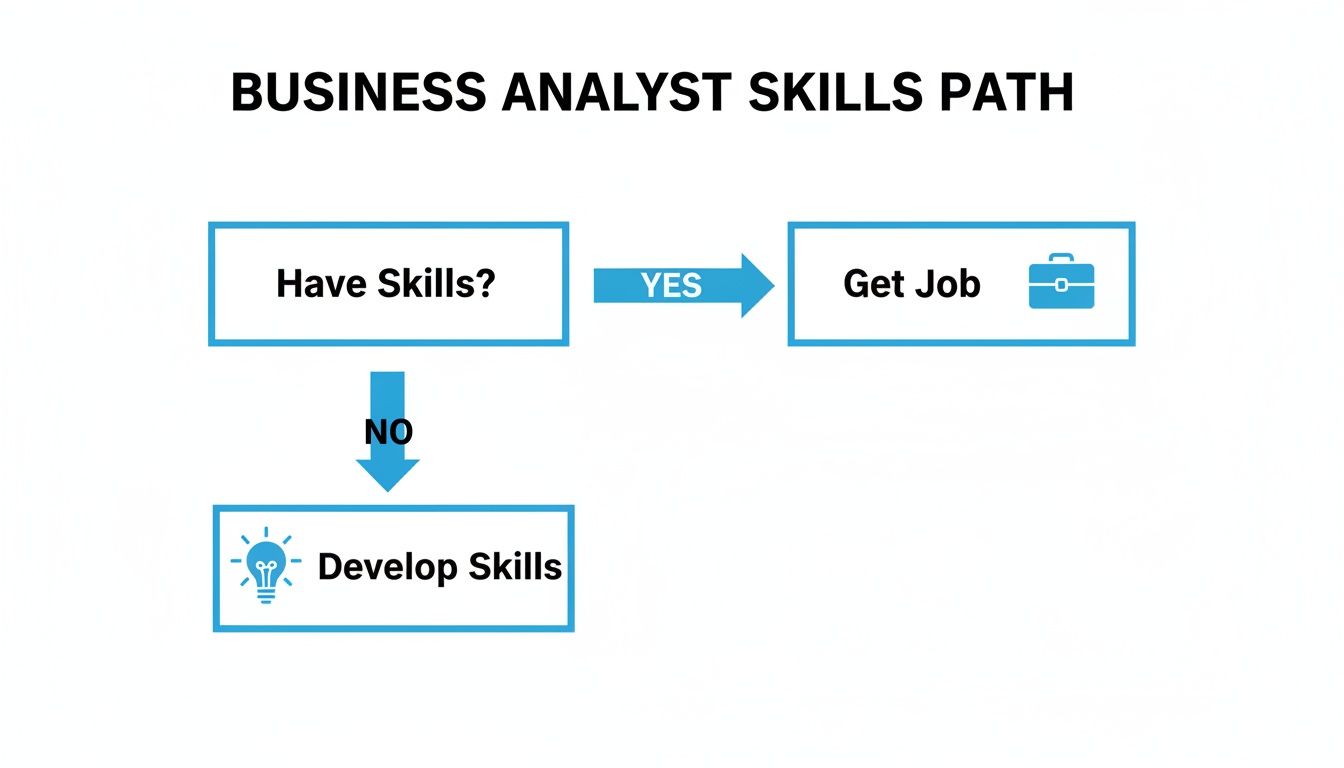
As the flowchart shows, building that educational foundation is the necessary first move before you start pursuing job opportunities.
By completing this diploma, you are actively demonstrating the commitment, discipline, and academic capability that employers and universities are looking for. It signals that you are serious about your career change and have taken a logical, well-thought-out step to achieve it.
This path turns a potential disadvantage—the lack of traditional qualifications—into a story of determination and proactive self-improvement. That's a powerful narrative to have when you start applying for university places and, eventually, for your first role as a business analyst. Your journey becomes a testament to your ability to set a goal, create a plan, and execute it successfully—the very essence of what a great business analyst does.
How to Gain Experience Before Your First BA Job

A solid qualification like an Access to HE Diploma is your ticket to the interview, but it's practical experience that really seals the deal. This is where many aspiring BAs get stuck in that classic catch-22: you need a job to get experience, but you need experience to get a job.
The secret is to stop waiting for permission. You need to start thinking like a BA and creating your own opportunities before you even start applying for roles. This is about being proactive and building a portfolio that shows you can walk the walk, not just talk the talk.
Create Your Own BA Projects
You don't need a manager or a company to start analysing business processes. One of the most impressive things you can do is kick off your own self-directed project. It shows real initiative and a genuine passion for the work.
Think about a business or an app you use all the time—your local gym, a favourite coffee shop's ordering app, or even how your community library manages its loans. Now, put on your BA hat and treat it like a real consultancy gig.
- Map out the current process. How does it work right now? For the app, maybe it’s the user journey from logging in to completing a purchase. For the gym, it could be the new member sign-up process.
- Hunt for the pain points. Where are the bottlenecks and frustrations? Does the app keep crashing? Is the queue at the coffee shop a mess every morning? If you can, chat with other users or even the staff to get their take.
- Propose genuine improvements. This is your chance to shine. What are some tangible solutions? Could the app’s user interface be simplified? Could the coffee shop introduce a mobile ordering system to manage the morning rush?
- Produce real BA documents. Don't just have the ideas in your head—document them professionally. This means creating process flow diagrams, a list of functional requirements for your suggested changes, and a brief business case explaining why your improvements would make a difference.
A project like this isn't just practice; it's a powerful piece for your portfolio that gives you something concrete and impressive to talk about in interviews.
Volunteer Your Analytical Skills
Charities and non-profit organisations are often running on pure passion but are short on resources. They frequently face operational hurdles they just don't have the time or in-house expertise to solve, which makes them a perfect place for you to step in.
Volunteering is a brilliant way to get your hands on real-world problems, work with actual stakeholders, and navigate genuine business constraints.
You could offer to help a local animal rescue analyse its donor database to spot fundraising trends. Or maybe you could assist a community centre with mapping out its event booking system to find inefficiencies. The trick is to approach them professionally. Explain that you're an aspiring business analyst eager to apply your skills in requirements gathering and process improvement to help them achieve their goals.
Gaining experience through volunteering does more than just build your portfolio; it shows a commitment to using your analytical skills for a greater good, a quality that resonates strongly with many employers.
Reframe Your Current and Past Roles
Don't overlook the goldmine of experience sitting right there in your work history. Chances are, you’ve already been doing tasks that are closely related to business analysis without even realising it. Your job is to find them and re-word them on your CV using the language of a BA.
Go back through your previous jobs. Did you ever:
- Gather feedback from colleagues to improve a team workflow? That’s stakeholder management and requirements elicitation.
- Analyse sales figures in a spreadsheet to identify a pattern? That’s data analysis.
- Explain a complicated problem to your manager in a simple, clear way? That’s stakeholder communication.
- Help create a new rota or system to make things run more smoothly? That’s process improvement.
By translating your past duties into BA terminology, you’re showing that you already have a practical, foundational understanding of the role. For those who are starting from scratch and need ideas on how to frame their abilities, it's worth looking into guides on skills for a resume with no experience. This approach masterfully bridges the gap between the work you've done and the career you want.
Crafting a Standout CV and Nailing the Interview

You’ve put in the hard work and have the new qualifications and practical experience under your belt. Now it’s time to show everyone what you’ve got. This stage is all about connecting your journey directly to what recruiters are desperate to find. It’s not about just listing what you’ve done; it’s about proving you’re the solution to their problems.
Think of your CV as your professional handshake – its one job is to get you in the door for an interview. If you’re changing careers, a standard chronological CV just won't cut it. You need a CV that puts your skills front and centre, immediately shouting about your value as an aspiring business analyst.
Structuring Your Business Analyst CV
Kick things off with a powerful professional summary right at the top. In just a couple of sentences, state your goal to become a business analyst, mention your new qualification (like an Access to HE Diploma in Business and Management), and highlight 2-3 of your most relevant skills. This introduction sets the scene and tells a busy recruiter exactly why they should keep reading.
Next up, create a dedicated "Key Skills" section. This is your chance to mirror the language from the job description. If they’re asking for "stakeholder engagement" or "process mapping," make sure those exact phrases are in your list, backed up with a brief example of how you've used them.
When you get to your work history, it's time to shift your focus from tasks to achievements. Don't just say you "managed customer complaints." Reframe it to show your impact: "Analysed customer complaint data to identify root causes, which led to a 15% reduction in repeat issues by proposing a new workflow." This shows you don't just do things; you analyse situations and make them better.
Preparing for the BA Interview
A business analyst interview is more than just the usual questions. Recruiters are testing your analytical mindset, how you communicate, and your ability to think on your feet under pressure. Be ready for a mix of behavioural questions and practical case studies.
Behavioural questions often start with "Tell me about a time when..." They want to hear real stories about how you’ve handled challenges in the past. This is the perfect opportunity to show off your problem-solving skills, even if the situation wasn’t in an official BA role.
Your interview isn’t a test of what you already know, but a demonstration of how you think. Walk the interviewer through your thought process, showing them how you break down complex problems into manageable pieces.
A classic example is: "Tell me about a time you managed conflicting stakeholder demands." Have a concise story ready about a time you had to balance the needs of different people—maybe a manager and a client—to find a successful compromise.
Using the STAR Method to Shine
The STAR method is a simple but incredibly powerful way to structure your answers to those behavioural questions. It makes sure your stories are clear, to the point, and leave a lasting impression.
- Situation: Briefly describe the context. What was going on?
- Task: What was your specific goal or responsibility?
- Action: Explain the concrete steps you took to handle it.
- Result: What was the outcome? Always use numbers and specific results where possible to highlight your positive impact.
Let’s apply this to a case study question, like, "How would you improve an e-commerce checkout process?"
- Situation: "The current checkout process is suffering from a high cart abandonment rate, which is directly impacting sales."
- Task: "My objective is to pinpoint the friction points in the customer journey and propose solutions to increase the number of completed purchases."
- Action: "First, I'd dive into the data, using website analytics to see exactly where users are dropping off. Then, I'd get qualitative feedback through user surveys and interviews. With that information, I'd create process maps of the current and proposed flows, and write up user stories for the development team."
- Result: "The end goal would be to present a data-backed proposal to stakeholders, aiming for a measurable drop in cart abandonment—for example, a 10% decrease within three months of the changes going live."
Getting comfortable with this method will help you communicate your value with confidence, proving you have the structured, analytical mind needed to excel as a business analyst.
Your Questions Answered on Becoming a Business Analyst
Starting a new career always brings up a lot of questions. As you get closer to your goal of becoming a business analyst, it’s completely normal to wonder about the day-to-day, how long it will all take, and what your future might look like.
Let's clear up some of the most common queries we hear from people just like you.
Do I Need to Know How to Code to Be a Business Analyst?
This is probably the biggest myth out there, so let’s get it straight: absolutely not. A business analyst’s main job is to be the bridge between what the business wants and what the technical team builds. You’re a translator, not a coder.
That said, having a basic grasp of technical concepts is a huge advantage. Understanding a little about how databases work or what an API is can make your conversations with developers much smoother. Some BAs find learning a bit of SQL (Structured Query Language) incredibly helpful, as it lets them pull data for their own analysis without having to wait for someone else.
What Is the Career Progression for a Business Analyst?
The career path for a BA is brilliant because it's so varied. If you’re ambitious, you won’t be in one spot for long.
Most people follow a path that looks something like this:
- Junior Business Analyst: This is where you’ll start out, learning the essentials on smaller projects and helping out senior members of the team.
- Business Analyst: After a couple of years, you’ll be ready to take on your own projects, manage more complex stakeholder needs, and really start making an impact.
- Senior Business Analyst: In this role, you’re tackling the big, high-stakes projects. You’ll also likely be mentoring junior BAs and helping shape the team's direction.
From a senior role, your options really open up. Many BAs move into specialised roles like Product Manager or Project Manager, while others go into freelance consulting. The skills you build are valued right across senior leadership, so doors will open that you probably haven't even thought of yet.
How Long Does It Typically Take to Become a Business Analyst?
This really comes down to where you’re starting from. If you’re beginning without A-levels, a realistic first step is an Access to HE Diploma, which usually takes about a year of flexible, online study. After that, you'd be looking at a standard three-year university degree.
If you already have a degree but it's in a different field, your journey could be much quicker. You might focus on getting some practical experience and key certifications over 1-2 years to get yourself job-ready.
The biggest factor in your timeline isn’t your background—it’s your commitment. Consistent learning and actively looking for experience will always speed up your journey into a business analyst role.
Are There Any Recommended Certifications for a New Business Analyst?
While your education and hands-on experience are what really count, getting a certification can definitely make your CV stand out to employers.
For anyone just starting, the ECBA (Entry Certificate in Business Analysis) from the International Institute of Business Analysis (IIBA) is a fantastic choice. It’s designed for newcomers and shows you have a solid understanding of the fundamentals. In the UK, qualifications from BCS, The Chartered Institute for IT, are also highly respected and offer a clear path for development as you grow in your career.
The journey to becoming a business analyst is an achievable goal, and having the right educational foundation makes all the difference. At Access Courses Online, we specialise in helping adults like you take that critical first step towards a new career.
Our accredited online Access to Higher Education Diplomas are designed to fit around your life, giving you the qualifications and confidence to progress to university and beyond. Explore our courses today and start building your future.