
So, you’re thinking about becoming a nurse. It’s an incredible career choice—one that’s challenging, rewarding, and makes a real difference in people’s lives every single day. But figuring out the first steps, especially if you’re changing careers or don’t have A-Levels, can feel a bit overwhelming.
That’s where this guide comes in. We’ll walk you through the entire journey, from figuring out your qualifications to finally getting registered with the Nursing and Midwifery Council (NMC). Think of it as your practical roadmap to a fulfilling new future.
We’ll break down everything you need to know, including:
- The different routes into nursing, from university degrees to apprenticeships.
- How to craft a standout university application, even if you’ve been out of education for years.
- The nitty-gritty of professional checks and the final NMC registration.
- All the funding options available to make your studies possible.
Why Now is the Perfect Time to Become a Nurse
Let’s be honest: the need for skilled, compassionate nurses in the UK is huge, and it’s only getting bigger. The healthcare sector is crying out for dedicated people like you, which means nursing offers a stable and secure career path.
The numbers don’t lie. As of March 2025, the NMC register hit an all-time high of 853,707 professionals. But here’s the crucial part: the number of new nurses joining actually slowed down, dropping to 45,597 from 53,077 the year before. This highlights a critical need for more UK-trained nurses. You can get the full picture in the NMC's annual data report.
What does this mean for you? It means universities are actively looking for passionate people from all walks of life. Your life experience, resilience, and commitment are incredibly valuable.
This is especially true for adult learners. If you don't have the traditional qualifications, don't worry. Pathways like the Access to HE Diploma in Nursing are designed specifically to get you university-ready. They give you the UCAS points and foundational knowledge you need, and many can be studied online, fitting around your life. You can learn more about this route in our guide on how an Access to HE Diploma in Nursing works.
Finding the Right Educational Pathway Into Nursing
Choosing how you'll get qualified is the first big decision on your journey to becoming a registered nurse in the UK. The best path for you really depends on your academic background, your financial situation, and what else is going on in your life. The great news is there's more than one route, making a nursing career a realistic goal for everyone, from school leavers to experienced professionals looking for a meaningful change.
The most common route is the full-time BSc (Hons) Nursing degree, a three-year university course. It’s an intense mix of academic theory and hands-on practical placements in real clinical settings. Right from the start, you'll choose one of four specialisms to focus on.
- Adult Nursing: This is all about caring for adults of every age, dealing with a huge range of physical health conditions.
- Children’s Nursing: You'll be providing care for children and young people, from tiny newborns right through to teenagers, and crucially, supporting their families too.
- Mental Health Nursing: Here, you'll support individuals facing mental health challenges, helping them manage their conditions and improve their quality of life.
- Learning Disability Nursing: This involves working with people who have learning disabilities, helping them to live as independently and fully as possible.
Each specialism leads to a specific registration with the Nursing and Midwifery Council (NMC), which will shape your career from day one.
Earning While You Learn
For many people, the thought of three years of full-time study without a regular income just isn't realistic. If that sounds like you, the Nursing Degree Apprenticeship could be a brilliant alternative.
This route lets you work in a healthcare setting – often as a healthcare assistant – while studying for your nursing degree part-time. Your employer and the university team up to deliver your training. It means you get hands-on experience from the get-go, earn a salary, and your tuition fees are usually covered. These apprenticeships can be very competitive and often require you to already be an employee, but they offer a fantastic, debt-free path into the profession.
There's also a fast-track option if you already have a degree in another subject. A Postgraduate Diploma in Nursing (PGDip) is a two-year course that builds on the skills you already have, getting you to registration much quicker.
This flowchart gives you a simple visual guide to help you figure out which path might be right for your current situation.
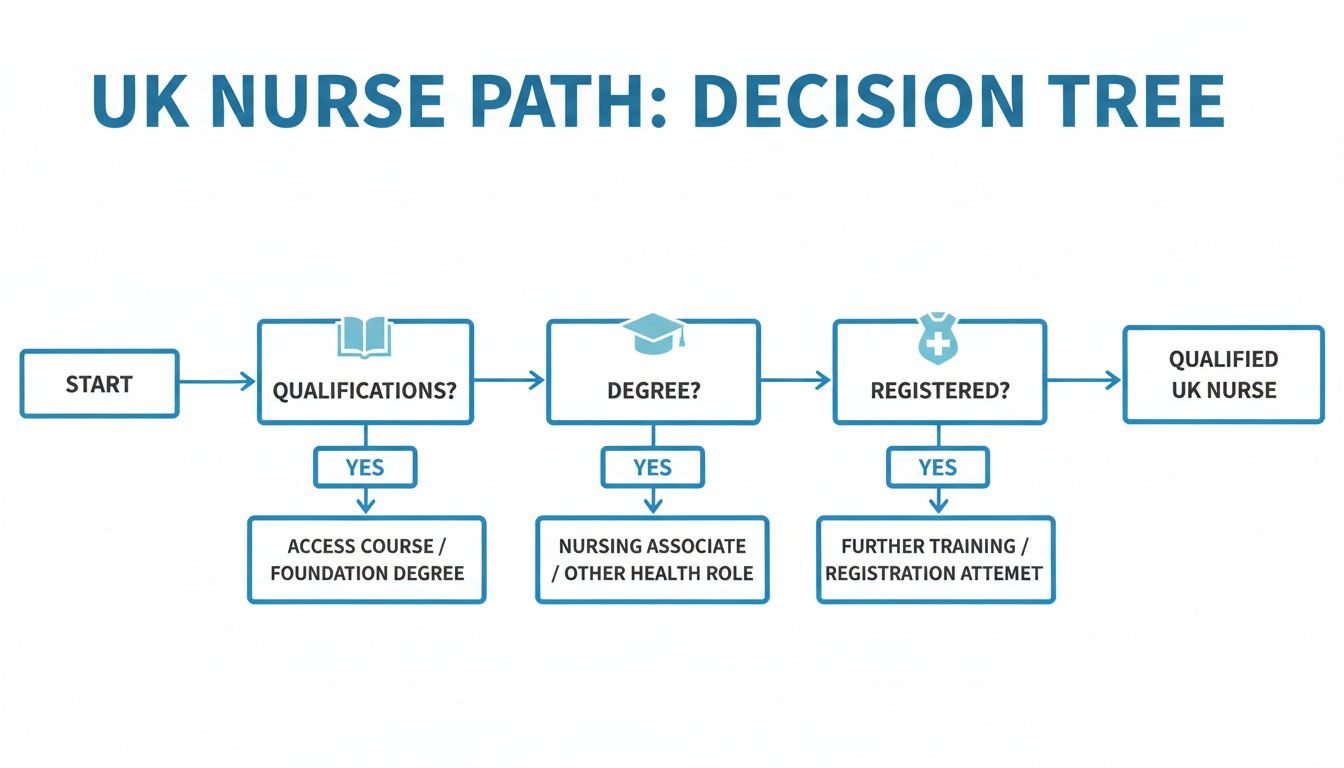
As the decision tree shows, what you've already studied is the key starting point for choosing between a direct university degree, an apprenticeship, or a preparatory course to get you there.
The Access to HE Diploma: Your Bridge to University
So, what happens if you don’t have A-Levels or the right number of UCAS points to apply directly to university? This is a really common situation for adults who decide nursing is their calling later in life. This is exactly where the Access to Higher Education Diploma (Nursing) comes in.
This qualification is designed specifically for adults returning to education. It gives you the foundational knowledge you need in subjects like human biology and psychology, hones your academic skills, and provides the UCAS points required for a nursing degree application.
Think of it as a one-year, university-focused prep course that puts you on a level playing field with applicants holding traditional qualifications. For thousands of aspiring nurses every year, it’s the key that unlocks the door to university.
For UK adults looking to get into nursing without A-Levels, this diploma is a game-changer. Online Access to HE Diplomas, like those from Access Courses Online (UKPRN 10033485), provide a direct bridge to NMC-approved university nursing degrees. They cover essential modules in human physiology and psychology and are accepted by 90% of UK universities for mature students. It's a proven route: since 2010, over 50,000 learners have used Access courses to enter health professions, with a massive 25% of those going into nursing.
Let’s look at a real-world example. Sarah was a retail manager for ten years. She was a great leader but felt unfulfilled and wanted a career with real purpose. With no A-Levels, university seemed out of reach. Instead, she enrolled in an online Access to HE Diploma in Nursing. By studying in the evenings and on weekends, she could fit her coursework around her full-time job and family. A year later, she had the qualification, confidence, and multiple university offers. She's now in her second year of a BSc in Adult Nursing.
Before committing, it's always a good idea to research various nursing degree programs to find the perfect fit. The brilliant thing about an Access to HE Diploma is its flexibility; you can prepare your university applications while still managing your current life, making the transition so much smoother. You can explore the specifics of what's covered in our detailed guide on the Access to Nursing Higher Education diploma.
This pathway proves that not having A-Levels is absolutely not a barrier to achieving your dream of becoming a nurse.
Crafting a Standout University Application
Getting the right qualifications is the first major hurdle, but getting a place on a competitive nursing course takes a lot more. Universities aren't just looking for academic stars; they want people who embody the core values and personal strengths essential for a career in care. Your university application is your big chance to prove you’re that person.
The whole process is handled through the UCAS (Universities and Colleges Admissions Service) portal. This is where you'll make your choices—you can apply for up to five courses—and submit all your details, including your grades and the crucial personal statement.

Think of UCAS as your gateway to almost every undergraduate course in the UK. It’s well worth taking the time to get familiar with its layout and, most importantly, its deadlines.
The Personal Statement: Your Time to Shine
The personal statement is, without a doubt, the most important part of your UCAS application. It's a short essay—just 4,000 characters—where you get to explain why you want to be a nurse and why you’d be a brilliant one. This is where you connect the dots between your life experiences and the demands of the nursing profession.
Admissions tutors sift through hundreds of these, so a generic statement about "wanting to help people" just won't cut it. You have to show them, not just tell them.
Dig deep into your past experiences, both professional and personal.
- Worked in a call centre? You've developed incredible patience, top-notch communication skills, and the ability to navigate difficult conversations – all vital for nursing.
- Raised a family? You've been a master of organisation, time management, advocacy, and resilience every single day.
- Volunteered in a local charity shop? You’ve gained experience working in a team and interacting with a diverse mix of people from your community.
The trick is to translate these real-life skills into solid proof of your nursing potential. Frame them as examples that highlight your compassion, your problem-solving abilities, and your unwavering commitment. For a more detailed guide, check out our article on how to write a personal statement that truly gets you noticed.
Preparing for the University Interview
If your personal statement hits the mark, your next step is the interview. These days, it’s not just a straightforward chat. Many universities now use a Multiple Mini Interview (MMI) format to see what you're really made of.
In an MMI, you'll move through a circuit of short, timed stations. Each one throws a different scenario or question at you, designed to test a specific skill or personal quality.
An MMI isn't just about what you know; it's about how you think. It tests your ethical reasoning, communication skills, empathy, and ability to think on your feet under pressure.
You could face stations that involve:
- Scenario-based questions: "A patient's family is upset about the care their loved one is receiving. What do you do?"
- Ethical dilemmas: You might be asked to discuss tricky issues like patient confidentiality or consent.
- Communication tasks: This could involve interacting with an actor playing the role of a distressed patient or a concerned colleague.
Preparation is absolutely key. Research the university's values and make sure you have a rock-solid understanding of the NHS Core Values, often known as the '6 Cs'.
| The 6 Cs of Nursing | Why They Matter in Your Interview |
|---|---|
| Care | This is the heart of nursing. Show you understand that care is about delivering an exceptional service to every single patient. |
| Compassion | More than just being nice, this is about intelligent kindness. Use examples where you have truly understood and responded to someone’s feelings. |
| Competence | Your ability to understand a patient’s needs and apply your knowledge. It’s about a commitment to learning throughout your career. |
| Communication | Essential for building trust with patients and collaborating with colleagues. Demonstrate how you listen actively and express yourself clearly. |
| Courage | Having the strength to do the right thing, especially when it’s tough, and to be an advocate for your patients. |
| Commitment | A genuine dedication to your patients and the public. Show your passion for nursing and your drive to improve care. |
Being able to weave these values into your interview answers, backed up by real examples from your own life, will show that you're not just academically prepared, but that you're also the right fit for what it means to be a nurse in the UK today.
The Final Checks: From Your Offer to Your NMC Pin
Getting that conditional offer from a university is an incredible feeling, but it’s not quite time to pop the champagne. Before you’re officially accepted onto your nursing course, there are a couple of essential professional checks you’ll need to clear.
Don't worry, these are completely standard for anyone heading into a healthcare role in the UK. They’re all about protecting patients and making sure you’re properly supported. Your university will walk you through everything, but it helps to know what’s coming. The two main hurdles are a Disclosure and Barring Service (DBS) check and an occupational health assessment.
The DBS Check: What You Need to Know
First up is the Disclosure and Barring Service (DBS) check. This is a routine criminal record check that’s non-negotiable for anyone working with children or vulnerable adults. Because your nursing placements will put you in direct contact with patients from day one, you’ll need an enhanced DBS check.
This check flags up any spent and unspent convictions, cautions, reprimands, and final warnings. The golden rule here is to be completely upfront on your application forms. Having something on your record doesn’t automatically mean you can't become a nurse, but trying to hide something that later appears on your check will raise serious red flags.
Universities look at these things on a case-by-case basis. What they really want to see is honesty and a mature understanding of your professional responsibilities.
The Occupational Health Assessment: It's All About Support
Alongside the DBS, you'll also complete an occupational health assessment. This isn’t a fitness test designed to catch you out. It’s simply a way to ensure you can meet the demands of the course and the profession, both physically and mentally. More importantly, it’s an opportunity to make sure any health conditions or disabilities you have are properly supported from the get-go.
Typically, the process involves:
- Filling out a detailed health questionnaire.
- Showing proof of your immunisations (like MMR and Hepatitis B).
- Sometimes, a quick chat with an occupational health professional.
Be open and honest. If you have a long-term health condition, this is your chance to discuss it so the university can put reasonable adjustments in place to help you thrive on your course and placements.
The Final Hurdle: Registering with the NMC
Fast forward three years, and you’ve made it through the degree! But before you can legally call yourself a Registered Nurse in the UK, you have one last, crucial step: registering with the Nursing and Midwifery Council (NMC). The NMC is the official regulator for all nurses and midwives in the UK, and getting on their register is your final ticket to practice.
Once you've successfully passed your course, your university will give the NMC the green light. You can then start your online application to join the register. A huge part of this is demonstrating that you meet the NMC's standards of 'Good Health and Good Character'.
This involves making declarations about your health and character, including confirming you have no convictions or cautions that might affect your ability to practise safely. Your university will also send a supporting declaration confirming you have the skills and knowledge needed to be a nurse.
Get ready to become very familiar with the Nursing and Midwifery Council's homepage!
This website will be your go-to for understanding professional standards, revalidation, and the code of conduct that will guide your entire nursing career.
Once your application is approved and you've paid the registration fee, you’ll be issued your unique NMC Pin. This number is your official licence to practise—the moment you officially become a registered nurse.
From the first DBS check to getting that NMC Pin, it's a well-trodden path. It’s all designed to uphold the incredibly high standards of the nursing profession and keep the public safe. By approaching it all with honesty, you’ll be ready to start your amazing new career.
Paying for Your Nursing Studies and Mapping Your Timeline
Let's be honest, one of the first questions on anyone's mind when thinking about a career change is, "How on earth will I afford it?" The good news is that financial worries shouldn't be the thing that stops you from becoming a nurse. There’s a solid support system in the UK designed specifically to help you through your studies.
Getting your head around the different funding streams is the key to making this dream a reality. The two main players you’ll get to know are the NHS Learning Support Fund (LSF) and Student Finance England.
The NHS Learning Support Fund
Think of the NHS Learning Support Fund (LSF) as your secret weapon. It’s an incredible package available to eligible nursing, midwifery, and many other healthcare students. The absolute headline is the non-repayable Training Grant of £5,000 you get for each academic year.
No, you don't pay it back. It’s a grant designed to help you with living costs while you focus on your course. But that's not all. The LSF offers extra bits of help for specific situations:
- Parental Support: If you’re juggling your studies with kids (at least one dependent child under 15, or under 17 if they have special educational needs), you can get an extra £2,000 a year.
- Travel and Dual Accommodation Expenses (TDAE): Placements are a massive part of your degree, but sometimes they’re not on your doorstep. This part of the fund reimburses you for extra travel or temporary accommodation costs you might face getting to them.
- Exceptional Support Fund: If life throws you a curveball and you find yourself in serious financial trouble, you can apply for an extra grant of up to £3,000 a year.
You’ll manage all of this through the NHSBSA website, which becomes your go-to hub for your LSF application.
It’s a pretty straightforward portal where you can apply and track your funding, taking some of the stress out of the process.
Student Finance and Advanced Learner Loans
On top of the NHS funding, you can still apply for the standard Tuition Fee Loan and Maintenance Loan from Student Finance England. These loans cover your course fees and top up your living cost budget. You only start repaying them once you’ve graduated and are earning above a certain amount.
Now, for those of you starting this journey with an Access to HE Diploma, there’s another amazing option: the Advanced Learner Loan. This loan is there to cover your Access course tuition fees.
Here’s the brilliant part: when you use an Advanced Learner Loan for your Access course and then successfully complete a higher education course like a nursing degree, Student Finance England will completely write off your outstanding loan balance. In short, your Access course ends up being free.
Your Four-Year Journey to Becoming a Nurse
Seeing the whole path laid out can make a massive goal feel much more achievable. If you're starting with an Access to HE Diploma, you're realistically looking at a four-year timeline from day one of your Access course to becoming a registered nurse.
| Year | Milestone | What You'll Be Doing |
|---|---|---|
| Year 1 | Access to HE Diploma | You’ll get stuck into your online diploma. The goal is to smash your modules and get your UCAS application, complete with a killer personal statement, sent off in the autumn. |
| Year 2 | First Year of Your Degree | Welcome to uni! This year is all about building the foundations. It’s a mix of lectures and your first taste of clinical placements, where things start to click into place. |
| Year 3 | Second Year of Your Degree | Time to build on what you've learned. The placements get more complex, you'll be given more responsibility, and you'll start to figure out which area of nursing really excites you. |
| Year 4 | Final Year & Registration | The home stretch! You’ll tackle your final placements and dissertation. Once you pass your degree, you'll apply to the Nursing and Midwifery Council (NMC) for that all-important Pin number. You’re officially a Registered Nurse. |
Launching Your Career as a Newly Qualified Nurse

Congratulations, you've got your NMC Pin! This is the moment all that hard work has been building up to. Making the leap from student to Newly Qualified Nurse (NQN) is a massive step, but the NHS has some fantastic support systems ready to help you find your feet.
Your first year is all about the preceptorship programme. This isn't just a long induction week; it's a structured period of support designed to bridge the gap between theory and the fast-paced reality of clinical practice. You’ll be paired with a preceptor – a more experienced nurse – who will be your mentor and guide.
Think of it as a safety net. It’s your chance to ask all the questions you want, build your confidence with practical skills, and gradually take on more responsibility with someone experienced watching your back.
Where Will You Start Your Nursing Journey?
As an NQN, you’ve got a huge range of settings to choose from. While lots of graduates kick off their careers on a busy hospital ward, that's by no means the only path. The specialism you chose will point you in certain directions, but the possibilities are still incredibly broad.
Your first role could be in any of these places:
- Acute Hospital Wards: Getting stuck into areas like surgery, A&E, or general medicine is a brilliant way to see a lot and learn a lot, very quickly. It's fast-paced, for sure.
- Community Nursing: Fancy being out and about? This involves visiting patients in their own homes, helping them manage long-term conditions and keeping them out of hospital.
- GP Practices: Practice nurses are the backbone of primary care, involved in everything from baby immunisations and health screenings to managing chronic diseases like asthma and diabetes.
- Mental Health Trusts: You could be working on an inpatient unit or as part of a community mental health team, playing a vital role in people's recovery.
When you're ready to start applying, making your application shine is key. A good starting point is learning about crafting the perfect resume for nursing jobs in the UK.
Your first job doesn't define your entire career. Think of it as your foundation. It’s an opportunity to solidify your core nursing skills before deciding on future specialisations.
Looking Ahead: Career Progression
Getting your pin is just the beginning. Nursing is a career with almost limitless opportunities for development. Once you’ve got some solid experience under your belt, you could explore becoming a Clinical Nurse Specialist (CNS), focusing deeply on a specific area like diabetes or respiratory care.
Other popular routes include moving into leadership as a Ward Manager or Team Leader. Or perhaps you'll want to go back to university to become an Advanced Nurse Practitioner (ANP), where you can take on more responsibility for diagnosing and treating patients. The path you take is entirely up to you.
Your Nursing Questions, Answered
Thinking about a career in nursing can bring up a lot of questions, especially if you're coming back to education after a break or making a big career switch. It's completely normal to wonder about the practicalities. Let's tackle some of the most common queries we hear.
Can I Get Into Nursing Without A-Levels?
Yes, you absolutely can. Not having A-Levels is a common situation, and it definitely doesn't have to be a roadblock on your path to becoming a nurse.
The Access to Higher Education Diploma in Nursing was created for this exact purpose. It's a well-respected qualification that UK universities accept, giving you all the foundational knowledge and UCAS points you need to apply for a nursing degree.
How Long Does the Whole Process Take?
For most people starting without A-Levels, you're looking at a journey of about four years. That breaks down into one year to complete your Access to HE Diploma, followed by the standard three-year university degree.
If you already have a degree in a related field, you might be able to get on a fast-track. Some postgraduate courses can see you become a registered nurse in as little as two years.
What Qualities Really Matter for a Nurse?
Academic qualifications are one thing, but universities and future employers are looking for something more. They want to see the person behind the application.
During your application and interview, you'll need to show you have:
- Genuine compassion and empathy for people when they're at their most vulnerable.
- The resilience to cope with the emotional and physical pressures of the job.
- Excellent communication skills – being able to listen is just as important as being able to explain things clearly.
- A natural ability to work well as part of a team, because you'll be relying on your colleagues every single day.
Don't forget that your life experience is a massive plus here. All those skills you've picked up in other jobs or through life are incredibly valuable.
Remember, universities really value the maturity and different perspectives that career-changers bring. Your previous roles have given you skills that are directly transferable to nursing—don't ever underestimate that.
Is It Possible to Study Nursing Flexibly?
This is a big one, especially if you have a family or need to keep working. While most nursing degrees are full-time, there are some more flexible routes emerging, like the Nursing Degree Apprenticeship that lets you earn while you learn.
But the real game-changer for flexibility is the Access to HE Diploma. Many providers, like us, offer these courses fully online. You can study at your own pace, fitting it all in around your current life, not the other way around.
Ready to take that first step, even without A-Levels? Access Courses Online provides accredited, fully online Access to HE Diplomas designed to fit around you. Find out more and start your journey at https://accesscoursesonline.com.