
Choosing a career path is a big decision, but it's really a journey of matching what you enjoy and what you’re good at with the opportunities out there in the real world. It all starts with getting to know yourself, then moves on to exploring the job market, and finally, creating a solid plan to get the qualifications you need.
Starting Your Career Journey with Confidence
Deciding on a career can feel like a massive task, especially when you’re bombarded with endless options and opinions from others. It’s easy to get sidetracked by what’s trendy or what someone else thinks you should do.
But the truth is, the most rewarding careers are built on a solid foundation of self-awareness. Forget the old-fashioned idea of finding one 'perfect' job for life; modern careers are much more flexible and often involve several changes along the way.
The trick is to start by looking inward, not outward. Before you even think about scrolling through job ads or university prospectuses, take the time to understand your own values, strengths, and what genuinely interests you. This step is your filter – it helps you cut through the noise and focus on paths that truly resonate with who you are.
Understanding the Modern Career Landscape
Today's world of work is a far cry from what our parents or grandparents experienced. The whole concept of a single 'job for life' is pretty much gone. In fact, the average British worker changes jobs roughly every five years, and many people will have up to fifteen different jobs over their lifetime.
This trend has only sped up recently. Since 2020, around 4 million people have switched careers, often chasing better pay or a more fulfilling role. This just goes to show how vital it is to be adaptable and have a plan. You can explore more data on UK career changes to see just how much things are shifting.
Choosing a career isn't a one-time decision but a continuous process of discovery and adjustment. The goal is not to predict the future perfectly but to make the best possible choice with the information you have today, while remaining open to future opportunities.
A Framework for Making Your Decision
To make this whole process feel less overwhelming, it helps to break it down into manageable stages. A structured approach ensures you cover all the important bases, from self-reflection right through to creating a practical action plan. We'll walk you through each phase, offering practical exercises and real-world advice to support you.
The diagram below gives you a clear picture of the three core stages of this journey: Self-Discovery, Research, and the Action Plan.
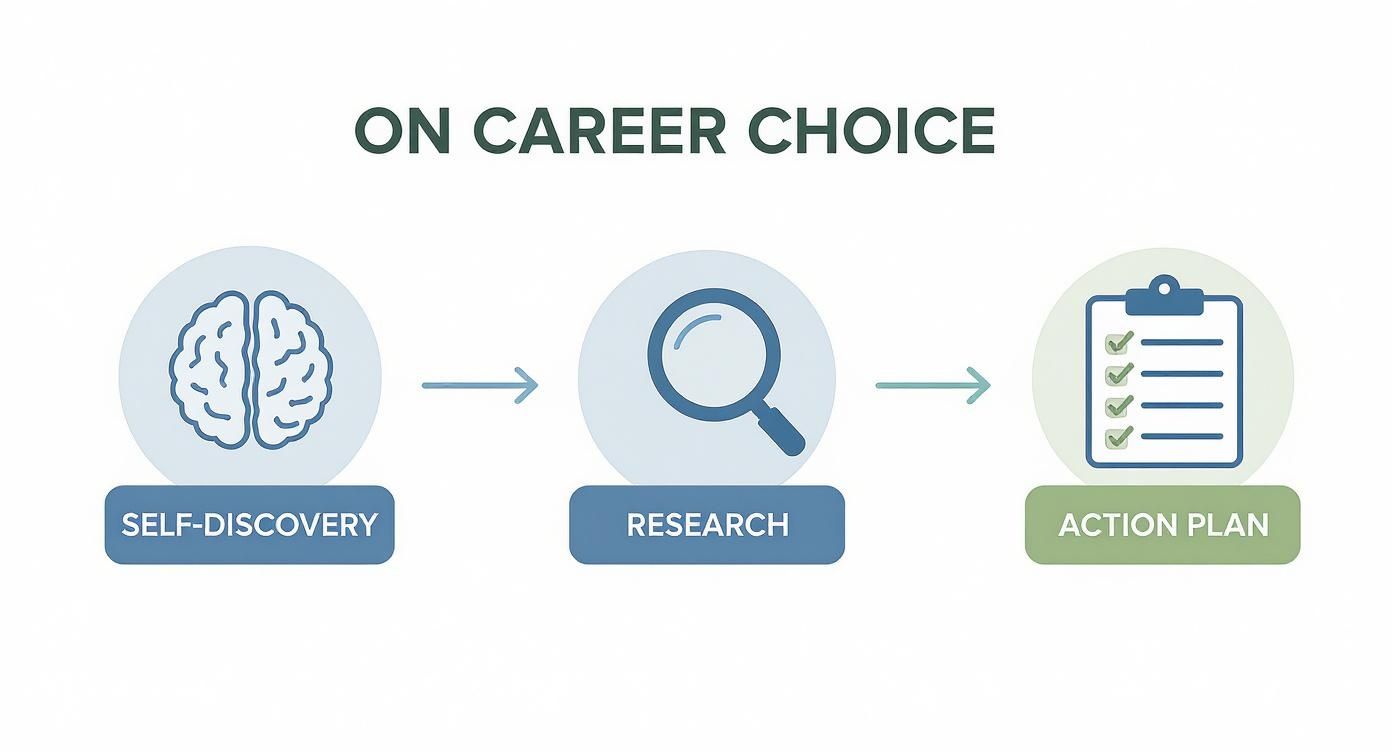
As you can see, a smart career choice is a logical progression. It always starts with understanding yourself before you start looking at what's out there.
To help simplify this, here’s a quick overview of the framework we’ll be following.
Your Career Choice Framework at a Glance
| Stage | Objective | Key Action |
|---|---|---|
| Self-Discovery | To understand your personal values, interests, and skills. | Completing self-assessment exercises and reflecting on past experiences. |
| Research | To explore potential careers and educational routes. | Investigating the labour market, job roles, and required qualifications. |
| Action Plan | To create a clear, step-by-step plan to achieve your goal. | Setting SMART goals, creating a timeline, and identifying resources. |
By following this framework, you can turn a daunting task into a clear, step-by-step project. Each stage builds on the one before it, moving you from a place of uncertainty to one of clarity and confidence. The next sections will dive deeper into each of these areas, giving you the tools you need to take control of your career journey.
Discovering Your Strengths and Passions
Before you can even think about job titles or industries, the journey has to start with you. It’s easy to get caught up in job trends, but the most fulfilling careers are built on a solid foundation of your unique strengths, values, and genuine interests. This is where you take a moment to look inward and create a personal inventory that will act as your compass.

This isn’t just about work experience; it’s about looking at your entire life and spotting the patterns. What activities leave you feeling energised? What kind of problems do you actually enjoy tackling? Answering these questions honestly is the first real step in choosing a career path that truly fits who you are.
Uncovering Your Core Skills and Talents
We all have things we’re naturally good at, but often we dismiss them precisely because they feel easy. A good place to start is to think about what friends, family, or colleagues always ask for your help with. Are you the go-to person for tech support, proofreading an important email, or planning a party? These are massive clues to your innate abilities.
A great exercise is to reflect on your achievements, both big and small. Dig deeper than your job title and pinpoint specific projects or moments where you felt genuinely proud of what you accomplished.
For each achievement, ask yourself:
- What specific actions did I take to make this happen?
- Which of my personal skills were most crucial for this success?
- What part of the process did I enjoy the most?
This simple exercise helps you move from vague ideas like "I'm a good communicator" to concrete, marketable skills like "I can explain complex information clearly to people with different levels of understanding."
Your strengths aren't just what you’re good at; they’re the activities that make you feel strong and capable. The real secret to job satisfaction is finding work where you get to use these strengths every single day.
Differentiating Hobbies from Career Passions
You’ve probably heard the advice to "follow your passion," but that can be a bit misleading. While your interests are incredibly important, not every hobby is meant to become a career. The real challenge is figuring out which of your passions could actually sustain you—professionally, financially, and emotionally—for the long haul.
Think of it this way: a hobby is something you enjoy in your spare time, but a career-worthy passion is an interest you feel compelled to explore more deeply. It’s the subject you can’t stop reading about or the activity you keep coming back to, even when it gets difficult.
Here’s a real-world example. Someone might love organising social events for friends. While that could point to a career in event planning, the core strength might actually be project management. They excel at juggling deadlines, coordinating with different people, and seeing a plan through from start to finish. That skill is transferable to countless industries, from construction to software development.
Using Frameworks for Self-Reflection
While no test can define you, personality frameworks can be brilliant tools to kick-start your self-reflection. They provide a structured way to think about your preferences and can give you the language to describe your natural tendencies, pointing you towards work environments where you’re likely to thrive.
Some popular frameworks to look into include:
- Myers-Briggs Type Indicator (MBTI): Explores your preferences for how you get your energy, process information, make decisions, and organise your life.
- The Big Five (OCEAN): Measures five key dimensions of personality: Openness, Conscientiousness, Extraversion, Agreeableness, and Neuroticism.
- Holland Codes (RIASEC): Matches your personality to career interests, categorising them as Realistic, Investigative, Artistic, Social, Enterprising, or Conventional.
The goal isn't to get a rigid label. It's to use the results as a starting point. Does the description feel right? Do the suggested career fields spark any interest? By combining these insights with your own personal reflections, you'll build a much clearer picture of who you are. This personal inventory is the filter you'll use to evaluate every potential career path, making sure your final choice is one that’s authentic to you.
Researching the Modern UK Job Market
Once you’ve got a clearer picture of yourself—your skills, values, and passions—it’s time to connect that personal insight with real-world opportunities. Choosing a career path isn’t just about what you want to do; it’s also about understanding where your talents are most needed. This is the stage where your ambitions meet the reality of the modern UK job market.

Good research means looking beyond appealing job titles to see what’s really happening in different industries. It’s about finding a role that is not only fulfilling but also offers stability and the chance to grow. This practical approach ensures you’re making a strategic choice, not just a hopeful one.
Identifying High-Growth Sectors and Roles
The world of work is always changing. Some industries are expanding, while others are shrinking. To build a future-proof career, it makes sense to look at sectors showing strong signs of growth. This doesn't mean you have to abandon a passion if it's in a slower field, but it does mean being aware of the economic landscape.
Government data and industry reports are your best friends here. They give you an objective look at where the jobs of tomorrow are likely to be. In the UK, for instance, several priority sectors are projected to see a big jump in demand.
Employment in key areas like Digital, Adult Social Care, Construction, and Engineering is expected to grow from 5.9 million in 2025 to 6.7 million by 2030—a massive 15% increase. Specific roles like care workers and programmers are set to add tens of thousands of new jobs, showing you exactly where the biggest opportunities are. You can explore the government's detailed assessment of priority skills to 2030 to get a better handle on these trends.
To get you started, here's a look at some of those priority sectors and the kinds of roles and entry routes you might find.
Key UK Growth Sectors and Potential Roles
| Growth Sector | Example Roles | Common Entry Pathways |
|---|---|---|
| Health & Social Care | Nurse, Midwife, Social Worker, Paramedic, Care Worker | University Degree (often via Access to HE Diploma), Apprenticeships, Vocational Qualifications |
| Digital Technology | Software Developer, Cybersecurity Analyst, Data Scientist | University Degree, Coding Bootcamps, Professional Certifications, Apprenticeships |
| Construction | Surveyor, Project Manager, Electrician, Civil Engineer | University Degree, Higher National Diplomas (HNDs), Apprenticeships, On-the-job training |
| Green Economy | Renewable Energy Technician, Environmental Consultant | University Degree (e.g., Environmental Science), Vocational training, Specialised certifications |
| Engineering | Mechanical Engineer, Aerospace Engineer, Electrical Engineer | University Degree, Higher Apprenticeships, HNDs/HNCs |
This table is just a starting point, of course, but it helps to see how different paths can lead to exciting, in-demand careers.
A data-driven approach like this helps you identify careers that offer long-term security. To dive deeper, focus your research on:
- Labour Market Information (LMI): Websites like the National Careers Service have detailed profiles on hundreds of jobs, including salaries and qualifications.
- Industry Publications: Trade magazines and online journals give you an inside look at the trends and challenges within a specific sector.
- Professional Bodies: Organisations like the British Computer Society or the Royal College of Nursing publish fantastic reports on workforce trends.
Going Beyond the Job Description
A job title and a brief description only tell you half the story. To really know if a career is the right fit, you need to get a feel for the day-to-day reality. This is where talking to people who are actually doing the job becomes your most powerful research tool.
An informational interview is just a casual chat with someone working in a career that interests you. It’s not a job interview; it’s a fact-finding mission where you get to ask honest questions and hear unfiltered insights.
"The best way to learn about a career is to talk to someone who is living it. Their experiences, both good and bad, provide a level of insight that no online article can match."
You’d be surprised how many people are happy to share their experiences. You can find professionals to talk to through:
- LinkedIn: Search for people in your target roles. Send a polite, brief message explaining you’re researching career paths and would value their perspective.
- Your Personal Network: Ask friends, family, and former colleagues if they know anyone working in your fields of interest.
- Alumni Networks: If you have a connection to a university or college, their alumni office can often connect you with graduates in specific industries.
Asking the Right Questions
When you do manage to set up a chat, being prepared is key. Your goal is to understand the real nuts and bolts of the job.
Here are a few powerful questions to get the conversation started:
- What does a typical day or week actually look like in your role?
- What are the most challenging parts of your job? And the most rewarding?
- What skills do you think are absolutely critical for success in this field?
- How do you see this industry changing over the next five to ten years?
- What advice would you give to someone just starting out on this path?
These conversations ground your research in human experience. You might discover that a role you romanticised is actually full of admin you’d hate, or that a career you overlooked offers the perfect blend of creativity and problem-solving you’ve been looking for. Combining hard data with these personal stories gives you a much clearer picture, helping you make a properly informed decision.
Connecting Your Skills to Your Target Career
This is where the magic happens. You’ve done the deep dive into who you are and what you want, and you’ve scouted the job market. Now, it's time to bring those two worlds together. The aim here is to get a really honest, realistic look at how your current skills stack up against the careers you're eyeing.This isn’t about finding a perfect 1:1 match straight out of the gate. In fact, you’ll almost certainly find some gaps between where you are and where you need to be. But don’t think of these as roadblocks. See them for what they are: a personalised map for your professional growth. They tell you exactly what you need to learn to become a standout candidate.
Mapping Your Skills to Job Requirements
The best way to kick this off is with a practical skill-mapping exercise. This doesn't need to be complex. Just grab a notebook or open a document and create two columns.
On one side, list the key skills and qualifications a job you’re interested in requires (you’ll find these in job descriptions). On the other side, list your own skills and experiences that line up.
Be brutally honest with yourself. If a job needs you to be a whiz with a specific piece of software you’ve never even heard of, write it down. If it asks for five years of project management experience and you’ve got two, that’s a gap. This simple exercise gives you crystal-clear direction on what to tackle next.
A skill gap isn't a dead end; it's a signpost pointing you towards your next learning opportunity. It transforms a vague career goal into a series of achievable, concrete steps.
This process also has a brilliant side effect: it shines a light on your strengths. You might be surprised to realise just how many valuable soft skills you already have – things like communication, problem-solving, and teamwork that employers are desperate for. Seeing that on paper is a massive confidence booster.
The Power of Transferable Skills
One of the most crucial parts of this step is spotting your transferable skills. These are the skills you’ve gained from previous jobs, your education, or even life experiences that can be applied to a completely new role or industry. So many career changers sell themselves short by underestimating just how valuable their past is.
Let’s look at a real-world example:
- Previous Role: A retail manager.
- Target Career: A project coordinator in the tech industry.
On the surface, they seem like chalk and cheese. But if you dig a little deeper, you’ll find a goldmine of transferable skills.
| Skill Gained in Retail | Application in Tech Project Coordination |
|---|---|
| Managing stock and budgets | Demonstrates financial literacy and resource management. |
| Handling customer complaints | Shows strong problem-solving and client communication skills. |
| Training new staff | Proves an ability to mentor and communicate complex processes. |
| Organising shift rotas | Highlights excellent scheduling and logistical planning abilities. |
Suddenly, that retail experience looks like a powerful asset. The trick is learning to speak the language of your new industry. Frame your skills not by where you learned them, but by what you can do with them.
Building Your Bridge to a New Career
Once you’ve identified your skill gaps, you can start building a plan to fill them. There are loads of ways to get the qualifications and experience you need, and the right path for you will depend on your goals, timeline, and how you like to learn. As you focus your search, you might be differentiating between management and strategy consulting, for instance, and realising each has its own distinct skill requirements.
Here are a few great ways to start bridging those gaps:
- Volunteering or Freelance Projects: Offer your time to a local charity or take on a few small freelance gigs. This is a fantastic way to get hands-on experience in a new field without the pressure of a full-time job.
- Short Courses and Certifications: If you need to get up to speed on specific technical skills, online courses or professional certifications are a quick and focused way to do it.
- Formal Education: For many careers like nursing or social work, a degree is non-negotiable. This is where options like an Access to Higher Education Diploma can be a game-changer for adults returning to their studies.
Continuously adding to your skillset is the bedrock of career progression. To get more ideas, you can read about upskilling as a key to advancing your career and see how it fits into your bigger picture. By mixing and matching these approaches, you can create a clear, actionable path from where you are today to where you truly want to be.
Choosing Your Education and Training Pathway
So, you've taken a good, hard look at your skills and figured out where the gaps are. What's next? It's time to choose the right training to build that bridge to your new career. For adult learners in the UK, the options are more flexible than ever, which is fantastic news. It’s all about finding a path that fits your career goals and your real life—finances, family, work, and all.

This part of the journey means weighing up the cost, the time commitment, and the learning style of each option. Whether you need the deep, theoretical knowledge from a university degree or the practical, hands-on experience of an apprenticeship, there’s a route that will get you where you need to be.
Comparing Your Main Options
Let's break down the most common routes for adult learners. Each has its own strengths, so think about which one genuinely aligns with your life and the career you’re aiming for.
-
University Degrees: A degree gives you a deep, theoretical understanding of a subject. It's often non-negotiable for professional roles like nursing, social work, or engineering. While it's a big investment of time and money, it unlocks doors to a huge range of graduate-level jobs.
-
Apprenticeships: Fancy earning while you learn? An apprenticeship combines on-the-job training with study. It's a brilliant way to get practical experience and a recognised qualification, often leading straight into a permanent job with the company you trained with.
-
Vocational Training: Courses like BTECs or NVQs are laser-focused on giving you the specific, practical skills for a particular job. Think anything from digital marketing to construction trades. They’re usually shorter and more direct than a degree.
-
Online Certifications: If you just need to top up specific skills—especially in tech—online courses and certifications offer amazing flexibility. They can be a quick and budget-friendly way to fill a precise knowledge gap you found during your skills mapping.
The "best" educational path is entirely personal. It's the one that respects your current responsibilities while effectively building the bridge to your future career. Don't just look at the qualification; consider how the learning process itself will fit into your life.
The University Route for Adult Learners
Going to university is a powerful move towards a professional career. The latest UK data shows that 15 months after graduating, 71.9% of first-degree graduates were in professional-level jobs. It's a competitive world out there, though, which just goes to show you need to keep developing even after you've got your degree. You can explore more about graduate outcomes from Prospects Luminate.
For many adults who don't have the traditional A-levels, university can feel like a closed door. This is where an Access to Higher Education (HE) Diploma can be a complete game-changer.
These diplomas are designed specifically for adults returning to education. As a Level 3 qualification, they’re equivalent to three A-levels and are widely recognised by universities all over the UK. An Access to HE Diploma gives you both the subject knowledge and the study skills to hit the ground running in a degree programme.
How Access to HE Diplomas Work
Think of an Access to HE Diploma as a focused, supportive launchpad that gets you ready for university. If your dream is to become a nurse, for example, a Diploma in Health Professions will cover the exact biology, sociology, and psychology topics that universities want to see.
Here are the key benefits for adult learners:
- A Direct Pathway: They are specifically designed to get mature students into university.
- Flexible Study: Many providers, like us, offer online courses, so you can fit your studies around your job and family.
- Relevant Content: The curriculum is tailored to prepare you for the demands of a degree, building your confidence and academic skills along the way.
Of course, figuring out how to pay for it all is a massive consideration. The good news is there are various support systems in place. To get a clear picture of what’s on offer, it's really worth checking out our detailed guide on student finance for mature students. Understanding your funding options can make a high-quality education far more achievable, turning your career dream into a real, practical plan.
Common Career Change Questions Answered
Taking the leap into a completely new career is bound to bring up a lot of questions. It's totally normal to feel a mix of nerves and excitement. The good news? You’re not the first person to feel this way, and many of the biggest worries are much more manageable than they first appear.
This section tackles some of the most common concerns head-on. We'll give you clear, practical advice to help you navigate these challenges with confidence, turning those potential roadblocks into simple steps on your journey to a more fulfilling career.
Is It Too Late for Me to Change Careers?
This is probably the biggest fear we hear from adult learners, but let’s be clear: the idea that you're "too old" to change is a complete myth. In fact, employers are increasingly realising the value of life experience and the huge range of transferable skills that mature candidates bring to the table. Your years in another field aren't a weakness; they're a massive advantage.
Think about it. You have a proven work ethic, a deep understanding of professional environments, and a wealth of soft skills like communication, problem-solving, and resilience. These aren't things you can easily learn in a classroom.
"Your past career isn't something to hide; it's a foundation of experience. The key is to reframe your journey, showing how your unique background makes you a stronger, more adaptable candidate for your new field."
Plenty of people successfully switch careers well into their 30s, 40s, and even beyond. Our guide on why Access Courses are ideal for career changers is packed with insights on this very topic. Your age is a source of strength, not a barrier.
How Can I Manage the Financial Uncertainty?
Worries about money are completely valid. The thought of giving up a stable income to go back to studying can feel daunting, but with some smart planning, it's absolutely achievable. The trick is to create a financial buffer and a realistic budget before you make any big moves.
Start by mapping out your essential expenses and see where you can temporarily cut back. Building up a savings fund to cover a few months of living costs will give you a crucial safety net and take a lot of the stress out of your transition.
Consider these practical steps:
- Explore part-time study options: Courses that let you study online and flexibly mean you can often keep working, at least part-time, while you retrain.
- Look into funding: Research options like the Advanced Learner Loan. This can cover the cost of qualifications like an Access to HE Diploma and doesn't require repayment until you're earning above a certain salary.
- Create a transition budget: Plan your finances for the study period and the initial job-hunting phase.
A well-thought-out financial plan transforms a vague worry into a manageable project. If you're considering a significant shift in your professional life, you can also discover more essential guidance and practical career change tips to help you prepare for a successful transition.
What if I Make the Wrong Choice?
The fear of making a mistake can be paralysing, stopping you from making any choice at all. It really helps to remember that no career decision is irreversible. The modern career path is rarely a straight line; it's more like a series of steps, adjustments, and learning experiences.
The detailed self-assessment and research you’ve already done dramatically lower the risk of picking a path that’s a poor fit. You’re not just guessing; you’re making an informed decision based on what you know about yourself and the job market.
And if you do start down a new path and realise it isn’t right? You haven't failed. You’ve just gained valuable clarity and new skills that will be useful in your next move. Every step, even one that feels like a detour, teaches you something that makes your next choice even better. Focus on making the best decision with the information you have now, and trust your ability to adapt as you go.
Ready to take the next step towards a new career? At Access Courses Online, we specialise in helping adults like you get the qualifications needed for university and professional careers. Explore our accredited online courses and find your path to success today at https://accesscoursesonline.com.