

Stepping back into education can feel like a massive leap, but improving your reading comprehension is the single most important tool you can have in your corner. It’s not some innate talent you either have or you don't; it’s a practical, learnable skill. Mastering it will unlock your potential on the Access to HE Diploma and set you up for success at university.
This guide is designed to give you a clear, achievable roadmap, taking you from academic uncertainty to genuine confidence.
Why Strong Reading Comprehension is Your University Superpower
If you’ve got your sights set on a demanding field like Nursing, Computer Science, or Social Work, you'll quickly discover that university-level study is about much more than just reading words on a page. Your success will hinge on your ability to dissect complex ideas, question assumptions in research papers, and connect concepts from dense textbooks.
Feeling swamped by academic texts is completely normal, especially for adult learners. You are not alone in this. The trick is to shift from being a passive reader to an active one. Instead of just letting your eyes scan the lines, you need a solid strategy to actually engage with the material, pull out the essential information, and make it your own.
That’s exactly what this guide will give you. We'll walk through a proven, three-phase approach that breaks the entire process down into manageable actions.
Your Roadmap to Deeper Understanding
Effective reading isn’t a single action but a sequence of deliberate steps. Thinking about it this way takes the pressure off trying to understand everything at once. It organises your efforts and ensures you're building knowledge systematically—which is absolutely vital when studying for an Access to HE Diploma. You wouldn't build a house without a blueprint, and you shouldn't tackle a textbook without a plan.
The whole process involves prepping your mind before you even start reading, engaging actively with the content as you go, and then locking that knowledge in so it actually sticks.
This simple but powerful three-step strategy is shown below.
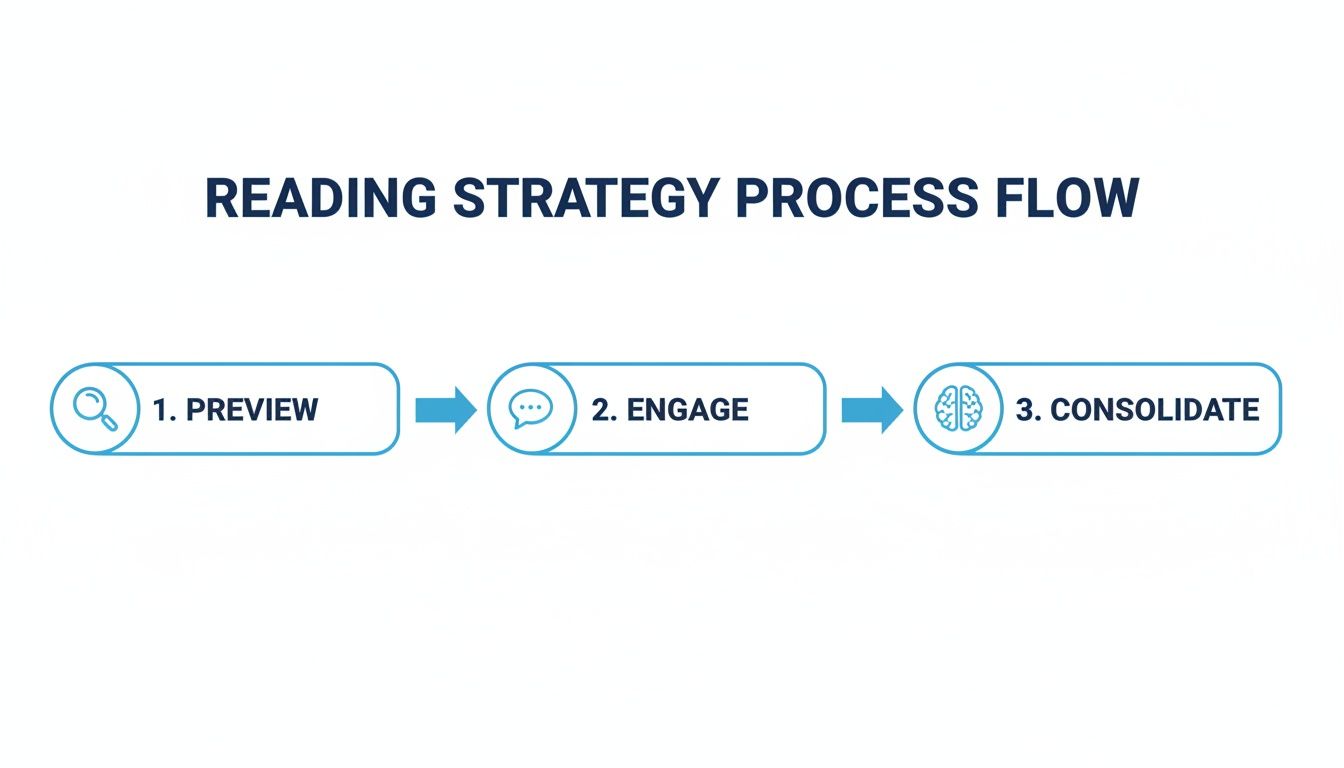
This workflow transforms reading from a passive chore into an active process of discovery and retention. That’s the core of effective learning.
Each phase has a distinct purpose:
- Previewing Texts: This pre-reading step is your reconnaissance mission. You’ll survey headings, diagrams, and summaries to create a mental map. It primes your brain for what’s to come, making the information much easier to absorb.
- Engaging Actively: While you're reading, you will learn to annotate, highlight with purpose, and constantly question the text. This is where you have a "conversation" with the author and start to form your own interpretations.
- Consolidating Knowledge: After you’ve finished a section, the work isn’t over. Summarising concepts in your own words and taking structured notes are vital for moving information from your short-term recall into your long-term memory.
The real goal isn't just to get through the reading; it's to ensure the reading gets through to you. By adopting these active strategies, you build a reliable system for understanding and retaining complex information, turning a potential source of stress into your greatest academic strength.
Your Reading Strategy Roadmap at a Glance
To give you a quick overview, here’s a breakdown of the strategy we’ll be covering. This table shows you what each phase involves and, more importantly, how it will directly benefit your studies.
| Strategy Phase | What You Will Do | The Impact on Your Studies |
|---|---|---|
| 1. Preview | Skim headings, intros, and conclusions. Look at images and charts. Get the big picture before diving in. | You'll start reading with context, making it easier to connect new ideas and avoid feeling lost in the detail. |
| 2. Engage | Ask questions as you read. Highlight key points. Make notes in the margins (or a separate notebook). | This turns reading into an active dialogue, boosting your focus and helping you pinpoint the most important information for assignments. |
| 3. Consolidate | Summarise each section in your own words. Create mind maps or flashcards to test your recall. | This locks information into your long-term memory, ensuring you're ready for exams and can apply what you've learned. |
Think of this table as your quick-reference guide. As we explore each strategy in more detail, you can always come back to see how it fits into the bigger picture of your academic success.
Prepare Your Mind Before You Read the First Sentence

Real reading comprehension doesn't start with the first paragraph. The real work begins before you even read the first sentence, with a crucial warm-up that gets your brain ready to learn.
Jumping straight into a dense academic chapter is like trying to navigate a new city without a map—you might get somewhere eventually, but you’ll probably feel lost and miss all the important landmarks.
Pre-reading strategies are your mental map. They give you a framework to hang new information on, making the material feel less intimidating and easier to process. One of the most effective, research-backed methods is the SQ3R model, which stands for Survey, Question, Read, Recite, and Review.
Right now, we’ll just focus on the first two: Survey and Question. Getting these right will make an immediate difference in how you approach your studies.
Survey the Chapter for a Mental Blueprint
Think of the 'Survey' step as a quick, high-level reconnaissance mission. Before you dive in word-for-word, take just five minutes to scan the entire chapter or article. This isn't about deep understanding yet; it's about building a mental outline.
During your survey, look for these key elements:
- The Title and Introduction: These set the scene and tell you the author's main point.
- Headings and Subheadings: These are the signposts that reveal the structure and key topics.
- Visuals: Pay close attention to charts, graphs, or images. Their captions often summarise crucial data.
- Bold or Italicised Words: Authors use these to highlight important vocabulary you'll need to know.
- The Conclusion or Summary: Reading this first gives you a clear idea of the main takeaways.
This initial skim might feel like you're cheating, but it’s a powerful trick. You’re familiarising your brain with the structure and key concepts, which educational studies show can cut down on feelings of confusion by as much as 25%.
By surveying first, you’re telling your brain, "This is what we're about to learn, and here’s how it’s organised." This simple act transforms a daunting wall of text into a structured, predictable landscape.
Turn Headings into Active Questions
Once you have your mental blueprint, it’s time to get curious. This is where you shift from being a passive reader into an active detective on the hunt for answers. The 'Question' phase is arguably the most critical change you can make.
Go back to the headings and subheadings you just surveyed and rephrase each one as a question. It’s a simple action that completely changes your relationship with the text.
Here’s how it works. Imagine you're studying a social science module for your Access to HE Diploma and see these headings:
-
Original Heading: "The Socio-Economic Impact of Urbanisation"
-
Your Question: "What were the main social and economic impacts of urbanisation?"
-
Original Heading: "Key Theories of Social Stratification"
-
Your Question: "What are the key theories of social stratification, and who developed them?"
This technique gives your reading a clear purpose. Instead of just passively taking in words, you are now actively searching for specific answers. To truly prepare your mind for this, it's vital to build strong concentration. You can explore science-backed techniques to focus while studying to make sure your mind is primed to absorb information.
The challenge for many adults is real. Recent OECD data shows that while England's adults score above average in literacy, a worrying 18% function at a level where even short, simple texts are a struggle. The top 14%, however, can handle the dense evaluations required for Higher Education. Using a proven method like SQ3R helps bridge that gap, with research showing it can boost retention by 20-30%. By actively questioning the material, you're training your brain to operate at that higher level.
Get Stuck In: How to Actively Engage with Your Reading
Right, you’ve scanned the text and have some questions buzzing in your head. Now it’s time to really dive in. This is where you switch from being a passive reader to an active participant, turning reading into a two-way conversation with the author.
Active reading isn’t about just letting your eyes drift over the words. It’s about properly interacting with the text – questioning its points, challenging its arguments, and linking its ideas to what you already know. Think of it as a mental dialogue. This is absolutely crucial for your Access to HE Diploma, as it’s what turns reading into real understanding you can use in essays and exams.
The great news is that these are skills you can build with a bit of practice. Let's move beyond mindless highlighting and learn how to annotate with purpose, spot the main ideas, and read between the lines to get the full picture.
Annotate with Purpose, Don't Just Colour In
We’ve all done it. A page glowing with yellow highlighter can feel super productive, but have you actually absorbed the information? Effective annotation is about leaving meaningful marks that show what you were thinking as you read.
Keep a pen handy and start having a chat in the margins. This simple act slows you down just enough to make sure you’re thinking, not just scanning. The goal is to create a personal map of your understanding and questions.
Here are a few practical ways to do it:
- Sum it up: In the margin, scribble a few words that nail the main point of each paragraph. This forces you to pinpoint the core message.
- Ask questions: If something seems confusing or you don’t agree, write your question down. "Why is this the key factor?" or "What's the evidence for this?" are great starters.
- Make connections: Note any links to other parts of the text, ideas from different modules, or even your own experiences. A quick "Links to Week 2 theory" can be a lifesaver later.
- Define jargon: Circle words you don’t know and jot down a simple definition. This builds your vocabulary on the fly and stops you from getting bogged down.
Your annotations are basically a breadcrumb trail of your thought process. When you come back to revise, those notes will be worth their weight in gold – far more useful than a sea of neon yellow.
If you're looking for more ways to engage with your course material, our guide on strategies for active learning has some great ideas.
Pinpoint the Main Idea and Its Backup
Every academic text is built around main ideas backed up by evidence. A huge part of reading comprehension is learning to tell the two apart. The main idea is the key point the author wants you to take away, while the supporting evidence is all the facts, examples, and stats they use to prove it.
To find the main idea, ask yourself, "What's the one thing the author really wants me to get from this paragraph?" You’ll often find it in the topic sentence, usually the first or second one. The rest of the paragraph should then explain the 'how' and 'why'.
Let's break down a quick example from a Health Professions text:
Original Passage:
"Cellular respiration is a fundamental metabolic process that converts biochemical energy from nutrients into adenosine triphosphate (ATP), the primary energy currency of the cell. This process is essential for the survival of nearly all forms of life. While glycolysis, the initial stage, occurs in the cytoplasm, the subsequent Krebs cycle and oxidative phosphorylation take place within the mitochondria. Consequently, mitochondria are often referred to as the 'powerhouses' of the cell, as they generate the vast majority of the cell's ATP supply."
Breaking it down:
- Main Idea: Cellular respiration is the vital process that creates ATP, the cell's energy source.
- Supporting Detail 1: The first stage, glycolysis, happens in the cytoplasm.
- Supporting Detail 2: Later stages happen inside the mitochondria.
- Conclusion/Evidence: This is why mitochondria are nicknamed the cell's 'powerhouses'.
Getting into the habit of this mental separation helps you cut through the waffle and lock onto what’s actually important.
Read Between the Lines and Make Inferences
Often, the most crucial information isn't spelled out for you. Authors imply ideas, trusting you to connect the dots. Being able to make inferences – drawing logical conclusions from evidence – is what separates a good reader from a great one.
Think of yourself as a detective. You take the clues the author provides (the words on the page) and combine them with your own background knowledge to uncover the unspoken message.
Take this short statement: "The patient presented with a persistent dry cough and shortness of breath. When asked about his work history, he mentioned spending over 30 years in construction before retiring."
- What's stated: The patient has a cough and had a long career in construction.
- What you can infer: The author is likely hinting that the patient’s symptoms could be linked to long-term exposure to dust or asbestos from his job, a well-known risk in that industry.
This is a vital skill for academic reading, especially when you're analysing arguments or interpreting data. Always ask yourself: "What is the author not saying directly, but wants me to figure out?"
Get to Grips with Academic Vocabulary and Boost Your Reading Speed
Hitting a wall of unfamiliar words or feeling like you’re reading at a snail’s pace? These are two of the biggest hurdles for adult learners, but they're not signs of failure. They’re simply skills that need a bit of focused practice.
Think of it this way: every time you stumble over a word, your brain has to stop what it’s doing—which is understanding the actual meaning of the text—and switch gears to figure out that one word. The more smoothly you can read, the more brainpower you have left for the important stuff. Getting your vocabulary and reading speed up to scratch will completely change the game for you.
How to Figure Out Words Without a Dictionary
Stopping to look up every tricky word is a surefire way to lose your reading rhythm. While a dictionary has its place, your first move should always be to sleuth out the meaning using clues already on the page.
Here are a few practical ways to do that:
- Use the Context: Look at the sentences around the word. Often, the writer will give you a definition or an example that makes the meaning obvious. Ask yourself, "Based on everything else here, what does this word have to mean?"
- Break the Word Down: A lot of academic words are just smaller, common parts stuck together. If you know 'bio' means life and 'ology' means 'the study of', then 'biology' is no longer a mystery.
- Spot Common Roots: Keep an eye out for recurring bits at the start of words (like 'un-', 'pre-', 're-') and at the end (like '-tion', '-able', '-ology'). Once you learn a few of these, you’ll see them everywhere, and new words become way less intimidating.
Think of yourself as a word detective. The clues are almost always hidden in plain sight, either in the sentence or in the word itself. Mastering this skill saves a ton of time and keeps you in the flow of what you’re reading.
Why Reading Fluency Is Your Secret Weapon
Reading fluency isn’t about racing through the pages. It’s about reading smoothly and accurately, with a natural rhythm, almost like you’re speaking. When you read fluently, you stop sounding out every single word. This frees up your brain to concentrate on the bigger picture—what the author is actually trying to tell you.
Getting to that point is key. Research has shown a powerful link between reading speed and understanding. A report from the FFT Education Datalab found that pupils reading below 100 words correct per minute (WCPM) only hit 42% of age-related expectations in reading tests. But those who got over 130 WCPM jumped to an incredible 95%. For adult learners like you, targeted practice can get you similar results, proving just how much fluency affects comprehension. You can dive deeper by reading the full report on reading fluency and its impact.
A Simple Drill to Get Faster
One of the best ways to build your fluency is an exercise called repeated reading. It sounds simple, but it’s a seriously effective drill that trains your brain to recognise words faster and read in whole phrases instead of one word at a time.
Here’s how you do it:
- Pick a short passage: Grab a paragraph from one of your course texts, something around 150-200 words long. Make sure it’s something you actually need to understand well.
- Time your first go: Set a timer for one minute and read the passage out loud at your normal pace. Mark where you stopped.
- Read it again (and again): Go back and re-read the same passage two or three more times. You’ll feel yourself getting smoother and more confident each time.
- Time your final read: On your fourth try, time yourself for one minute again. You'll be amazed at how much further you get.
Just doing this quick drill for five minutes a day can make a massive difference in a few weeks. It builds the 'muscle memory' you need for fluent reading, so you can focus all your energy on actually understanding your course material.
Turn What You Have Read into Lasting Knowledge
The real learning doesn't happen when you're reading. It happens after you’ve closed the book. Just because your eyes have passed over the words on a page doesn’t mean that knowledge has actually stuck around. To really improve your reading comprehension, you need a solid process for moving information out of your short-term recall and locking it into your long-term memory.
This final stage is all about consolidating everything you've just read. It’s where you actively process the material to make it your own, ensuring it’s ready to be used in assignments, exams, or discussions. These post-reading techniques are what separate a fleeting familiarity from a genuine, lasting understanding.
Summarise and Paraphrase for True Understanding
Here's the ultimate test of whether you've truly grasped a concept: can you explain it in your own words? Summarising and paraphrasing aren't just revision techniques; they are powerful learning tools that force your brain to process information on a much deeper level.
When you summarise, you’re boiling a huge chunk of text down to its core arguments and key points. This act forces you to figure out what's genuinely important, separating the main ideas from all those supporting details we talked about earlier.
Paraphrasing takes it a step further. It involves restating a specific idea or passage using completely different words and sentence structures, all without losing the original meaning. If you find you can't do this, it’s a massive red flag that you need to go back and reread that section.
Key Takeaway: A good summary should be brief, accurate, and sound like you wrote it. If you find yourself just copying and pasting sentences, you’re not summarising—you’re just transcribing. Real comprehension comes from actively rephrasing.
Find the Note-Taking System That Works for You
Effective note-taking is absolutely crucial for cementing knowledge. Instead of just passively copying down information, your notes should become a structured record of your understanding. Different methods work for different people, so it's well worth experimenting to find your perfect fit.
- The Cornell Method: This system divides your page into three sections: a main note-taking area, a narrower 'cue' column on the left, and a summary section at the bottom. As you read, you take notes in the main area. Afterwards, you pull out key questions or cues in the left column and write a short summary at the bottom. This organised approach makes revision incredibly efficient.
- Mind Mapping: If you're a visual learner, mind mapping is a brilliant way to organise information. Start with the main topic in the centre of the page and draw branches for key ideas, sub-topics, and supporting details. This method helps you see all the connections between different concepts at a single glance.
Both of these techniques transform note-taking from a passive chore into an active learning process. For a more detailed breakdown, you can learn more about how to take effective notes in our dedicated guide.
Lock in Learning with Recite and Review
Let’s circle back to the SQ3R method we mentioned earlier. The final two steps, Recite and Review, are all about making that knowledge permanent.
The 'Recite' phase is basically your first self-test. After reading a section, look away from the text and try to answer the questions you came up with earlier. You can say the answers out loud, scribble them on a whiteboard, or even try explaining the concept to a friend or family member.
This verbal processing shifts the information from passive recognition ("Oh yeah, I've seen that before") to active recall ("I can actually explain this").
Finally, 'Review' is your secret weapon against the "forgetting curve"—our brain's natural tendency to let new information fade over time. Don't wait until exam season to look at your notes again. Schedule brief, regular reviews. A quick 10-minute skim of yesterday's notes, followed by a 20-minute weekly review, can make a monumental difference.
To truly internalise what you read, consider using powerful learning techniques like the spaced repetition study method. This approach involves reviewing information at increasing intervals and has been proven to be incredibly effective for long-term retention. By consistently revisiting what you’ve learned, you’ll be ready for any challenge your Access to HE Diploma throws your way.
Build a Sustainable Reading Habit for Your Diploma
All the strategies we've talked about are brilliant, but they won't do you much good if you don't use them consistently. The final piece of the puzzle is building a reading habit that actually sticks, especially when you're juggling your Access to HE Diploma with work, family, and everything else life throws at you.
It's all about turning these good intentions into a practical, repeatable routine. Success isn't about finding huge, multi-hour blocks of time to study. For busy adult learners like you, the key is weaving short, focused bursts of reading into your week. Think small, start manageable, and be specific with your goals.
Design a Flexible Weekly Schedule
Forget the idea of cramming. It’s far more effective to look at your week and pinpoint those small windows of opportunity. A 20-30 minute slot here or there is perfect for targeted practice. The goal is to create a rhythm that feels achievable, not overwhelming.
Here’s what a practical weekly reading schedule could look like:
- Monday Morning: Before work, spend 20 minutes just previewing this week's chapter. A quick scan of the headings and introduction is all you need.
- Wednesday Lunch Break: Grab 30 minutes for some active reading. Tackle the first half of the chapter and make your annotations as you go.
- Friday Evening: Set aside 25 minutes to summarise the notes you made from Wednesday's session.
- Sunday Afternoon: Take a final 30-minute slot to actively read the second half of the chapter and jot down any questions you have for your tutor.
This approach breaks a daunting task into bite-sized, manageable steps. If you want more help with this, check out our in-depth article on creating a study schedule that actually works.
Measure What Matters: Progress and Support
So, how can you tell if your reading comprehension is genuinely getting better? One of the best ways to check your own understanding is the "teach-it" method. Try explaining a key concept from your reading to a friend or family member. If you can explain it clearly and answer their questions, you've definitely got it.
Tracking your progress with things like self-quizzes can also lead to 15-20% gains in understanding dense academic texts. It's a data-driven approach that can be incredibly empowering for adults returning to education. What’s more, getting into a routine of reading just 20 minutes a day in your subject area can build up that vital background knowledge. Reading habits are strongly linked to academic success, and research shows that attainment gaps often reflect differences in reading practice.
Don’t try to go it alone. Your tutors are your greatest resource. If a concept isn't clicking, ask them to clarify it. Hop onto the student forums and chat with your peers about tricky passages. Building that support network makes the whole journey feel less isolating and much more achievable.
And finally, remember to celebrate the small wins along the way. Acing a little quiz, finishing a chapter, or successfully explaining a complex theory are all milestones worth acknowledging. That's what fuels your motivation and turns a good intention into a lasting habit that will serve you brilliantly at university and beyond.
Your Top Questions Answered
As you start putting these new reading skills into practice, it's completely normal to have a few questions. Let's tackle some of the most common ones we hear from adult learners, so you can feel confident and stay on track.
How Quickly Will I See a Difference?
This is probably the number one question we get asked. With consistent practice – think 20-30 minutes a day using these active strategies – most learners start to feel a real shift in their confidence and how much they remember within about four to six weeks.
Remember, this is all about steady, meaningful progress, not an overnight fix. Building this skill is a marathon, not a sprint, so be patient and kind to yourself along the way.
What if My Mind Keeps Wandering When I Read?
You are not alone in this! It’s an incredibly common hurdle, especially when you're faced with dense, academic texts. The best way to combat a wandering mind is to get actively involved with what you're reading. Don't just let your eyes scan the page; make sure you're annotating, asking questions, and jotting down mini-summaries as you go.
Another great trick is the Pomodoro Technique. Try reading with intense focus for 25 minutes, then give yourself a strict 5-minute break. This simple method trains your brain to concentrate in short, manageable bursts.
Key Tip: If you feel your focus drifting, stop. Stand up, have a stretch, or make a quick cuppa. A short break can completely reset your concentration and bring you back to the text with fresh eyes.
What if I Still Don’t Understand the Vocabulary?
First off, never feel bad about looking up a word. It’s a sign of a curious and engaged learner! A brilliant habit to get into is keeping a vocabulary journal specifically for your course.
When you come across a new term, don't just find the definition. Write it down, and then add:
- The definition in your own words.
- The original sentence where you found it.
- A brand-new sentence that you’ve created yourself.
Going through this little process really helps to cement the word's meaning in your long-term memory. And don't forget, your tutors are a fantastic resource for clearing up any subject-specific jargon you're struggling with. That's what they're there for!
Ready to take that next step towards your university goals? At Access Courses Online, we provide accredited online diplomas designed specifically for adult learners like you. Find your perfect course today and start your journey.