

An Access to HE Diploma is demanding. It is a 60-credit Level 3 qualification equal to roughly 600 hours of learning, assessment and preparation, so it is not a short warm-up class.
People still finish it in large numbers, which is the part that usually gets missed when the workload looks intimidating on paper. The hard bit is rarely one terrifying exam. It is keeping going, week after week, while essays, tests and practical tasks arrive together. Adults coming back after years away, people fitting study around a job or caring, and anyone aiming at a competitive degree such as nursing feel that pressure first. You do not need A levels to start. You do need a realistic plan for the hours.
How Hard an Access Course Is in Numbers
Treat the Diploma as a full Level 3 qualification. The Quality Assurance Agency admissions toolkit sets every Diploma at 60 credits, with 45 graded Level 3 credits and 15 ungraded credits that can sit at Level 2 or Level 3. One credit stands for 10 notional learning hours, so the qualification is about 600 hours of learning, assessment, preparation and related study. A full-time Diploma is normally completed in one year, which means those hours sit inside a single academic year alongside written assignments, subject work and research.
Graded units use Pass, Merit and Distinction. Handing work in is not enough. You have to meet published learning outcomes and assessment criteria. That is why the course feels heavy for people returning to education, learners juggling employment or family, and students preparing for nursing and other health professions. Units are split into manageable credit values, and the route is built for adults who did not take a traditional school path. The strain comes from sustained organisation, not from a hidden requirement for old exam certificates.
| Requirement | Figure | What it means for you |
|---|---|---|
| Total credits | 60 | Every Diploma must reach this total |
| Graded Level 3 credits | 45 | Assessed as Pass, Merit or Distinction |
| Ungraded credits | 15 | Can be Level 2 or Level 3, passed but not graded |
| Notional learning hours | About 600 | 10 notional hours for each credit |
| UCAS equivalence | 3 A Levels | Entry route to degree-level study |
The Diploma gives you UCAS points for degree-level study and is treated as equivalent to 3 A Levels. It is an entry route, not an introductory taster.
Practical rule: If you cannot see where about 600 hours will sit in your year, the course will feel harder than the subject content alone.
The next section turns that total into weekly hours so you can test it against your own diary.
How Many Hours a Week You Will Need
600 hours across a year sits closer to a part-time shift than to a weekly homework sheet. Divide those notional hours by the weeks you will study. The figures below are calculations from the credit rule, not an official timetable. A slower reading pace will push them up.
| Study pattern | Length | Approximate hours per week |
|---|---|---|
| Full time, teaching year | 36 weeks | About 17 |
| Part time | 2 years | About 6 |
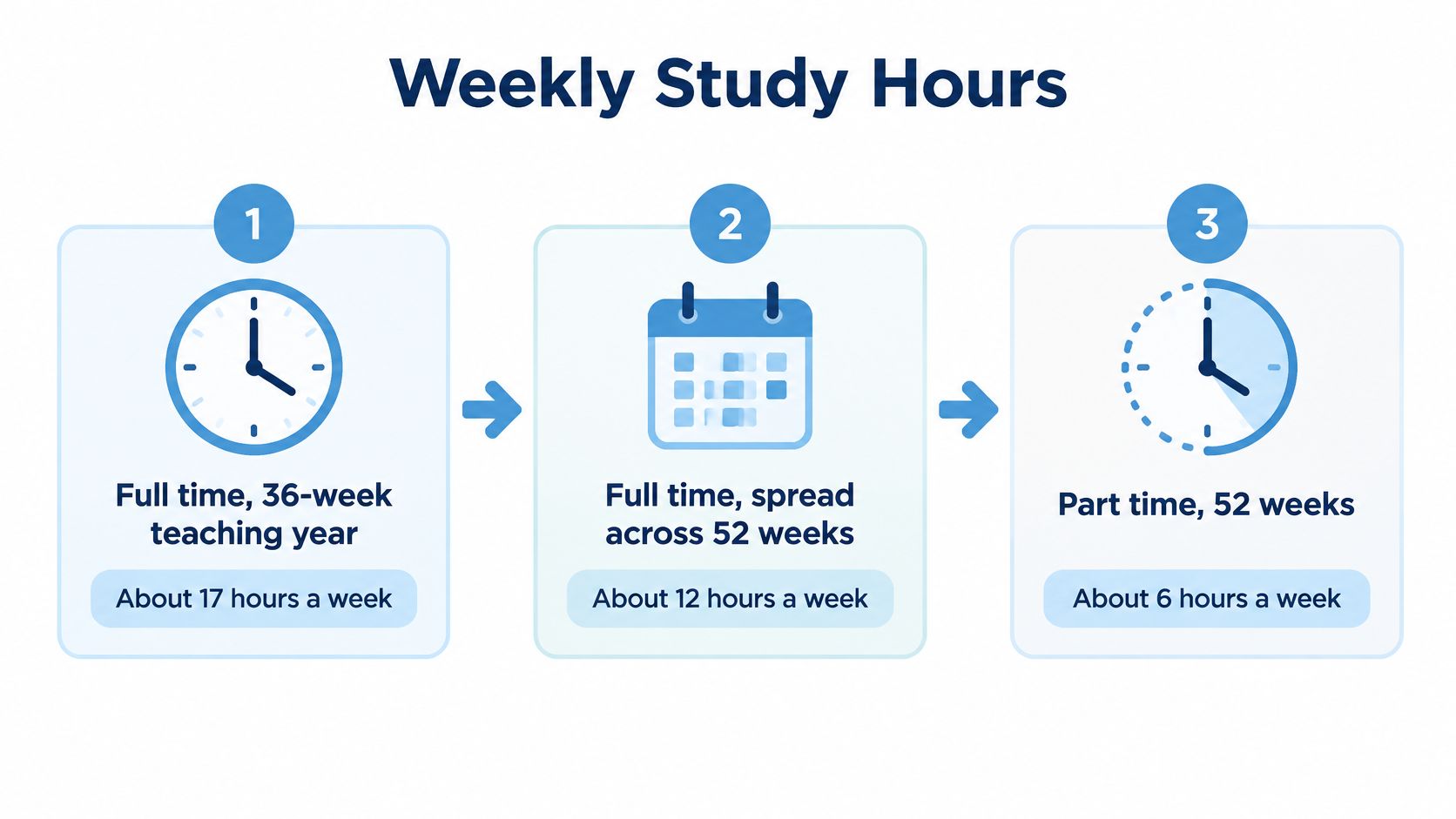
About 17 hours a week is three evenings of roughly four hours, plus a shorter weekend block. Spread the same full-time load across 52 weeks instead of a 36-week teaching year and the average falls to about 12 hours a week. The Diploma is a one-year Level 3 course that can also be studied part time over two or more years. That longer pattern is how the weekly load drops to about six hours. Six hours still has to land on the same days every week. Miss them and the lighter pattern becomes a backlog.
Set the hours before week one
- Pick a pattern and count the weeks you will study, skipping known holidays and heavy work periods.
- Divide 600 by those weeks. A 40-week year is 15 hours. A 30-week year is 20.
- Add a buffer of 10 to 15 per cent for referencing, revision and weeks when you are ill or overtime hits. On a 17-hour plan, that is roughly two extra hours.
- Block the total into two or three fixed sessions. Three evenings of four hours beats a vague promise to "catch up at the weekend".
- Put the first assignment deadline in the calendar and work backwards to a draft date a week earlier.
- After four weeks, compare hours logged with hours planned and move a session if the plan is fiction.
A simple log stops the guesswork. If you want something built for logging time against tasks, find an app that tracks client hours and use the same habit for study blocks. Pair that with a written weekly plan, and our guide to time management for students walks through how to protect those slots when work shifts.
Say you work four days and care for a child on the fifth. A two-year pattern of about six hours, split into Tuesday evening and Saturday morning, is more honest than a 17-hour full-time plan you will abandon in October.
Why the Workload Stacks Up Across Units
There is no single final exam that decides the Diploma. On a UK science pathway described by the National Careers Service, the credit load can include 15 credits of chemistry, 15 credits of biology and 9 credits of mathematics, plus the rest of the academic preparation. Assessment is a mix of written reports, presentations, tests, examinations and practical experiments. Several units run at once, so the diary fills from the middle of term, not only at the end.
Picture a weekend in that science route. Friday holds a chemistry lab report. Sunday morning is a biology test. Sunday evening was meant for a maths worksheet and the opening of an essay. Miss Friday and the report slides into Sunday. The test revision shrinks. The essay does not start. One slip touches three units because they share the same free hours. That stacking, not the difficulty of any one topic, is what makes the middle of the course feel sudden.
Three things usually cause the pile-up.
- Time away from study. Reading a journal article can take an evening when you have not done it for a decade.
- A full-time job. A late shift deletes the only slot you had reserved, and the work does not move itself.
- Referencing. Finding, reading and citing sources often takes longer than writing the answer.
Put every deadline from every unit on one calendar in week one, including draft dates. Send work in early enough that feedback can still change the grade. If a week collapses, rewrite the next fortnight rather than treating the miss as a reason to stop.
If the calendar shows two deadlines in the same week for three weeks running, rebalance now. Move a draft forward or ask which task can shift.
Academic Writing and Grading Standards to Master
Subject knowledge is only half the grade. The National Careers Service course outline describes assessment through essays, research reports, presentations, financial or marketing plans, timed assignments and other higher-education-style tasks. Graded credits are marked Pass, Merit or Distinction. The gap between those grades sits in argument, evaluation and evidence, not in whether you finished the task.

You are building a small set of transferable skills at the same time as the content: academic writing, source evaluation, referencing, data interpretation and presentation. Weak organisation, or writing that describes instead of evaluates, pulls the grade down even when you understand the topic. Our explanation of how Access courses are graded sets out how those standards are applied. Competitive degrees may also want particular subject credits or target grades, so read the university page before you choose units. At Access Courses Online, assignments are graded pass, merit or distinction, which means the same ladder applies whether you are writing a lab report or a business plan.
A week that protects the grade
Split the work so referencing is not left until midnight.
- Session one, reading and notes. Pull three sources and write one sentence on what each claims.
- Session two, drafting and referencing. Build the argument and attach the citation as you go, not after.
- Session three, a short review. Check the brief, cut description that does not answer it, and fix the reference list.
Say you know the biology well but every paragraph retells the textbook and the citations are missing. That script can land at Pass when the understanding was Merit. Evaluative writing says what the evidence shows, where it is weak, and how it answers the question.
Before you submit, run three checks. Does each paragraph make a claim? Is each claim sourced? Does the conclusion answer the brief you were given? If any answer is no, the draft is not ready, however long you have already spent on it.
Support and Flexible Study That Ease the Load
How the course is delivered changes how hard it feels. All of our courses are studied 100% online, at your own pace. You do not have to attend live lessons. You can watch session recordings and arrange a time to meet your tutor. One-to-one support is available through online video calls and messenger chats. That pattern suits people in full-time work, part-time work or caring roles, which is how our students study.

Flexibility helps only if you use the tutor before you are stuck, not after a deadline has passed.
Send an outline first. A half-page plan, with your claim and three sources, takes a tutor minutes to redirect. A finished 1,500-word essay that answers the wrong question takes you a weekend to repair.
Ask about referencing once, properly. Bring one paragraph and the style your brief names. Fix the habit on that example instead of collecting a new comment on every script.
Book a fixed check-in. A 20-minute call on the same weekday stops a quiet fortnight becoming a month behind. Recordings let you replay the explanation at 7am before a shift.
The more open your timetable, the more you need one protected weekly slot and a tutor you actually speak to.
A learner with no fixed evening can fall behind in a fortnight, because nothing in the diary rings an alarm. Own-pace study removes the classroom clock. It does not remove the credits. Put the hours in the diary first, then use chat and calls to keep the work on standard.
Funding and Entry Rules That Add Pressure
A learner can write a solid Level 3 essay and still stall on the form that decides whether the place is paid for. That stall is admin pressure. It is separate from whether you can do the academic work. The funding form works like a gate at the front of the building: you can be ready for the class inside and still be stuck outside if the paperwork is wrong.
In England, Advanced Learner Loans have supported eligible adult learners on approved Level 3 to 6 qualifications. The further education and skills statistics methodology records that the Adult Skills Fund replaced the Adult Education Budget from the 2024–25 funding year, and it describes a Lifelong Learning Entitlement intended to replace higher-education and Advanced Learner Loan arrangements for later course starts. England, Wales, Scotland and Northern Ireland do not share one rulebook. A loan or grant that covers tuition does not pay the rent, childcare or travel, so a funded place can still feel out of reach when bills are tight. An online Level 3 course is not automatically treated like an approved Diploma. Do not assume the start date you want sits under the loan rules in force today.
Checks before you enrol
- You need to be 19 or over by 31 August in the year you wish to study. That is the age rule for an Access to HE course with Access Courses Online.
- Read your nation's funding rules and any previous loan. A loan taken earlier can change what you can claim now.
- Access Courses Online can accept you without any GCSEs. Some universities still want GCSE English and maths, or an equivalent, so check the degree pages rather than the Diploma rules alone.
- Confirm which system covers your start date, and whether it pays tuition only or living costs as well, with the funding body and with the provider. Our guide to Access to Higher Education funding sets out the questions worth asking before you commit.
Rules change. Confirm them with the relevant funding body before you pay a deposit or turn down a job.
Decide Whether an Access Course Suits You
The QAA diploma specification reports that more than 20,000 students achieve an Access to Higher Education Diploma each year and progress to university courses across the UK. It also reports that 90% of graduates are employed or in further study six months after graduation. The standard is high, and the route is heavily used.
You still have to achieve all 60 credits, including 45 graded Level 3 credits, on a qualification universities across the UK recognise. It is written for adults who did not take A levels, and it still expects academic writing, independent study, deadline management and evidence-based work. It is not a short preparatory class.
The course suits you if you can keep roughly 12 to 17 hours a week, or a genuine part-time equivalent, for the full length, and you can accept graded assessment. If that full-time pattern will not fit, use the two-year or longer pattern before you decide the Diploma is wrong for you. Lack of A levels is not evidence you will fail.
What to do this week
- Read the entry requirements for your target degree. We can review published requirements and contact admissions on your behalf. The university makes the final decision.
- Put your weekly hours on a real calendar, using the pattern you can repeat in a bad month, not an ideal one.
- Run the funding checks for your nation and your start date before you compare course prices.
- Choose an accredited provider with tutor support, and ask how university applications are handled. All of our courses are accredited, and we discuss course choices, proofread personal statements and provide references.
If the hours fit and the funding is clear, the workload is challenging and finishable. If the hours do not fit any pattern you can keep, wait and rearrange work or caring first. Starting without the hours is what makes the Diploma feel impossible.
If you want a Diploma you can study fully online, with tutor support and help on university applications, look at the pathways at Access Courses Online. We run accredited Access to HE courses you can start around work, including routes into nursing, health, science, computing and business. Check the course that matches your degree, then match its credit load to the weekly hours you can keep.