

Maths Functional Skills are qualifications built for the real world. Forget abstract algebra and complicated theories for a moment—this is all about giving you the practical numeracy skills that employers and universities are crying out for. Think of it as maths for everyday life and work, focused on solving problems you'll actually encounter.
It’s the key to unlocking your next big career move or educational goal.
What Are Maths Functional Skills?
Ever tried to follow a recipe, manage a household budget, or figure out a sales discount at your favourite shop? All these everyday tasks rely on a solid grasp of maths. That’s exactly what Maths Functional Skills delivers: the practical, hands-on numeracy you need to navigate life and work with confidence.
It steps away from the complex, theoretical maths you might remember from school and gets straight to the point—how numbers work in the real world.
For many adults, this qualification is a vital stepping stone. Whether you’re aiming for a promotion, coming back to education after a break, or getting ready for university, it proves you have a level of competence that is genuinely respected.
The Two Key Levels Explained
The qualification comes in two main levels, and each one serves a different purpose on your journey.
- Level 1 Functional Skills: This is often seen as equivalent to a GCSE grade 3 (or D). It's a fantastic starting point if you need to build up your confidence and get a refresher on your core maths skills.
- Level 2 Functional Skills: Now, this one is the real game-changer. It’s widely recognised by universities and employers as equivalent to a GCSE grade 4 (or a C). Hitting this level is often a non-negotiable requirement for getting into higher education, especially for Access to Higher Education Diplomas.
To help you see the differences more clearly, here’s a quick comparison.
Maths Functional Skills Level 1 vs Level 2 at a Glance
Use this quick comparison to see which level aligns with your career and education goals.
| Feature | Functional Skills Level 1 | Functional Skills Level 2 |
|---|---|---|
| GCSE Equivalence | Roughly equivalent to a GCSE Grade 3 (D) | Widely accepted as equivalent to a GCSE Grade 4 (C) |
| Best For | Learners needing a solid foundation or a confidence boost in their maths skills. | Learners aiming for university, apprenticeships, or careers requiring a GCSE pass. |
| Core Skills Focus | Straightforward calculations, basic fractions, decimals, percentages, and simple data. | More complex problem-solving, multi-step calculations, and interpreting varied data. |
| University Entry | Not typically accepted for direct university entry. | Accepted by most UK universities for entry onto degree courses. |
| Common Career Paths | Entry-level roles, apprenticeships, and progression to Level 2. | Nursing, midwifery, teaching, social work, business, and other professional fields. |
The main takeaway? Level 2 is the qualification that opens doors to degree courses in high-demand fields like nursing, business, and social work. It's an essential part of the puzzle for serious career progression.
If you want to dig a bit deeper into the qualifications themselves, you can learn more about what Functional Skills qualifications are in our detailed guide.
A Smarter Alternative to GCSE Resits
For adults returning to education, the thought of resitting a traditional GCSE can be intimidating. The great news is that Maths Functional Skills qualifications often offer a much more achievable path to the same goal. The focus on practical, real-world application just clicks better with adult learners, and the pass rates really back this up.
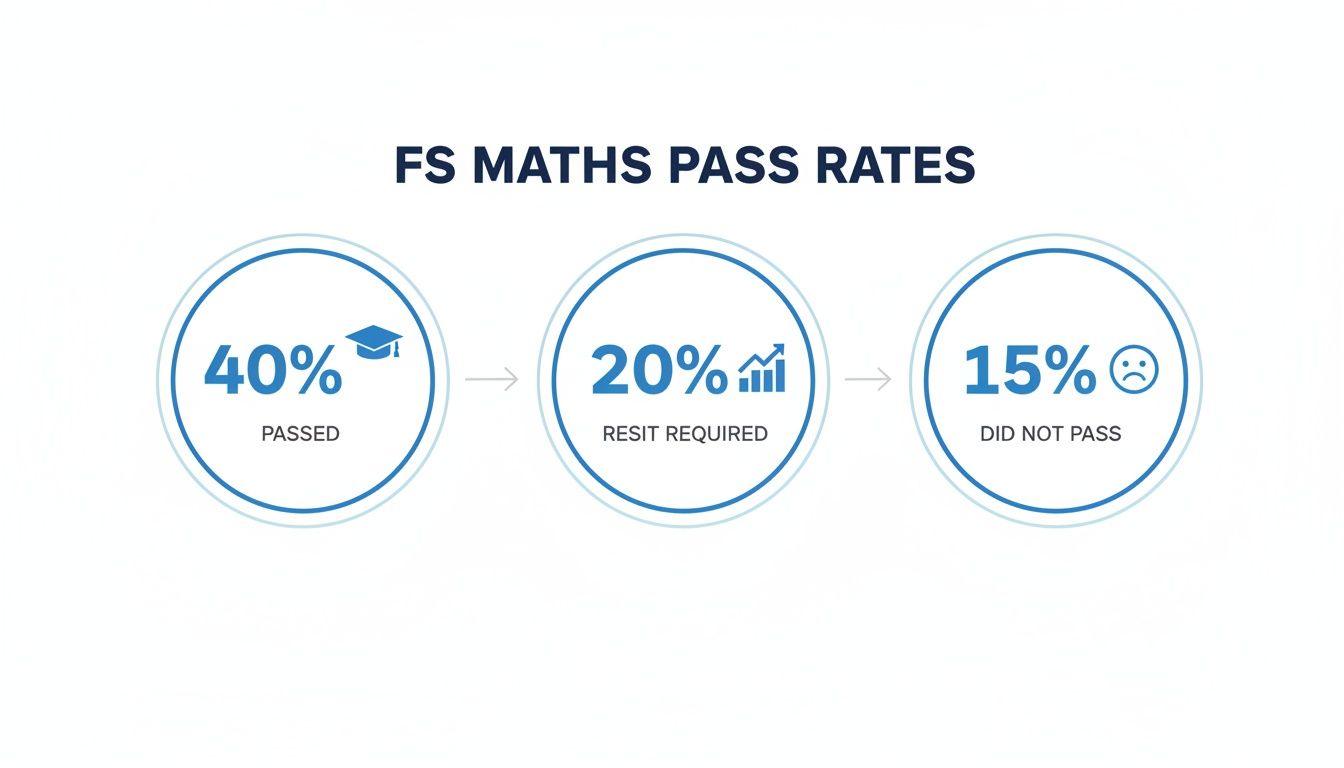
In fact, recent data paints a very encouraging picture. Comparing Functional Skills Maths pass rates to GCSE outcomes shows that Level 2 success rates were between 36-50% in 2023-24. That’s a huge difference when you look at the 15% pass rate for 17 to 19-year-olds resitting their GCSEs.
Pearson's data confirms this trend, showing that Level 2 Maths pass rates consistently outperform GCSEs, making it a statistically stronger choice for many adult learners.
This qualification isn't just about passing an exam; it's about building the confidence and practical skills to solve problems effectively. From calculating measurements for a DIY project to interpreting data in a work report, these are abilities you will use for the rest of your life.
Decoding What You Will Actually Learn
Forget the abstract, dusty maths problems you might remember from school. The Maths Functional Skills curriculum is built for one single purpose: to give you the practical number skills you need for everyday life and your future career. It’s all based on real-world scenarios, making every topic feel relevant and immediately useful.
The whole qualification is built around three core pillars. Each one is designed to help you build confidence in a different area of practical maths, whether that’s managing your money or just making sense of the world around you. Let’s break down exactly what you’ll be learning.
Pillar 1: Using Numbers and the Number System
This is the foundation for everything else. It’s all about getting comfortable with the numbers you see every day and using them to make smart decisions. Think of it as your toolkit for personal finance and workplace calculations.
You'll get to grips with essential concepts, including:
- Fractions and Decimals: Learn to confidently switch between them to compare prices at the supermarket or get the ingredients right for a recipe.
- Percentages: This is a huge one. It’s crucial for everything from understanding a 20% off sale to calculating interest on a loan or figuring out a pay rise.
- Ratio and Proportion: You'll use these skills to scale up a recipe, mix solutions correctly in a healthcare setting, or even understand map scales for a journey.
An aspiring business owner, for instance, would use these skills every day to calculate profit margins and analyse sales data. A healthcare assistant might use them to make sure medication dosages are spot-on.
Pillar 2: Measures, Shape, and Space
This pillar moves beyond numbers on a page and into the physical world. It’s about understanding measurements, dimensions, and how things fit together—skills that are just as vital for home DIY projects as they are for professional technical jobs. This area helps you visualise and solve practical problems.
The key topics you'll cover are:
- Area, Perimeter, and Volume: This is essential for tasks like figuring out how much paint you need for a room, ordering the right amount of carpet, or calculating the capacity of a container.
- Metric and Imperial Units: You'll become confident converting between units like centimetres and inches or kilograms and pounds, which is a common requirement in many UK industries.
- Time and Temperature: Learn to manage schedules, calculate journey times, and interpret temperature scales with accuracy.
A future nurse needs to be precise with measurements to monitor a patient’s health, while a tradesperson will use these skills constantly to plan projects and order the right materials.
Pillar 3: Handling Information and Data
In our modern world, we’re surrounded by information presented in charts, graphs, and tables. This final pillar teaches you how to read, interpret, and analyse that data to draw your own conclusions. It's about becoming a critical thinker who can see the real story behind the numbers.
This part of the curriculum is all about turning raw data into useful knowledge. You'll learn to spot trends, question statistics, and make informed decisions based on evidence rather than guesswork.
The course demands that you can pull knowledge from across all these topics. For instance, awarding bodies like NCFE have noted that maths results can be challenging because learners must apply skills from different areas—like percentages and data interpretation—to solve a single problem. This is exactly why structured revision is so important for success.
You can explore more about these qualification demands and how they stack up against the Level 2 GCSE grade 4 (C) equivalence in this detailed breakdown from City & Guilds about pass rates.
Navigating the Exam Format and Pass Requirements
Knowing what to expect in your maths functional skills exam is a massive step towards feeling confident and in control. This isn't a test of abstract theory; it's all about seeing how you apply mathematical thinking to real-life situations. Let's break down exactly what the exam looks like.
The exam is split into two distinct parts, and each one tests a different set of skills.
-
The Non-Calculator Section: This is usually the shorter part of the test. It's designed to check your core numeracy skills—your ability to handle addition, subtraction, multiplication, and division without any help. It also looks at how well you understand fractions, percentages, and decimals in their raw form.
-
The Calculator-Permitted Section: This is the main event. It's the longer section and is packed with more complex, multi-step problems. Here, the focus isn't just on crunching the numbers but on your ability to figure out the right mathematical steps to solve a problem. Think of the calculator as a tool that lets you manage the tricky calculations so you can focus on the logic.
Showing Your Working Is a Game-Changer
In both sections, the questions are framed as real-world scenarios. You might be asked to work out the materials for a DIY project, make sense of a company's sales figures, or manage a personal budget. If there’s one piece of advice to take away, it’s this: always show your working.
Think of it as explaining your thought process to the examiner. Even if you make a slip and get the final answer wrong, you can pick up a lot of partial marks just for showing you were on the right track. A simple calculation error shouldn't cost you the entire question if your method was solid.
The examiners aren't just looking for the right answer; they want to see how you got there. Clearly laying out each step of your calculation is the best way to secure every possible mark and prove your understanding.
Understanding the Pass Requirements
The qualification is graded as a simple pass or fail. Unlike GCSEs, there are no confusing tiers or grades to worry about. You either meet the required standard or you don't, which makes your goal crystal clear.
So, what score do you need to aim for? While the exact pass mark can shift slightly from paper to paper to keep things fair, you’ll typically need to get around 55% to 60% to pass. This should be a relief—it means you don't need a perfect paper to succeed. For a deeper look at the specifics, our guide to the Functional Skills Level 2 qualification has more detail.
Taking Your Exam Online From Home
One of the biggest pluses for adult learners is the option to take the exam remotely. This is done with an online proctor (or invigilator) who supervises you through your webcam and microphone to make sure exam conditions are followed.
To sit your exam online, you’ll generally need:
- A reliable internet connection.
- A computer or laptop with a working webcam and microphone.
- A quiet room where you won’t be disturbed.
The proctor will walk you through the setup process before the exam starts, making sure you're comfortable with the technology. This flexible approach takes away the stress of travelling to an exam centre, letting you earn your qualification from a familiar and comfortable space.
Nail Your Revision: Study Strategies and Practice Questions
Knowing your maths is one thing, but turning that knowledge into a passing grade? That all comes down to smart preparation. For busy adults, last-minute cramming just doesn't work. The secret is often the ‘little and often’ method—carving out short, focused study sessions that fit around your life.
This approach keeps the material fresh in your mind without leading to burnout. Honestly, twenty minutes of focused practice each day is far more powerful than a frantic five-hour session once a week. It builds momentum and confidence, turning what feels like a huge task into a simple, manageable habit.
Of course, staying on track is half the battle. If you feel your motivation dipping, check out these brilliant strategies to motivate students to keep your learning drive strong.
The Power of Practice Papers
If I could give you only one piece of advice, it would be this: do as many past papers as you can get your hands on. This is the single most effective thing you can do to get ready for the exam. It’s not just about testing what you know; it’s about getting comfortable with the exact style and structure of the questions you’re going to face.
Working through practice papers helps you to:
- Get to Grips with Question Formats: You’ll quickly learn to spot what the examiner is really asking for and how they expect you to lay out your answers.
- Become a Time Management Pro: Doing papers under timed conditions is the only way to get your pacing right for the real thing.
- Pinpoint Your Weak Spots: Getting a question wrong during revision is a good thing! It shows you exactly which topics need a bit more of your attention.
By the time you walk into the actual exam, the layout and question types will feel completely familiar. This massively reduces any pre-exam jitters and lets you focus all your energy on solving the problems.
Worked Example: Level 2 Question
Let's walk through a typical multi-step problem to see how you should break it down. This kind of question, mixing percentages with everyday calculations, is a classic feature of the calculator paper.
Scenario: A local cafe sells 350 coffees on a Monday. The manager predicts that sales will jump by 15% on a Saturday. If each coffee costs £2.80, how much money will the cafe make from coffee sales on Saturday?
Step-by-Step Solution:
-
Work Out the Increase in Sales: First, we need to find 15% of the Monday sales.
- Calculation: 350 coffees x 0.15 = 52.5
- Now, you can't sell half a coffee, so it's logical to round this up to 53 extra coffees.
-
Find the Total Sales for Saturday: Add the extra coffees to the Monday total.
- Calculation: 350 + 53 = 403 coffees.
-
Calculate the Total Revenue: Finally, multiply the number of coffees sold on Saturday by the price of each one.
- Calculation: 403 coffees x £2.80 = £1,128.40
Final Answer: The cafe will make £1,128.40 from selling coffee on Saturday. See how breaking the problem into small, logical steps makes it easy to follow and, crucially, show your working?
Dodging Common Exam Mistakes
It's often the small, silly errors that rob students of precious marks. Just being aware of these common slip-ups is the first step to making sure you don't fall into the same traps.
The goal isn't just to know the maths, but to apply it accurately under pressure. Avoiding simple mistakes can easily be the difference between a pass and a fail.
Here are the most common mistakes we see and how to sidestep them:
- Misreading the Question: This is the number one mark-killer. Always read the question twice, and maybe even highlight the key numbers and instructions. Ask yourself: what is it actually asking me to do?
- Calculator Blunders: It’s so easy to hit the wrong button when you’re in a rush. Always double-check your entries, especially on long calculations. A quick sense-check (e.g., "does this answer look reasonable?") can help you spot a major typo.
- Forgetting to Show Your Working: This is a big one! Even if you get the final answer wrong, you can still pick up marks for using the correct method. Always write down every step of your calculation.
- Mixing Up Your Units: Be so careful with units like metres and centimetres, or pounds and pence. Make sure your final answer is in the unit the question asks for.
By actively practising your exam technique and keeping these common pitfalls in mind, you put yourself in the strongest possible position to earn every mark you deserve and get that pass.
How We Help You Succeed at Access Courses Online
Choosing the right course is one thing, but choosing the right provider? That’s where the real difference is made. The support system you have in your corner can make or break your success, especially when you’re juggling studies with work, family, and everything else life throws your way.
Here at Access Courses Online, our entire approach is built around adult learners like you. We know what it takes to get your maths functional skills qualification and open the door to university.
A rigid, 9-to-5 study schedule just doesn't work for most people. That’s why our platform is completely flexible. You can log in and learn whenever and wherever it suits you, with absolutely no deadlines breathing down your neck. It puts you back in the driver's seat of your own education.

Dedicated Support from Tutors Who Get It
Studying online doesn’t mean studying alone. Not with us, anyway. As soon as you enrol, we pair you with a dedicated tutor who’s an expert in their field. Think of them as your personal guide, ready to offer one-on-one support whenever you hit a bump in the road.
Stuck on a tricky topic? Need a bit of a confidence boost? Your tutor is just an email, phone call, or even a WhatsApp message away. This kind of personalised support means you’ll never feel lost. You’ll have the confidence to tackle any challenge head-on. To get a real feel for this, check out our guide on what it’s like to study an Access course from home.
Of course, it's always smart to get a broader perspective by understanding UK online course platforms, but our focus will always be on providing the direct, personal support that helps adult learners thrive.
Practical Help Every Step of the Way
We do more than just teach the coursework. Our team is here to provide all the administrative support you need, taking the stress out of the practical side of things so you can just focus on learning.
We’ve put together a quick table to show you what your journey with us looks like.
Your Journey with Access Courses Online
| Stage | How We Support You |
|---|---|
| Enrolment & Getting Started | We get you set up with your course materials and introduce you to your personal tutor. |
| Ongoing Study Support | Your tutor is available for one-on-one help via email, phone, or WhatsApp whenever you need it. |
| Exam Booking | We guide you through the entire process of booking your online exam, making it simple and stress-free. |
| Reasonable Adjustments | If you have additional learning needs, we work with you to arrange adjustments like extra time for your exam. |
| Financing Your Course | We offer interest-free payment plans, allowing you to spread the cost over 12 months to make it affordable. |
| Certification & Next Steps | Once you pass, we celebrate with you and provide guidance on your progression to an Access Diploma or university. |
Our goal is simple: remove the barriers and give you a clear, supportive path from the day you sign up to the day you get your certificate.
A Clear Pathway to Higher Education
For so many of our students, a maths functional skills qualification is the key that unlocks the door to an Access to Higher Education Diploma and, eventually, a university degree. We specialise in this journey and know exactly how to get you there.
These qualifications are a vital bridge for adults aiming for university, especially if you don’t have traditional A-Levels. The practical skills you learn—from budgeting to analysing data—are directly useful for degrees in Business, Science, and Health.
With our structured support and clear progression routes, you're not just earning a qualification; you're investing in a new future. We provide the tools, guidance, and flexibility you need to turn your career ambitions into reality.
Your Questions Answered
Stepping back into education can bring up a lot of questions. We get it. To help clear up any confusion, we’ve put together honest, practical answers to the queries we hear most often about maths functional skills. Our goal is to give you the clarity and confidence you need to take that next step.
How Long Does a Maths Functional Skills Course Take?
This is one of the best parts – you’re in the driver’s seat. Our courses are self-paced because we know life is busy. They’re designed to fit around your world, not the other way around.
Some of our learners who can dedicate a good chunk of time might get through the course in just a few weeks. Others take several months, chipping away at their studies between work shifts and family life. On average, most people are ready for their exam within 3 to 6 months.
The key thing to remember is that there are no rigid deadlines breathing down your neck. You set the pace. This means you can move as quickly or as steadily as you need to, ensuring you feel genuinely prepared and confident when exam day comes.
Is Functional Skills Level 2 Maths Really Accepted by Universities?
Yes, absolutely. This is probably the most important question we get asked, and the answer is a definite yes. Ofqual, the official qualifications regulator here in the UK, recognises a Level 2 Functional Skills qualification in Maths as being equivalent to a GCSE grade 4 (which you might remember as a grade C).
This means universities up and down the country accept it as a valid entry requirement for countless courses. It’s particularly vital for anyone looking to do an Access to HE Diploma, as it opens the door to sought-after degrees in fields like nursing, midwifery, social work, and business. For thousands of adult learners every year, this qualification is the key that unlocks their path to higher education.
Think of the Level 2 qualification not just as an alternative to a GCSE, but as a respected and practical pathway designed specifically for learners who need to prove their skills for university or a career boost.
What Happens If I Don’t Pass the Exam?
First of all, don’t panic. It’s completely normal to worry about this, but failing an exam on your first go is not the end of the road. Far from it. One of the great things about the Functional Skills system is that it’s built for second chances.
If you don't pass, you’ll get detailed feedback showing you exactly which areas you need to work on. Our expert tutors will then jump in and work with you one-on-one to build a revision plan that targets those weaker spots. It completely removes that intense, 'one-shot' pressure you often get with traditional exams.
This supportive approach lets you learn from the experience, strengthen your knowledge, and walk into your next attempt feeling much more prepared and in control. A resit is just another step on your learning journey, not a setback.
Can I Pass If I Have Severe Maths Anxiety?
You are not alone. Maths anxiety is incredibly common, and so many adult learners are carrying around bad memories from their school days. Our courses are specifically designed to help you leave those feelings behind and build a new, positive relationship with numbers.
We do this in a few key ways:
- We focus on practical, real-world maths. Forget abstract theory. We concentrate on the kind of problems you can actually relate to, like working out a budget or planning a project. This makes it all feel more relevant and a lot less scary.
- You get a stress-free learning environment. Because the course is online and self-paced, you can learn from the comfort of your own home, without the pressure of a classroom.
- You get one-to-one, judgement-free support. Your tutor is there to provide personalised, encouraging guidance. They’ll help you build your confidence one step at a time and are ready to answer any question, no matter how big or small you think it is.
Many of our most successful students started out feeling anxious and full of doubt. With the right support and a focus on how maths works in the real world, they not only passed their exam but also found a confidence they never thought they’d have.
At Access Courses Online, we provide the flexible courses, dedicated tutor support, and clear guidance you need to achieve your goals. If you're ready to gain the qualification that unlocks university and new career opportunities, we're here to help you every step of the way. Explore our courses today at https://accesscoursesonline.com.