
Your mental health nursing personal statement is your chance to tell a story. It’s where you connect your unique life experiences to the core values of nursing, creating a narrative that shows your empathy, resilience, and genuine passion for the profession. Think of it as much more than a list of achievements—it’s a critical part of your university application.
Why Your Personal Statement Matters for Mental Health Nursing
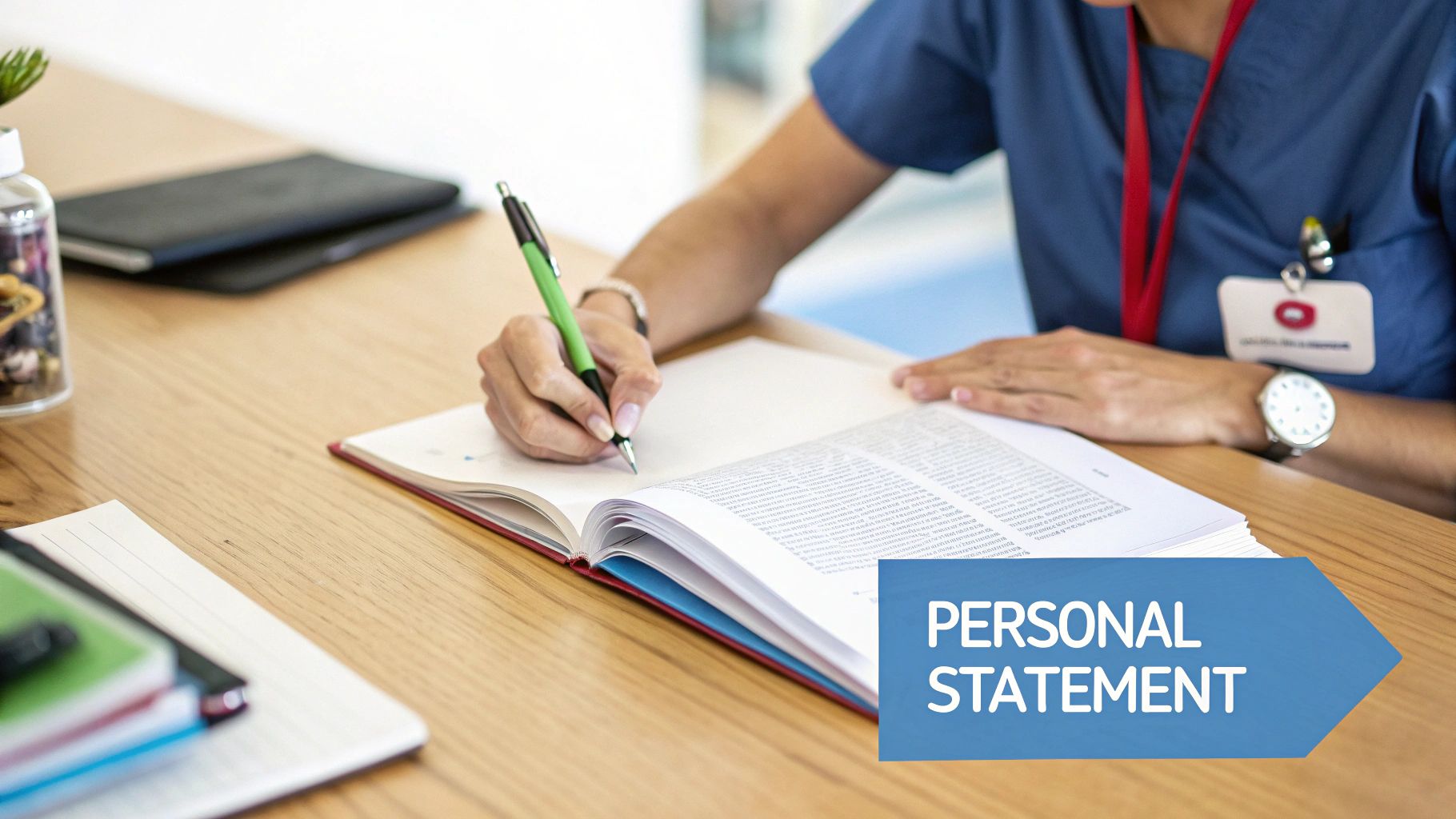
Let’s be honest, writing about yourself can feel a bit daunting. But for a career as demanding and rewarding as mental health nursing, this statement is your single best opportunity to show admissions tutors who you are beyond your grades. It's the space where you finally connect the dots between your background and your future.
This is especially true for adult learners and those on Access to HE courses. Your journey—whether it’s from a different career, raising a family, or volunteering—is packed with the exact transferable skills universities are looking for. Tutors actively seek out the maturity, insight, and real-world resilience that these experiences bring to the table.
Admissions tutors aren't just scanning for keywords; they want to see that you truly get what the role involves. They are looking for a unique blend of specific qualities.
Key Qualities Admissions Tutors Are Looking For
Here's a quick look at the essential attributes you need to weave into your statement.
| Core Competency | What It Looks Like | How You Can Show It |
|---|---|---|
| Deep Compassion | A genuine ability to connect with people who are distressed, vulnerable, or in crisis. | Use examples from work or life where you’ve supported someone through a difficult time. |
| Emotional Resilience | The strength to handle challenging and emotionally charged situations on a daily basis without burning out. | Talk about a time you faced a significant challenge and what you learned from the experience. |
| Superb Communication | Building trust with service users and collaborating effectively with multidisciplinary teams. | Describe a situation where your listening or communication skills made a real difference. |
| A Strong Sense of Advocacy | Standing up for individuals who are often marginalised and ensuring their voices are heard. | Mention volunteering or any instance where you advocated for someone else’s needs. |
This narrative is your primary tool for convincing a university that you’re the right fit. If you want to dive deeper into crafting a compelling application, there's some great advice on how to write a personal statement that wins admissions.
The timing couldn't be better. The demand for skilled mental health professionals has never been higher, and with the NHS planning to boost training places by a massive 93% by 2031/32, now is the perfect moment to make a change.
Your personal statement is how you turn a blank page into a powerful story that says, “I am ready for this.” For more guidance, explore our detailed advice on how to kickstart a career in mental health.
Structuring Your Statement for Maximum Impact
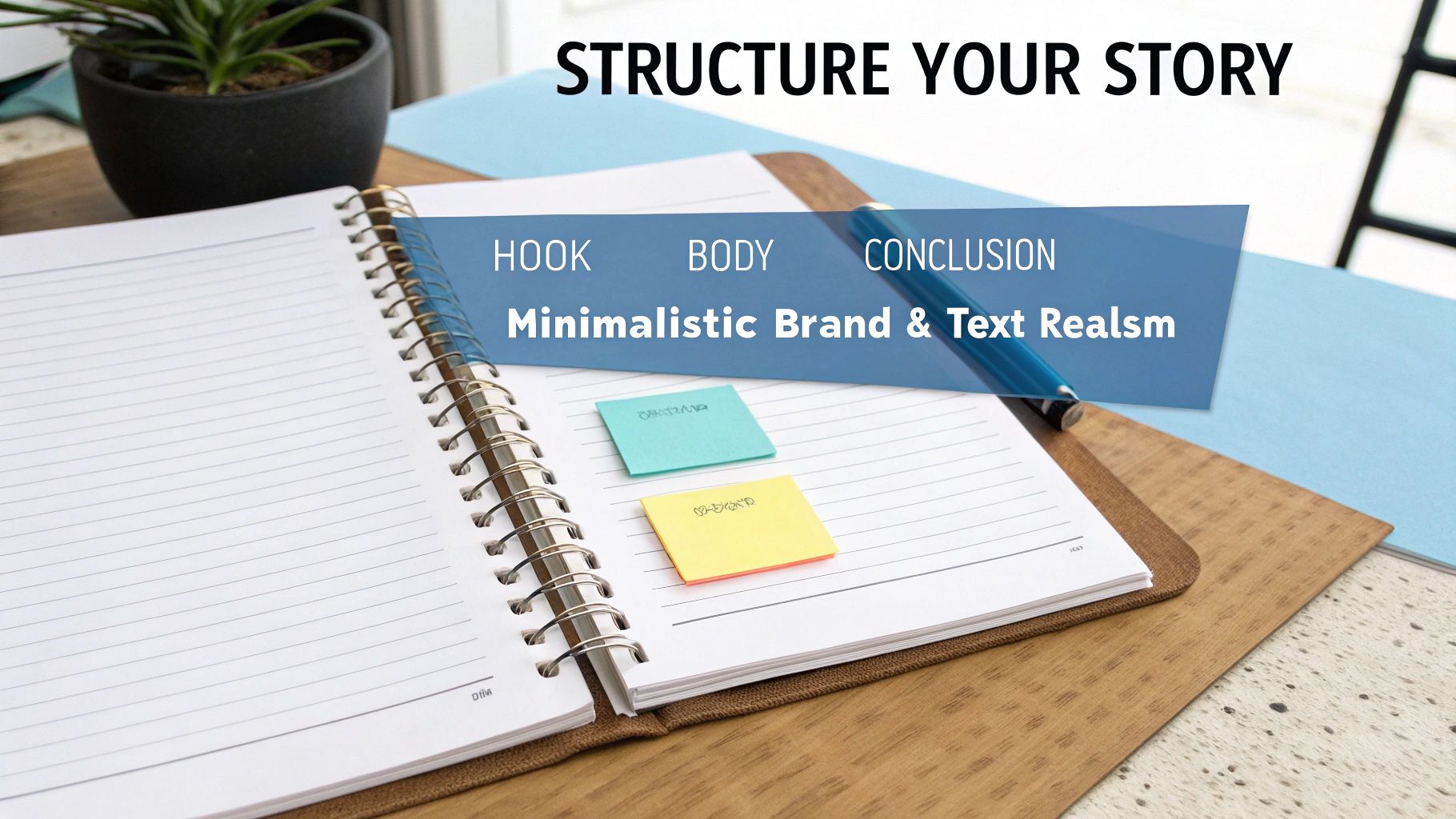
A great personal statement is so much more than a list of your accomplishments. It's a story—your story—with a clear beginning, middle, and end. You’re essentially building a case for why you belong on this course, and you need a logical flow that guides the admissions tutor from your first spark of interest right through to your future ambitions.
When you structure your statement properly, you avoid it becoming a jumbled mess of experiences. Instead, you create a powerful narrative that pulls the reader in, builds momentum, and leaves them feeling like they absolutely have to meet you. Every paragraph should have a purpose, adding another layer to your argument that you are a perfect fit.
The Three-Act Narrative
The most effective statements I’ve seen all follow a simple, tried-and-tested structure. Breaking it down this way helps you hit all the key points without rambling or repeating yourself.
-
Act One: The Hook: Your introduction is your first impression. It needs to grab their attention from the very first sentence. State your passion for mental health nursing and give them a hint of the unique perspective you’re bringing to the table.
-
Act Two: The Evidence: This is the heart of your statement. The middle paragraphs are where you bring the proof. You'll dedicate space here to show concrete evidence of your skills, experiences, and deep understanding of what this profession really involves.
-
Act Three: The Future: Your conclusion ties it all together beautifully. It should recap why you’re a great fit, reinforce your commitment, and directly connect your personal ambitions to the specific university you're applying to.
For a deeper dive into the nuts and bolts of application essays, our comprehensive guide on how to write a personal statement is packed with valuable insights to help you sharpen your approach.
Building Your Core Argument
Within the main body of your mental health nursing personal statement, each paragraph needs to focus on a particular theme or skill. Don't just list things like "good communicator" or "resilient"—prove it.
For example, you could have one paragraph dedicated to your communication skills. Talk about a specific time in your retail job where you had to de-escalate a tense situation with a customer. What did you do? What was the outcome?
Then, another paragraph might explore your resilience. Maybe you can draw on your experience of juggling an Access to HE course with family life, showing how you’ve mastered time management and how determined you are to succeed.
Key Takeaway: Think of your structure as the skeleton of your story. A strong framework ensures your passion and experiences are presented in the most persuasive way possible, making the admissions tutor’s job of saying ‘yes’ an easy one.
By dedicating paragraphs to specific qualities and backing them up with real-world examples, you elevate your statement from a generic application to a compelling case for your admission. You’re showing, not just telling, that you have what it takes to thrive in this incredibly demanding but rewarding field.
Crafting an Introduction That Captivates
Your opening paragraph is your one shot to make a great first impression. Imagine an admissions tutor sifting through a huge stack of applications. A generic line like, "I've always wanted to help people," is just going to get lost in the noise. Your mental health nursing personal statement needs to grab them from the very first sentence.
This isn’t about being over-the-top or dramatic. It's about finding a genuine, specific hook that shows exactly why you’re drawn to this field. Your intro has to immediately signal that you've really thought about the unique challenges and incredible rewards of mental health nursing.
Finding Your Authentic Hook
A really powerful introduction often comes from a single, memorable moment or a key realisation. The trick is to steer clear of vague feelings and anchor your passion in something real and concrete.
Think about what really sparked your interest. Was it:
- A Specific Interaction? Maybe a conversation you had with a healthcare professional, a friend, or even a stranger completely shifted your perspective. You can describe the moment without ever revealing personal details about others.
- A Compelling Piece of Media? Perhaps a documentary, a book, or a particular article opened your eyes to the realities of mental healthcare and made you want to be part of the solution.
- A Startling Statistic? Was there a fact about mental health prevalence that just stopped you in your tracks? Something that lit a fire in you to make a difference?
The aim here is to show, not just tell. Instead of just saying you’re compassionate, open with a tiny story that proves it. It’s far more memorable and a whole lot more convincing.
From Bland to Brilliant
Let's break down how to turn a weak, forgettable opening into one that has real impact.
Before:
"From a young age, I've always been a compassionate person who wants to help those in need. I believe a career in mental health nursing is the perfect way for me to use this quality to make a real difference in people's lives."
We see this kind of opening all the time. It’s sincere, of course, but it doesn’t stand out and it lacks any real punch.
After:
"Reading that one in four adults in the UK will experience a mental health problem each year wasn't just a statistic to me; it was a call to action. It reframed my understanding of community and highlighted the critical role of empathetic, highly-skilled professionals who can offer support during someone's most vulnerable moments."
See the difference? This revised version is instantly more engaging. It shows you’re aware of the bigger picture, you're intellectually curious, and you're coming at this with a mature, focused perspective. Your introduction sets the tone for everything that follows, so make it count.
Connecting Your Experience to Core Nursing Skills
This is where you bring your story to life. It’s the part of your statement where you connect your past experiences—no matter how unrelated they might seem—to your future as a mental health nurse. Admissions tutors aren't just scanning for healthcare roles; they're searching for evidence of empathy, resilience, and communication.
Many applicants, especially those changing careers, get stuck here. They worry their retail job or office work isn't relevant. That’s a huge misconception. The patience you learned dealing with a frustrated customer is directly linked to de-escalation. The organisational skills you used to juggle deadlines are exactly what’s needed to manage a complex caseload.
Your mental health nursing personal statement needs to translate these experiences into the language of nursing.
Highlighting Key Nursing Competencies
Admissions tutors want to see your potential, not just hear you list your skills. The trick is to show, not just tell, using short, powerful examples from your own life.
-
Empathy: This goes far beyond simply feeling sorry for someone. It’s about truly trying to understand their perspective, even when it’s completely different from your own. Think about a time you supported a friend or colleague through a crisis. How did you listen without judgement? Proving you can connect with people on a human level is critical, and understanding the power of empathy is a great place to start.
-
Resilience: Let's be honest, mental health nursing is emotionally demanding. You have to show you can handle the pressure and bounce back when things get tough. Maybe you can talk about navigating a difficult project at work or the challenge of balancing your Access to HE studies with family commitments. The key is to focus on what you learned from the experience and how it made you stronger.
-
Communication: This is the absolute foundation of nursing. It’s about active listening, explaining things clearly, and knowing how to adapt your style for different people. Describe a situation where your ability to communicate well prevented a misunderstanding or helped to resolve a conflict.
The best paragraphs often start with a hook that grabs the reader's attention.
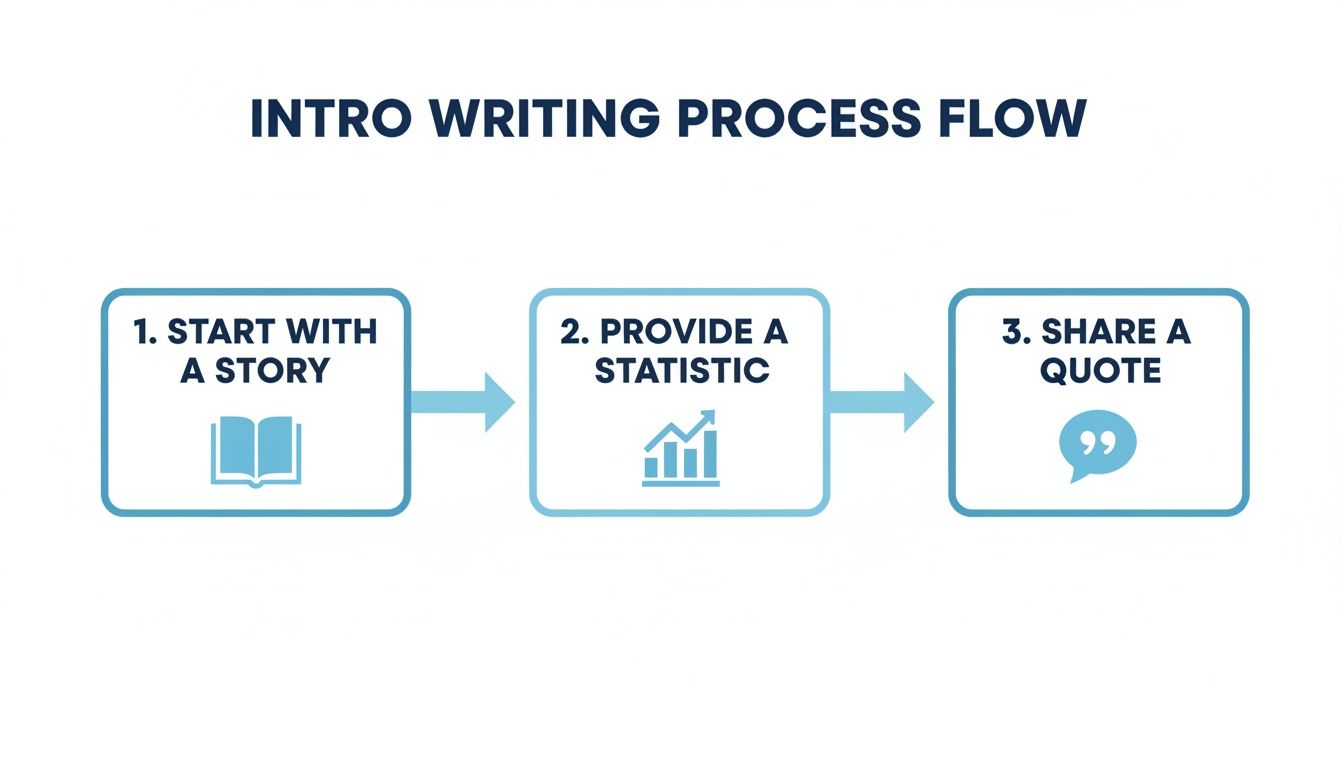
As the image shows, opening with a personal story, a striking statistic, or a meaningful quote can be a brilliant way to frame your experience and make an immediate impact.
Connecting Your Background to Nursing Competencies
To help you get started, here’s a table showing how you can link different jobs to the skills admissions tutors are looking for. It’s all about reframing what you’ve already done.
| Your Past Experience | Essential Nursing Skill | How to Phrase It in Your Statement |
|---|---|---|
| Retail / Hospitality | De-escalation & Empathy | "Handling customer complaints taught me to remain calm under pressure, listen actively to validate their concerns, and find solutions that de-escalated tense situations." |
| Office Administration | Organisation & Confidentiality | "Managing sensitive client files and coordinating complex schedules honed my organisational skills and reinforced the critical importance of maintaining strict confidentiality." |
| Call Centre Work | Active Listening & Resilience | "Working in a call centre developed my resilience and taught me to listen for the underlying issues in a conversation, a skill vital for understanding patient needs beyond their words." |
| Parenting / Carer Role | Patience & Advocacy | "As a primary carer, I learned to advocate for another's needs, manage medications, and provide consistent emotional support, developing a deep well of patience and compassion." |
Think of your past roles as a training ground. You've been building these core competencies for years, even if you didn't call them that at the time.
Using the STAR Method to Frame Your Examples
A simple but incredibly effective way to structure your examples is the STAR method. It stops you from waffling and helps you present clear, compelling evidence of your skills.
The STAR Method Breakdown:
Situation: Briefly set the scene. Where were you?
Task: What was the goal you needed to achieve?
Action: What specific steps did you take? Always use "I" statements.
Result: What happened because of your actions? What was the outcome?
Let's see it in action. Instead of a vague statement like, "My hospitality job gave me good communication skills," you can transform it into a powerful story.
Here’s how:
"(S) While managing a busy café, a customer became visibly distressed when their order was made incorrectly. (T) My immediate goal was to resolve the situation calmly and ensure they left feeling heard and valued. (A) I invited the customer to a quieter part of the café, listened to their concerns without interruption, and validated their frustration. I then personally remade their order and offered a full refund for the trouble. (R) The customer’s demeanour changed completely. They calmed down, thanked me for understanding, and have since become a regular, proving that empathetic communication can not only defuse tension but also rebuild trust."
This approach turns a bland claim into concrete proof. It shows you’re ready for the realities of mental health nursing—a field where these skills are needed every single day. The demand is undeniable; NHS mental health services in England recently recorded 5.2 million referrals, yet nursing vacancy rates are still hovering around 9.9%. Your skills are needed now more than ever.
Wrapping It Up: How to Write a Conclusion That Leaves a Lasting Impression
Your conclusion is your final chance to make your case. It’s the last thing an admissions tutor reads, so it needs to pack a punch and leave them with a really strong, positive feeling about you. A weak or rushed ending can make an otherwise brilliant mental health nursing personal statement feel a bit flat.
This isn’t the place to just rehash everything you’ve already said. The goal here is to neatly summarise your core message and, crucially, connect it directly to the university you’re applying to. You need to show them this isn't a copy-paste job; you genuinely want to study with them.
Make It Personal to the University
A generic conclusion that could be for any nursing course simply won't cut it. To show you’re serious, you have to prove you’ve done your homework on their specific programme. This tells them you’re not just firing off applications left, right, and centre. You can actually see yourself studying there.
A bit of research will uncover specific details you can drop in. Look for things like:
- A particular module that grabs your attention, like "Complex Care in Mental Health."
- The research of a lecturer you find particularly inspiring.
- A unique placement opportunity they offer that genuinely excites you.
Weaving one of these details into your conclusion shows that you’ve made a thoughtful, informed decision. For instance, you could say something like, "I was particularly drawn to your module on therapeutic interventions, as it aligns perfectly with my goal of developing practical skills to support individuals in acute distress." That one sentence proves you’ve read their curriculum and have a clear idea of where you’re headed.
Leaving Them with Confidence
Your final few lines should shout that you're ready for the hard work. You need to sound prepared, motivated, and fully aware of what this career path demands, both academically and emotionally.
Your conclusion is your last opportunity to reinforce that you understand the realities of mental health nursing and are fully prepared to embrace them. It should articulate not just a desire to learn, but a readiness to contribute.
End with a forward-looking statement that shows your passion and enthusiasm. Don't hold back. You want the admissions tutor to finish reading and think, "Yes, this person has the resilience, empathy, and drive to be an excellent mental health nurse."
A powerful closing might look something like this: "I am eager to bring my life experience and dedication to your programme. I am confident that the practical skills I will gain at [University Name] will prepare me to become a compassionate and effective advocate for my future patients. I am ready for the challenges ahead and excited to begin this vital work."
Common Mistakes to Sidestep
Even the most promising applicant can fall at the final hurdle. A polished mental health nursing personal statement steers clear of the common slip-ups that make admissions tutors’ eyes glaze over.
If you can avoid these, you let your genuine passion and experience shine through, and that’s what really counts.
One of the biggest culprits is relying on tired clichés. Tutors have read phrases like "I've always wanted to help people" or "I'm a caring person" thousands of times. While the sentiment is lovely, it doesn't tell them anything unique about you. Instead, show them you're a caring person through your examples; don't just state it.
Another classic mistake is just listing your skills without backing them up. Don’t just write that you have "excellent communication skills." Prove it. Share a short, sharp story from a job or life experience that shows those skills in action. That's where you make a real impression.
Proofreading: Your Final Polish
Sloppy mistakes can kill your credibility in an instant. Spelling and grammar errors suggest a lack of attention to detail, which is a massive red flag for any aspiring nurse. Always, always get a second pair of eyes on your statement before you hit submit.
Here are a few simple tricks that work wonders:
- Read It Out Loud: This is my number one tip. You’ll immediately catch awkward sentences and typos that your brain automatically corrects when reading silently.
- Ask a Friend to Read It: Someone else will spot mistakes you’ve become blind to after reading your draft for the tenth time. A fresh perspective is invaluable.
- Watch the Character Count: UCAS is incredibly strict. You have a maximum of 4,000 characters and 47 lines. If you go over, your statement just gets cut off. Be ruthless with your editing to make sure every word counts.
Your Final Check: Remember, this personal statement is a professional document. It needs to be authentic and full of your personality, but it also has to prove you’re a serious, detail-oriented candidate who’s ready for the demands of a university degree.
Getting the Tone Just Right
Finding the right tone can feel like walking a tightrope. You want to sound confident but not arrogant, and personal without oversharing. It’s a delicate balance. Steer clear of making sweeping generalisations about mental illness or using overly emotional language that feels unprofessional.
Your goal is to come across as a mature, reflective, and professional applicant. Focus on what you’ve learned from your experiences and, crucially, how you plan to use that knowledge during your degree and in your future career.
This thoughtful, balanced approach will leave a much more powerful and lasting impression on the admissions team.
Answering Your Top Questions
Let's get into some of the questions that pop up time and again when you sit down to write your mental health nursing personal statement. These are the queries that often cause the most stress, but honestly, the answers are more straightforward than you might think.
A big one is whether you should mention your own mental health experiences. This is a delicate balancing act. A brief, insightful mention can be a powerful way to show your empathy and a genuine understanding of what service users might be going through.
However, the spotlight must immediately shift back to your professional ability to care for others. The story should highlight your resilience and what you've learned, not just your personal recovery journey. It’s all about showing how that experience will inform your practice, not making it the centrepiece of your application.
What If I Have No Healthcare Experience?
This is a massive worry for many people, especially career changers, but it really shouldn’t be. The skills you’ve gained from jobs that seem completely unrelated are incredibly valuable and transferable. Your time in retail, parenting, or an office has already equipped you with core nursing competencies.
Think about it this way:
- Retail work has taught you how to de-escalate tense situations, practice patience, and communicate clearly under pressure.
- Parenting has built your advocacy skills, your ability to organise chaos, and a deep well of compassion.
- Office admin has honed your attention to detail and your capacity for handling sensitive, confidential information.
The trick is to reframe these experiences. You need to connect the dots for the admissions tutor, showing them you already have the foundational qualities of a brilliant nurse.
Your past isn't a barrier; it's your foundation. Every role has taught you something that you can bring into nursing. The key is to connect those dots clearly for the admissions team.
So, how can you truly stand out from the crowd? Focus on being authentic. Kick things off with a unique opening story and back up your claims with solid, concrete evidence of your skills. Show you’ve done your homework on the university and that you have a genuine grasp of what being a mental health nurse actually involves. That combination is what will set you apart.
Once your statement is polished, it's time to get ready for the next stage. Our guide to common nursing interview questions and answers is the perfect place to start your preparation.
At Access Courses Online, we provide accredited, flexible online diplomas to help you reach university and start your new career. Find out how we can support your journey. https://accesscoursesonline.com