

You may be searching for midwifery courses online because a traditional university timetable doesn't fit your life. Perhaps you're working, caring for children, returning to education after a long break, or wondering whether you can prepare for a healthcare degree from home. Online study can make the academic part more manageable, but it doesn't turn midwifery into a fully remote profession.
The most important distinction is between an online preparation course and the NMC-approved programme that leads to registration. The route normally involves preparation, university admission and supervised clinical education. Once you understand those three stages, the phrase “online midwifery course” becomes much easier to evaluate.
What Most People Mean When They Search for Midwifery Courses Online
Consider an adult learner who has decided that midwifery is the right career but doesn't yet meet a university's entry requirements. She has a job, children at home and school qualifications that no longer reflect her ability. An online course looks attractive because she can study biology, health and social care around her existing responsibilities rather than attending a college campus every weekday.
That learner may not be looking for an online route to registration. She may be looking for an Access to Higher Education Diploma that will help her apply for a university midwifery degree. Other people searching the same phrase may already hold a relevant qualification and want to find an NMC-approved degree with some online teaching. Those are very different searches, with different time commitments and outcomes.
The three stages to keep separate
Stage one is preparation. An online Access to HE Diploma can help an adult learner build recent academic evidence and meet subject requirements for university applications. It may include areas such as biological science, health studies, psychology and sociology, but it doesn't make the learner a registered midwife.
Stage two is admission. You apply to universities offering approved pre-registration midwifery programmes. Each institution sets its own academic, health, screening and interview requirements, so an Access qualification accepted by one university may not be assessed in exactly the same way by another.
Stage three is professional education. The approved degree combines academic learning with supervised practice in maternity settings. The Nursing and Midwifery Council explains that approved midwifery programmes normally take at least three years, while registered adult nurses may be eligible for an 18-month shortened programme leading to dual registration. At least half of the programme must take place in clinical practice, with direct contact with women, babies and families. (NMC guidance on becoming a midwife)
Practical rule: If a course promises UK midwife registration without explaining where supervised clinical practice takes place, treat that as a reason to investigate further.
The online option can therefore be useful, particularly before university. It can give you flexibility, but it can't remove the attendance, travel and personal responsibilities attached to clinical education.
The Two Real Pathways into UK Midwifery
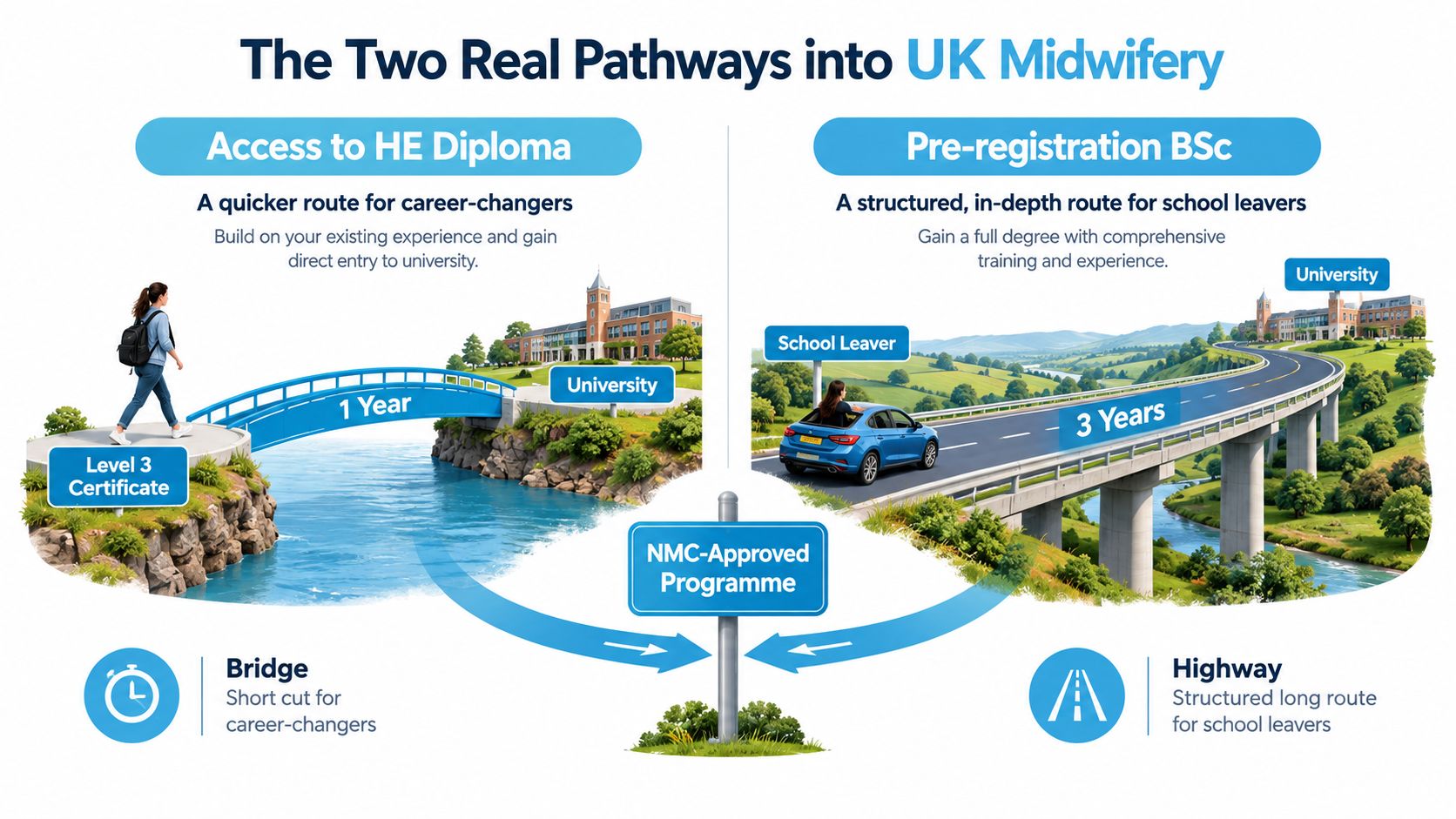
Think of the route into midwifery as a journey to a regulated destination. An Access to HE Diploma is a bridge that can help a career changer reach the university shore. An NMC-approved pre-registration degree is the road that takes you through the professional training itself. Both may be part of your journey, but only the approved programme provides the education required for registration.
The preparation route
An Access to HE Diploma is designed for adults who want to progress to university but don't have the usual school-leaving qualifications. It develops study skills, subject knowledge and confidence through assessed work. A midwifery-focused diploma can be a sensible option if your existing qualifications are incomplete, too old for a particular university's policy, or don't include the science or health content an admissions team expects.
The diploma is an entry qualification, not a professional licence. Completing it may allow you to apply, but you'll still need to satisfy the university's requirements, pass its selection process and complete the approved degree. You can read more about the relationship between preparation and university entry in this guide to becoming a midwife through an Access route.
The regulated route
The standard pre-registration BSc is the main professional pathway for applicants who meet university entry requirements. The NMC requires an approved programme to include academic learning, practice learning and opportunities to achieve the required midwife proficiencies. Your university arranges the programme, placements, supervision and assessments.
Registered adult nurses may have another option. The NMC states that they may complete an 18-month shortened programme leading to dual registration, provided they meet the relevant requirements. This isn't a shortcut available to every graduate or healthcare worker. Your previous registration and experience must fit the university and regulatory criteria.
The key question is not just “Can I study midwifery online?” Ask instead:
- What qualification does this course award?
- Does it lead to university application or NMC registration?
- Which organisation approves the professional programme?
- Where will clinical practice happen?
- Who arranges supervision and assesses competence?
A provider that answers those questions clearly is helping you make an informed decision. A provider that focuses only on recorded lessons and flexible access may be describing preparation rather than professional midwifery education.
What Can and Cannot Be Studied Online
Online teaching works well for knowledge that can be read, discussed, tested and revisited. You can learn anatomy, physiology, pharmacology, communication, ethics, public health and evidence-based practice through digital modules, recorded teaching and tutor-led seminars. Case studies can also help you practise deciding what information matters, what questions to ask and when to escalate concern.
Clinical competence is different. A future midwife must develop practical skills, professional judgement and communication through supervised contact with women, babies and families. Those abilities can't be confirmed by watching a video or completing a multiple-choice quiz at home.
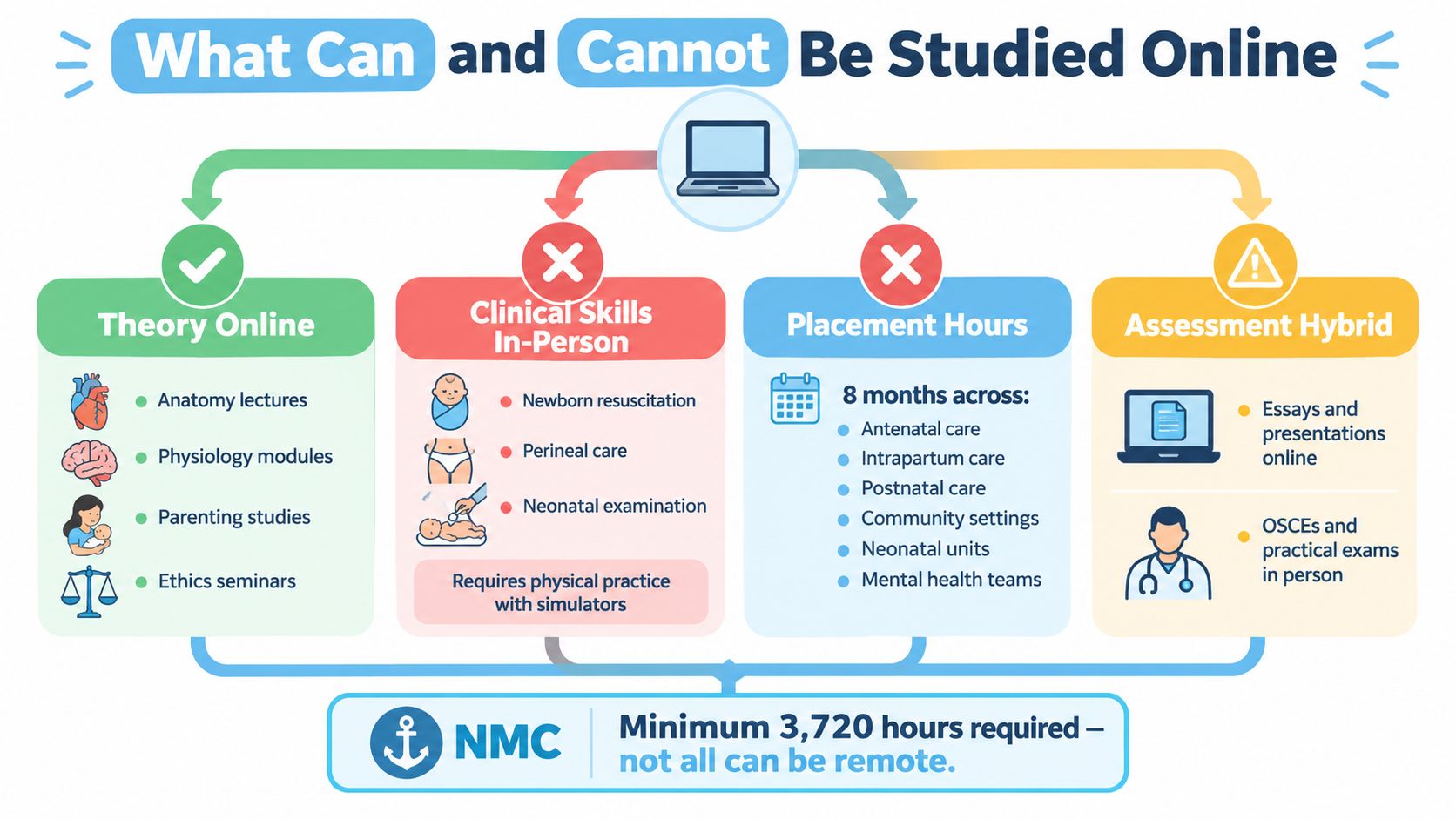
The NMC requires an approved pre-registration midwifery programme to last at least three academic years and comprise a minimum of 4,600 hours. Programme design must provide practice-learning opportunities for the required proficiencies. The NMC's standards specify that at least 50% of available curriculum hours must be spent in clinical practice. In a 4,600-hour programme, that is approximately 2,300 hours of supervised practice. (NMC standards for pre-registration midwifery programmes)
A realistic division of learning
| Learning activity | Suitable for online delivery | What still needs in-person education |
|---|---|---|
| Anatomy, physiology and pharmacology | Recorded lectures, readings and online tests | Tutor support where concepts affect clinical decisions |
| Clinical reasoning | Case-based activities and guided discussion | Application to real people under supervision |
| Communication and ethics | Seminars, reflective tasks and role-play | Observed interaction and feedback |
| Practical skills | Demonstrations and preparation materials | Supervised skills practice and competence assessment |
| Practice learning | Preparation and reflective documentation | Approved maternity placements and direct contact |
Blended education can strengthen theory when it gives students repeated opportunities to apply knowledge. An NHS England evidence review of a level-four pre-registration midwifery module reported that students exposed to blended learning scored 32.57 points more than the comparison group, with significance reported at p < 0.001. In the post-intervention cohort, 55% passed compared with none in the pre-intervention cohort. The review also described a Virtual Maternity Clinic that supported repeated observation of practice. (NHS England evidence review on blended learning and midwifery education)
Those findings support online theory as part of a carefully integrated programme. They don't show that a learner can meet hands-on registration requirements remotely. The quality test is whether digital teaching prepares you for placement, not whether it claims to replace placement.
Entry Requirements You Will Need to Meet
University entry requirements vary, so treat any checklist as a starting point rather than a guarantee of admission. A university may assess your qualifications, recent study, caring experience, interview performance and readiness for clinical education together.
Your academic self-check
Start by checking whether you have the required English and maths qualifications. Science is also commonly relevant, particularly because midwifery degrees involve biological knowledge and clinical reasoning. Some universities accept equivalent qualifications, but you should ask admissions staff to confirm what they recognise before enrolling on a preparation course.
If you don't have suitable recent qualifications, an Access to HE Diploma may provide an alternative route. Look for a course with appropriate health and science content, and check that the universities you may apply to accept that diploma. The Access to Higher Education midwifery route can be useful to investigate alongside individual university specifications.
Recent academic study can help demonstrate that you're ready for degree-level work. It also gives you a chance to practise referencing, structured writing, scientific terminology and time management before the demands of a professional programme begin.
Requirements beyond grades
A successful application depends on more than certificates. Universities commonly require checks and assessments connected with safe practice, including:
- Disclosure checks: You may need an enhanced DBS check and relevant workforce screening before placement.
- Occupational health clearance: Your health must be assessed against the demands of clinical education, and the university may require evidence of immunisation.
- Selection interviews: Values-based questions may explore compassion, respect, teamwork, accountability and your understanding of professional responsibility.
- Literacy and numeracy: Some institutions assess these skills during selection rather than relying only on previous grades.
- Relevant experience: Caring, support work or voluntary activity can help you reflect on communication, boundaries and the actualities of supporting people.
One current university specification accepts an Access to HE Diploma but still requires GCSE-equivalent English and maths and health screening, illustrating why you must read each institution's current requirements rather than rely on a generic course advert. (Bradford BSc Midwifery programme specification)
Mature learner entry and Accreditation of Prior Experiential Learning may help applicants whose education or experience doesn't fit a standard pattern. They don't remove the need to meet professional requirements. Ask the admissions team how they assess older qualifications, functional skills, employment history and prior learning.
How Blended Online Learning Actually Works in Practice
A strong blended programme is more than a library of recorded lectures. Students need a planned rhythm that connects independent study with tutor contact, simulated scenarios, skills sessions and placement preparation.
A typical pattern might include self-directed work in a virtual learning environment, live online seminars, case discussions and scheduled feedback. The exact timetable varies between providers. Some universities bring students to campus for concentrated skills teaching, while others use simulation centres and arrange practice blocks through partner trusts.
What to look for in the digital classroom
Good online provision makes learning active. Look for:
- Captions and transcripts so you can review technical explanations accurately.
- Moderated discussion boards where registered midwifery lecturers correct misunderstandings.
- Small-group tutorials that let you ask questions instead of studying in isolation.
- Case-based activities using pregnancy, birth and postnatal scenarios.
- Digital portfolios for recording reflections, feedback and evidence of progress.
- Virtual clinic activities that let you rehearse questioning, observation and decision-making before placement.
The NHS England review described earlier included a Virtual Maternity Clinic and found that blended teaching could support knowledge acquisition when it was integrated into the wider programme. That distinction matters. Online learning is most useful when it helps you arrive at practice better prepared and more able to explain your decisions.
| Activity | Hours | Mode | Purpose |
|---|---|---|---|
| Independent theory | Varies by programme | Online | Build subject knowledge and prepare for seminars |
| Live teaching | Varies by programme | Online or campus | Test understanding and receive tutor guidance |
| Simulation and skills | Set by the university | In person or simulation centre | Practise safely before supervised clinical work |
| Placement | Required by the approved programme | Maternity and community settings | Develop and demonstrate professional competence |
| Reflection and assessment | Varies by module | Online and in person | Connect evidence, feedback and clinical learning |
Blended study also demands self-discipline. You need reliable internet access, a quiet place to concentrate when possible, confidence using online systems and a plan for completing work without the external structure of a daily classroom. Before accepting an offer, ask how often you must attend campus, where placements are located and how the university supports students who work or have caring responsibilities. More practical guidance is available in this explanation of what blended learning involves.
Employment Prospects After Qualification
You may finish your midwifery degree ready to practise, yet still need to compete for a post in the area where you live. Student demand and workforce need do not guarantee a vacancy at the right time. Recruitment depends on local vacancies, trust budgets, available posts and your willingness to consider different settings or travel.
NHS England reported 3,390 midwifery acceptances in 2025, compared with 3,290 in 2024, an overall increase of 3%. Acceptances among 18 to 24-year-olds rose by 10% (NHS England student nursing and midwifery figures). These figures show continued interest in training, not a guaranteed job for every graduate.
Students approaching qualification can still feel uncertain about their prospects, particularly if they have applied for posts without success. Treat that uncertainty as a reason to plan early. Your placement experience, references, location and flexibility can all affect how you approach applications.
Research employment alongside your course choices. Ask each university which NHS trusts host its placements, how careers support works and whether graduates receive help with applications and interviews. Check vacancies at local trusts instead of relying only on national workforce headlines. A long-term shortage can exist while an individual trust pauses recruitment, changes its budget or offers fewer permanent posts than expected.
Placement geography matters here. An online Access to HE course can help you prepare academically, but it cannot remove the practical demands of the regulated degree. Before applying, consider whether you can afford the travel, childcare and time involved in supervised clinical learning, because those pressures may continue while you search for your first post.
Keep your options open without accepting poor conditions. Maternity units, community midwifery, birth centres and rotational posts may offer different starting points. Compare contracts, travel requirements, supervision, induction and development opportunities carefully. Your first role should give you a safe setting to consolidate practice, ask questions and build confidence as a newly qualified midwife.
Funding Options and Practical Costs
Funding depends on which stage you're entering and where you live in the UK. The financial plan for an Access course isn't the same as the plan for an undergraduate degree, and neither automatically covers every cost connected with placement.
Preparation funding
Adults taking an eligible Access to HE Diploma may be able to explore an Advanced Learner Loan. Eligibility depends on the course, learner circumstances and the relevant funding rules. Ask the course provider and Student Finance England to confirm the position before you enrol.
Some providers offer instalment plans or other payment arrangements. Compare the total cost, assessment support, cancellation terms and what happens if you need to pause your studies. A lower monthly payment isn't necessarily a lower overall cost.
Degree and placement support
For an undergraduate midwifery degree, investigate student finance, university bursaries and NHS support schemes. The NHS Learning Support Fund may provide assistance such as a training grant, parental support and help with travel or accommodation connected with placement, subject to eligibility and the rules in force when you apply.
Don't build your budget around a funding headline alone. Ask whether support is paid throughout the year, whether it depends on household circumstances and which placement expenses qualify. Student finance repayment arrangements also depend on the loan type and the earnings threshold that applies to you.
| Training stage | Main funding source | Typical amount | Repayment required |
|---|---|---|---|
| Access preparation | Advanced Learner Loan or provider payment plan | Depends on eligibility and provider | Check the loan terms |
| University degree | Student Finance England and university support | Depends on course and circumstances | Depends on the finance arrangement |
| Clinical placement | NHS Learning Support Fund and possible travel support | Depends on eligibility and approved costs | Usually support rather than tuition borrowing |
| Additional hardship | University bursary or hardship fund | Assessed individually | Usually not a repayable loan |
Costs people forget
Plan for expenses that may sit outside tuition:
- Travel: Placement may require early starts, public transport, parking or travel between sites.
- Childcare: Long shifts and changing placement patterns can make ordinary childcare arrangements difficult.
- Equipment: Uniform, footwear, stationery and technology may all be necessary.
- Screening: DBS processing, occupational health appointments and required checks may involve costs or administration.
- Lost flexibility: Reducing work hours can affect your household budget even when tuition is funded.
Contact the university's student finance team before accepting an offer. A written budget should include your regular bills, travel, childcare, equipment and a buffer for placement periods when your routine changes.
Your Next Steps Towards Becoming a Midwife
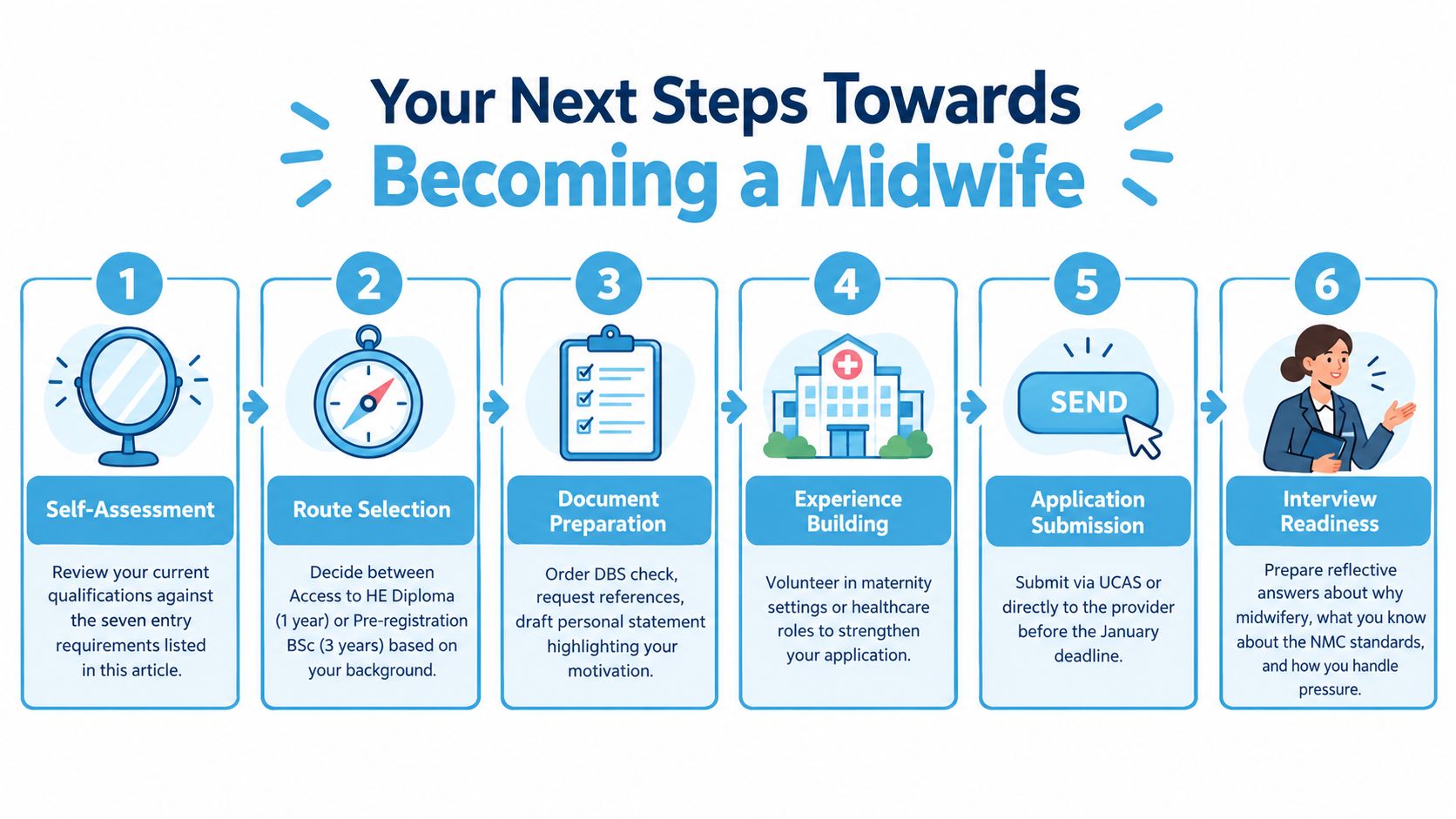
You don't need to solve the whole route in one afternoon. Work through the decisions in order, and keep a written record of what each university tells you.
Start with an honest audit
Write down your existing qualifications, grades, dates, work history and caring experience. Compare them with the entry requirements of several NMC-approved university programmes. Don't assume that an old qualification, a functional skills award or professional experience will be accepted without confirmation.
If you need preparation, compare Access to HE providers by checking their accreditation, subject content, assessment methods, tutor support and progression information. Ask whether the course is designed for applicants to midwifery and which universities have accepted it.
Research the professional route
Use the NMC's information to understand what an approved programme involves. Then contact university admissions teams with specific questions:
- Which academic qualifications do you accept?
- How do you assess mature applicants?
- Where are placements located?
- How much campus attendance is required?
- What health, DBS and vaccination checks apply?
- How do you support students with caring or employment responsibilities?
- What happens if a student struggles during placement?
Attend open days if you can. You need to see the campus, meet staff and ask how the university connects classroom learning with clinical practice. A course page may tell you that some teaching is online, but an admissions tutor can explain the timetable and placement reality more clearly.
Prepare the application, not just the paperwork
Apply through the relevant process, follow the current deadlines and give yourself time to request certificates and references. Your personal statement and interview should show more than enthusiasm for babies. Midwifery involves safeguarding, communication, evidence-based decisions, teamwork, emotional resilience and respect for women's choices.
Use examples from work, volunteering or caring responsibilities to demonstrate reflection. Explain what you learned, what you would do differently and how the experience shaped your understanding of professional boundaries. Universities want applicants who can think carefully about responsibility, not applicants who claim the work will always be rewarding.
The NMC states that approved programmes normally take at least three years, with an 18-month shortened route available for eligible registered adult nurses. Preparation can add further time, especially if you need an Access qualification first. The most useful question is not whether the path is convenient, but whether you can organise the academic and placement commitments safely.
Begin by checking your qualifications and identifying two or three local university programmes. If an online Access to HE Diploma is the missing step, Access Courses Online offers a flexible online midwifery preparation course covering areas such as biological science, health studies, psychology and sociology. Use that information to contact the provider, compare it with other recognised options and build a realistic plan for progressing to an NMC-approved degree.