

In 2019/20, approximately 254,000 mature undergraduate students entered UK universities, about 37% of all undergraduate entrants. The same year, approximately 202,000 mature postgraduate entrants made up around 50% of postgraduate entrants, as set out in the Commons Library briefing on mature students in higher education. You are not a side category. Tutors already read applications built on work, caring and interrupted study, so a school-leaver template wastes your best material. A personal statement for mature students is an evidence file: what you did, what you learned, and why that prepares you for this degree now.
Why Mature Applicants Need a Different Statement
A mature student, in UK undergraduate admissions, is generally an applicant aged 21 or over when the course starts. If that is you, predicted grades, a list of A-levels and a paragraph on sport are the wrong frame. They describe a school timetable you are not coming from. Admissions teams assess non-traditional histories every cycle. Your route is not something to apologise for. It is the file you select from.

What belongs in the file
The lines that carry weight usually sit outside a sixth-form record. UCAS advises mature applicants to show how employment, prior experience and training have built transferable skills and strengths. Name the skill only after you have named the work that produced it.
- Paid employment: years in a role, a caseload, people you supervised, or a project with a result.
- Caring responsibilities: the planning and reliability that come with looking after a child or a relative.
- Vocational training and professional development: assessed certificates and standards you had to meet.
- Volunteering: a regular commitment you can describe with a scale or an outcome.
- Time away from education: only where you can show what you kept up, not as a confession.
A bare list ("organised, resilient, a good communicator") could sit on any application. It proves nothing about this course.
Readiness, not a life story
The statement is a short account of readiness. It connects life and work to the subject, explains why study is the right step now, and shows you know what university-level work asks: weekly reading, referenced writing, and deadlines that do not move because a shift overran.
Practical rule: If a tutor cannot tell, within about thirty seconds, which course the statement is for and why you are ready, the draft is still a biography.
Test the first two sentences before you edit anything else. Open with the course and one line of current evidence. Leave age, regret and a full chronology out of the opening.
Turning Your Experience Into an Evidence Inventory
Before a draft sentence exists, build the file. List what you have done over the last five to ten years and sort it into employment, caring, training, volunteering, previous study and independent learning. Keep items with a clear result or a measurable scale: a team you supervised, a complaints caseload you cleared, a course you finished with a distinction. Drop work that does not touch the degree, however proud you are of it. Three to five items is enough once subject interest also has to fit.
Academic evidence leads
Split every item into academic evidence and life evidence. Academic evidence is work someone assessed: a finished Access module, a marked essay, a certificate with a pass standard or a grade. Life evidence is a shift pattern, a caring role, a supervisory duty. Academic evidence should lead, because it shows you can already do work the degree will mark. Life evidence supports that. It does not stand in for it.
Work experience only helps once you can say what you learned and which part of the degree that learning serves. If you cannot fill the third column below, the item does not earn a paragraph.
| Experience | Transferable skill | Degree demand it evidences |
|---|---|---|
| Shift work or rota planning | Time management and organisation | Managing weekly reading and deadlines |
| Caring for a relative or child | Prioritising and resilience | Sustained independent study alongside other commitments |
| Supervising a team | Communication and negotiation | Seminar discussion and group projects |
| Handling customer complaints | Problem-solving and resourcefulness | Analysing a case and proposing a solution in an essay |
| Volunteering with a charity | Empathy and reflective practice | Placement and professional practice modules |
| Previous study or Access modules | Academic writing and referencing | Assessed essays and referenced arguments |
| Professional training or certificates | Subject knowledge and professional standards | Core module content and assessment criteria |
| Self-directed reading or projects | Independent research | Dissertation and research-based modules |
One sentence per keeper
For each item you keep, write one sentence in three parts: what you did, the scale or result, and what you learned.
Say you supervised four care assistants on a night rota for two years and introduced a handover sheet that cut missed medication notes. The sentence is not "I am a leader". It is the rota, the sheet, and the lesson about clear written communication. If the sentence is still vague, the item cannot carry a paragraph. Replace it, or cut it. You draft from this inventory, not from a memory of "my journey".
How to Build Each Paragraph Step by Step
Work backwards from the course page, not forwards from your biography. UCAS guidance on the application process for mature students asks you to explain transferable skills such as time management, organisation, communication, resourcefulness, negotiation and problem-solving, and to connect them to degree-level study. Treat each paragraph as a short evidence file a tutor can check against those published criteria.
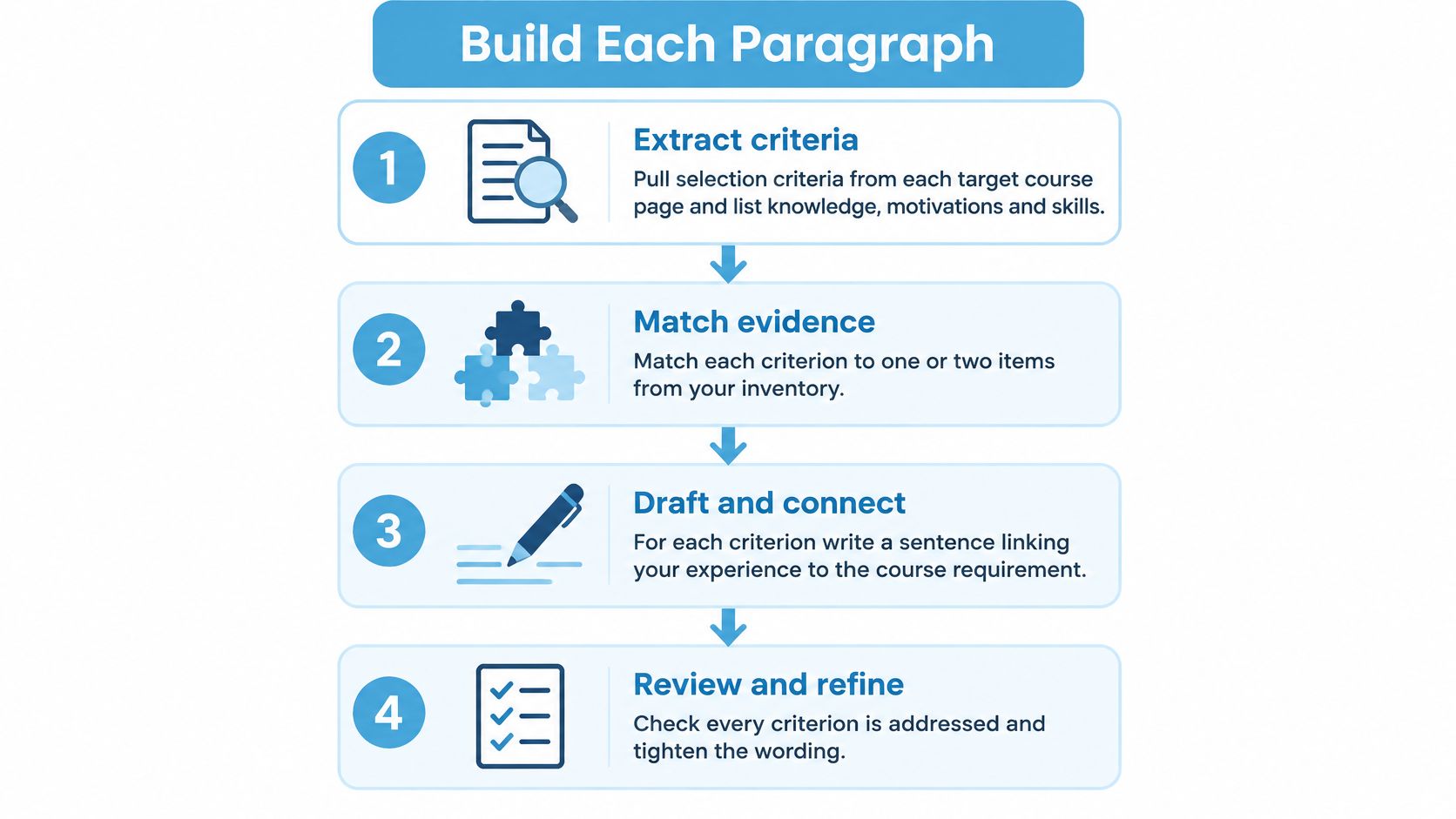
Six steps, in order
- Extract the criteria. List the knowledge, motivations, skills and experience each target course page names. Those lines are the questions the statement has to answer, which stops a generic pitch.
- Match evidence. Give each criterion one or two items from the inventory. A criterion with no match is a gap in preparation. Do not invent a sentence to cover it.
- Write claim, evidence, relevance. One sentence for the claim, one or two for the evidence with a concrete detail, and one for why it matters on the degree.
Copy this chain and swap in your detail. Claim: "I can manage competing deadlines." Evidence: "I coordinated shift work and family responsibilities while completing an Access assignment." Relevance: "This preparation will support sustained academic study." Keep that order every time. Claim, then proof, then the course. State what you did and what it shows. Do not apologise for arriving by a non-standard route.
- Order the paragraphs. Put the strongest subject link first, usually how you have tested the interest. Follow with the skills that show you can manage the workload, then study plans and career. Why the subject fits now, why higher education is the next step, and how the course relates to a career change belong in those paragraphs, not in a separate life history. The trade-off is space: a career paragraph that repeats the subject paragraph wastes characters you need for proof.
- Check the admissions questions. Each major paragraph should answer at least one of these: why this subject, what you have done to test the interest, what you have built, and why you can succeed now. A paragraph that answers none of them is background. Cut it.
- Fit the limit, then clean the draft. Keep the statement within UCAS's character limit, including spaces, and cut biography before you cut evidence. Where two items prove the same skill, keep the one with a result.
On the quality pass, remove generic praise of the university, unsupported claims, irrelevant family detail, exaggeration, and errors of spelling or grammar. Stay specific, use your best English, and do not invent, because claims may be tested at interview. Prior experience transfers only when it also shows subject interest.
Open with the course and one line of readiness. Those two sentences should already tell the reader which degree this is and why you can start it.
Handling Gaps, Constraints and Non-Traditional Routes
Caring for someone, a break in paid work, or a thin qualifications record is context. It is not an argument for a place. The picture below is a familiar one for many applicants, and the writing task is to turn that reality into a plan, not a plea.

Barriers are structural. The proportion of adults identifying cost as a barrier to learning rose from 8% in 2019 to 24% in 2025, and mature learners commonly juggle work and family. Parliamentary analysis also notes that mature students can be more debt-averse than younger applicants, which can affect whether people apply, as recorded in the impact assessment on adult skills and training. You do not have to offer hardship as proof that you deserve a place.
Three situations, three usable sentences
An employment gap. Say where you were, what you did, and what you kept up.
For three years I cared for a parent and ran the household budget, and in that time I kept a weekly reading habit and completed an online study-skills course.
Outdated or missing qualifications. Name the route in one sentence, then move to current evidence. "I left school without A-levels and later took an Access to Higher Education Diploma." If that is your route, name the diploma, its level and the modules passed, then one assessed piece with its outcome. "On the Access to HE Diploma (Health) at Level 3 I passed Human Biology and Study Skills, and my referenced essay on infection control was graded distinction." Recent marks beat an old certificate. Universities do not all ask for the same things, so compare mature student entry requirements with each course page.
Cost, childcare and time. Describe the arrangement, not the shortage.
I have a study routine of three evenings and Sunday morning, I already submit work on a blended online course, and my employer has confirmed one study day a month.
Fees, funding, disability support and access arrangements belong with university funding and student-support teams, not in this statement. Mention a constraint only when it changes how you will study.
Mature learners often favour online or blended study and extras such as out-of-hours teaching, but that flexibility is not automatic. If you need it, choose a course that offers it, and say you have already worked that way. Hearing how other adults describe the same planning can stop a draft sliding into a hardship story.
Common Mistakes and How to Fix Them
The most common failure is a chronological life story, which reads as background rather than readiness. Mature applicants are not one group, so one "returner" script cannot fit them. UCAS's mature-student profile puts just over half at ages 21 to 24, 38% at 25 to 39, and 10% over 40. A 22-year-old who left college early and a 42-year-old changing career should not sound alike. Write to your own distance from school.
Seven problems and the fix for each
| Mistake | Why it hurts | Fix |
|---|---|---|
| Chronological life story | Reads as background, not readiness | Open with the course, then choose two or three events that prove a skill |
| Dwelling on past disadvantage | Shifts the focus to hardship rather than ability | Name the route in one sentence and move to current evidence |
| Generic transferable-skills list | Every applicant can write it, so it proves nothing | Replace each skill with one dated example and its result |
| Career ambition with no subject engagement | Shows motivation but no test of the interest | Add a module, reading, placement or project that tested the subject |
| Unsupported claims about being ready | Invites doubt at interview | Attach one concrete detail to every claim |
| Errors in spelling and grammar | Suggests the applicant has not checked their work | Read aloud, then get a second reader to proofread |
| Describing the course in general terms | Looks like a template statement | Name a module, a tutor's research area or a course feature |
Keep two or three events that prove a skill the course will test. Drop the rest, even when they explain how you arrived. State the route once, without an apology, then move to current evidence. A hardship paragraph spends lines on disadvantage. Those lines should carry a dated result instead.
"Organised" and "resilient" prove nothing until each has a date and a result. If you cannot supply that, cut the skill. Career ambition without a module, reading, placement or project is a wish. I would add that test of the subject before polishing the motivation line. Enthusiasm is easy to see. Engagement has to be written.
One concrete detail fixes an unsupported claim, and it is the detail you may be asked about at interview. Read the draft aloud, then use a second reader for spelling and grammar. Access Courses Online helps students with university applications, including discussing course choices, proofreading personal statements and providing references. Do that check before you submit.
Name a module, a tutor's research area or one course feature. A paragraph you could send to five universities is a template. Fix the story and the hardship lines, and still work the claims, the errors and the course detail. An unchecked row is visible.
Check Your Statement Against Each Course Before You Apply
Pick the course you most want and put its selection criteria next to the draft. For each criterion, point to the sentence that answers it. A criterion with no sentence is a gap. Close that gap before you look at another university. A missing answer on your first choice matters more than a soft line on your third.
Other choices, then the limit
Repeat the pass for your second and third choices. Criteria differ. A nursing course may want care experience and reflective practice. A business course may want evidence you can handle numbers. You may need to shift emphasis, not write three unrelated statements.
- Character limit: confirm the statement sits inside it, and cut biography before evidence if it does not.
- Every claim: confirm it has an example you could talk through if asked.
- Entry rules: check GCSE English and maths where a university asks for them.
Students can be accepted onto an Access to HE course without any GCSEs, though some universities still require GCSE English and maths or an equivalent. The statement should not imply you hold a qualification you do not. If you are unsure which course your evidence fits, request a consultation with course leaders and careers advisers, including how remote study works.
I would set the second-reader date at least a week before you submit, so one weak paragraph can be rewritten without colliding with the deadline.
Help with the UCAS application and the personal statement is available if you want another reader on that check. The UCAS application is easier once you know which parts carry the evidence and which parts are administrative. Book the final draft early enough that the second reader, the entry-requirement check and any course-specific tweak all happen before you press submit.
Access Courses Online helps with university applications for adults returning to study, including course choice, proofreading a personal statement and references, alongside online Access to Higher Education diplomas you can fit around work. If your draft still reads like a life story rather than evidence a tutor can assess, bring it to a conversation before you apply. Visit Access Courses Online to talk through your route and get the statement checked against the course you want.