

If you’ve got your sights set on a university course that requires 104 UCAS points, you might be wondering exactly what that looks like in terms of grades. The good news is, there are several ways to hit that magic number, whether you’re studying A-Levels, BTECs, or another qualification.
What Grades Is 104 UCAS Points
Think of the UCAS Tariff system as a way to level the playing field. It’s designed to help universities fairly compare applicants who have taken different educational paths. Each grade you earn, regardless of the qualification, is worth a certain number of points. Your job is simply to collect enough of them to meet your course requirements.
So, how do you get to 104? You can either get all your points from one type of qualification or mix and match to build up your total. It's all about finding the combination that works for you.
This diagram breaks down some of the most common routes to reaching your goal.
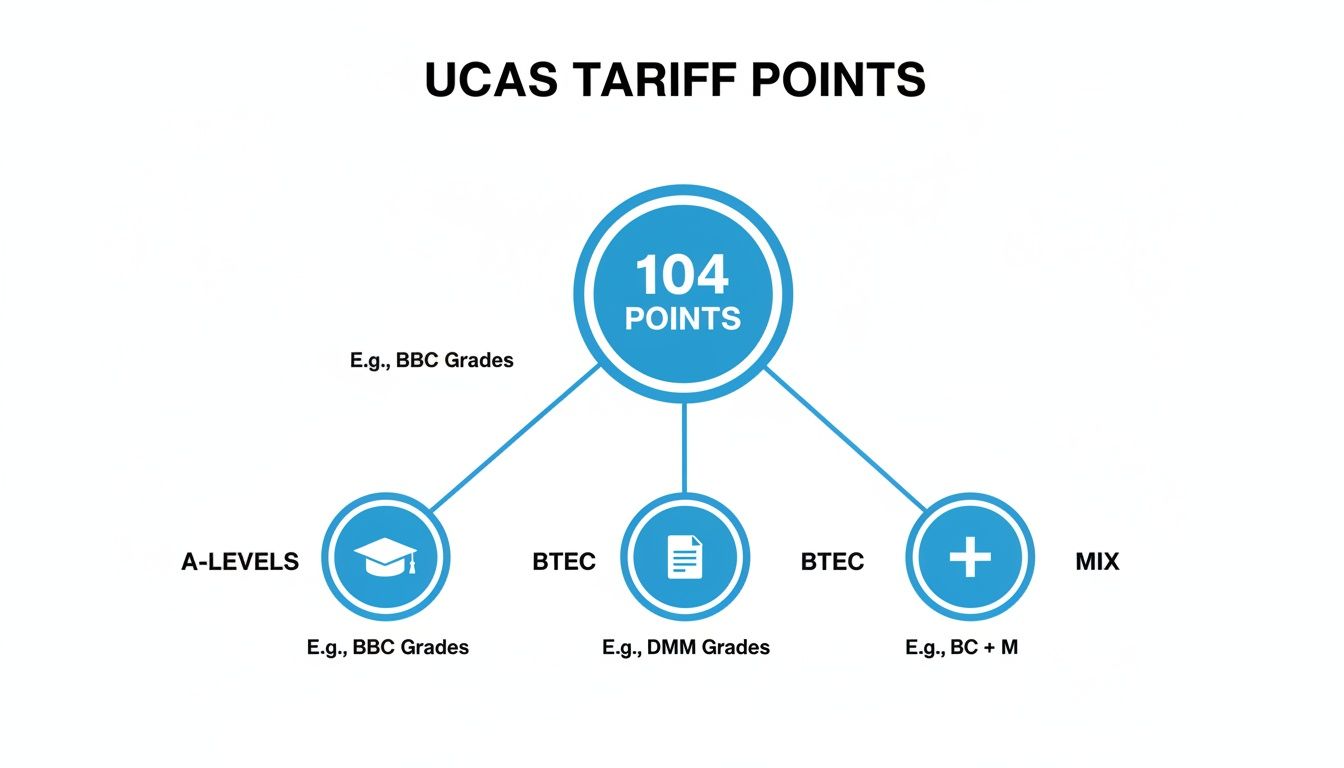
As you can see, there's more than one path to success. Staying organised is key when you're juggling applications and study plans, which is where the best Notion templates for students can be a real lifesaver.
Common Grade Combinations
To make things a bit clearer, let's look at some of the most frequent grade combinations that add up to 104 UCAS points.
Common Ways to Achieve 104 UCAS Points
| Qualification Type | Example Grade Combination | Total UCAS Points |
|---|---|---|
| A-Levels | BCC | 104 |
| A-Levels | A*D | 104 |
| BTEC National Diploma | D*D (Distinction*, Distinction) | 104 |
| Access to HE Diploma | A specific number of credits at Merit/Distinction | 104 |
This table gives you a snapshot of what’s needed, but remember that many other combinations are possible, especially if you’re studying a mix of qualifications.
Cracking the Code: What Is the UCAS Tariff System?
Ever wondered why universities talk about 'points' instead of just grades? This is where the UCAS Tariff system comes into play. Think of it as a universal translator for all your hard-earned qualifications, turning different grades into a single, simple number.
This system was created to level the playing field. It helps admissions teams fairly compare a student with three A-Levels against someone with a BTEC Diploma or an Access to HE Diploma. Without it, trying to weigh up such different qualifications would be a real headache.
For instance, an A-Level grade B is worth 40 points. So is a Distinction in a BTEC subsidiary diploma. The system makes sure that achievements from different educational paths are recognised equally, which makes the whole application process a lot more straightforward.
Why Do These Points Actually Matter?
The Tariff system gives thousands of UK university courses a clear, standardised benchmark. While it’s true that not every university uses it—some of the top-tier institutions might ask for specific grades like AAB—a huge number rely on a points total for their entry requirements.
By converting your grades into a numerical total, the UCAS Tariff system helps everyone—students and universities alike—understand the value of different qualifications in a clear and simple way. It’s the reason you’ll see offers like '104 UCAS points'.
This is especially useful for courses that attract applicants from a massive range of backgrounds and qualifications. It cuts through the complexity by creating a common language that everyone can understand. For you, it means your unique mix of skills and studies can be clearly presented and valued, opening up even more pathways to higher education.
Getting to 104 UCAS Points with A-Levels
When you’re looking at university entry requirements, seeing a number like 104 UCAS points can feel a bit abstract. But when it comes to A-Levels, it’s all just simple maths. Each grade you earn has a point value, and knowing how they add up is the first step to mapping out your journey to higher education.
Think of it like this: an A grade gets you 48 points, a B is worth 40, and a C gives you 32. These are the big hitters. Even lower grades, like a D (24 points) or an E (16 points), still add to your total. The game is simply to combine your grades to hit that magic number.
Common A-Level Combinations That Add Up
Most students will use three A-Levels to get to their target score. Let's look at a few classic combinations that get you to exactly 104 UCAS points:
- BCC: A really common and achievable mix. The maths is straightforward: 40 + 32 + 32 = 104 points.
- ABD: This shows how a stronger grade can help lift the average. Here, you've got 48 + 40 + 16, which also equals 104 points.
- A*D: This combination highlights how one outstanding grade can do most of the heavy lifting. While an A* (56 points) and a D (24 points) only add up to 80 points, it puts you in a great position to top up your score with another qualification.
What these examples really show is the flexibility of the UCAS system. It’s not always about getting straight Bs or Cs; it’s about building a total score that opens the door to your chosen university course.
Using Other Qualifications to Boost Your Score
So, what happens if your predicted A-Level grades don't quite get you there? Don't panic. This is where other qualifications can be a massive help.
An Extended Project Qualification (EPQ) or a good grade in an AS-Level can be the perfect way to close a small points gap, turning a near-miss into a guaranteed offer.
Let's imagine you’re on track for CCD in your A-Levels. That adds up to 32 + 32 + 24 = 88 points. It’s a respectable score, but you’re still 16 points short of the 104 target. This is where an AS-Level can save the day. If you bagged a B in an AS-Level (16 points), you’d land exactly on 104. To play around with your own predicted grades and see how they stack up, our UCAS point calculator is a great tool.
This mix-and-match approach is becoming more and more common. Since the UCAS Tariff was updated back in 2017, universities have become accustomed to seeing varied grade combinations from applicants.
Vocational and Alternative Routes to 104 Points
While A-Levels are the path many people think of for university, they are far from the only way in. Vocational qualifications are powerful, respected routes into higher education, often giving you the kind of practical skills that universities and employers are desperate for.
These qualifications show your abilities in a different, but equally important, way. For example, BTEC qualifications are graded using Pass (P), Merit (M), and Distinction (D). These grades translate directly into UCAS points, helping you build your total score towards your goal.
BTECs, T-Levels, and More
A BTEC Level 3 National Diploma with grades of Merit, Pass, Pass (MPP) is a really common way students hit the 104 UCAS points mark. It just goes to show that a mix of solid, consistent work can open the same university doors as traditional A-Level grades.
The newer T-Levels are also becoming a key route. A Pass in a T-Level is worth a hefty 96 points, meaning a small boost from another qualification could easily get you over the 104-point line.
The UCAS Tariff system is designed to value all kinds of educational experiences. It makes sure that the hands-on, practical learning you get from qualifications like BTECs and Access to HE Diplomas is given the same weight as academic A-Levels.
The numbers back this up. In 2024, a massive 28% of UCAS applicants applied with BTECs or similar qualifications. Many of these students successfully landed places on competitive courses, including in-demand health programmes at top universities.
Vocational & Alternative Qualifications for 104 UCAS Points
There are plenty of other pathways that can get you to that magic number. Here's a quick look at how some of the most popular vocational and alternative qualifications stack up when aiming for around 104 UCAS points.
| Qualification | Grades Needed for ~104 Points | Notes |
|---|---|---|
| BTEC National Diploma | Merit, Pass, Pass (MPP) | This combination gets you exactly 104 points. |
| BTEC Extended Certificate | Distinction, Merit, Merit (DMM) | Worth 96 points – gets you very close! |
| T-Level | Pass | Worth 96 points. Can be combined with an EPQ. |
| Access to HE Diploma | Varies (e.g., 24 Merits, 21 Passes) | Universities make specific credit-based offers. |
As you can see, you've got options! It’s all about finding the qualification that best fits your learning style and career goals.
Access to HE Diplomas
For adults returning to education, the Access to Higher Education Diploma is a fantastic pathway. Instead of focusing on a single points total, these diplomas are all about credits achieved at Pass, Merit, or Distinction.
Universities will often make you an offer based on the number of credits you need at each grade, which gives you a really clear target to aim for. You can find out more about how this works in our guide to Access course UCAS points.
What University Courses Can 104 Points Unlock

So, you’ve got a clear picture of the grades you need for 104 UCAS points—but what does that actually mean for your future? The great news is that hitting this target opens up a huge range of exciting degree courses, especially at modern universities known for their practical, career-focused teaching.
This score is a fantastic stepping stone into many popular and essential fields. It often meets the entry requirements for degrees that are crying out for skilled graduates, making it a brilliant goal for anyone who wants to make a tangible impact with their career.
Popular Fields and Degree Programmes
With 104 points under your belt, you’re in a strong position to apply for all sorts of degree programmes. Many universities offer direct entry onto courses in these subject areas:
- Health and Social Care: Think degrees in Social Work, Youth Studies, or Health and Social Care. These programmes are always on the lookout for dedicated applicants with a solid academic base.
- Creative Arts and Design: Courses like Graphic Design, Media Production, or Fine Art often value a strong portfolio alongside UCAS points, and 104 is a very common entry point.
- Business and Management: A huge number of Business Studies, Marketing, and Human Resource Management degrees have entry requirements right in this range.
- Humanities and Social Sciences: You’ll find plenty of opportunities in subjects like Sociology, Criminology, and English Literature, particularly outside of the most competitive universities.
For high-demand careers like nursing, 104 UCAS points can make you a really competitive candidate at many universities. It’s always worth checking the specifics, and you can get a better idea by looking into nursing degree entry requirements to see how your points stack up.
Setting Realistic University Goals
It’s also important to be realistic about where 104 UCAS points can take you. This total is less likely to meet the standard entry requirements for the most competitive courses at high-tariff institutions, such as those in the Russell Group, which often ask for top A-Level grades like AAB or higher.
But that’s not the whole story. Some Russell Group members, like the University of Exeter, actually accept students with around 104 points onto their foundation year programmes. In fact, official 2022/23 data shows that students who started university with 80-120 points have great outcomes, with 78% landing professional jobs or starting further study just 15 months later. It just goes to show that a degree earned via this route provides a solid launchpad for a successful career.
Your UCAS Points Questions, Answered
Getting your head around university applications can feel like learning a new language, especially when it comes to UCAS points. Once you’ve figured out what grades you need for 104 UCAS points, a few more practical questions usually pop up. Let’s clear them up so you can move forward with confidence.
Do All Universities Use UCAS Tariff Points?
Not always, no. It’s a common misconception that every university in the UK uses the Tariff system. In reality, many of the most competitive institutions, particularly Russell Group universities like Oxford and Cambridge, tend to make offers based on specific grades (like A*AA) instead of a total points score.
That being said, a massive number of UK universities do use the Tariff. They find it a really fair and practical way to compare applicants who come with a whole mix of different qualifications. The golden rule? Always, always check the specific entry requirements on the course page for every single university you’re interested in.
Can I Combine Points From Different Qualifications?
Yes, absolutely! This is one of the best things about the UCAS Tariff system. It’s built to be flexible, letting you mix and match points from various qualifications to reach your target. It’s all about showing the full picture of your abilities.
For instance, you could blend points from:
- Three different A-Levels
- A BTEC qualification plus an AS-Level
- An Access to HE Diploma on its own
- An Extended Project Qualification (EPQ)
- Even music grades (from Grade 6 and up)
This flexibility is a game-changer. It means you can paint a much broader picture of your skills and achievements. Say your A-Levels get you to 96 points (CCC) – an A in an EPQ is worth 24 points, which would comfortably lift you over that 104-point threshold.
What Should I Do If I Miss My Required Points?
First things first: if you don't quite get the points you need on results day, don’t panic. It might feel like a setback, but you still have several brilliant options on the table.
Your immediate next step should be to dive into UCAS Clearing. This is where universities advertise courses that still have places left, and they’re often a bit more flexible with their entry requirements. You could also explore foundation year programmes, which are designed to get you fully prepped for a degree. Other routes include resitting exams or taking another qualification to top up your score. A great tip is to phone the university's admissions office directly to talk through your situation—sometimes, a real conversation can make all the difference.
If you're an adult learner searching for a structured and supportive path to university, Access Courses Online is here to help. Our accredited online Access to HE Diplomas are designed to get you ready for higher education, with flexible study that genuinely fits around your life. Explore our courses and start your journey today.