
Independent learning is a bit of a buzzword, but what does it actually mean for you? Put simply, it’s about taking the reins of your own education. You’re the one setting the goals, managing your schedule, and checking your own progress, rather than just waiting for someone to tell you what to do next.
What Is Independent Learning Really All About?

Let’s forget the textbook definition for a moment. Imagine you're the head chef of your own kitchen. You’re given the core ingredients and a basic recipe (that’s your course material), but you’re in charge from there. You decide when to start cooking, how to blend different flavours through your own research, and ultimately, how to perfect the final dish based on feedback and your own taste tests.
That’s independent learning in a nutshell. It’s often mistaken for learning completely alone, but that couldn't be further from the truth. Real independent learning is about being resourceful and feeling empowered to steer your own journey. You learn to drive your studies with purpose, figuring out when to knuckle down on your own and when it’s time to ask for a helping hand. For adult learners, especially if you've been out of the classroom for a while, this is the single most important mindset to develop.
Moving from Passive to Active Learning
The biggest change is shifting from being a passenger to being the driver. In a traditional school setting, you follow a rigid timetable set by others. With independent learning, you’re the one building that timetable. Understanding the difference between classic instructor-led training and Self-Paced Learning really helps to get your head around this.
This active way of studying involves a few key things:
- Setting Your Own Goals: You decide what you want to get out of each study session, always keeping your long-term ambition—like getting that university place—in sight.
- Managing Your Resources: You get skilled at finding reliable information that goes beyond the course materials and learn to use your tutor as a strategic guide, not just a teacher.
- Reflecting on Progress: You start to look at your own work with a critical eye, properly understand the feedback you're given, and tweak your study methods to keep improving.
Independent learning isn't a magical trait you're born with; it's a skill you build through practice and support. It’s the engine that powers you through a flexible online course.
For anyone starting an online Access to HE Diploma, getting good at this is the absolute foundation for success. It perfectly mirrors the independence you'll need at university and in your future career, setting you up for the challenges ahead. It’s a huge part of what makes online study work, and you can learn more about how this fits into the bigger picture of distance learning on our blog.
Why Independent Learning Is Your Secret Weapon for the Future
Learning how to study independently is about so much more than just getting through your next assignment. It’s about building the exact skills that will set you up for success at university and in your future career. Think of it as the bridge between where you are now and where you want to be, whether that’s earning a nursing degree or starting your own business.
When you take charge of your own study schedule, you're not just getting organised. You're proving you can handle the freedom and responsibility that comes with higher education. Universities expect you to be in the driver's seat – managing your own deadlines, research, and progress. Getting a handle on this now gives you a massive head start.
Building the Skills That Get You Hired
Once you've got your qualification, employers are looking for people who can think for themselves. They want team members who don’t need constant hand-holding and aren't afraid to take the initiative.
Here are the powerhouse skills you develop through independent study:
- Resilience: You learn how to tackle tricky problems, find your own solutions, and push through when things get tough.
- Critical Thinking: Instead of just memorising facts, you start to analyse information, question what you’re told, and build your own strong arguments.
- Adaptability: Managing your own learning makes you great at picking up new things quickly – an absolutely essential skill in today’s fast-moving world.
This shift towards self-led learning is becoming increasingly important, especially for adults returning to education. Online Access to Higher Education Diplomas, for example, are built around this idea, allowing people to fit their studies around work and family. It reflects a bigger trend in education, as you can see in these further education statistics from the UK government.
From Student to Confident Professional
Ultimately, learning on your own terms builds a deep-seated confidence that’s hard to beat. It changes you from someone who just receives information into someone who actively seeks it out and can solve complex challenges without hesitation.
When you successfully navigate your own learning journey, you prove to yourself that you’re capable of achieving big things. That self-belief is the foundation for everything you’ll do long after your course is finished.
Every module you complete on your own is another step towards becoming the capable, self-reliant professional you want to be. It’s the best kind of on-the-job training for your future career.
The Five Pillars of a Successful Independent Learner
Knowing what independent learning is in theory is one thing, but actually putting it into practice is a whole different ball game. It’s not about a single magic bullet; it’s a collection of skills and habits that all work together. By breaking it down into five core pillars, you can see exactly where to focus your energy to build the foundations for success.
These pillars are what transform you from someone who just passively receives information into an active, engaged learner who truly owns their educational journey.
Pillar 1: Purposeful Motivation
This is your ‘why’. It’s that deep-down reason you decided to jump back into education in the first place. It’s not just about passing an exam; it's about seeing yourself in that nurse's uniform, finally launching that business, or becoming the role model you want to be for your family.
When you’re staring at your books late at night after a long day, this motivation is the fuel in your tank. A successful independent learner always connects their daily to-do list back to this bigger picture, which turns a tough assignment into a meaningful step toward a life-changing goal.
Pillar 2: Strategic Time Management
As an adult learner, your time is your most precious resource. Strategic time management isn't about magically finding more hours in the day – it’s about making every hour you have truly count. This means designing a realistic study schedule that actually fits around your life, not forcing your life to fit around it.
It’s also about learning how to focus properly. Distractions are everywhere, so mastering techniques for deep, concentrated study is a game-changer. You can get some great practical tips from this guide on What is Deep Work to help you cut through the noise. This pillar is all about being intentional with your study blocks and fiercely protecting them.
Pillar 3: Active Critical Thinking
This is where you make the shift from simply soaking up information to actively questioning it. An independent learner doesn't just read a chapter; they have a conversation with it. They ask questions like, "Do I really agree with this?", "How does this connect to what I already know?", and "What evidence is there to back this up?"
It’s about developing a curious, analytical mind – a skill that is absolutely essential for university and for solving problems in any profession. Real learning happens when you challenge ideas, not just memorise them.
This diagram shows how independent learning nurtures the core skills of resilience, critical thinking, and confidence.
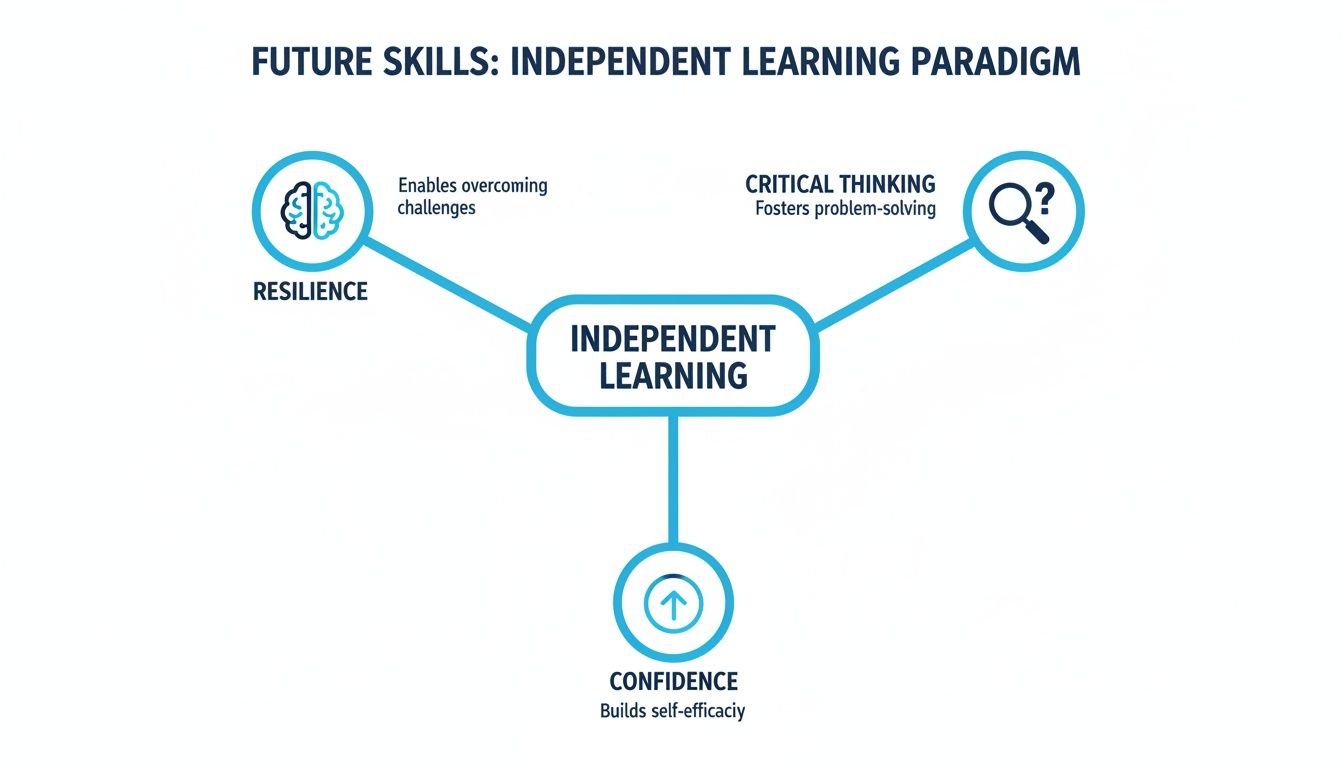
As you can see, these aren't separate traits. They're deeply connected skills that build on and reinforce one another throughout your learning journey.
Pillar 4: Proactive Resourcefulness
Independent learning never means learning alone. Far from it. It actually means knowing exactly when and how to ask for help. This pillar is all about being resourceful and using every tool you have, whether that’s your personal tutor, the online library, student forums, or the feedback on your last assignment.
The key is that you don’t wait for support to come to you; you actively go out and find it.
Pillar 5: Reflective Self-Evaluation
Finally, a successful independent learner is a reflective one. This means learning to see feedback not as criticism, but as a gift. You get good at assessing your own work, spotting where you can improve, and tweaking your study strategies to get better results next time.
This constant cycle of review and adjustment builds incredible self-awareness. It's the hallmark of true self-directed learning, where you take the steering wheel of your own education.
How to Design Your Personal Study Blueprint

Knowing the theory is one thing, but putting it into practice is where you’ll see real progress. Shifting to an independent learning mindset isn't just a vague idea; it needs a tangible plan. Think of it as your personal study blueprint—a way to turn good intentions into consistent, sustainable habits.
This isn't about magically finding more hours in the day. It’s about making your study time more intentional and effective, even when life feels completely chaotic.
Building this blueprint starts with your environment. You don't need a pristine, silent office to get things done. Even a small, designated corner of a room can become your study zone. The key is to create little psychological cues that tell your brain it’s time to focus.
This could be as simple as having a specific box with your notebooks that you only open when studying. Or maybe it's putting on a particular playlist to signal the start of a session. Whatever you choose, the goal is to make it as easy as possible to slip into learning mode.
Crafting a Realistic Weekly Schedule
One of the most common traps is creating a wildly ambitious schedule that’s impossible to stick with. A successful study plan has to respect your existing commitments—work, family, and just as importantly, rest. Start by blocking out your non-negotiables first.
Once you see what's left, you can schedule your study blocks. It's a reality for most adult learners. A recent HEPI report found that 68% of even full-time students now have paid term-time jobs. This has naturally led to a drop in weekly independent study hours, highlighting why flexible online courses that fit around real life have become so essential.
This data just confirms what many of us already know: short, focused bursts of study are often far more realistic than long, uninterrupted sessions. For a deeper dive, you might find our guide on creating a study schedule that actually works helpful.
Example Weekly Plan: Access to HE Student
Let’s get practical. Imagine an adult learner studying for an Access to HE Diploma in Nursing while working part-time and juggling family life. Their blueprint might look something like this:
- Monday: 8:00 PM - 9:30 PM (90 mins) - Review last week's feedback and plan this week's mini-goals. Read the first section of the new module.
- Tuesday: Work shift. No study scheduled (rest is productive!).
- Wednesday: 6:30 AM - 7:15 AM (45 mins) - Squeeze in an early session watching a lecture before the house wakes up.
- Thursday: 1:00 PM - 2:30 PM (90 mins) - Use a lunch break and a bit of time after work for assignment research.
- Friday: Day off from studying. Fully switch off.
- Saturday: 10:00 AM - 12:00 PM (2 hours) - The biggest block of the week, dedicated to assignment writing.
- Sunday: 8:30 PM - 9:15 PM (45 mins) - A final review of the week's learning and submitting any work that's due.
Notice how the plan uses small, manageable chunks of time? This approach, often called time-blocking, prevents that feeling of being overwhelmed and makes it so much easier to stay consistent.
This whole schedule is built on the idea of setting micro-goals. Instead of a massive, daunting task like "write my essay," the goal becomes something small like, "write the introduction." This strategy builds momentum and turns the huge task of completing a diploma into a series of achievable daily wins. It makes the entire process feel far more manageable and rewarding.
Leveraging Tutors and Tech on Your Learning Journey
One of the biggest myths about independent learning is that you’re left completely on your own. In reality, especially with a well-structured online course, nothing could be further from the truth. True independence isn’t about isolation; it’s about having a strong support system that empowers you to succeed on your own terms.
Think of it like learning to drive. You’re the one in the driver’s seat, but you have a qualified instructor right there with you, plus a car packed with modern safety features. Independent learning works the same way, combining human guidance with helpful technology to keep you moving forward safely and confidently.
Your Tutor: More Than a Marker, a Strategic Guide
Your personal tutor is far more than just the person who marks your assignments. They are your strategic guide, your mentor, and honestly, your most valuable resource on this journey. Their job isn't to spoon-feed you the answers, but to help you build the skills to find them for yourself.
To get the most out of this relationship, it’s vital to be proactive. Don't wait for your tutor to check in on you; reach out with specific questions when they come up. A great approach is to explain what you've already tried and pinpoint exactly where you’re getting stuck.
For instance, instead of just saying, "I don't get this topic," try framing your question like this: "I've read the chapter on cellular respiration and I think I understand the basics, but I'm struggling to explain the difference between glycolysis and the Krebs cycle in my own words. Could you point me towards another resource or maybe explain it from a different angle?"
This kind of proactive communication shows you’re an engaged, independent learner and helps your tutor give you targeted, effective support that actually helps.
A tutor’s goal is to build your confidence and critical thinking skills, effectively ‘scaffolding’ your learning. They provide support when you need it, then gradually step back as you become more capable of navigating challenges on your own.
How Technology Empowers Your Independence
Beyond your tutor, the online learning platform itself is designed to support your autonomy. These systems aren't just digital filing cabinets for course materials; they are active tools built to help you manage your own progress and stay motivated.
Here’s how the technology becomes your co-pilot on this journey:
- Progress Trackers: Visual dashboards show you exactly how much of a module you've completed and what's next. This creates a powerful sense of accomplishment and clarity.
- Resource Hubs: Think of these as organised digital libraries with extra reading, videos, and guides. They encourage you to dig deeper into topics that spark your interest or where you need a bit more help.
- Clear Assignment Frameworks: Detailed briefs and submission portals remove any guesswork. You always know what is expected of you, by when, and how to submit your work.
This combination of a dedicated tutor and a purpose-built platform creates a robust learning environment. It provides the structure and safety net you need to confidently take ownership of your education, proving that independent learning is really about being supported, not stranded.
Ready to Take the First Step?
Becoming an independent learner isn't like flipping a switch. It’s a journey you build piece by piece, one small, deliberate action at a time. The goal here isn't to be perfect overnight, but simply to start making progress. You've already done the hard part by exploring what this all means for your future. Now it’s time to put that knowledge into practice.
This whole journey starts with a bit of self-awareness and taking that first proactive step, no matter how small it feels.
Start Your Journey Today
Here are a few things you can do right now to start building your confidence and skills:
- Take a Look at Your Habits: Be honest with yourself about how you study right now. What’s actually working for you? Where do you feel stuck or frustrated? Figuring out your starting point is the most important first move.
- Try a Course Taster: Why not dip your toe in the water first? Many online providers, including us, offer free course tasters. They give you a real feel for the subject and the online learning style without any big commitment.
- Chat with an Advisor: Sometimes, a simple conversation can make all the difference. Our student advisors can help you figure out how a course fits into your life and career plans, making the path ahead feel much clearer.
The most powerful move you can make is always the first one. Every successful journey begins with that single decision to just get started.
Taking that initial step is all it takes to get the ball rolling. At Access Courses Online, we’re here to support your ambitions and give you the guidance you need to turn those goals into your new reality.
Frequently Asked Questions About Independent Learning
Setting out on an independent study journey is exciting, but it’s natural to have a few questions. We’ve tackled some of the most common worries from adult learners just like you to help you feel confident and ready for the road ahead.
How Do I Stay Motivated When I Feel Stuck?
Let’s be honest: motivation isn’t a constant feeling. It’s a wave you learn to ride, and the trick is to anchor your daily study to your long-term goal. Before you even open a book, take thirty seconds to visualise why you’re doing this. Picture yourself in a nurse’s uniform, at your university graduation, or starting that new career. It makes all the difference.
When you inevitably hit a tough spot, break the problem down into the smallest possible step. Instead of telling yourself, "I need to understand this whole chapter," try this: "I will read the first paragraph and summarise it in one sentence." These tiny wins build momentum and prove to you that you can, in fact, overcome the challenge.
A common mistake is waiting for motivation to strike like lightning. Successful independent learners know that you have to create your own motivation by taking small, consistent actions—even when you don’t feel like it. Progress itself is the most powerful motivator there is.
Can I Really Do This with a Full-Time Job and a Family?
Absolutely. The secret isn't about magically finding more hours in the day; it's about being realistic and flexible with the time you already have. Many of our most successful learners balance their studies with incredibly demanding lives by using short, focused bursts of activity. A solid 45-minute session before anyone else is awake or a focused hour during a lunch break can be surprisingly productive.
- Be Strategic: Use simple techniques like time-blocking to protect small pockets of study time in your calendar. Treat them like appointments you can't miss.
- Communicate with Your Family: Let your family know when your study blocks are. This helps manage expectations and gets them on your team.
- Embrace 'Good Enough': Some weeks will be more productive than others, and that's okay. Aim for consistency over perfection. A little bit often is better than nothing at all.
What If I Don’t Have a Quiet Place to Study?
You don’t need a silent, dedicated office to succeed. Creating a "study zone" can be as simple as putting on a pair of noise-cancelling headphones at the kitchen table. It could also mean organising your study materials in a specific box that you only open when it's time to learn.
These small rituals are powerful. They send a signal to your brain that it's time to focus, helping you get into the right headspace, no matter what’s going on around you.
At Access Courses Online, we understand these challenges because our courses are designed specifically with adult learners in mind. We provide the structure and one-to-one support to help you succeed on your own terms.
Explore our accredited online courses today and start your journey to university.