
Vocational education is all about learning by doing. It's a practical, skills-first approach that gets you ready for a specific job or trade. Instead of burying you in abstract theory, it gives you hands-on training for real-world careers, from healthcare and tech to skilled trades like plumbing or electrical work.
Your Hands-On Path to a New Career
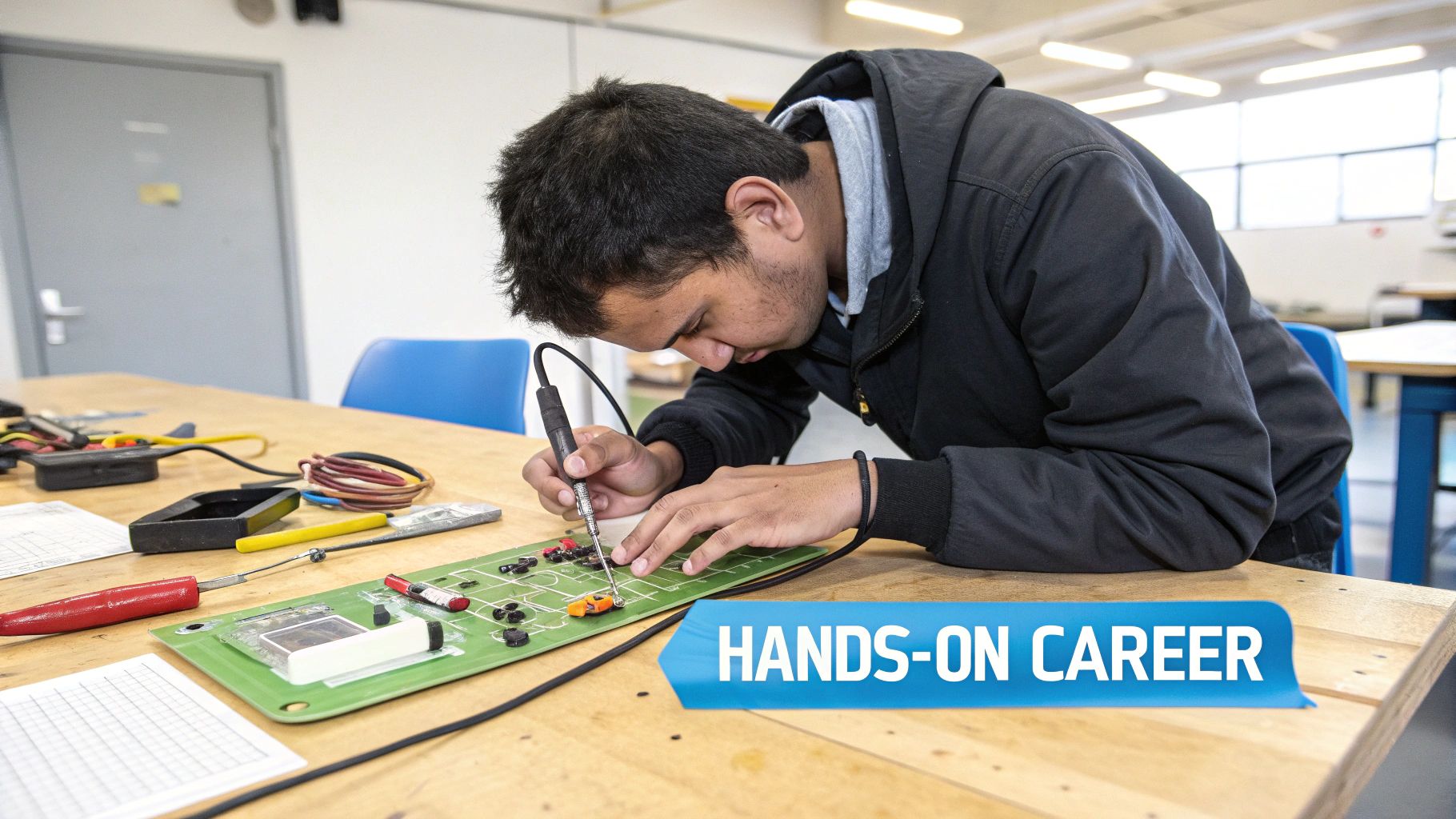
Think about it like this: you could spend years studying the theory of flight, or you could train to become a pilot. One is purely academic, but the other gives you the practical skills to actually fly the plane. That’s the heart of what vocational education offers—a direct, skill-focused route into the career you want.
This approach is a game-changer for adult learners, career changers, or anyone who feels the traditional academic path just isn't the right fit. It pulls you out of the textbook and immerses you in the exact tasks you’ll be doing every day in your future role.
Building Real-World Competence
The main goal here is to build job-ready competence. This means when you finish your course, you won’t just understand a subject—you'll be able to perform specific, valuable tasks that employers are actively looking for.
This practical focus makes it a respected and powerful alternative to A-levels. For many, it's a much more direct way to achieve their goals, whether that's getting into the workforce quickly or moving on to university. Some of the most common qualifications include:
- Apprenticeships: A brilliant mix of on-the-job training and classroom study.
- BTECs and T-Levels: Industry-focused qualifications designed for post-16 learners.
- Access to HE Diplomas: Specifically created for adults who have their sights set on university.
At its core, vocational education answers the question, "How can I learn the skills I need for the job I want?" It bridges the gap between knowing something and being able to do it, making you a valuable candidate from day one.
Designed for Adult Learners and Career Changers
Vocational pathways are built with the understanding that adult learners have lives. They bring unique experiences to the table and need flexibility. Courses like the Access to Higher Education Diploma are structured to fit around your existing commitments, like work and family.
Best of all, they often don’t require traditional entry qualifications like GCSEs. Instead, they focus on your potential and dedication, giving you the academic and practical skills to succeed. Many courses also weave in essential literacy and numeracy training—you can learn more about what are Functional Skills qualifications in our detailed guide.
This structure gets rid of the usual roadblocks, opening doors to brilliant careers in fields like nursing, social work, and computer science that might have felt out of reach. It offers a clear, supportive, and flexible path to making your ambitions a reality.
Navigating the UK Vocational Education System
Trying to get your head around the UK's education system can feel a bit like looking at a busy train station map. You've got the main line—A-levels—that everyone knows about. But there are several other tracks, the vocational routes, that can take you to the very same brilliant destinations, whether that's a university degree or a fantastic, high-skilled job.
This practical, hands-on approach to learning isn't a side-track; it’s a major part of the UK’s post-16 education, running right alongside traditional A-levels. In fact, the government has noted that in a single year, awarding bodies issued around 5.1 million certificates for vocational and similar qualifications. It’s a huge, respected, and thriving part of our national education.
Understanding Qualification Levels
To figure out which track is right for you, it helps to understand how the qualifications stack up. The UK uses a simple framework to show how different qualifications compare, making it much easier to see your potential journey.
The most important thing to remember, especially if you're aiming for university, is that a Level 3 vocational qualification is the direct equivalent of A-levels. This is the key that unlocks the door to most degree courses in the UK. So, whether you have three A-levels or a Level 3 diploma, universities see you as having the same academic capability.
Here’s a quick breakdown:
- Level 2: Think of this as the same level as GCSEs (grades 9-4 or A*-C). It’s perfect for building a solid foundation.
- Level 3: This is your A-level equivalent. It's the standard for getting into university.
- Levels 4 & 5: These are equivalent to the first and second years of a university degree (like HNCs and HNDs).
When you achieve a Level 3 qualification, you're not just earning a certificate. You're proving to universities that you have the knowledge, the skills, and the determination to succeed on a degree programme, placing you on equal footing with students from the A-level route.
Designed for What Employers Actually Need
One of the best things about vocational courses in the UK is how closely they’re tied to the world of work. They aren’t just designed in a classroom; they’re often built with input from employers and industry experts to fill real-world skills gaps.
What this means for you is that you're learning skills that companies are desperately looking for right now. Whether you're training to become a nurse, a web developer, or an engineer, the course is built to make you a confident, effective employee from day one. This practical focus is clear in many sectors, as detailed in guides like How to get an HGV Licence in the UK, which shows a direct path to employment.
Your Direct Path to University
For many adult learners, the most straightforward vocational route to university is the Access to Higher Education Diploma. This is a Level 3 qualification specifically created for people who have been out of the classroom for a while. It offers a focused, fast-track way to get the UCAS points you need for your dream degree.
These courses are tailored to get you ready for the demands of university, teaching you essential academic skills alongside your chosen subject. Our guide offers a more detailed look into how Access to HE courses work. Ultimately, this pathway makes getting a university degree a real, achievable goal for everyone, no matter what their educational background looks like.
Finding the Right Vocational Course for You
With so many vocational paths out there, figuring out which one lines up with your goals is the most important first step. This isn't just about picking a subject you like; it’s about choosing a learning style and qualification that fits into your life and actually gets you where you want to go.
Whether your dream is to land a new job straight away or to head off to university, there’s a route designed specifically for you. The UK’s vocational landscape is packed with different qualifications, and each has its own strengths. Some will have you learning in a real workplace from day one, while others are built to get you ready for the academic demands of a degree. Understanding the difference is everything when it comes to making a confident choice.
Exploring Your Main Options
Let's break down some of the most common and respected vocational qualifications in the UK. Each one serves a different purpose and suits different kinds of learners and career goals.
-
Apprenticeships: Absolutely ideal if you want to earn money while you're learning a trade or profession. You'll spend most of your time in a real job, getting hands-on experience and working with industry pros, with a smaller portion of your time spent on formal study.
-
T-Levels: A newer, two-year qualification for 16-19 year olds that brilliantly blends classroom learning with a serious industry placement. They've been designed with employers to give you the exact skills needed for skilled work, a higher apprenticeship, or university.
-
BTECs (Business and Technology Education Council): These are career-focused qualifications that come in various levels. They are known for being highly practical and are recognised by both employers and universities, covering everything from business and engineering to health and social care.
-
Access to Higher Education (HE) Diplomas: This is a Level 3 qualification made specifically for adults (usually aged 19+) who want to go to university but don't have the traditional A-levels. It's a fast-track route, often completed in just one year, that gets you fully prepared for degree-level study.
This handy decision tree shows how your main goal—whether that's immediate employment or getting into university—can point you towards the right vocational qualification.
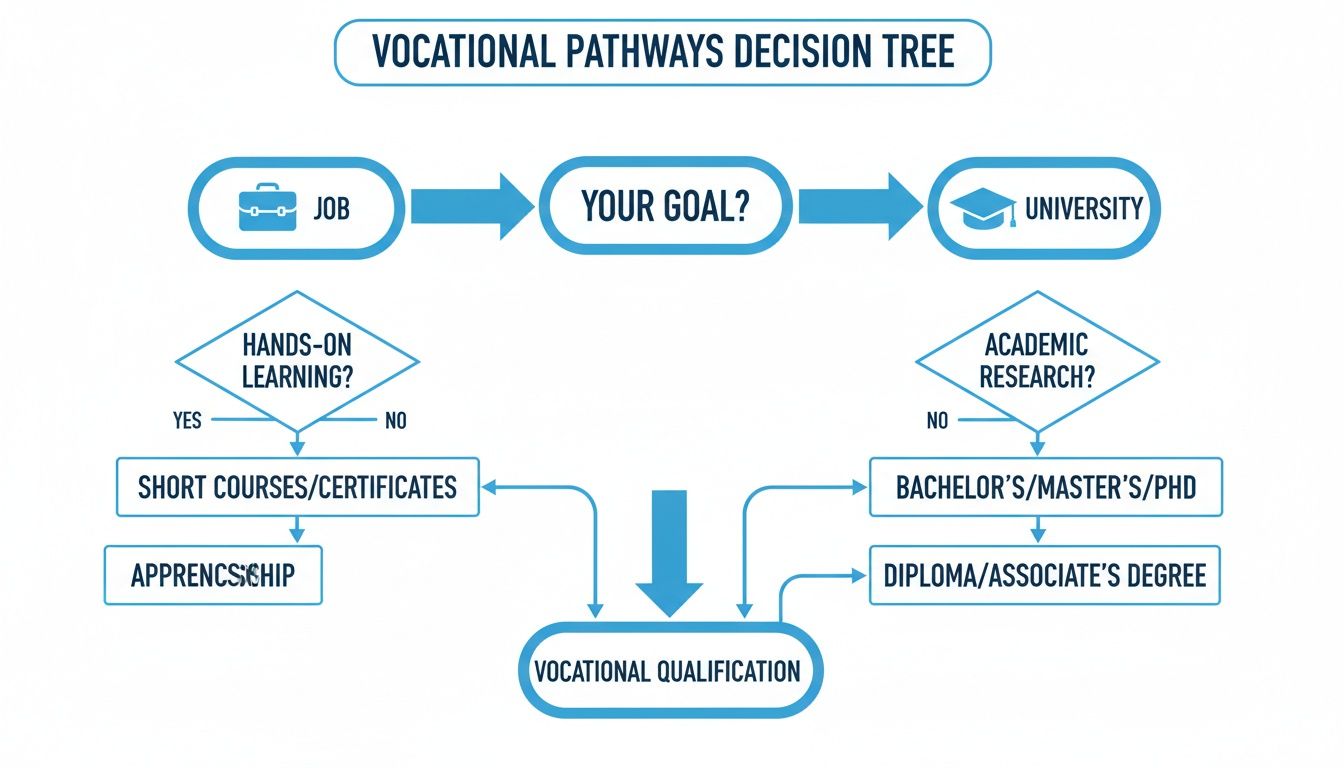
As you can see, no matter if your sights are set on a job or a degree, a vocational qualification provides a direct and proven path to get you there.
Comparing UK Vocational Qualifications
To make things even clearer, here’s a side-by-side comparison of the most common vocational routes. Seeing the key features in one place can help you quickly work out the best fit for your goals and how you like to learn.
| Qualification Type | Best For | Study Method | Typical Duration | Main Outcome |
|---|---|---|---|---|
| Apprenticeship | Earning while learning on the job | 80% work-based, 20% study | 1-5 years | Direct employment & a formal qualification |
| T-Level | 16-19 year olds wanting a mix of classroom and work experience | Classroom learning with a 45-day industry placement | 2 years | Skilled employment, apprenticeship, or uni |
| BTEC | Learners who prefer continuous, practical assessment over exams | Primarily coursework, projects, and practical tasks | 1-2 years | Employment or progression to higher education |
| Access to HE Diploma | Adults returning to education to get into university | Academic study focused on a specific degree path | 9-12 months | University entry (provides UCAS points) |
What really stands out from this table is that an Access to HE Diploma is the most direct and accelerated route for an adult learner whose primary ambition is getting into university. Its whole structure is designed to bridge the gap for those who've been out of the classroom for a while.
Who Is Each Qualification Really For?
Let's dig a bit deeper. Your personal situation is unique, so the right choice will really depend on your current lifestyle, commitments, and what you want for your future.
An Apprenticeship is perfect if you’re a hands-on learner who wants financial independence right away. You need to be ready for the world of work and have the discipline to balance a job with your studies.
T-Levels and BTECs are fantastic choices for younger learners who have a clear idea of the career sector they're interested in but want to keep their options open for either work or university when they finish.
Finally, the Access to HE Diploma is tailor-made for the career changer, the parent returning to education, or anyone who feels they missed their chance at a degree the first time around. It provides a focused, supportive environment to get you ready for the challenges of university, making it an empowering step towards a whole new professional life.
Vocational vs Academic: Which Is Your Best Route?
Deciding between a practical or theoretical path can feel like a huge, life-altering choice. But it doesn't have to be that complicated.
Let's think of it this way: imagine you're building a house. The academic route is like being the architect. You'll spend your time learning the deep theory behind structural integrity, complex physics, and design principles. You create the blueprint.
The vocational route is like being the master builder. You're the one on-site, using specialist tools and hands-on skills to turn that blueprint into a real, tangible home. Both roles are absolutely essential, highly respected, and require incredible skill—they just get to the end result in completely different ways.
Neither path is 'better' than the other. It all comes down to what suits your learning style, your career goals, and your life right now. The key is figuring out if you learn best by diving into abstract concepts first, or by rolling up your sleeves and learning by doing.
Understanding the Core Differences
At its heart, the split comes down to theory versus practice. Academic courses, like A-levels and many traditional university degrees, are built to give you a deep, theoretical understanding of a subject. The focus is on research, critical thinking, and exploring broad ideas.
Vocational education, on the other hand, is designed around a specific job. The entire curriculum is shaped to give you the exact skills an employer in that field is looking for. It directly answers the question: "What will I actually be doing in this job, and how do I learn to do it well?"
Let's break down the two approaches:
- Learning Style: Academic learning is often about lectures, essays, and exams. Vocational learning centres on practical assessments, real-world projects, and proving you can do the job.
- Pace and Focus: Academic routes can be broad, exploring many different parts of a subject over several years. Vocational courses are usually much more focused and can get you ready for a specific career in months, not years.
- End Goal: The immediate goal for many academic courses is more study. For vocational qualifications, the immediate goal is almost always getting straight into a specific profession.
From a national perspective, vocational training is becoming a crucial answer to skills gaps in the economy. With an estimated 12.7% of 16- to 24-year-olds not in education, employment, or training (NEET), and many adults needing to upskill, these practical programmes have never been more important.
The Best of Both Worlds for Adult Learners
For adults looking to learn or change careers, the lines between vocational and academic are becoming wonderfully blurred. You no longer have to pick one side. Qualifications like the Access to Higher Education Diploma offer a perfect blend of both worlds.
These courses are vocational in spirit—they are intensely focused on preparing you for a specific degree and career path, like nursing, social work, or computing. They teach you the essential study skills and subject knowledge you need to hit the ground running at university.
An Access to HE Diploma acts as a powerful bridge. It takes your life experience and ambition and combines it with focused, university-level academic preparation, giving you the best of both the practical and theoretical worlds.
This hybrid approach is precisely why universities hold these diplomas in such high regard. They see applicants who not only have the academic knowledge but also the focus and practical mindset that comes from a vocational-style course. It proves you're ready for the demands of a degree. As you weigh up your options, seeking out good TAFE and university assignment assistance can provide clarity on what to expect from different study paths.
Ultimately, choosing your route is about being honest about how you learn and what you want to achieve. For many adults aiming for a degree, a vocational qualification like an Access to HE Diploma is often the most direct, accessible, and supportive path to get there.
How to Start Your Vocational Course Journey

Making the decision to go for a new career is a huge step. But what comes next? It’s time to turn that ambition into a clear, actionable plan.
Starting your journey into vocational education isn’t about navigating some complex system on your own. It’s simply about taking a series of manageable steps to get you from where you are today to where you want to be.
We’ll walk you through the whole process, breaking it down into a simple roadmap. From figuring out which course truly aligns with your goals to sorting out the funding, here’s everything you need to know to get started with confidence.
Researching Your Ideal Course
First things first: you need to connect your dream career to a specific qualification. Don’t just look at a course title; dig deeper into what it actually teaches and, more importantly, where it can take you. This is the foundation of your entire journey.
Start by pinpointing the profession you want to enter. Are you hoping to become a nurse, a social worker, or a business manager? Once you have a clear goal, you can work backwards to find the qualification that will open that door. For many adult learners, this will be an Access to Higher Education Diploma tailored to that exact field.
As you research, ask yourself these key questions:
- What are the specific modules? Look at the course content. Does it genuinely interest you and cover the topics you need for your future degree?
- What are the progression routes? Reputable providers will proudly show which universities have accepted their students for specific degrees. This is your proof that the course actually works.
- Is the provider accredited? Make sure the course is regulated by an official body like the Quality Assurance Agency for Higher Education (QAA).
Understanding the Entry Requirements
One of the biggest worries for adult learners is whether their past education will hold them back. The good news is that for many vocational courses—especially Access to HE Diplomas—the entry requirements are designed to be flexible and inclusive.
Providers get it. They understand that you bring valuable life experience to the table, and they’re often more interested in your motivation and commitment than in decade-old exam results.
While some university degrees might later require GCSEs in English and Maths, many online providers offer equivalent Functional Skills qualifications that you can study right alongside your main course. This means there’s almost always a supportive pathway available, no matter your starting point.
Your past doesn't define your future academic potential. Vocational education focuses on where you're going, not where you've been, offering a fresh start for anyone with the drive to succeed.
Navigating Your Funding Options
Funding is often a major concern, but there are excellent systems in place in the UK to support adult learners. You don't need to let finances be a barrier to your new career.
The most popular option for funding a Level 3 qualification like an Access to HE Diploma is the Advanced Learner Loan. This is a government-backed loan that covers your course fees, and you only start repaying it once you’re earning over a certain amount.
But here’s the best part: if you use an Advanced Learner Loan for your Access course and then go on to complete a university degree, Student Finance England will write off your loan entirely. This essentially makes your Access to HE Diploma free, acting as an incredible incentive to continue your educational journey. For anyone considering a career change, our guide on retraining for a new career offers more valuable insights into this process.
Choosing a Provider and Applying
Once you’ve found the right course and have your funding sorted, the final step is to choose a provider that fits your life. For many adults juggling work and family, online learning is the perfect solution, giving you the freedom to study at your own pace.
When looking at providers, check out the level of support they offer. Will you get a dedicated tutor? Is there a student support team you can contact easily? A strong support system is vital for staying motivated and on track.
The application process is usually straightforward—often just an online form followed by a chat with an admissions advisor to make sure the course is the right fit for you. This supportive start sets the tone for a successful and rewarding learning experience.
Got Questions About Vocational Education? We’ve Got Answers.
Stepping back into education is a big decision, and it’s completely normal to have a few questions buzzing around your head. For many adults, the world of vocational education feels like new territory, full of unfamiliar terms and pathways that look very different from the school system they remember.
That’s where we come in. We’ve gathered the most common questions and concerns from people just like you who are thinking about this practical, career-focused route. Our goal is to give you clear, straightforward answers so you can feel confident and ready to make your move.
Can I Actually Get into University with a Vocational Qualification?
Yes, you absolutely can. This is probably the biggest and most stubborn myth out there, and it’s time we put it to rest for good. A Level 3 vocational qualification isn't a barrier to university; it's a launchpad.
In fact, some qualifications like the Access to Higher Education (HE) Diploma are created for one main reason: to get you into university. They are the academic equivalent of three A-Levels and give you the UCAS points you need to apply for thousands of degree courses right across the UK.
And universities don't just accept them – they value them. Why? Because these courses prove you have the specific subject knowledge and the academic chops (think research, referencing, and essay writing) to hit the ground running in a degree programme. An Access to HE Diploma tells a university you’re a focused, committed learner who is ready for the challenge.
A vocational qualification isn’t a lesser path; it’s just a different one. For many adults, it’s a more direct, focused, and effective way to get a university degree, especially in competitive fields like Nursing, Midwifery, and Social Work.
Good course providers will have well-established progression routes to a wide range of universities, so you can start your course knowing it will get you where you want to go. The numbers back this up. In the 2024/25 academic year, there were over 1,246,010 enrolments on regulated qualifications in England's further education system. As these further education and skills statistics show, many of these learners are on a direct path to higher education.
Am I Too Old to Start a Vocational Course?
Not a chance. There is no upper age limit on learning, and vocational education is one of the most welcoming places for learners of all ages. Courses like the Access to HE Diploma were specifically created with adult learners and career-changers in mind.
You won't be the oldest person in the "classroom." The student community for these diplomas is incredibly diverse, with people in their 20s, 30s, 40s, and beyond. Everyone is there for the same reason: to build a better future.
Your life and work experience aren't things to hide; they’re your biggest assets. You bring maturity, perspective, and a strong sense of purpose to your studies—qualities that will help you fly. Online courses, especially, offer the flexibility needed to fit your studies around work, family, and everything else life throws at you. It’s never too late to invest in yourself.
How on Earth Can I Fund My Course as an Adult?
Worries about money are completely understandable, but there are some excellent financial support systems in place to make your education affordable. Don't let cost be the thing that stands in the way of your dreams.
For Level 3 courses like the Access to HE Diploma, most learners can apply for an Advanced Learner Loan from the UK government. This loan covers the full cost of your course fees, meaning you don't have to pay a penny upfront. You only start making repayments once you’ve finished your course and are earning above a certain salary.
But here’s the best part of the scheme:
- You take out the Advanced Learner Loan to pay for your Access to HE Diploma.
- You successfully finish your diploma.
- You then go on to complete a university degree (like a BSc in Nursing or a BA in Business).
- Once you graduate from university, Student Finance England will write off your entire Advanced Learner Loan.
That’s right. Your Access to HE Diploma could end up being completely free. It’s a fantastic incentive designed to help adults get into higher education. If a loan isn't for you, many providers also offer flexible, interest-free payment plans to help you spread the cost.
What Kind of Support Will I Get as an Online Student?
The thought of studying online can feel a bit isolating, but a good provider will have a solid support system built in to make sure you never feel like you're going it alone. A high-quality online course is designed to be just as supportive as a traditional classroom—sometimes even more so.
When you’re looking at providers, check that they offer a few key things:
- Dedicated Tutors: You should have a personal tutor who is an expert in your subject. They’ll be the one giving you feedback on assignments and answering your questions via email, phone, or online messages.
- Student Support Teams: Beyond the academic side, there should be a separate team for everything else—admin queries, tech support, and general guidance. They’re your go-to for any non-academic wobbles.
- A Peer Community: Look for courses with active online forums or student groups. Connecting with others who are on the exact same journey is a brilliant way to stay motivated, swap ideas, and feel like part of a team.
This mix of professional guidance and peer support makes all the difference, ensuring you feel connected and capable from the day you enrol right through to your final assignment.
At Access Courses Online, we provide the dedicated support and accredited qualifications you need to turn your career ambitions into reality. Our flexible online Access to HE Diplomas are your direct pathway to a university degree and the future you deserve.
Ready to start your journey? Explore our courses today and take that first exciting step.