
Functional Skills Maths and English Level 2 aren't just another set of qualifications; they're your ticket to proving you've got the essential, real-world numeracy and literacy skills that matter.
Think of them less like a stuffy, theoretical exam and more like a hands-on driving test for everyday life. They show employers, colleges, and universities that you can confidently handle the maths and English challenges you'll face every day. Best of all, they're widely recognised as being on par with a GCSE grade 4 or C.
What Are Functional Skills?
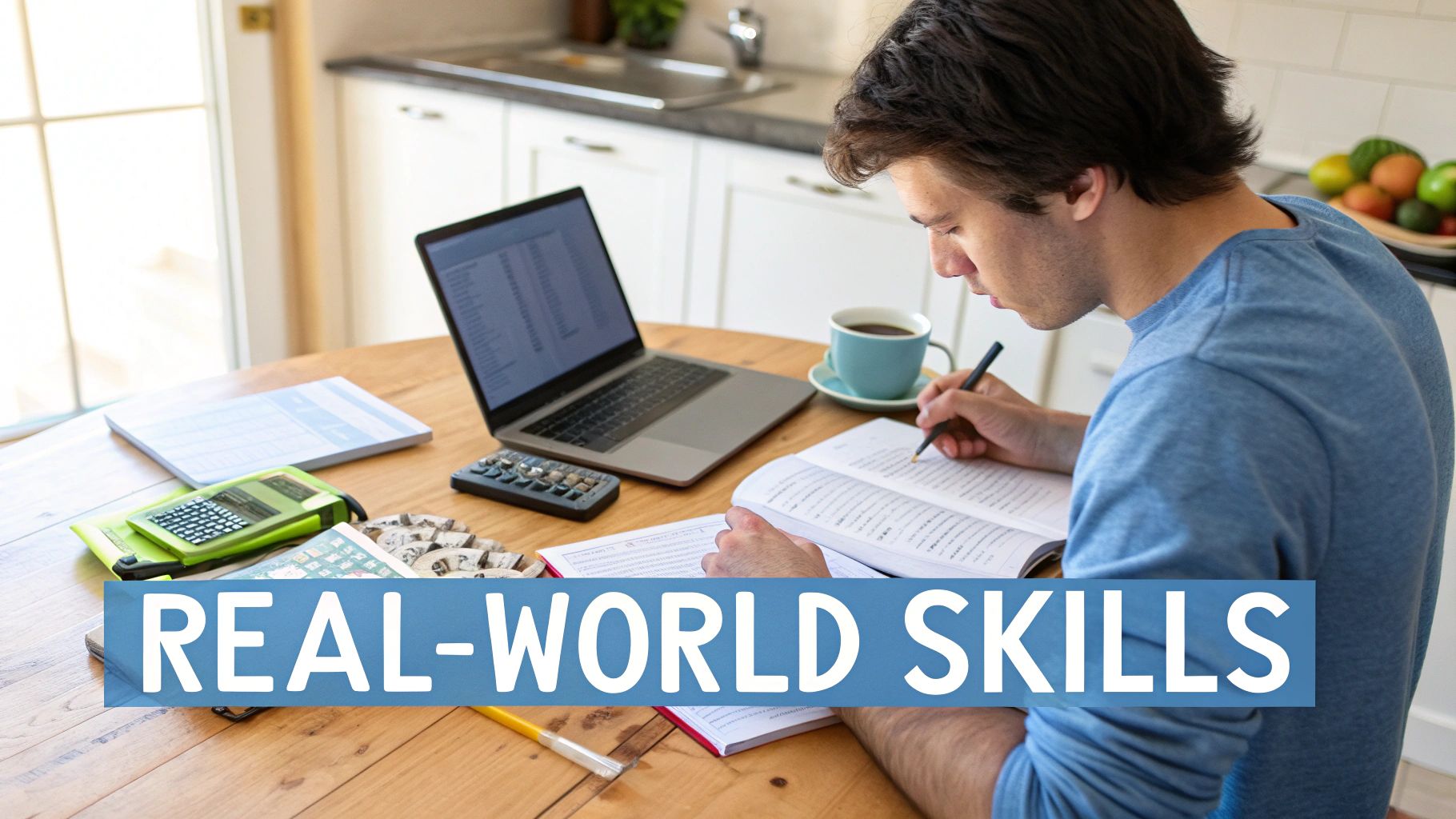
Ever tried to build a piece of flat-pack furniture with nothing but a complex physics textbook for guidance? You'd have all the theory on force and leverage, but you wouldn't know which screw goes where. That’s the perfect way to understand the difference between purely academic qualifications and Functional Skills.
Functional Skills Level 2 qualifications are all about applying what you know to solve real problems. The entire curriculum is built around scenarios you'll actually encounter, whether you're managing a household budget, writing a professional email, or understanding workplace instructions.
These qualifications fill a massive gap in the broader education and training industry, offering a credible and practical alternative for people who need a different path to success.
Who Benefits from This Practical Approach?
The beauty of these qualifications is how many different people they help. They are a lifeline for adult learners who might not have gotten the GCSE grades they wanted at school, giving them a genuine second chance.
They're also essential for:
- Apprentices who must meet the maths and English requirements of their training programmes.
- Career changers needing to prove they have a solid foundation before moving into a new profession.
- Aspiring university students who need a Level 2 qualification to get onto an Access to HE Diploma or certain degree courses.
Functional Skills Level 2 vs GCSE At a Glance
So, how do Functional Skills really stack up against GCSEs? While they're seen as equivalent, their approach and purpose are quite different. This table breaks it down.
| Feature | Functional Skills Level 2 | GCSE (Grade 4/C) |
|---|---|---|
| Primary Focus | Practical, real-world problem-solving. How to use skills. | Academic knowledge and theoretical understanding. |
| Assessment Style | Scenario-based tasks and problem-solving exercises. | Written exams, essays, and theoretical questions. |
| Curriculum Content | Focused on everyday situations like budgeting, data, and clear communication. | Covers a broad range of abstract and academic topics. |
| Best For | Adult learners, apprentices, and anyone needing job-ready skills. | School-age learners and those pursuing academic pathways. |
Both routes are valuable, but Functional Skills are specifically designed to give you the practical edge needed for work and adult life.
A Recognised and Respected Qualification
One of the biggest strengths of Functional Skills Maths and English Level 2 is just how widely they are respected. They aren’t a lesser-known alternative; they are officially accepted as equivalent to a GCSE at grade C or grade 4.
The pass mark for Level 2 Maths exams, for instance, is often around 55%, with English being similar. This makes it a very achievable goal for anyone willing to put in the work.
This isn't just an informal agreement. The equivalence is regulated by Ofqual, the official qualifications watchdog in England. This stamp of approval guarantees that when you earn your Level 2 certificate, you're holding a qualification that employers, colleges, and universities know and trust. It genuinely opens doors.
A Breakdown of the Level 2 Curriculum
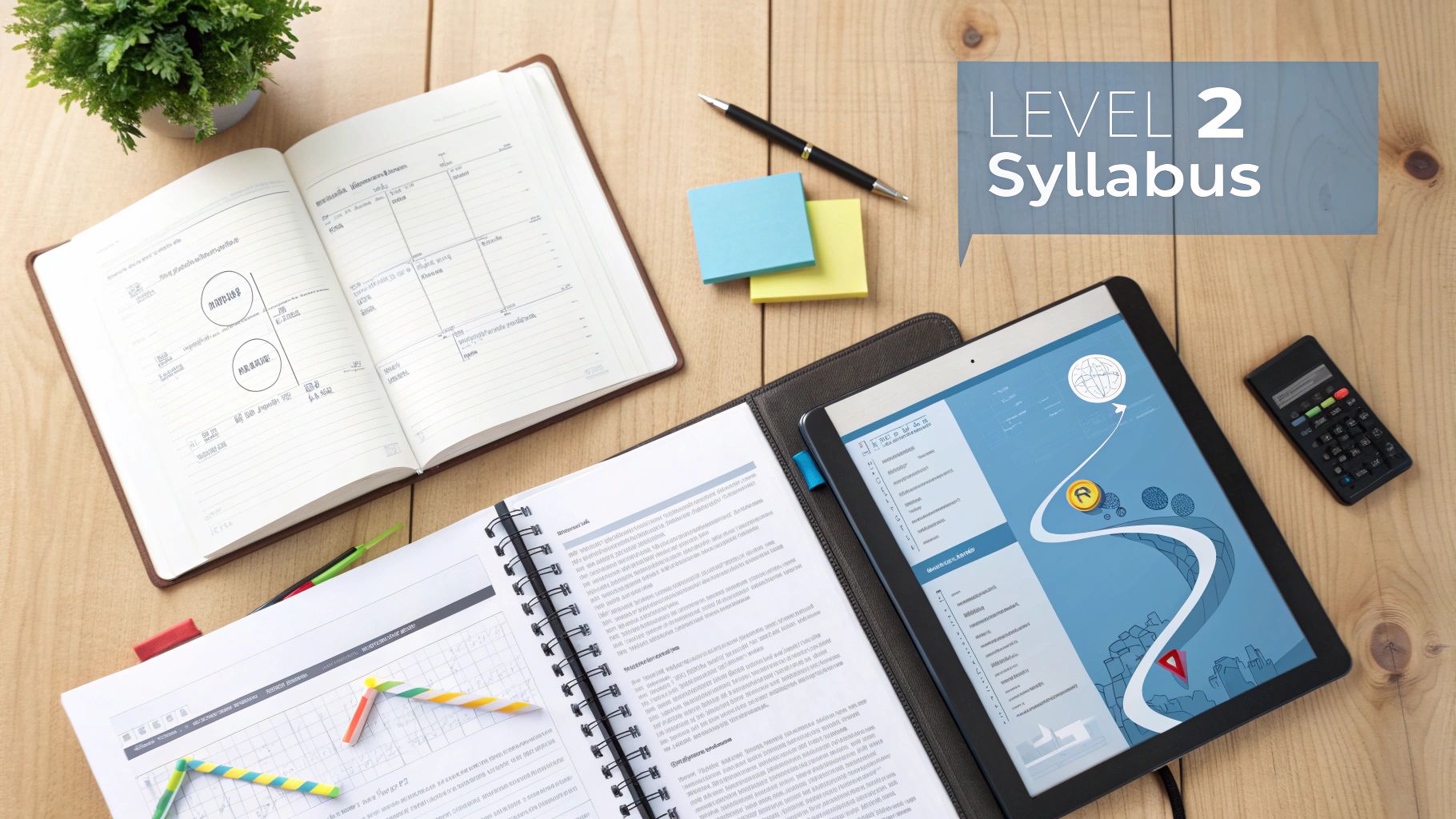
Let's get one thing straight: Functional Skills Maths and English Level 2 isn't about memorising abstract formulas or getting lost in obscure literature. Far from it. The entire curriculum is designed to give you practical, usable skills that you can apply straight away in your daily life and career. Think of it as a toolkit for navigating the modern world with complete confidence.
A great course doesn't just throw a list of topics at you; it builds your understanding one step at a time, connecting every new idea to a real-world situation. That's exactly the approach here, drawing on the principles of creating an effective course outline to ensure the learning sticks.
Everything you learn is focused on what you can do with that knowledge. Whether that's working out your pay slip or writing a professional email, these are skills designed to be put into practice immediately.
Mastering Everyday Maths
The Functional Skills Maths Level 2 course pulls maths out of the textbook and plants it firmly in the real world. Every concept is grounded in practical scenarios you’ll actually face. The goal isn’t just to pass an exam, but to make you a confident problem-solver in everyday situations.
You’ll get to grips with core areas essential for managing your finances, succeeding at work, and just making sense of the world around you. This is about building numeracy skills for life. For a closer look at the specifics, you can explore our detailed guide on Functional Skills Level 2 Maths.
Here are some of the key topics you’ll master:
- Numbers and the Number System: This covers everything from fractions and decimals to percentages and ratios. You’ll finally feel confident calculating a 20% discount in a sale or figuring out the right ratio of ingredients for a recipe.
- Measures, Shapes, and Space: This is all about practical geometry and measurements. Think working out the area of a room to buy the right amount of carpet, or converting between metric and imperial units for a DIY project.
- Handling Information and Data: A vital skill in today's world. You’ll learn how to read and properly interpret graphs, charts, and tables, calculate averages, and get your head around basic probability.
Imagine you're planning a holiday. You'll use your maths skills to compare flight prices with different percentage discounts, convert currency, read timetables, and budget your daily spending. That's the essence of the Functional Skills Maths curriculum.
Developing Powerful English Skills
The Functional Skills English Level 2 qualification is all about effective communication, built on the three core pillars of reading, writing, and speaking. The focus is always on being clear, understanding your purpose, and knowing your audience.
You'll learn to adapt how you communicate in different situations, from a formal report at work to an informal chat with your team. This qualification makes sure you can express yourself clearly and understand information accurately.
The course is split into three main components:
- Reading: You’ll learn to analyse all sorts of texts, from articles and reports to instruction manuals. The trick is to identify the main points, figure out what the writer is trying to say, and tell the difference between a fact and an opinion.
- Writing: This part is about producing clear, well-structured, and grammatically sound writing for different needs. You'll get plenty of practice writing emails, letters, and reports, making sure your spelling, punctuation, and formatting are spot on.
- Speaking, Listening, and Communicating: This involves getting stuck into discussions. You’ll learn how to present your ideas clearly, listen to what others are saying, and respond in the right way in both formal meetings and casual group chats.
This structured approach guarantees you’ll build the kind of well-rounded literacy skills that employers are really looking for, and that will empower you in every part of your life.
How the Functional Skills Level 2 Exams Work
Exams can feel like a step into the unknown, but knowing exactly what to expect is the best way to walk in feeling confident and prepared. The functional skills maths and english level 2 assessments aren't designed to be tricky academic hurdles. Instead, they're straightforward tests of your practical, everyday abilities.
Let’s break down the structure of each exam so you can feel completely in control. The goal here is to demystify the process, turning what could be a stressful day into a manageable and predictable step on your journey. When you understand the format, timings, and what examiners are looking for, you can focus all your energy on showing them what you know.
The Structure of the Maths Level 2 Exam
The Functional Skills Maths Level 2 exam is a single assessment, but it’s split into two distinct parts. This is done for a simple reason: to test your mental arithmetic and problem-solving skills separately from your ability to use a calculator for more complex sums.
The total exam time is usually around two hours, divided between the two sections. Good time management is your best friend here, making sure you give each part the attention it deserves.
-
Section 1: The Non-Calculator Paper
- This is the shorter part of the exam, typically lasting around 25-30 minutes.
- It tests your core numeracy skills – think calculations with whole numbers, fractions, decimals, and percentages, all without any tech to help you.
- You’ll need to rely on your mental maths and written calculation methods to work through the questions.
-
Section 2: The Calculator Paper
- This is the longer section, taking up the bulk of the exam time at around 90 minutes.
- Here, you can use a calculator to tackle more complex, multi-step problems that are all based on real-world scenarios.
- This part focuses heavily on interpreting data from charts and graphs, as well as applying formulas to solve practical challenges.
The non-calculator section makes up roughly 25% of your total marks, with the calculator section accounting for the remaining 75%. This shows just how important both core arithmetic and applied problem-solving are.
The Three Parts of the English Level 2 Exam
Unlike the maths exam, the Functional Skills English Level 2 qualification is assessed through three separate components. Each one targets a different communication skill, and you’ll need to pass all three to get your overall qualification. This modular approach is great because it lets you focus your preparation on one area at a time.
Knowing the specifics of each test is really useful. If you want to dive deeper, it's worth checking out our complete guide to the Functional Skills English Level 2 exam for more targeted tips.
Here’s a quick look at what each English component involves:
- Reading: This is a one-hour exam where you'll be given a couple of different texts to read and analyse. The questions will test your ability to pull out the main points, understand the purpose of the text, and tell the difference between fact and opinion.
- Writing: This exam also lasts about an hour and is split into two tasks. You might be asked to write something formal, like a letter of complaint or a report, and something less formal, like an article or an email. Examiners will be looking for correct spelling, punctuation, and grammar, as well as clear structure and the right tone for the task.
- Speaking, Listening, and Communication (SLC): This is the only part that isn't a written exam. It’s a practical assessment where you’ll take part in a group discussion and give a short presentation on a topic you’re familiar with. This usually takes around 20-30 minutes and is all about assessing how clearly you can express your ideas and listen to others.
Understanding these structures helps you prepare far more effectively. You can get to grips with past papers and become completely comfortable with the format long before exam day arrives.
Who Should Take These Level 2 Qualifications
Figuring out if a qualification is the right move can feel like a huge decision. But when it comes to functional skills maths and english level 2, the answer for a huge range of people is a clear 'yes'. These aren't just for one type of learner; they're a key that unlocks doors for anyone needing to prove their practical, real-world abilities.
Think of these qualifications as a bridge. For some, it's a bridge from a past school experience that didn’t quite go to plan, offering a second chance to get that crucial pass grade. For others, it’s a bridge to a totally new career, a university degree, or a higher-level apprenticeship. The common thread is always progression—these courses are for people ready to move forward.
The Career Changer
Imagine you've worked in retail for a decade but now dream of retraining as a paramedic. University courses for healthcare roles have strict entry requirements, and a Level 2 qualification in both maths and English is almost always a deal-breaker.
This is where Functional Skills really shines. A "Career Changer" can fit a flexible online course around their current job, gaining the exact qualifications needed to apply for an Access to HE Diploma and, eventually, their dream spot at university. It makes a career switch that once felt impossible feel completely within reach.
The University Hopeful
Many aspiring students, particularly adults returning to education, discover their school-era qualifications no longer meet today's university entry criteria. Maybe they left school with a grade D in GCSE Maths, or an equivalent that isn't recognised anymore.
For the "University Hopeful," a Level 2 qualification is the most direct route to ticking that box. It’s a fast, focused way to show you have the academic competence needed for degree-level study, proving you’ve got the literacy and numeracy skills to succeed.
Functional Skills Level 2 provides a nationally recognised, Ofqual-regulated qualification that universities and colleges respect. It’s not just a stepping stone; it's a solid foundation for future academic success, ticking a crucial box on application forms.
The Apprentice
Apprenticeships are a brilliant way to earn while you learn, but they have their own requirements. Many programmes insist that apprentices must hold or achieve a Level 2 in maths and English to complete their training. The "Apprentice" needs a qualification that can fit around their work commitments.
The practical, hands-on nature of Functional Skills is a perfect match here. It reinforces the skills they're already using on the job every day, which makes the learning feel relevant and immediately useful. While a mandatory requirement for apprentices aged 19 and over was removed in early 2024, employers still place huge value on these proven abilities. You can read more about these educational trends on the official government statistics website.
At the end of the day, whether you're changing careers, aiming for university, or getting ahead in your current role, these qualifications are designed for you. They give you the official proof of the essential skills that every employer and university is looking for.
Finding and Funding Your Online Course
So, you've decided that Functional Skills Maths and English Level 2 are the right qualifications for you. That's a brilliant first step. Now for the practical part: finding a course that fits your life and figuring out how to pay for it.
The great news is that online learning has made these qualifications more accessible than ever. You can study flexibly around work, family, and everything else life throws your way.
Navigating the world of online providers can feel a bit overwhelming, but the key is to look for quality and accreditation. Your first priority should always be to choose a provider that offers courses regulated by Ofqual, the UK's official qualifications watchdog. This guarantees that the certificate you earn is nationally recognised and holds real value with employers and universities.
This decision tree can help you visualise if these qualifications align with your goals, whether that's a career change, university entry, or completing an apprenticeship.
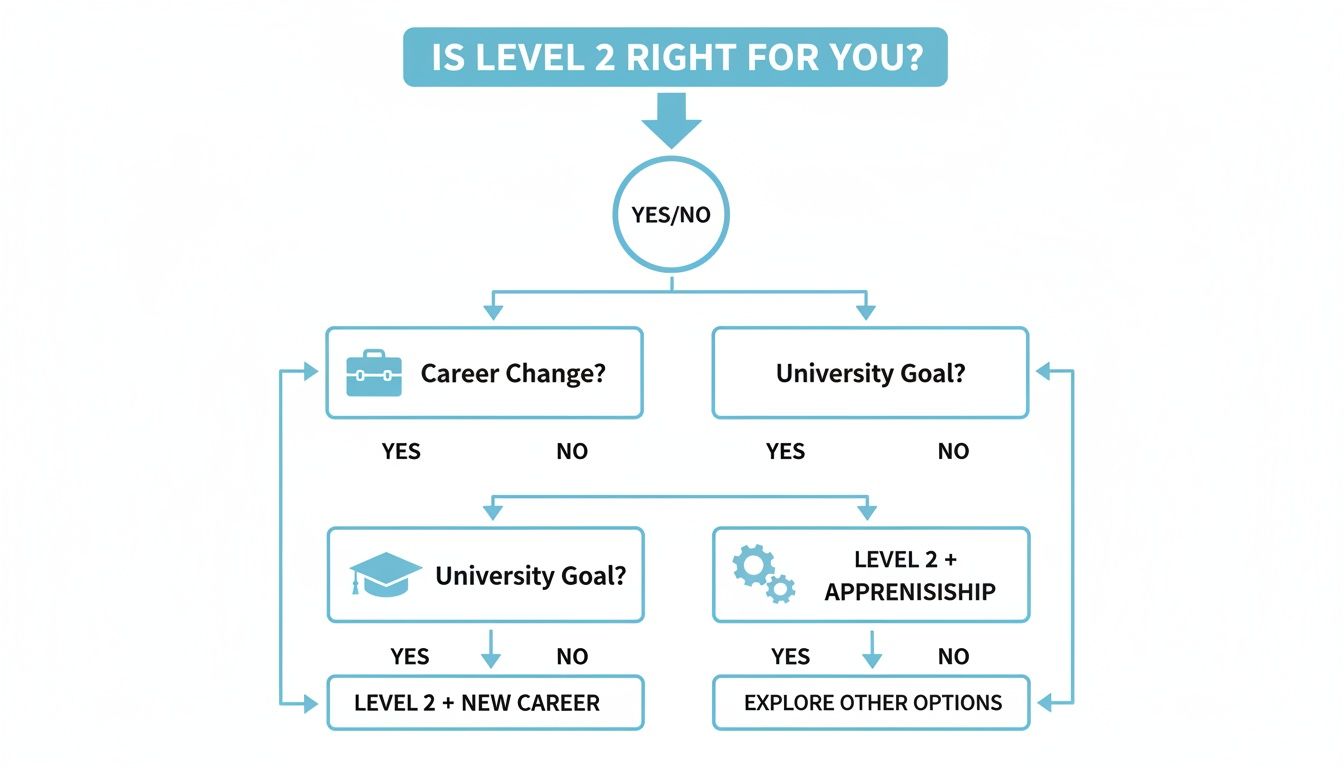
As you can see, Level 2 qualifications are a direct and effective pathway toward achieving these common professional and academic milestones.
Exploring Your Funding Options
One of the biggest questions people have is about cost. Fortunately, there are several ways to get funding, and you might be surprised to find you’re eligible for support. The adult education system is designed to help people gain these essential skills.
The main source of support is the Adult Education Budget (AEB), a government fund set up to help adults get the skills they need for work. For many people, this means they can access a fully funded Functional Skills course.
Whether you're eligible for AEB funding usually comes down to a few things:
- Your age: It's mainly for learners aged 19 and over.
- Your current qualifications: If you don’t already have a GCSE at grade 4 (or C) or above in maths or English, you are very likely to qualify for a free course.
- Your employment status: Funding can also be influenced by whether you are employed or receiving certain benefits.
If you don't qualify for government funding, self-funding is the alternative. Online providers offer competitive pricing, with exam costs for a single subject often ranging from £150 to £250. Many also provide flexible payment plans to help spread the cost, making it a manageable investment in your future.
Choosing the Right Online Provider
With your funding route in mind, the final step is picking the best online provider for you. Not all courses are created equal, and asking the right questions upfront can make a huge difference to your learning experience. A good provider will be transparent, supportive, and focused on your success.
Before you enrol, make sure you get clear answers to these crucial questions:
- Are you Ofqual Regulated? This is non-negotiable. Check that their qualifications are accredited by an official awarding body like City & Guilds or Pearson.
- What Tutor Support is Included? Find out how you can contact tutors (email, phone, video call) and what their response times are. Personalised support is vital.
- Are Learning Materials and Mock Exams Included? A quality course will provide everything you need, including practice papers that mimic the real exam.
- How Long is the Course Access? See how long you'll have access to the materials. Most providers offer 12 months, which gives you plenty of flexibility.
For more guidance, check out our guide on finding the best functional skills courses online.
Courses for this qualification typically require around 50 hours of study, which is perfectly achievable for busy adults. Once you pass, you can receive your e-certificate in as little as 48 hours, letting you move on with your plans right away.
Proven Strategies and Resources for Exam Success
Passing your Functional Skills Maths and English Level 2 exams is well within your reach, especially with the right game plan. It’s not about endless, last-minute cramming; it’s about smart, consistent prep that builds your knowledge and, just as importantly, your confidence.
Let’s start with the most effective strategy: a realistic study schedule. As a busy adult, you need a plan that bends to your life, not the other way around. Believe it or not, 30 minutes of focused study three or four times a week will get you much further than one long, draining session on a Sunday. Consistency really is the secret ingredient here.
Build Your Study Toolkit
Having the right tools makes all the difference. The main goal is to get so familiar with the exam format and question styles that nothing on the day throws you off. Thankfully, there are heaps of brilliant, free materials out there to get you ready.
Here are the essentials you should have in your toolkit:
- Official Past Papers: This is your secret weapon. Awarding bodies like City & Guilds and Pearson put their old exam papers on their websites. They show you exactly what to expect, from the wording of the questions to the layout of the paper.
- Reputable Revision Websites: Sites like BBC Skillswise are fantastic. They offer free lessons, short videos, and quizzes that are perfectly matched to the Functional Skills curriculum. They’re a great way to brush up on any topics you’re finding a bit tricky.
- Online Practice Tests: Lots of course providers offer free mock exams or diagnostic tests. These are brilliant for getting a starting point—seeing where your skills are right now and shining a light on the areas that need a bit more love.
Using a mix of these resources means you’re not just learning the theory; you’re actively practising how to use it when the clock is ticking.
The Power of Mock Exams
If there’s one technique that truly prepares you for the real thing, it’s doing mock exams under timed conditions. Think of it as a dress rehearsal. It helps you get a feel for the right pace, manage your time smartly, and learn how to handle that exam-day pressure in a low-stakes way.
Every mock you complete is like a feedback session. It pinpoints your weaker spots, showing you exactly where to focus your revision. It's a much more efficient way to study than just re-reading an entire textbook from cover to cover.
And this approach works. Recent data has shown just how effective proper support and accessible assessments can be. In the 2023-24 academic year, there was a notable improvement in pass rates for Functional Skills Level 2 English, demonstrating that learners can and do succeed with the right preparation. You can explore more about these positive trends on NCFE.org.uk.
By using these strategies consistently, you’re doing more than just studying for a test. You’re building a solid foundation of practical skills and developing the calm, confident mindset that will make all the difference on exam day and beyond.
Common Questions About Functional Skills Level 2
As you start to think about your next steps, it's completely normal for a few questions to pop up. Let's walk through some of the most common queries we get about functional skills maths and english level 2, so you can feel confident and clear about the path ahead.
Are They Really Equivalent to a GCSE?
Yes, they absolutely are. An Ofqual-regulated Functional Skills Level 2 qualification is officially recognised as the same as a GCSE at grade 4 (what used to be called a grade C). This means it’s accepted by the vast majority of employers, colleges, and universities as meeting their entry requirements.
That said, it’s always a smart move to double-check with the specific institution you’re applying to. A small number of very competitive courses might have their own preferences, so a quick email or phone call can give you total peace of mind.
How Long Does It Take to Complete a Course?
This is one of the best parts – it’s flexible and really depends on you. As a general guide, most providers suggest you’ll need around 50-60 guided learning hours for each subject.
Many motivated learners find they can get through a course and be ready for their exam in just 6 to 12 weeks. The beauty of learning online is that you're in the driver's seat. You can fit your studies around your work schedule and family life, without the pressure of a fixed timetable.
This isn't a race. The goal is to build genuine confidence and understanding. The flexibility of online courses empowers you to take the time you need to master the material before sitting the exam.
Can I Just Take the Exam Without a Course?
You certainly can. If you already feel you have a strong grasp of the material, most online providers offer an 'exam only' option. This can be a great choice for learners who just need to formalise their existing skills.
However, most people find a preparation course is a huge help. These courses are designed to cover the exact curriculum, give you access to mock exams, and get you comfortable with the style of questions you'll face. It can make a real difference in boosting your chances of passing first time.
What Happens If I Fail an Exam?
Failing an exam can be disappointing, but it's definitely not the end of the road. Every accredited provider offers resits, and some course packages even include one for free.
Most importantly, you'll receive valuable feedback showing you exactly where you lost marks. This is incredibly useful, as it allows you to focus your revision on the areas that need a bit more work before you try again. It's a common and constructive part of the learning process for many people.
Ready to take the next step towards your university and career goals? Access Courses Online provides fully accredited, flexible courses to help you succeed.