

Want to know the real secret to a top-grade essay? It’s not about using fancy words or obscure facts. It’s all about having a strong, logical structure.
Think of it as a simple roadmap for your reader. Getting the hang of how to structure an essay comes down to nailing three core parts: a clear introduction, a well-supported body, and a decisive conclusion. Once you’ve mastered this framework, you can guide your reader through your arguments with ease.
Why a Clear Essay Structure Is Your Secret Weapon

Before we get into the nitty-gritty of introductions and paragraphs, let’s talk about why this is so important. For adult learners returning to education, a solid essay structure is the great equaliser. It’s genuinely the most powerful tool you have to make your arguments clear, persuasive, and easy for your marker to follow.
A logical flow stops you from falling into the most common traps, like rambling thoughts or throwing in information without a clear purpose. When your ideas are organised, they become so much more powerful. This isn't just an academic box to tick; it’s a skill that directly leads to better grades and a massive confidence boost.
The Great Equaliser in Action
Structure is a game-changer for Access to HE students. You’re likely juggling work, family, and your studies, so you need to make every single word count. Having a predictable framework means you can pour your energy into the quality of your ideas instead of stressing about how to present them.
Imagine you're writing an essay for a Nursing or Social Science course. Without structure, a discussion on patient-centred care could easily become a jumbled mess of facts. But with a clear structure, it transforms into a powerful argument that shows you can think critically.
Here’s how it works:
- You establish a clear position in your introduction.
- You present distinct points in each body paragraph, backing them up with evidence.
- You conclude by summarising why your argument matters.
This simple approach makes it dead easy for your marker to see how you’ve met the assessment criteria. It’s a proven method that levels the playing field, letting your knowledge shine.
The impact of this skill is undeniable. Strong structural skills taught in Access courses help adult learners compete effectively at university, proving that a solid foundation in writing is key to academic success.
Evidence of Success for Adult Learners
The proof is in the results. Mastering a clear essay structure has been a turning point for countless Access to HE Diploma students in the UK.
QAA statistics from 2021-22 revealed that an incredible 25% of these learners achieved first-class degrees after moving on to higher education. That nearly matches the 26% rate for students with traditional A-level qualifications. This tiny gap shows just how well structured writing skills equip adults to excel at university. You can find out more about these impressive statistics on the QAA website.
Learning how this skill applies to different assignments, like figuring out how to structure a research paper, just reinforces its importance. Ultimately, mastering essay structure gives you a reliable blueprint you can use for any topic, empowering you to tackle any question with confidence.
The Three Pillars of an Effective Essay
Every single powerful essay you’ll ever write, no matter the subject, rests on three core pillars: the Introduction, the Body, and the Conclusion. Really getting to grips with how to structure an essay is all about understanding the specific job each of these parts has to do.
Think of it like building a house. Your introduction is the foundation and the front door – it welcomes the reader and shows them the plan. The body is the main structure, the rooms where you explore your ideas. And the conclusion? That's the roof, tying everything together and giving the whole structure a solid, complete feel.
Let's break down exactly what your marker is looking for in each of these critical sections.
Pillar One: The Introduction
The introduction does a lot more than just state your topic. It sets the whole tone and direction for your essay. Its main job is to grab your reader’s attention and tell them precisely what you’re going to argue. A weak start can leave your marker feeling confused or uninspired from the get-go.
To make it effective, you need to focus on two key ingredients:
- The Hook: This is your opening line or two. It should be engaging and relevant, something that pulls the reader into the topic. It could be a surprising statistic, a thought-provoking question, or a concise statement that frames the problem you're addressing.
- The Thesis Statement: This is, without a doubt, the most important sentence in your entire essay. It's a clear, direct summary of your main argument, and it acts as a mini-roadmap, outlining the points you’ll cover in the body paragraphs.
For example, if you were writing about patient-centred care, your hook might mention the changing expectations of patients in today's NHS. Your thesis statement would then clearly state your argument, perhaps asserting that patient-centred care improves health outcomes by boosting patient compliance and satisfaction. See how it tells the reader exactly what's coming?
Pillar Two: The Body
The body is the heart of your essay. This is where you really develop your argument, present your evidence, and show your marker you have a deep understanding of the topic. It’s not one long chunk of text but a series of distinct, well-organised paragraphs.
Each body paragraph needs to function like a mini-essay, focusing on one single idea that supports your overall thesis. If you find yourself discussing two different points in the same paragraph, that’s a clear sign you need to split them. This ‘one idea per paragraph’ rule is non-negotiable for a well-structured essay.
A well-structured body section is where marks are truly won. Each paragraph should logically follow the last, building a compelling case brick by brick and guiding the reader smoothly through your line of reasoning.
Pillar Three: The Conclusion
Finally, the conclusion is your chance to leave a lasting impression. A common mistake is to just repeat what you’ve already said, but a strong conclusion does so much more than summarise. Its purpose is to synthesise your arguments and powerfully reinforce your thesis, showing the reader why your points matter.
A knockout conclusion should achieve three things:
- Restate your thesis in a new, confident way, reminding the reader of your core argument.
- Synthesise your main points, briefly explaining how they connect to support your thesis. Don’t just list them; show the bigger picture they create.
- Provide a final thought or a "so what?" statement. This could be a recommendation, a prediction, or a comment on the wider implications of your argument. It’s your last chance to show off your critical thinking.
Think of the conclusion as the answer to the question your introduction posed. It provides closure and reinforces the value of the argument you’ve so carefully built.
To give you a clearer picture, here's a simple blueprint breaking down how these pillars work together.
The Three-Pillar Essay Blueprint
| Essay Section | Core Purpose | Key Elements | Approx. Word Count % |
|---|---|---|---|
| Introduction | To introduce the topic and state your argument | Hook, background context, thesis statement | 10% |
| Body | To develop the argument with evidence | Topic sentences, evidence, explanation, linking | 80% |
| Conclusion | To summarise the argument and give a final view | Restated thesis, synthesis of points, final thought | 10% |
By treating these three pillars as distinct but deeply connected parts, you create a coherent and convincing structure that will impress any marker. It's a formula for success, every single time.
Building Strong Paragraphs with the PEEL Method
Once you've got your introduction mapped out, it's time to get into the heart of your essay: the body paragraphs. This is where you move from simply planning your argument to actually proving it. But remember, the strength of your essay hinges on the strength of each paragraph. A common mistake students make is just dropping facts onto the page without weaving them into a convincing argument.
To avoid that trap, you need a solid structure for every single paragraph. That’s where the PEEL method comes in. It’s a simple but incredibly effective framework that makes sure every paragraph you write is focused, well-supported, and directly contributes to your main thesis. Think of it as a recipe for a perfect paragraph.
Decoding the PEEL Acronym
So, what is PEEL? It’s an acronym for Point, Evidence, Explanation, and Link. By following these four steps in order, you can build paragraphs that are clear, logical, and will impress your marker. Let's break down what each part does.
- P - Point: This is your topic sentence. It’s a single, clear statement that tells the reader what the paragraph is about and how it supports your main argument.
- E - Evidence: This is where you back up your point with proof. It could be a quote from a key text, a statistic from a study, a specific example, or another piece of data.
- E - Explanation: This is the most important bit. Here, you unpack the evidence in your own words. You explain how and why it supports your point, showing off your critical thinking.
- L - Link: This is your concluding sentence. It smartly ties the idea of the paragraph back to your main thesis or smoothly leads into the next paragraph, making sure your essay flows well.
Using this structure helps you create a mini-argument in each paragraph, methodically building your case. It stops you from waffling and forces you to justify every claim you make.
PEEL in Action: A Health Studies Example
Let's see how this works in practice. Imagine you're writing an essay on public health campaigns, and your thesis argues they are essential for promoting preventative health. Here’s how you could structure a body paragraph using PEEL.
Point: A major strength of public health campaigns is their capacity to reach a huge and diverse audience, making vital health information accessible to whole communities.
Evidence: For example, the NHS "Stop Smoking" campaign used a mix of TV ads, social media, and local outreach events, reaching an estimated 70% of smokers in the UK at its peak.
Explanation: This multi-channel approach wasn't just about shouting a message from the rooftops; it was about embedding that message into people's daily lives. By popping up in different places, the campaign constantly reinforced the importance of quitting and offered clear steps to do so. This is far more effective than just relying on one source of information that many people might miss.
Link: Therefore, the wide reach of campaigns like this is crucial for creating a national mindset of preventative health, which directly supports the argument that they are a cornerstone of modern public health strategy.
Each part of PEEL has a specific job. The Point makes the claim, the Evidence proves it, the Explanation shows why it matters, and the Link ties it all back together. Getting into this rhythm is the key to taking your writing from simply descriptive to truly analytical.
Why This Method Works for Access Students
For Access to HE students, knowing how to structure an essay properly is a total game-changer. The PEEL method gives you a clear, repeatable system that builds your confidence and will definitely help improve your grades. It's especially useful when you're pulling together information from different sources, as it helps you organise your thoughts and evidence in a logical way.
Recent insights into UK higher education show just how crucial structured writing techniques are for academic success, especially for adults returning to education. In fact, data shows that Access to HE Diploma holders from disadvantaged areas are making incredible progress, with 24% of entrants coming from these backgrounds compared to just 11% with other qualifications. This success is directly linked to the rigorous essay-writing skills taught in courses that use methods like PEEL. You can discover more about these standout statistics on the Skills and Education Group website.
This structured approach forces you to constantly analyse, not just describe. Your evidence—whether it’s a quote or a statistic—can’t speak for itself. That 'Explanation' part is where you really earn your marks by showing what you understand. Of course, your evidence needs to be solid in the first place, which all starts with good research and note-taking. If that's an area you want to improve, check out our guide on how to take effective notes to build a strong foundation.
By consistently applying the PEEL framework, you’re not just writing an essay; you're building a powerful, evidence-based argument from the ground up.
Turning Your Outline Into a Coherent First Draft
The dreaded blank page—it’s the biggest hurdle for most students. But if you’ve built a solid outline, you’ve already won half the battle. Now it’s time to turn that plan into a flowing, coherent first draft. This stage isn't about perfection; it's about getting your ideas down on paper in a structured way, with your outline as your guide.
Staring at your plan can feel just as intimidating as an empty document, but the process is more straightforward than you might think. You’ve already done the heavy lifting by brainstorming ideas, gathering your evidence, and mapping out a logical sequence. The next step is to "flesh out" each section, turning those bullet points into proper sentences and paragraphs.
From Points to Paragraphs
Think of your outline as a skeleton; now you’re just adding the muscle.
Start with the first point from your first body paragraph. This becomes your topic sentence. Next, look at the evidence you’ve listed—that’s your supporting detail. Finally, use your analysis notes to write the ‘Explain’ and ‘Link’ parts of your PEEL paragraph.
Don’t get hung up on crafting the perfect sentence just yet. The goal here is momentum. Write freely, focusing on getting the core idea of each paragraph down as clearly as you can. It’s far easier to go back and polish rough sentences later than it is to write perfect prose from a standstill. Before you even start, it’s a good idea to have your research notes in order. Mastering a few effective note-taking methods can make this whole process much smoother.
The diagram below shows how each part of the PEEL method—Point, Evidence, Explain, and Link—flows into the next to build a strong, logical paragraph.
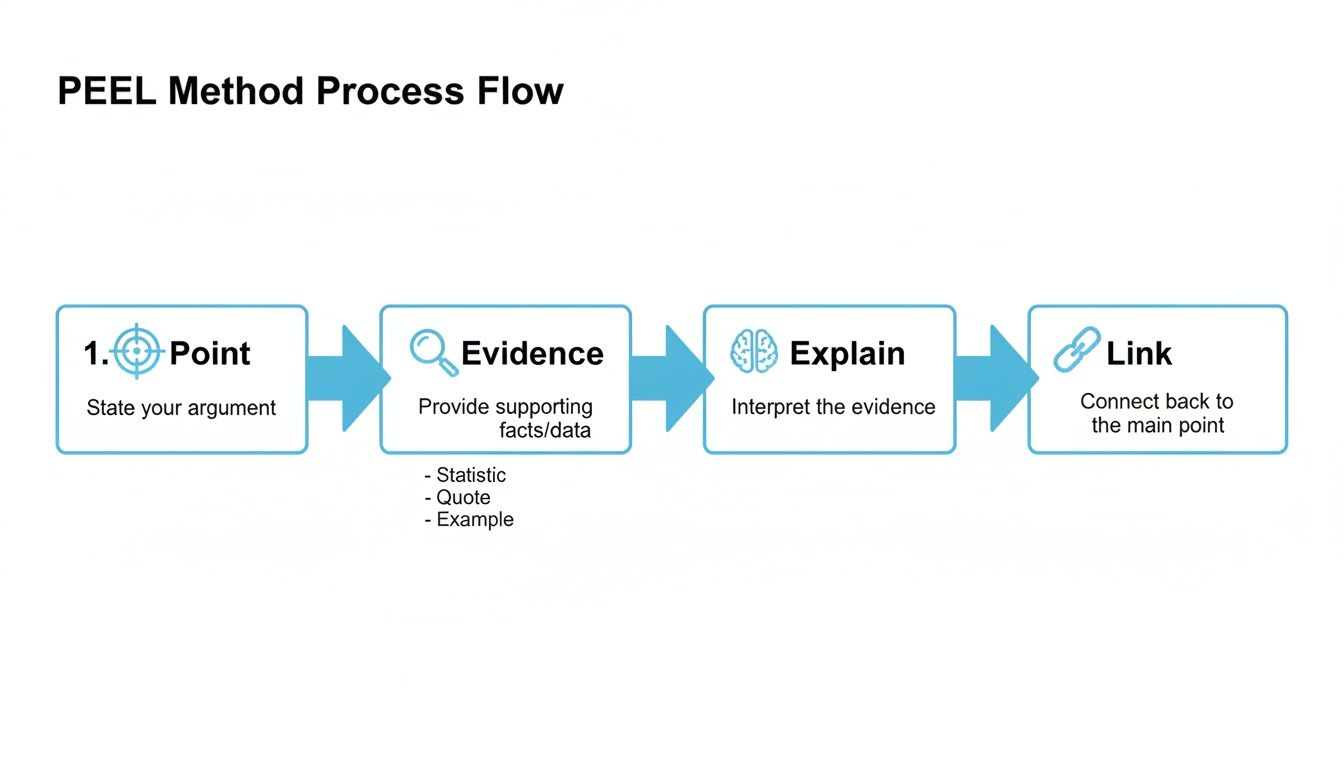
This structured approach makes sure every single paragraph has a clear purpose and directly supports your main argument.
Building Your Essay Block by Block
Here’s a tip from experience: write the body paragraphs first.
The introduction and conclusion are often the trickiest parts because they have to frame your entire argument perfectly. By tackling the body paragraphs first, you’ll have a much clearer idea of what your essay actually says, which makes writing the intro and conclusion far simpler.
Work through your outline one paragraph at a time. After you finish each one, give it a quick read to check it connects logically to the next point in your plan. This helps maintain the flow and stops you from drifting away from your main thesis.
Don't edit while you write. Resist the urge to constantly correct grammar or rephrase sentences in your first draft. This habit, known as 'tinkering', breaks your creative flow and can lead to writer's block. Just focus on getting the words out.
Remember, the first draft is for you. It’s your chance to explore your ideas without the pressure of a deadline or a marker’s critical eye. Let it be messy. For a more detailed guide and some great templates, check out our full post on creating an essay plan that sets you up for success at https://accesscoursesonline.com/blogs/news/essay-plan-template.
Sample Outlines in Practice
To show you how an outline directly translates into an essay, let’s look at how the same structure works across different subjects. It proves that no matter the topic, the fundamental principles of a well-structured essay stay the same.
The table below compares two simplified outlines for typical Access to HE assignments—one in Health Professions and another in Social Science. Notice how each one follows the same intro-body-conclusion structure and uses PEEL-based points, even though the content is completely different.
Sample Essay Outline Comparison
| Essay Component | Health Professions Example ('Discuss the impact of patient-centred care...') | Social Science Example ('Analyse the causes of social inequality...') |
|---|---|---|
| Introduction | Thesis: Patient-centred care improves health outcomes by increasing patient compliance and satisfaction. | Thesis: Social inequality stems from a combination of economic structures, educational disparity, and systemic bias. |
| Body Paragraph 1 (Point) | Increased patient compliance is a key benefit of a patient-centred approach. | Economic factors, such as wealth distribution, are a primary driver of social inequality. |
| Body Paragraph 2 (Point) | Patient satisfaction and trust are enhanced when care is personalised. | Unequal access to quality education perpetuates the cycle of inequality across generations. |
| Body Paragraph 3 (Point) | A potential challenge is the increased time and resources required from healthcare staff. | Systemic discrimination based on race and gender creates significant barriers to social mobility. |
| Conclusion | Synthesis: While resource-intensive, the benefits to patient outcomes confirm patient-centred care is essential. | Synthesis: These interconnected factors show inequality is a complex structural issue, not just an individual one. |
Seeing these side-by-side really highlights a key takeaway: a good structure is universal. Once you master this framework, you can apply it to any essay question, on any topic, with confidence. Your outline is your safety net, keeping you from getting lost and ensuring your final essay is focused, coherent, and persuasive.
Common Essay Structure Mistakes and How to Avoid Them
Even when you've got a brilliant plan, it's surprisingly easy to fall into a few common traps that can pull your essay down. Tutors see the same structural problems crop up again and again, so getting wise to them is your best defence.
Think of this as a troubleshooting guide. We'll walk through the most frequent mistakes that cost students marks and give you some clear, practical ways to sidestep them. Honestly, getting this right is a massive part of learning how to structure an essay that earns top grades.
The Overstuffed Paragraph
This is probably the most common mistake of all: trying to cram way too many ideas into one paragraph. It usually happens when you’ve got lots to say but haven't quite sorted your thoughts into separate, distinct points. The result? A confusing jumble of text that pulls your reader in a dozen different directions at once.
Just remember the golden rule: one paragraph, one main idea. If you catch yourself switching topics halfway through, that’s your cue to hit the 'Enter' key and start a new one.
- Before: Public health campaigns are effective because they reach a wide audience through various media, but they also face challenges like budget limitations and public scepticism, which can sometimes reduce their impact unless they are carefully planned.
-
After:
- Paragraph 1: "A major strength of public health campaigns is their capacity to reach a huge and diverse audience, making vital health information accessible..."
- Paragraph 2: "However, these campaigns are not without their challenges. Budgetary constraints, for instance, can severely limit their scope and longevity..."
Separating the points like this gives each one the breathing room it needs to be properly developed and backed up with evidence, making your whole argument much stronger.
The 'Shopping List' Essay
This is where an essay just lists facts, quotes, or bits of evidence one after the other, with no real analysis or explanation in between. It reads more like a shopping list of information than a proper argument. You might have done some fantastic research, but if you don't explain why it's important, you're not showing any critical thinking.
This is a classic sign of forgetting the 'E' for 'Explain' in the PEEL method. Your evidence can't speak for itself – you have to be the one to interpret it for the reader and show how it links back to your point.
Key Takeaway: Your job isn't just to present information, but to build an argument. Every piece of evidence needs to be followed by your own analysis, explaining what it means and how it supports your thesis.
The Wandering Introduction
An unfocused introduction is another classic pitfall. Some students spend far too long giving vague, general background information and take forever to get to the actual point. Your introduction needs to be sharp and to the point, ideally making up around 10% of your total word count.
Your intro really only has two jobs: get the reader's attention and clearly state your thesis. Anything else is probably just filler that weakens your opening. Get straight to it and tell your marker exactly what you're going to argue.
The Repetitive Conclusion
A weak conclusion does little more than rephrase the introduction and repeat the main points you've already made. While a summary is part of it, a conclusion's main job is to synthesise – to pull all your threads together and show the reader the bigger picture. It needs to answer the "so what?" question, leaving your marker with a strong final impression.
To dodge this, try to:
- Restate your thesis but in a fresh, new way.
- Briefly synthesise your key arguments, highlighting how they connect.
- Offer a final thought on the wider implications of your topic.
Fixing these common errors can make a huge difference to the clarity and impact of your writing. For more tips on improving your study habits, check out our guide on 10 common study mistakes and how to avoid them.
Common Questions About Essay Structure
Even with the best plan in the world, a few questions always pop up when you're staring at a blank page. That’s perfectly normal. Let's tackle some of the most common queries Access to HE students have about structuring essays, so you can move forward with confidence.
How Should I Split the Word Count?
This is the big one, isn't it? Thankfully, the answer is simpler than you might think. While it's not a set-in-stone rule, a great guideline to follow is the 10/80/10 split.
Here’s how it works:
- Introduction: Aim for this to be about 10% of your total word count. So, for a 2,000-word essay, you're looking at around 200 words.
- Main Body: This is where the magic happens. It’s the heart of your essay and should take up roughly 80% of the space. In our 2,000-word example, that’s a solid 1,600 words.
- Conclusion: Just like the intro, keep it concise. The final 10% (200 words) is all you need to wrap things up neatly.
Following this breakdown helps ensure you dedicate enough space to developing your arguments without getting bogged down in a long-winded introduction or a repetitive conclusion. It’s a balanced approach that markers really appreciate.
Does the Structure Change for Different Types of Essays?
Yes and no. The core foundation—Introduction, Body, Conclusion—is always your starting point. What changes is the purpose of your body paragraphs, depending on the type of essay you're writing.
For an argumentative essay, for example, each body paragraph will champion a specific point that backs up your thesis. You'll be using methods like PEEL to really dig into the evidence and persuade your reader. You might even have a paragraph dedicated to acknowledging and shutting down a counter-argument.
On the other hand, an expository essay (which explains or explores a topic) is less about winning a debate and more about providing clarity. Here, your body paragraphs will break down different aspects of the topic in a logical order—maybe chronologically or by theme—to build a complete picture for your reader. The paragraph structure is the same, but the goal is to inform, not to convince.
No matter the essay type, the principle is the same: create a logical journey that guides your reader from a clear beginning to a well-supported end. Think of your structure as the roadmap and your content as the destination.
How Detailed Should My Essay Outline Be?
Your outline is your best friend during the writing process. It should be detailed enough to give you a clear path forward, but not so rigid that it stifles your writing. A good, functional outline usually includes:
- Your Thesis Statement: Write it out in full, right at the top. This is your guiding star.
- Topic Sentences: For every body paragraph, write out the complete topic sentence (the 'Point' in PEEL). This keeps each paragraph focused.
- Key Evidence: Make a quick note of the specific quotes, data, or examples you plan to use in each paragraph. A simple keyword or a citation is fine—no need to write it all out yet.
- A Final Thought: Jot down the main takeaway you want to leave your reader with in the conclusion.
This level of detail gives you a solid framework to build on, but still leaves you plenty of room to be creative and flexible as you get into your first draft.
Ready to turn these structural skills into university-level success? At Access Courses Online, we provide accredited online Access to HE Diplomas that give you the tools and confidence to excel. Find your perfect course and start your journey today.