

Thinking about switching universities is a big step. It's a process that needs honest self-reflection to figure out why you want to move and some careful planning to make sure you get it right. You'll need to look into new courses, check if you meet the requirements, and then put together a strong application to send directly to the university or through UCAS.
Deciding if Transferring University Is Your Best Option
That first thought about switching unis often starts small. Maybe it’s a lecture that just doesn't click, a campus that doesn’t quite feel like home, or that slow-dawning realisation that the career you want is in a completely different direction.
Before you jump into applications, it’s really important to pause and have an honest chat with yourself. Is this just a temporary wobble, or is there a genuine mismatch between you, your course, and your current uni?
Lots of students find out their first choice wasn't what they thought it would be. For example, you might pick a broad Business Management degree only to discover your real passion is for digital marketing – a specialism your current uni barely touches on. That kind of academic mismatch is a perfectly valid reason to start looking elsewhere.
Evaluate Your Core Motivations
To get some clarity, try to break down your feelings. Think about the academic side of things, but also the social and professional aspects of your uni experience. Are you feeling bored or unchallenged by your modules? Or maybe you're finding it tough to make friends and find your people, which is just as crucial for a happy uni life.
Ask yourself these key questions:
- Academic Fit: Does the course content genuinely interest you and line up with what you want to do in the future?
- Teaching Quality: Are you happy with the teaching, the resources, and the academic support you're getting?
- Social Environment: Does the uni culture, the location, and the social scene actually suit you and support your well-being?
- Career Goals: Is your current degree realistically going to get you where you want to go, career-wise?
A transfer should be a strategic move towards something better, not just an escape from a tough semester. Pinpointing exactly why you want to leave will not only confirm your decision but will also give you the powerful story you'll need for your new personal statement.
This decision tree can help you visualise the different factors at play – academic, social, and career – and see how they might influence your choice.
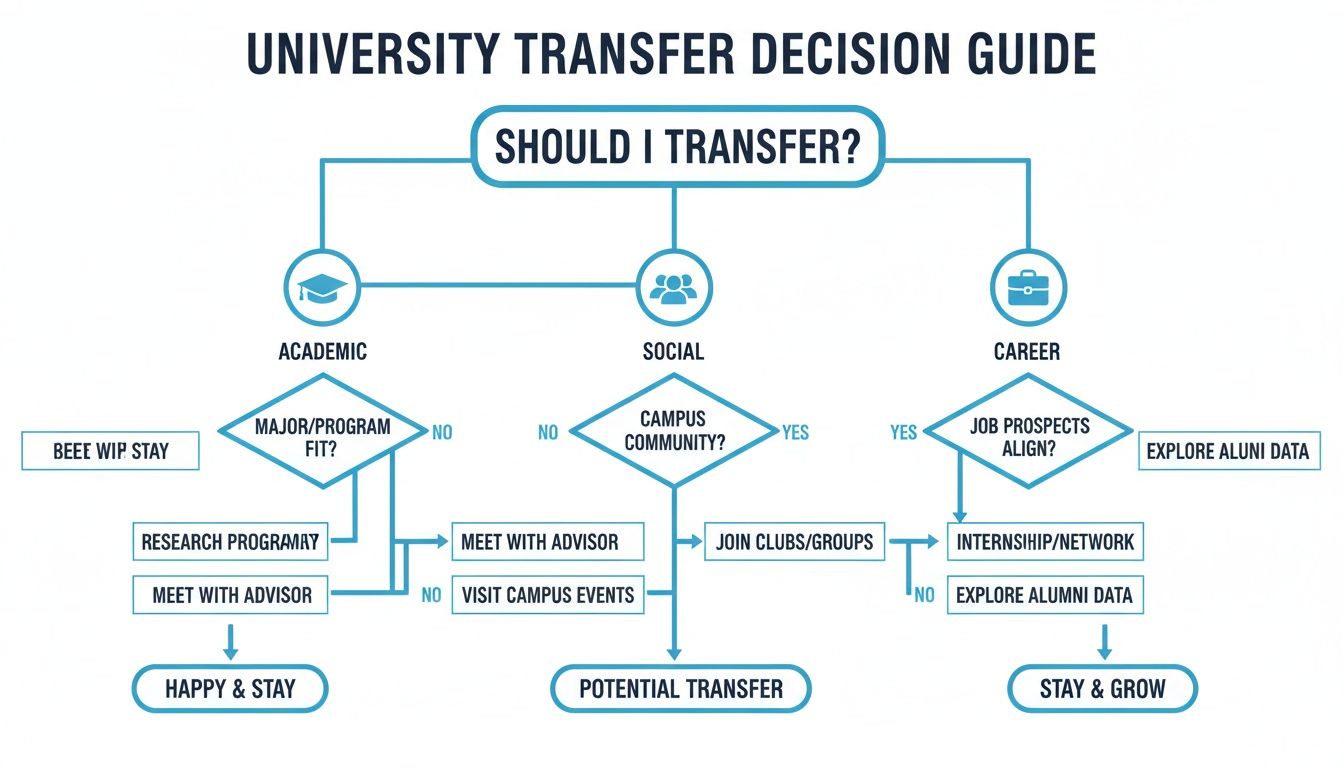
By following the different paths, you can get a clearer idea of your motivations and make sure you’re transferring for all the right reasons.
So, you’ve decided to move. Now comes the slightly tricky part: figuring out the right way to transfer from one UK university to another. It’s not quite as simple as clicking a "transfer" button; instead, it’s about finding the best path for your specific circumstances. Getting this right from the start will save you a massive headache later on.
The good news is, you’re not the first person to do this. Far from it. Picture this: you start at university, full of excitement, only to find the course isn't what you expected, the city isn't for you, or your personal life has thrown you a curveball. It happens all the time. Transferring is a very real option, especially early in your degree. In fact, Higher Education Statistics Agency (HESA) data shows a massive 78% of successful transfers happen during or just after the first year. It's a well-trodden path.
Mid-Course Transfers Versus Starting Fresh
You have two main routes to consider: a mid-course transfer or starting a new degree from scratch. Each one has big implications for your time, money, and degree classification down the line.
- Mid-Course Transfer (Direct Entry): This is where you apply to join another university in your second or third year. It's the perfect solution if your current course is a very close match to the one you want to join. The massive win here is that you don’t lose a year and can progress straight into the next stage of your degree.
- Starting a New UCAS Application: This means you'll be applying to start a degree from Year 1, just like you did when you first left school or college. You’ll often have to go this route if you’re making a big subject change, or if the new university's curriculum is just too different to allow for a direct swap.
The deciding factor between these two? Credit transferability. It all boils down to whether the modules you’ve already passed can count towards your new degree.
Checking Your Academic Eligibility and Credits
Before you get your heart set on a new university, you need to do a bit of detective work. The single biggest hurdle for a mid-course transfer is proving that what you've learned so far lines up with the new university's first-year curriculum.
First, get your documents in order. You'll need:
- Your official university transcript showing all your module results.
- The module descriptions or syllabus for every unit you've completed.
- The course handbook or structure for your target degree (you can usually find this on the uni's website).
Once you have these, it's time for a side-by-side comparison. For instance, if your "Introduction to Business" module covered accounting, marketing, and HR, does the target university's first-year business module cover the same ground? The closer the match, the better your chances.
Key Takeaway: Universities need to see that you've already mastered the foundational knowledge from their first year. If there are big gaps, they'll almost always suggest you apply for Year 1 entry. This isn't to be difficult; it's to make sure you're not set up to fail later.
This whole process of accepting your previous learning has an official name: Recognition of Prior Learning (RPL). It's the formal system universities use to grant you "advanced standing" and let you skip a year.
What are the Key Timelines?
Timing your application is crucial. While some universities have flexible deadlines, most operate within specific windows. Missing them can mean waiting another year. You need to get organised early.
Below is a general guide to when you should be looking to apply, but always, always check the specific deadlines on your target university's website. They can vary quite a bit.
| Typical University Transfer Application Windows |
| :--- | :--- |
| Transfer For | Typical Application Period |
| Autumn (September) Entry | January - June: The main window for most universities. |
| Spring (January) Entry | September - November: Less common, but some unis offer it. |
| Clearing (Mid-Course) | July - September: For last-minute places, usually for Year 1 entry. |
Don't leave it to the last minute. Gathering transcripts, getting references, and writing a compelling personal statement all take time. Start your research at least a few months before these windows open.
The Universal Transfer Form Explained
During your research, you might come across something called the Universal Transfer Form (UTF). This sounds more official than it is. It's not a centralised application system, but rather a standardised document some universities use to make the paperwork a bit easier.
So, what is it? It's simply a form that gathers your academic record, references, and reasons for transferring all in one place. It needs to be completed by you, signed off by your current university's academic registrar, and usually a personal tutor.
Not all universities use it. Many have their own internal forms and processes. However, if a university you’re applying to requests a UTF, it can simplify getting the official sign-off you need from your current institution. The first thing you should do is check the admissions page of your target university to see exactly what they require. This initial legwork is absolutely vital for a smooth application.
Building a Standout Transfer Application
You’ve found the right university and confirmed they have a spot. The next hurdle? Putting together an application that genuinely stands out. A transfer application is a totally different beast from your original UCAS submission. It needs to tell a story of growth, reflection, and clear-headed ambition.
Your main goal is to show the admissions team you're not just running away from a bad experience, but purposefully moving towards a much better academic fit. This means getting the right documents together, completely rethinking your personal statement, and knowing how to communicate professionally. It’s an admin-heavy process, but every step is a chance to show them you’re the mature, motivated candidate they’re looking for.

Gathering Your Essential Documents
Before you even think about writing, get your paperwork in order. Admissions departments live on official documents, and having everything ready to go will make the whole process smoother. It also shows you’re organised and serious.
You'll almost certainly need these:
- Official Transcript: This is the big one—a formal record from your current uni listing all the modules you’ve taken and the grades you got. Get in touch with your university's academic registry or student services office to request an official copy.
- Module Descriptions: Alongside your transcript, you need detailed descriptions or syllabuses for every module. This is non-negotiable. It’s how the new university will map your learning against their curriculum to figure out what credits can be transferred.
- Academic References: You’ll need at least one, maybe two. Pick a tutor or lecturer who knows you and your work well. Give them a decent amount of notice—at least a few weeks—and arm them with your draft personal statement and the new course details so they can write a strong, relevant reference for you.
Getting these documents sorted early saves a lot of last-minute panic and stops your application from getting stuck in administrative limbo.
Rewriting Your Personal Statement for Transfer
That personal statement that got you into uni the first time? It’s not going to cut it now. This new statement needs to answer one very specific question: why the move? Your story has to be positive, forward-looking, and laser-focused on your academic goals.
Instead of pointing fingers at your current university, frame your decision as a story of academic development. Maybe a specific first-year module sparked a passion for a niche area that your target university is known for. That shows you’ve matured as a student and have a much clearer vision for your future.
Key Insight: A transfer personal statement isn't about what went wrong at your old university; it's about what will go right at the new one. Focus on specific modules, research opportunities, or academic staff at the target institution that align with your newfound academic goals.
Your structure should be logical. Start by briefly touching on the positive things from your current uni before explaining how your academic interests have evolved. Then, draw a direct line between those evolving interests and what the new course offers. If you need a hand structuring this vital document, our detailed guide on how to write a personal statement provides a solid framework for telling your story effectively.
Communicating with Admissions Tutors
Being proactive and professional in your communication can make a massive difference. It's often a smart move to reach out to the admissions tutor for your target course before you even formally apply. This shows real initiative and can give you priceless info on vacancies and whether your credits are likely to match up.
Keep your email short, professional, and straight to the point. Introduce yourself, state your current course and uni, and clearly explain why you’re interested in transferring to their specific programme.
Example Email to an Admissions Tutor
Subject: Enquiry Regarding Second-Year Transfer to BA History
Dear Dr. Smith,
My name is [Your Name], and I am a first-year BA History student at [Your Current University]. I am writing to enquire about the possibility of transferring into the second year of your BA History programme for the upcoming academic year.
I have been particularly drawn to your programme's focus on [Mention a Specific Module or Specialism], which aligns with the academic interests I have developed during my studies this year. My current modules include [List 1-2 Relevant Modules], and I am on track to achieve a [Your Predicted Grade, e.g., 2:1].
Could you please let me know if you anticipate having any vacancies for second-year entry and whether my academic profile would be a suitable fit for consideration? I have attached my current transcript and module descriptions for your review.
Thank you for your time and consideration.
Best regards,
[Your Name]
[Your Student ID Number]
This kind of clear, respectful email sets a brilliant tone from the get-go. It gives the tutor the key information they need and shows you’ve done your homework. By managing these tasks with care, you build a powerful case for why you are the perfect transfer candidate.
Understanding Credit Transfers and Student Finance
Let's be honest, the two biggest worries that pop up when you think about transferring university are nearly always the same: "Will my credits actually transfer?" and "How on earth will this affect my student loan?"
Getting straight answers to these questions is absolutely crucial if you want the move to go smoothly. The good news is, there are systems in place for both. You just need to know how to navigate them.
First up, your academic work. The official term for getting your new uni to accept the modules you’ve already passed is Recognition of Prior Learning (RPL). This isn’t just a formality; it’s a detailed look to make sure what you’ve already learned lines up with what they teach in their first year.
Whether you're successful really boils down to the evidence you can provide. You’ll need to hand over your official transcript and detailed descriptions of every module you've studied. An admissions tutor will then sit down and compare your learning outcomes with their own course curriculum to see how well they match.
Maximising Your Credit Transfer
The ultimate goal here is to get as much of your hard work recognised as possible. The more credits they accept, the better your chances of slotting straight into the second year. That saves you a whole year of time and, of course, a lot of money. If it’s only a partial match, you might find yourself having to take extra modules or even starting again from Year 1.
To give yourself the best shot at a successful transfer:
- Be meticulous with your paperwork. Gather everything you can find – syllabuses, reading lists, even old assignment briefs. The more detail you give the admissions team, the easier you make their job of saying "yes."
- Connect the dots for them. When you get in touch, don't be afraid to point out the direct overlaps between the modules you’ve passed and the ones on their course. It shows you’ve done your homework.
- Know your qualifications. If you're applying with something like an Access to HE Diploma, it comes with a set amount of UCAS points. It’s worth using a UCAS point calculator to figure out exactly where you stand before you even start the application.

Navigating Changes to Your Student Finance
Right, once you've got your academic place sorted, it's time to tackle the money side of things. Your student finance package is tied to a specific course at a specific university. Crucially, it does not automatically move with you. It’s your responsibility to tell the student finance body about your move.
As soon as you have your transfer confirmed in writing, you need to log in to your student finance account and fill out a 'Change of Circumstance' form. For students in England, this is done via Student Finance England (SFE). If you're in Scotland, Wales, or Northern Ireland, you’ll need to follow the process for your specific funding body.
Do this immediately. I can't stress this enough. Any delay can cause a massive headache and leave you without your tuition fee payment or maintenance loan just when the new term is starting.
Your funding will then be completely reassessed. The tuition fee loan will be adjusted to whatever your new university charges. Your maintenance loan could also change, as it’s often calculated based on where your new university is located and whether you're living at home.
And for anyone thinking of transferring internationally, getting your head around things like student abroad health insurance is a non-negotiable part of your financial prep.
Here’s a quick checklist for the 'Change of Circumstance' process:
- Get it in writing: Wait until you have the official offer letter from your new uni.
- Tell Student Finance: Log in to your account and fill out the form with your new university and course details.
- Check with your unis: Make sure both your old and new universities have told Student Finance your withdrawal and enrolment dates. This is a classic trip-up that causes major delays.
- Review your new entitlement: You'll get a new letter confirming your funding. Read it carefully so you know exactly what to expect.
Getting these two things—your credits and your finances—sorted is probably the most stressful admin part of transferring. But if you’re organised and proactive, you can avoid most of the drama and make sure your move is as seamless as possible.
Advice for Mature Students and Career Changers
Transferring university as a mature student or career changer is a completely different ball game. You’re not just swapping lecture halls; you're making a deliberate, strategic pivot in your life and career. Your experience isn't a disadvantage—it's your single greatest asset.
Unlike an 18-year-old applicant, you bring a wealth of real-world knowledge, resilience, and a crystal-clear sense of purpose. Admissions tutors see this as a huge positive. Your challenge is simply to frame it effectively, turning your life story into a compelling case for why this transfer is the essential next step.
Leveraging Your Life and Work Experience
Your personal statement is where you connect the dots between your past and your future. Don't just list previous jobs; explain how those experiences have shaped your academic ambitions and make you a perfect fit for the course.
Think about it this way: a former retail manager wanting to transfer into a Business with Marketing degree has a powerful story to tell. They can discuss how managing stock taught them about supply chains, how handling customer complaints gave them real-world insights into consumer behaviour, and how creating staff rotas sparked an interest in operational management. This isn't just work experience; it's applied knowledge that proves your motivation beyond any doubt.
To make your application shine, focus on these areas:
- Transferable Skills: Go beyond the buzzwords. Highlight skills like project management, problem-solving, communication, and budgeting, but use specific, concrete examples from your career to demonstrate them.
- Industry Insight: Show you understand the professional world you're aiming for. Explain how your previous career gives you a unique perspective on the subject you want to study.
- Renewed Purpose: Clearly articulate what prompted this change. Was it a desire for a greater intellectual challenge, hitting a ceiling in your old career, or a passion you can no longer ignore? Be honest and direct.
A mature student's application is powerful because it's grounded in experience. You're not guessing what you want to do—you know. Your job is to show the admissions team that this specific course, at this specific university, is the logical and necessary bridge to get you there.
This approach demonstrates a level of focus and maturity that universities find incredibly attractive.
Showcasing Your Academic Readiness
For those of you returning to education after a break—perhaps after smashing an Access to HE Diploma—proving your readiness for degree-level study is key. Your diploma is concrete evidence of your ability to handle academic rigour, so don't be shy about it.
In your application, explicitly reference the skills you gained. Talk about how you mastered academic writing, critical analysis, and independent research during your Access course. If you excelled in specific modules relevant to your new degree, mention them by name and discuss what you learned. This reassures admissions tutors that you’re prepared to hit the ground running from day one.
The landscape of UK higher education is certainly shifting, with more flexible routes opening up all the time. This is particularly beneficial for non-traditional students. As UK universities see a boom, transfers are becoming more common for mature students seeking this kind of flexible progression. Recent data for the early 2025 intake showed a 31% growth in firm acceptances for January starts, highlighting a trend towards non-standard entry points that can really benefit career changers. You can discover insights about UK university admissions on Edify.pk and see how these trends might work for you.
Addressing Financial and Practical Concerns
Let's be real: the practical side of transferring can feel daunting, especially when you have responsibilities beyond your studies. Funding is often the number one concern. The rules around student finance can be different for mature students, particularly if you have previous qualifications or are studying part-time, so it's essential to get clear, tailored advice.
To get your head around the options, check out our guide on student finance for mature students. It breaks down the support available and can help you make an informed plan.
Beyond funding, think about the support services at your potential new university. Do they have dedicated advisors for mature students? What are their childcare facilities like? These practical elements are just as important as the course content for ensuring you can succeed. When you communicate with the university, don't hesitate to ask these questions. It shows you're a serious, forward-thinking applicant who understands what it takes to thrive. Your unique journey is a strength—make sure your application reflects that at every stage.
Common Questions About Transferring Universities
Thinking about transferring universities always brings up a lot of "what if" scenarios. It's a path with a few moving parts, and it’s completely normal to have questions about the practical side of things. Getting clear, straightforward answers can make the entire process feel much more manageable.
Let's tackle some of the most frequent questions students ask, giving you the clarity you need to move forward with confidence.
Can I Transfer After My First Year?
Yes, absolutely. Transferring after you’ve completed your first year is the most common time for students to make a move. Universities are generally very open to second-year entry applications, as long as you've performed well and your current course modules are a good match for theirs.
A strong alignment between your completed modules and their first-year curriculum is the key here. It makes the credit transfer process so much simpler for the admissions team. You’ll usually apply directly to the new university, but it’s essential to check their specific admissions policy first, as processes can vary.
How Will Transferring Affect My Final Degree Grade?
This is a critical question, and the answer depends entirely on your new university's policy. There’s no single UK-wide rule, which means you must do your homework on this.
Some institutions will only calculate your final grade based on the marks you achieve with them in your second and third years. Others may have a system to incorporate or acknowledge the grades from your previous university.
It is absolutely essential to ask the admissions department about their specific policy on degree classification for transfer students before you accept an offer. This will prevent any unwelcome surprises when you get closer to graduation.
Understanding this from the get-go ensures you know exactly how your hard work will be recognised.
What Happens to My Student Finance?
Your student finance package is tied to your specific course and institution—it doesn't move with you automatically. You must inform your student finance body (e.g., Student Finance England) as soon as your transfer is confirmed.
This is done by submitting a 'Change of Circumstance' form through your online account. They will then reassess your funding based on your new course and university. It's vital to do this immediately to prevent any delays or interruptions in your tuition fee or maintenance loan payments.
Should I Apply Through UCAS or Directly?
The right way to apply depends on when you plan to join the new university.
- For mid-course transfers (joining in the second or third year), most universities handle applications directly. This is often called 'direct entry' or 'advanced standing'.
- If you plan to start over from Year 1 at a new university, you will almost always need to submit a new application through UCAS.
The admissions page on your target university's website is the definitive source of information. It will clearly state the correct procedure for transfer applicants, so make that your first port of call.
At Access Courses Online, we specialise in helping adults gain the qualifications needed to progress to university. If you're looking to change direction and need an accredited Access to HE Diploma to get there, we provide flexible, online courses that fit around your life. Find out how we can help you reach your goals at https://accesscoursesonline.com.