

Writing a reflective essay is all about looking back on a personal experience, really digging into it, and figuring out what you learned and how it’s going to change what you do next. It’s more than just telling a story; it’s about connecting that experience to what you’re learning in your course and showing you can think critically about your own growth.
What Is a Reflective Essay and Why It Matters for Your Degree
A reflective essay isn't a diary entry or a simple play-by-play of an event. Think of it as a bridge connecting classroom theory with the messy reality of the real world. Tutors set this type of assignment to get you to look closely at a specific experience – maybe a tricky interaction with a patient, a group project that went sideways, or a tough decision you had to make – and properly analyse it. The aim is to pull out real, meaningful insights that show how you’re learning and developing.
This kind of writing is a big deal in degrees where theory and practice go hand-in-hand, like healthcare, business, education, and social work. Your tutors aren’t just being nosy; they want to see if you can:
- Connect theory to practice: Can you take a concept from a lecture and apply it to something that actually happened?
- Show self-awareness: Are you able to recognise your own strengths and weaknesses, and understand how an experience made you feel?
- Analyse your actions: Can you go beyond just describing what happened and explain why it happened and what it all means?
- Plan for the future: Can you use what you’ve learned to make a solid plan for how you’ll handle things differently next time?
A Powerful Tool for University Preparation
Getting the hang of reflective writing during your Access to HE course gives you a massive head start. It proves to university admissions tutors that you’re ready for the kind of thinking required in higher education. You’re showing you can do more than just memorise facts – you can think deeply about your own actions and, crucially, learn from them.
This focus on personal experience and growth is why so many adult learners thrive. The Access to HE Diploma is a game-changer for people returning to education, and a good reflective essay works in the same way, turning personal stories into powerful academic arguments. This pathway is designed for everyone, with 29% of entrants from ethnic minorities and 26% reporting disabilities.
A reflective essay is the perfect place to articulate how you’ve balanced life’s challenges to succeed academically – a reality for the 25% of Access students who go on to achieve a first-class degree, which is right up there with the 26% from traditional A-Level routes. You can find more data on the success of the Access to HE Diploma from QAA.
In short, a reflective essay is your chance to prove you are an active, thoughtful learner. It’s not about recounting a perfect experience but showing how you analyse and grow from imperfect ones. This is precisely the skill that will help you excel at university and in your future career.
Choosing the Right Reflective Model for Your Essay
Staring at a blank page can feel like the biggest hurdle when you're learning how to write a reflective essay. The good news? You don't have to pull your thoughts out of thin air. Using a reflective model gives your ideas a ready-made structure, turning scattered memories into a coherent and analytical piece of writing.
Think of these models as proven frameworks designed to guide you through the process. They're not just stuffy academic theories; they are practical toolkits that prompt you to ask the right questions at the right time. This systematic approach is what helps you move beyond simple description and into the deeper analysis that tutors are always looking for.
Understanding Gibbs' Reflective Cycle
One of the most popular frameworks you'll come across, especially in fields like healthcare and education, is Gibbs' Reflective Cycle (1988). Its popularity is down to its straightforward, cyclical nature that really encourages continuous learning. It neatly breaks the whole process down into six manageable stages, each with a clear job to do.
Here’s how it works:
- Description: What happened? Just stick to the facts. Give a clear, concise account of the experience without any analysis or judgement just yet.
- Feelings: What were you thinking and feeling? This is where you acknowledge your emotional response to the situation. Honesty is key.
- Evaluation: What was good and bad about what happened? Try to make an objective judgement about what went well and what didn't.
- Analysis: What sense can you make of it all? This is the heart of your essay. It's where you connect your experience to academic theories and wider reading.
- Conclusion: What else could you have done? Based on your analysis, think about what you might have done differently.
- Action Plan: If it happened again, what would you do? This final step is all about future practice, outlining specific things you'll do to improve.
Using Gibbs ensures you cover all the bases of a strong reflection. It naturally pushes you from describing an event to properly analysing its meaning and planning for the future.
This simple diagram shows how the core elements of any reflection—Experience, Theory, and Learning—are all interconnected.
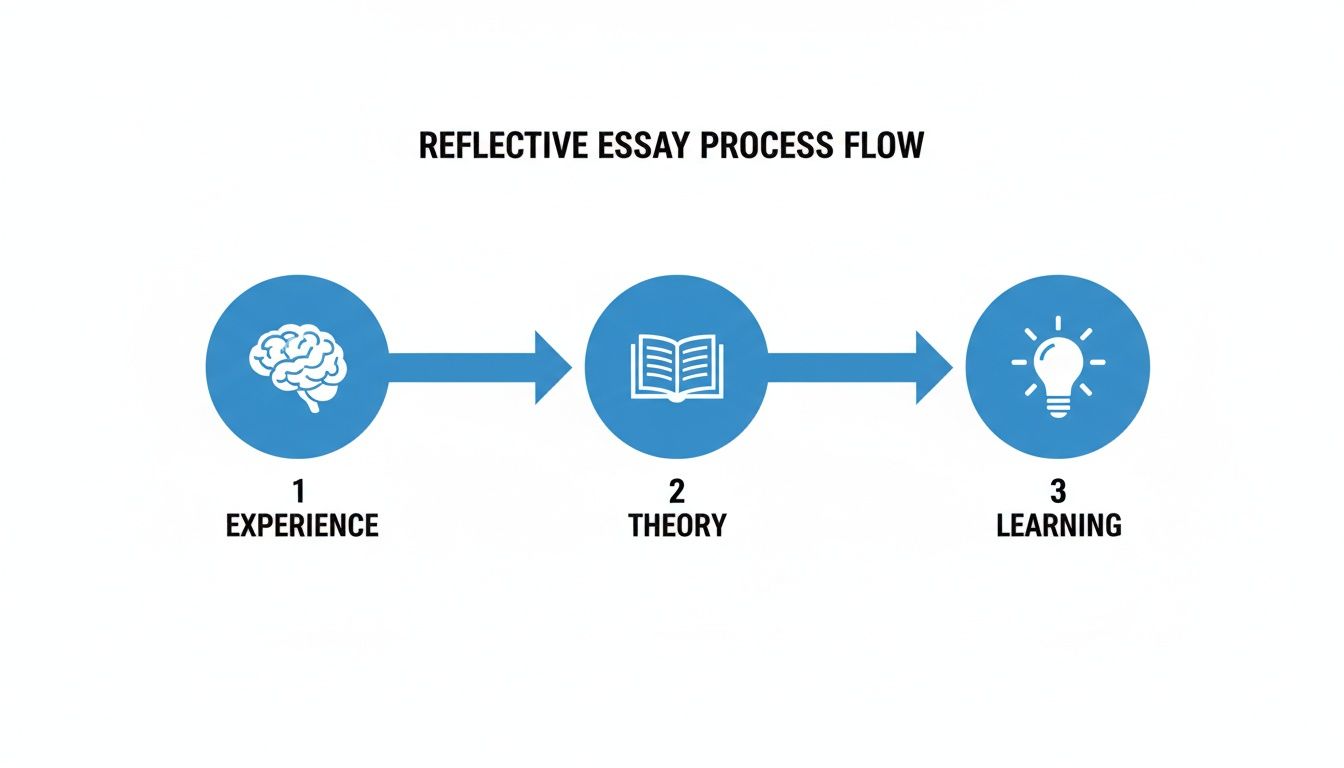
The flow from a concrete experience, through the lens of theory, to a point of new learning is exactly what your tutor wants to see.
Exploring Kolb's Experiential Learning Cycle
Another big name in reflection is Kolb's Experiential Learning Cycle (1984). While Gibbs' model is very structured and step-by-step, Kolb's is more focused on the process of learning from experience. It suggests that real, deep learning happens in a four-stage cycle that you can actually jump into at any point.
Kolb's cycle looks like this:
- Concrete Experience: This is simply the 'doing' part—the event or situation you're reflecting on.
- Reflective Observation: You step back to review what happened, looking at the experience from a few different angles.
- Abstract Conceptualisation: Here, you try to make sense of it all by linking it to theories and forming new ideas or concepts.
- Active Experimentation: Finally, you test out your new ideas in future situations, which then creates a new 'concrete experience' to reflect on. And so the cycle continues.
Kolb's model is brilliant for understanding how you learn. It really drives home the point that reflection isn't a one-off task but an ongoing cycle where every experience informs the next.
Comparing Popular Reflective Models
To help you decide, let's put the two most common models side-by-side. Seeing their stages laid out can make it much clearer which one might suit your assignment better.
| Stage | Gibbs' Reflective Cycle (1988) | Kolb's Experiential Learning Cycle (1984) |
|---|---|---|
| The Event | Description: What happened? | Concrete Experience: Having an experience. |
| Initial Thoughts | Feelings: What were you thinking and feeling? | Reflective Observation: Reviewing the experience. |
| Making Judgements | Evaluation: What was good and bad about it? | (Integrated into other stages) |
| Making Sense | Analysis: Connecting experience to theory. | Abstract Conceptualisation: Concluding and learning. |
| Looking Forward | Conclusion & Action Plan: What would you do differently? | Active Experimentation: Trying out what you've learned. |
While Gibbs gives you a very clear, almost paint-by-numbers structure, Kolb offers a more fluid way to think about your ongoing development. There's no right or wrong answer—just what works for you.
So, How Do You Choose the Right Model?
The best framework often depends on the experience you're writing about and, of course, what your course requires.
Here are a few pointers:
- For a specific, one-off incident: Gibbs' cycle is often perfect. Its step-by-step structure is great for dissecting a single event, like a difficult conversation with a patient or a team project that went wrong.
- For your personal learning journey: Kolb's cycle is excellent for exploring how you've developed a skill or understanding over a period of time. It helps you tell the story of your growth from a novice into a more competent practitioner.
- Check your module handbook first: This is the golden rule! Many courses, especially vocational ones like nursing, social work, or teaching, will recommend or even require a specific model. Always check your assignment brief before you start writing.
Ultimately, you should use a model as a scaffold, not a rigid box. It's there to help organise your thoughts and make sure your reflection is deep, critical, and analytical. Picking the right one is your first step towards crafting an essay that truly stands out.
Crafting Your Reflective Essay from Introduction to Conclusion
 Once you’ve chosen your reflective model, it’s time to get those thoughts out of your head and onto the page. This is where we shift from planning to actually writing, building your essay piece by piece. Let's walk through how to tackle the introduction, the body paragraphs, and the conclusion to make sure every part of your essay pulls its weight.
Even with the best plan in the world, staring at a blank page can be tough. If you’re finding it hard to get the words flowing, it might be worth checking out some practical tips for overcoming writer's block.
Nailing the Introduction
Your introduction is your first handshake with the reader – it needs to be firm and confident. Its job is to grab their attention, set the scene, and spell out exactly what you’re going to do. Forget long, rambling openings; the best introductions are sharp and to the point.
Start by briefly introducing the experience you're reflecting on. This gives your reader immediate context. Next, explain why this experience was significant enough to warrant reflection. What made it stand out?
Crucially, you should also mention the reflective model you plan to use (like Gibbs' Reflective Cycle) and give a quick outline of what the essay will cover. This is like a mini-map for your tutor, showing them you have a clear plan.
A strong introduction hooks the reader by clearly identifying the experience, its significance, and the reflective framework you will use to analyse it. Think of it as a clear signpost for the journey ahead.
Building Analytical Body Paragraphs
The body of your essay is where the real magic happens. This is your chance to go beyond simply telling a story and dive into some deep, critical analysis. Each paragraph needs a logical structure, blending your personal experience with what you've learned from your course.
A common pitfall is getting bogged down in description. Your tutor wasn't there, so they do need some context, but the marks are earned in the analysis.
A good rule of thumb is to aim for roughly 20% description and 80% analysis and evaluation. Use your chosen reflective model to guide you. If you're using Gibbs, for instance, you could dedicate separate paragraphs to your feelings, evaluation, and analysis, or combine them where it makes sense.
To really sharpen your analysis, keep asking yourself, "So what?". Why did you feel that way? What does this mean for your future practice? How does this link to a theory you've studied? For more on structuring academic arguments, our guide on how to write academic essays has some great foundational tips.
Transitioning from Description to Analysis
The real skill in reflective writing is making the leap from describing what happened to analysing why it matters. Using specific sentence starters is a brilliant way to make this transition feel natural and push your thinking deeper.
Try weaving in phrases like these to move from storytelling to proper analysis:
- "Initially, I felt... however, upon reflection, I realise this was because..."
- "This situation challenged my assumption that..."
- "Connecting this to [insert theory/concept], I can see that..."
- "This experience highlighted a significant gap in my knowledge regarding..."
- "As a result, I now understand the importance of..."
These little phrases act as prompts, forcing you away from pure description and towards the critical evaluation your tutor wants to see. They are the tools that build the bridge from 'what' to 'why'.
Writing a Powerful Conclusion
A good conclusion does more than just summarise what you’ve already said. A weak ending can let down an otherwise brilliant essay, so you need to finish strong. The goal is to pull together your key learning points and, most importantly, look to the future.
Start by briefly restating the main insights you gained. What are the one or two biggest takeaways from this whole process? What did you learn about yourself, your skills, or the subject?
The most vital part of the conclusion, though, is your action plan. This is where you outline specific, measurable steps you will take because of what you've learned. Don't just say, "I'll try to communicate better." Be concrete: "In future group projects, I will make sure to schedule a five-minute check-in at the start of each meeting to clarify everyone's role." This shows that your reflection has led to real, tangible growth, which is what elevates a good reflective essay to a great one.
See How It Works with Real-World Reflective Essay Examples
Theory is one thing, but seeing it in action makes all the difference. To really get a feel for how a reflective essay comes together, let's break down a couple of practical examples. We’ll look at annotated snippets from two different fields—healthcare and business—to show you what a high-scoring reflection actually looks like on the page.
Think of these as blueprints you can adapt for your own experiences. They’ll help you see how to weave together the story of what happened, your analysis, relevant theories, and what you’ll do differently next time.

Healthcare Example: An Access to Nursing Student
Let’s imagine a student on an Access to Nursing course reflecting on a tough patient interaction during her work placement. We'll call her Sarah. She was trying to help an elderly patient who became distressed and verbally aggressive.
Here’s a look at how she might structure her body paragraphs using Gibbs' Reflective Cycle.
Description (What happened?)
"During my evening shift, I was assisting Mr. Jones, an 82-year-old patient with dementia, with his meal. He suddenly became very agitated, refusing his food and accusing me of trying to harm him. He raised his voice and threw his spoon on the floor, which was upsetting for him and the other patients nearby."
This is perfect. It’s a clean, factual account of the event. She’s set the scene without jumping into analysis, which is exactly what this first stage needs.
Feelings (What was I thinking and feeling?)
"My initial reaction was a surge of panic. My first thought was that I must have done something wrong. I also felt quite defensive and a little intimidated by his tone. I was acutely aware of the other patients watching, which just made me feel flustered and anxious about whether I was handling it correctly."
This part is honest and self-aware. Sarah doesn’t shy away from her immediate emotional response, a crucial step before you can step back and evaluate things more objectively.
Analysis (Making sense of the situation)
"Thinking about it now, I realise my anxiety probably came from my lack of experience with de-escalation techniques. When I connect this to the communication models we studied in class, I can see it was a classic barrier to communication, caused by his cognitive impairment. The theory of person-centred care suggests I should have focused on his underlying emotional needs instead of the task of eating. His agitation wasn't a personal attack—it was his way of expressing distress."
This is where the magic happens. Sarah shifts from feeling to thinking. She connects her personal experience directly to course theory ("person-centred care," "communication models") and analyses why it happened and why she reacted the way she did. This is what demonstrates deep, critical learning.
Business Studies Example: A Group Project Failure
Now, let's switch gears to a business student, Ben, who's reflecting on a group project that didn’t go to plan.
Evaluation (What was good and bad about the experience?)
"On the plus side, our initial brainstorming sessions were creative and really productive. But the negative aspects far outweighed the good. We completely failed to establish clear roles for each person, our project timeline was unrealistic from the start, and communication completely broke down in the final week. This led to a disjointed and poorly delivered final presentation."
Ben gives a balanced view here, acknowledging what worked before diving into what didn't. This kind of objective evaluation is a cornerstone of good reflective practice.
Conclusion (What else could I have done?)
"Looking back, I see I could have been much more proactive. I noticed the communication issues early on but just assumed someone else would sort them out. I should have been the one to suggest using a project management tool like Trello to assign tasks and keep track of progress. Even a simple, structured weekly check-in could have stopped the last-minute panic and helped us work better as a team."
This shows real personal responsibility. Ben isn't just blaming the group; he’s pinpointing specific, alternative actions he could have taken.
Action Plan (What will I do next time?)
"For any future group task, I will immediately suggest we use a framework like SMART goals to define our objectives. I’m also going to volunteer to be the communications lead for the first half of the project to make sure everyone stays in the loop. To build my confidence here, I'm planning to complete a short online course on project management fundamentals."
See how specific and actionable this is? Ben has created a concrete plan for improvement. This tells the tutor that the reflection has led to genuine professional development, not just ticking a box.
This future-focused approach is what separates an average essay from a brilliant one. It shows a commitment to growth, a quality that's vital for students on Access to HE courses. Many are navigating career changes and juggling studies with major life commitments. In 2021-22, over 60% of Access enrolments were in health-related subjects like Nursing, with a large majority being women. You can discover more insights about these Access to HE statistics and their impact on higher education.
Common Reflective Writing Mistakes and How to Fix Them

Knowing what not to do is half the battle when you're learning how to write a good reflective essay. Even the most powerful experience can fall flat if your writing gets tangled up in a few common traps. This section is your personal troubleshooter, pointing out the mistakes I see students make all the time and giving you clear, practical ways to fix them.
Think of it as getting a bit of tutor feedback before you've even handed your work in. Spotting these issues in your own draft is a key self-editing skill, and it can make a real difference to your marks.
Mistake 1: Being Too Descriptive
This is the big one, the most common pitfall by far. The essay ends up reading like a diary entry – a simple play-by-play of what happened, with almost no analysis. Your tutor already knows you had an experience; they want to see you think critically about it.
- Before: "During the group project, John and I had a disagreement about the marketing strategy. We argued for ten minutes, and eventually, the team leader had to step in. After that, we finished the task."
- After: "The disagreement with John over the marketing strategy really highlighted a breakdown in our team’s conflict-resolution process. My immediate feeling was frustration, but on reflection, I realise this stemmed from my own assumption that my idea was superior. This links to Tuckman's 'storming' stage of group development, showing how conflict can be a necessary phase before a team can move forward."
See the difference? The 'after' example goes beyond just "what happened" to explore the "so what?". It connects a personal event to an academic theory, which shows much deeper learning.
Mistake 2: Being Overly Personal Without Academic Links
While these essays are personal, they are still academic assignments. Sharing your feelings is a key part of it, but those feelings need to be analysed through the lens of your course material. Without that connection, your writing just won't have the critical depth it needs.
Remember, the goal is to show how your personal experience illuminates or even challenges the theories you're studying. The experience is your evidence; the theory is the framework for your analysis.
For instance, instead of just saying "I felt anxious," you could analyse that feeling within the context of professional practice standards or psychological theories of stress. This approach turns a personal feeling into a proper academic insight. If you need a refresher on the basics, our guide on how to structure an essay can help you get your points organised.
Mistake 3: A Weak or Vague Conclusion
Another frequent issue is a conclusion that just repeats what’s already been said or ends with a generic statement like, "I will try to be better next time." A strong conclusion needs a concrete, forward-looking action plan. It’s the final piece of proof that your reflection has led to real growth.
- Weak Action Plan: "In the future, I will improve my communication skills."
- Strong Action Plan: "To improve my communication, my first step will be to actively practise paraphrasing during team discussions to make sure I've understood others' perspectives before I respond. I will also ask my peers for feedback on my clarity after our next presentation."
The second version is specific, measurable, and shows a clear plan to change behaviour based on what was learned. Procrastination often leads to rushed, weak conclusions; exploring some strategies to overcome procrastination can help you give this vital final step the time it deserves.
Your Final Checklist Before You Submit Your Essay
That final polish can be the difference between a good reflective essay and a great one. Before you hit ‘submit’, it’s well worth taking a moment to put on your editor's hat and review your work with a critical eye. This quick checklist will help you catch any last-minute issues and make sure all that hard work pays off.
Stepping back like this helps you shift from writer to editor, which is a crucial change in perspective. And remember, a solid plan is the foundation of any good essay. For future assignments, our free essay plan template can help you organise your thoughts right from the start.
Structure and Flow
A great trick is to read your essay aloud. This helps you catch awkward phrasing and check the rhythm of your writing. Does each paragraph flow logically into the next? Do you have a clear introduction that sets the scene, and a powerful conclusion that not only sums up your learning but also gives a concrete plan for the future?
- Clarity: Is the point of your essay obvious right from the first paragraph?
- Signposting: Have you used your reflective model (like Gibbs' cycle) to guide the reader clearly through your thought process?
- Paragraphing: Does each paragraph stick to one main idea? Avoid those long, dense blocks of text that are hard to read.
Critical Analysis and Reflection
This is where you'll pick up the most marks. Have you gone beyond simply describing what happened? Your analysis needs to be the real heart of the essay.
The core of a reflective essay isn't just telling a story, but breaking down why it matters. For every point you make, ask yourself: have I truly answered the "so what?" question?
Go back and double-check that you've explicitly connected your experience to the theories or concepts from your course. That link needs to be crystal clear, showing you can apply academic knowledge to real-world situations.
Language, Tone and Proofreading
Finally, it’s time to zoom in on the details. Is your tone right? It should be reflective and professional. While you'll be using the first person ("I felt," "I realised"), your writing must still maintain an academic feel.
Proofread like a hawk for spelling mistakes, grammatical errors, and typos. It often helps to read your work backwards, sentence by sentence, which forces your brain to spot errors it would normally skim over. Lastly, make sure you’ve followed all the boring but important stuff, like the word count and the required referencing style.
Answering Your Top Questions on Reflective Essays
Even with the best guide in hand, a few questions always seem to crop up when you're getting to grips with reflective writing. Let's tackle some of the most common ones head-on, so you can move forward with total confidence.
Can I Really Use “I”?
Yes, one hundred percent! A reflective essay is one of the few times in academic writing where using the first person isn’t just allowed – it’s a must.
This is all about your personal journey, your thoughts, and what you’ve learned. Phrases like "I realised," "I felt," and "I now plan to..." are essential. Trying to write about your own experience in the third person would just feel clunky and create a strange distance from your own story.
How Personal is Too Personal?
This is a great question, and it's all about finding the right balance. You need to be honest about your thoughts and feelings, but remember, this is an academic analysis, not a private diary entry.
Stick to the emotions and personal realisations that are directly tied to your professional or academic growth.
The trick is to always link your feelings back to your professional practice or the theories you've been studying. Instead of simply stating "I felt upset," you could explain how that feeling of being upset revealed a gap in your skills or challenged a belief you once held.
Always keep your tone professional and steer clear of sharing overly private details that don't help you analyse the experience.
Isn't This Just a Normal Essay?
Not at all. A standard essay typically asks you to build an argument using external sources like research papers, books, and data. Your own opinion takes a backseat to the evidence.
A reflective essay flips this entirely. It places your personal experience right at the centre of the investigation.
Think of it this way: your experience becomes the raw data. The theories and models from your course are the tools you use to analyse that data. In a normal essay, you look outwards for evidence; in a reflective essay, you start by looking inwards.