
Congratulations, you've done it! You're officially a qualified nurse. Take a moment to let that sink in. It’s a massive achievement and one you’ll look back on for the rest of your career. Getting here, especially if you came through an Access to HE Diploma to retrain, has taken serious dedication and a whole lot of hard work.
From Student to Staff Nurse: Your First Steps After Qualifying
That time right after you finish your degree can feel a bit strange, like you're in limbo. You've passed everything, but there are a few crucial admin hurdles to clear before you can step onto the ward for your first shift as a registered professional.
Think of this guide as your first proper briefing. We’ll walk you through exactly what you need to do, turning that hard-earned qualification into a career.
Securing Your NMC Pin
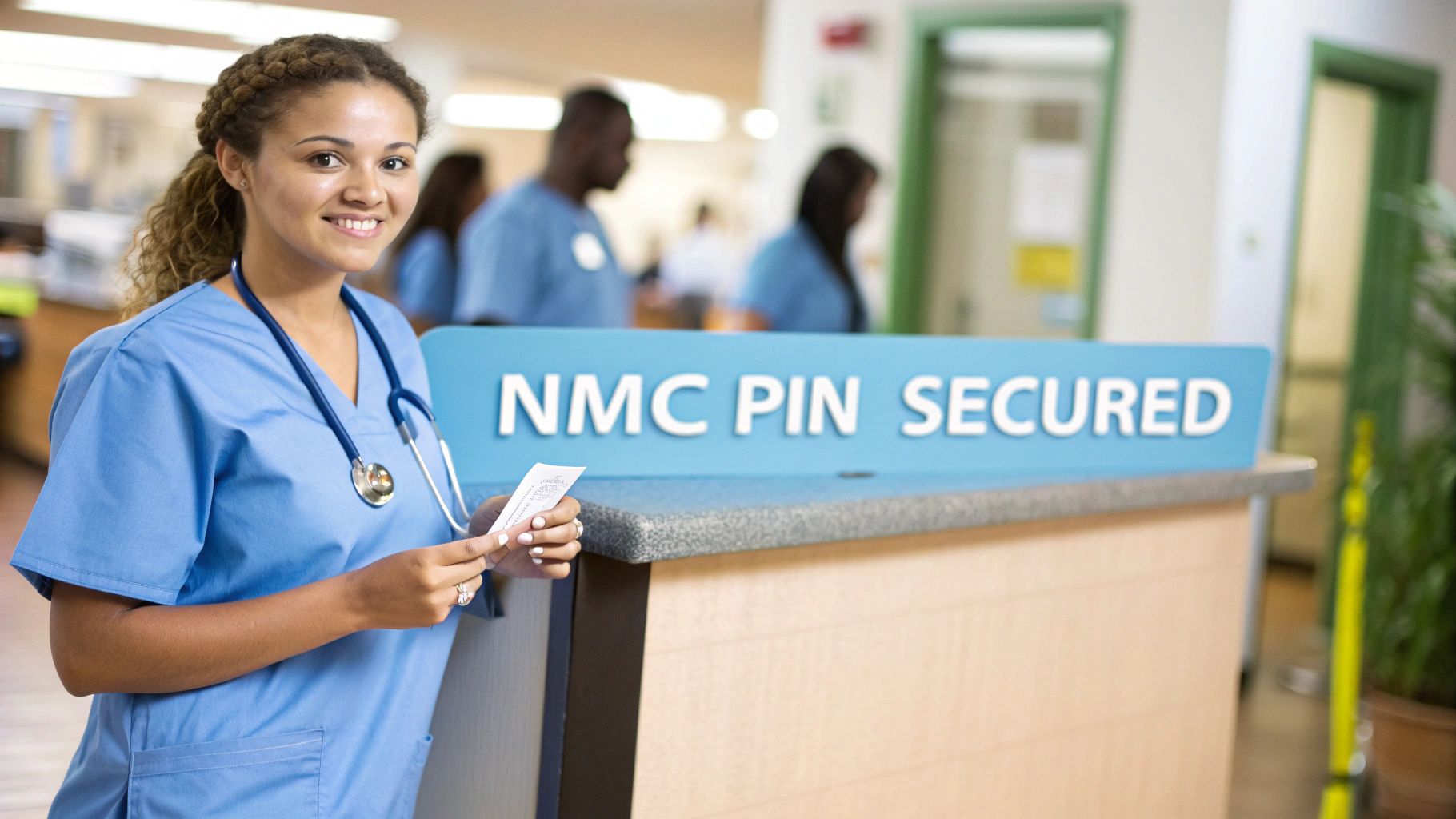
First thing's first: you need to get registered with the Nursing and Midwifery Council (NMC) to get your PIN. This little number is your official licence to practise nursing in the UK. Simply put, you cannot legally work as a registered nurse without it.
Your university handles the first part of this. They'll confirm with the NMC that you've successfully completed your course. After that, you'll get an email inviting you to create an NMC Online account to finish your registration and pay the fee.
Key Takeaway: Your NMC PIN is non-negotiable. Keep a close eye on your emails once your results are out and get that registration sorted as soon as you can. Delays can happen, so a bit of patience might be needed, but don't put it off.
Arranging Professional Indemnity Insurance
While most NHS trusts provide some level of cover, it’s a really good idea to have your own professional indemnity insurance. Think of it as a safety net that protects you if a clinical negligence claim ever comes up. It’s about peace of mind.
The easiest way to get this is by joining a professional body or a union, as they usually include indemnity insurance with their membership. These organisations are brilliant for support, advice, and legal help too.
A couple of the main ones to look into are:
- The Royal College of Nursing (RCN): Offers solid indemnity cover along with tons of resources and workplace support.
- UNISON: Provides legal and professional support for all healthcare workers, including insurance.
This small annual cost is well worth it for the confidence it gives you as you start out. You’re joining a huge and growing profession. In fact, between April and September 2023 alone, 7,094 new professionals joined the NMC register, which just shows how much skilled nurses are needed. You can find out more about the UK's nursing workforce stats and facts on nurses.co.uk.
How to Secure Your First Nursing Role

With your NMC registration sorted, it’s time for the next big step: landing your very first nursing post. It can feel like a huge mountain to climb, but this is your moment to really show off the skills and passion you’ve poured into your training. Let’s skip the generic advice and get straight to the practical steps that will make your application impossible to ignore.
It all starts with a brilliant CV. Think of it as more than just a list of your qualifications; it needs to tell a compelling story about why you’re the perfect fit for the ward.
Crafting a CV That Shines
Right now, your student placements are your professional experience, so make them count. Don't just list where you were and when. Instead, think about the specific skills you gained and use active, confident language to describe them.
For instance, rather than saying you "Observed medication rounds," reframe it: "Actively participated in medication administration under supervision, ensuring adherence to the five rights of medication safety." See the difference? One is passive, the other shows you were an engaged member of the team.
If you’re a mature student who’s retrained, your past career is a goldmine. Experience in retail, for example, gives you incredible skills in communication, de-escalation, and handling pressure—all vital in nursing.
Be sure to highlight specific achievements:
- Clinical Skills: Mention any competencies you’ve been signed off on, like cannulation, catheterisation, or complex wound care.
- Patient Advocacy: Share an example of a time you advocated for a patient’s wishes, showing your commitment to person-centred care.
- Team Collaboration: Talk about your role within the multidisciplinary team during a complex patient case.
Navigating NHS Jobs and Applications
The vast majority of newly qualified nursing jobs in the UK are advertised on the NHS Jobs website. This platform needs to become your new best friend. Get your account set up and create saved searches with alerts for "Newly Qualified Nurse" or "Band 5 Nurse" in the areas you want to work.
When you find a role you like, the "supporting information" section of the application is where the magic happens. This is your opportunity to directly address every single point on the job’s person specification. Go through it line by line and give a solid example from your placements that proves you meet the criteria.
Top Tip: Never just say you have "good communication skills." Instead, describe a specific, difficult conversation you had with a patient or their family. Explain how you managed it, what the outcome was, and what you learned from the experience.
As you start to think about your career long-term, it's also worth looking at different ways of working. Exploring options like flexible remote nurse practitioner roles can give you an idea of the work-life balance that might be possible later in your career, helping you build a sustainable path from the very beginning.
Mastering the NQN Interview
Getting an interview is a huge achievement, so well done! Now, it's all about preparation. Most NHS interviews are a mix of values-based questions and competency scenarios. They don’t just want to know what you can do; they want to understand how you do it and if your personal values align with those of the Trust.
A fantastic way to structure your answers is by using the STAR method. It gives you a clear framework to talk about your experience:
- Situation: Briefly set the scene. Where were you and what was happening?
- Task: What was your specific responsibility or goal?
- Action: Detail the steps you took. Always use "I" statements.
- Result: Explain what happened because of your actions. What was the outcome, and what did you learn?
Let's say they ask: "Tell us about a time you had to manage a deteriorating patient."
A great STAR response would sound something like this: "During my final placement on a busy surgical ward (Situation), my task was to complete the routine observations for four post-operative patients (Task). I noticed one patient's respiratory rate was climbing and their sats were dropping. I immediately escalated my concerns to my mentor, clearly stating the NEWS2 score and my findings. While waiting for them, I sat the patient upright and administered oxygen as prescribed (Action). The patient was quickly reviewed by a doctor, treated for sepsis, and made a full recovery. This really reinforced for me how crucial it is to spot those early signs and escalate concerns clearly and confidently (Result)."
For more detailed tips, check out our guide on how to answer common nursing interview questions.
Surviving and Thriving During Your First Year

That first year after qualifying is an absolute whirlwind of learning, growing, and facing challenges you never could have anticipated. It’s the moment all that theory from your lectures finally collides with the messy, unpredictable reality of clinical practice.
This period isn’t about knowing everything. Far from it. It’s about learning how to manage, how to prioritise, and, most importantly, when to ask for help.
That feeling of being completely overwhelmed? It’s totally normal. Most nurses call it ‘reality shock’—that jarring gap between being a student in a structured environment and suddenly having the full weight and accountability of a registered professional on your shoulders. The good news is, every single nurse has been there, and there are systems in place specifically designed to guide you through it.
Making the Most of Your Preceptorship
Your preceptorship is, without a doubt, the most important part of your first year as a newly qualified nurse. It’s a formal period of support created to help you transition safely and build your confidence. You’ll be assigned a preceptor, who is an experienced nurse, to act as your guide, mentor, and your go-to person for pretty much everything.
This isn't just about ticking boxes on a competency checklist; it’s about building a solid professional relationship. Be proactive. Make a point of scheduling regular check-ins with your preceptor to chat about your progress, raise any concerns, and set goals for the coming weeks.
A great preceptor doesn't just show you what to do; they help you understand why you're doing it. They will challenge your clinical reasoning and encourage you to think critically, turning every task into a valuable learning opportunity.
To get the most out of your time, come prepared. If you know you're going to be looking after a patient with a condition you're a bit rusty on, do a little reading beforehand. It shows initiative and means you can ask more specific, insightful questions. This is your time to consolidate your skills in a safe, supported environment, so squeeze every bit of learning out of it. A great way to embed this learning is by understanding what is reflective practice in healthcare and using it to shape your growth.
To keep you on track, here’s a simple checklist of areas to focus on during that first year. Think of it as a roadmap to help you measure your progress and identify where you might need a bit more support.
Key Focus Areas During Your Preceptorship Year
| Skill Area | What to Focus On | Example Goal |
|---|---|---|
| Clinical Skills | Moving from task-focused care to holistic patient management. | Confidently manage a full patient load of 4-6 patients by month six, including admissions and discharges. |
| Time Management | Developing a system for prioritising tasks at the start of each shift. | Create a daily plan within the first 30 minutes of my shift, identifying the sickest patient first. |
| Communication | Mastering structured handovers (SBAR) and difficult conversations. | Lead 3 patient handovers per shift using the SBAR framework without needing prompts from my preceptor. |
| Critical Thinking | Connecting observations (e.g., vital signs) with the patient's overall clinical picture. | Independently recognise and escalate a deteriorating patient using the NEWS2 score. |
| Delegation | Learning what can be safely delegated to Healthcare Assistants and other support staff. | By month nine, feel confident in delegating appropriate tasks to the wider team to ensure patient needs are met. |
| Self-Care & Resilience | Recognising signs of burnout and developing coping strategies for tough shifts. | Actively participate in at least one team debrief per month after a challenging event. |
This isn't an exhaustive list, but it gives you a solid foundation. Use it to guide conversations with your preceptor and celebrate your progress as you hit each milestone.
Mastering the Art of Prioritisation and Handovers
One of the steepest learning curves is simply managing your time on a busy ward. At the start of a shift, you could be responsible for a bay of four, maybe six, patients, all with complex and competing needs. It’s impossible to do everything at once. Learning to prioritise isn't just a skill—it's essential for survival.
A good habit to get into is to quickly identify your sickest patients. Who has the highest NEWS2 score? Who is due for time-critical medication like intravenous antibiotics? These jobs have to come first. Once they’re sorted, you can build the rest of your care plan around those critical priorities.
A flawless handover is just as vital. It’s not about reading out a list of tasks. It’s about painting a clear, concise picture of the patient's journey during your shift. Using a structured tool like SBAR (Situation, Background, Assessment, Recommendation) is a game-changer for this.
Let’s walk through a real-world example. You’re handing over a patient who has become unwell:
- Situation: "This is John Smith in bed 3. He developed new-onset atrial fibrillation this afternoon."
- Background: "He's an 82-year-old man admitted with a chest infection. He's on IV antibiotics and has a history of heart failure."
- Assessment: "His heart rate has been jumping between 120-140 bpm. Blood pressure is stable at 110/70. I've given the stat dose of bisoprolol prescribed by the doctor, and an ECG has been done."
- Recommendation: "He needs his heart rate monitoring hourly, and the doctors want a formal cardiology review in the morning."
This structure guarantees the next nurse has all the key information they need to provide safe, continuous care.
Navigating Shift Work and Tough Situations
Getting used to shift work—the nights, the weekends, the long days—is a huge physical and mental adjustment. Your body clock will be all over the place, so protecting your sleep is non-negotiable. Blackout curtains, keeping your room cool, and ditching caffeine before you try to sleep after a night shift can make a world of difference.
You’re also going to face emotionally draining situations. It might be managing a rapidly deteriorating patient for the first time, or having a difficult conversation with a family. In those moments, fall back on your training. Stick to the basics: ABCDE assessment, clear communication, and immediate escalation.
Never, ever be afraid to pull that emergency buzzer or shout for help. It is not a sign of failure. It’s the sign of a safe practitioner who always puts their patient first. After a tough event, make sure you debrief with your team. Talking it through helps you process what happened and learn from it, building the resilience you'll need for a long and rewarding career.
Building Resilience and Protecting Your Wellbeing

Let's be honest: nursing is one of the most rewarding careers out there, but it's also one of the toughest. The physical and emotional demands, especially in your first year, can really take their toll. That's why building resilience isn't just a 'nice-to-have'—it's a fundamental professional skill that will shield you from burnout and set you up for a long, fulfilling career.
This goes way beyond generic advice like "do more yoga." It's about creating practical, nursing-specific strategies to handle the unique pressures of the job. Your wellbeing is every bit as important as your clinical competence.
Strategies for Managing Stress
The secret to managing stress isn't ignoring it; it's having a toolbox of techniques you can rely on, both during a frantic shift and after you've clocked off.
One of the most effective tools is the post-shift debrief. This doesn't have to be a formal meeting. It can be as simple as a five-minute chat with a trusted colleague where you both get to download the day's events. Just sharing the load can make it feel so much lighter.
Most NHS Trusts also offer more formal support. Keep an eye out for clinical supervision, which gives you a structured, confidential space to reflect on your practice with a trained facilitator. These sessions are incredibly valuable for processing difficult experiences and stopping emotional fatigue from building up over time.
The Power of a Strong Support Network
You are not going through this alone. The other newly qualified nurses starting alongside you are your single greatest resource. They're the only ones who truly understand what you're experiencing—the nerves, the small victories, and those shifts that feel completely overwhelming.
Make an effort to connect with them. Start a WhatsApp group, grab a coffee before your shift, or just make a point of checking in with each other on the ward. This peer support network will become your lifeline, offering solidarity and understanding exactly when you need it most.
Remember, reaching out for support is a sign of strength and self-awareness, not weakness. A strong support system is a cornerstone of a resilient nursing career, allowing you to share burdens and celebrate successes with people who truly get it.
It's also reassuring to know that the wider system is invested in you. The government's Graduate Guarantee, for example, is a pledge to create thousands of new nursing posts, letting NHS trusts recruit based on their future needs. This initiative, plus the increase in nursing apprenticeships, shows a real commitment to nurturing the next generation of nurses, who Health Secretary Wes Streeting has rightly called the 'beating heart of the NHS'. You can find out more about how the NHS is supporting new nurses on england.nhs.uk.
Practical Self-Care for Shift Workers
Self-care for a nurse looks a bit different. It has to be practical and fit around a demanding, ever-changing rota. Forget complicated routines; focus on the fundamentals that deliver the biggest impact.
- Sleep Hygiene: This is completely non-negotiable. If you're on nights, invest in some blackout curtains and an eye mask. Try your best to maintain a consistent sleep-wake cycle, even on your days off, to help regulate your body clock.
- Meal Preparation: The last thing you want to do after a 12-hour shift is cook from scratch. Spend a couple of hours on a day off batch-cooking simple, nourishing meals like chilli, curry, or a pasta bake that you can just heat up.
- Movement: You spend all day on your feet, but that isn't the same as restorative exercise. Find something you actually enjoy, whether that’s a walk in the park, a quick home workout, or a team sport. It’s fantastic for clearing your head.
Setting Professional Boundaries
Finally, one of the most vital skills you can master as a newly qualified nurse is setting professional boundaries. This really boils down to learning how to leave work at work.
It’s all too easy to go home and ruminate over a challenging case or a conversation that didn't go to plan. But letting work spill over into your personal life is a fast track to burnout. Try creating a "commute ritual" to signal the end of your shift—this could be listening to a specific podcast, calling a friend (to talk about anything but work), or changing out of your uniform the second you walk through the door.
By consciously creating that separation, you give your mind and body the space they need to properly rest and recharge. It’s how you ensure you can walk back onto the ward for your next shift ready to provide the compassionate, high-quality care your patients deserve.
Understanding Pay and Your Future Career Path
Okay, let's get to the good stuff: getting paid for all your hard work and figuring out what comes next. One of the best things about starting your nursing career in the UK is the clarity around pay and progression. There's a structure in place, which is a massive relief when you're just finding your feet.
Getting your head around this from day one helps you not only manage your finances but also see the incredible map of opportunities laid out in front of you. This is about so much more than your first pay slip; it's about seeing the potential for a long, rewarding career.
Demystifying NHS Pay Bands
For most newly qualified nurses jumping into the NHS, you'll start on Band 5 of the Agenda for Change pay scale. Think of this as the national pay system for pretty much all NHS staff (except doctors and dentists). It's designed to make sure pay is fair and consistent based on the responsibilities of your role.
As a Band 5 nurse, your starting salary is fixed at a certain point. But the great news is, it doesn't stay there. Each year, you’ll automatically move up to the next pay point, or 'increment', within Band 5. It’s a built-in reward for your growing experience.
On top of your basic salary, you’ll also earn more for working 'unsocial' hours. This covers any shifts on nights, weekends, and bank holidays. These enhancements can really add up and make a big difference to your take-home pay, so it's worth understanding how they're calculated.
Key Takeaway: Your Band 5 salary is just the beginning. With annual increments and extra pay for unsocial hours, your earnings will grow. Always have a look at the latest Agenda for Change pay scales to see the current rates.
Your Journey Beyond Preceptorship
That first year is all about finding your confidence and embedding your skills, but your development journey is just getting started. Nursing is truly a career of lifelong learning, mainly driven by two things: Continuing Professional Development (CPD) and Revalidation.
- Continuing Professional Development (CPD): This is simply the ongoing process of keeping your skills sharp and your knowledge current. You'll need to log a set number of CPD hours through things like training days, e-learning modules, or even just reflecting on your practice.
- Revalidation: Every three years, you have to revalidate with the NMC to prove you're still fit to practise. It involves gathering evidence of your CPD, your practice hours, and getting feedback from colleagues.
Honestly, think of CPD as your ticket to bigger and better things. Every new skill you learn is what opens the door to climbing the career ladder, moving from a Band 5 staff nurse to more senior and specialist positions.
Exploring Future Nursing Career Paths
Once your preceptorship is done and you feel settled in your role, a whole world of possibilities opens up. Nursing isn't just one career path; it’s a massive, diverse field with countless specialist avenues to explore. As you start thinking about where you want to go long-term, a good career path guide can give you some brilliant ideas and direction.
Here are just a handful of the routes you could take:
- Clinical Nurse Specialist (CNS) (Band 6/7): Love a particular area of medicine? You could become the go-to expert in something like diabetes, respiratory care, or tissue viability.
- Advanced Nurse Practitioner (ANP) (Band 8a): Ready for more autonomy? ANPs take on advanced skills like physical assessments, diagnosing conditions, and prescribing medications.
- Ward Manager/Charge Nurse (Band 7): If you've got a knack for leadership, you could move into management, running a ward and leading your own team of nurses.
- Research Nurse: Fascinated by the science? You could work on clinical trials, helping to develop the treatments of the future.
- Nurse Educator: Feel passionate about shaping the next generation? A move into teaching, either at a university or in a clinical setting, could be for you.
The experience you're gaining right now as a newly qualified nurse is the foundation for every single one of these roles. And for anyone exploring different ways into the profession, our guide to the Nursing Associate degree offers more detail on alternative routes. Every shift, every patient, every challenge—it's all building a skillset that will open doors you haven't even thought of yet.
Your NQN Questions Answered
Stepping from the lecture hall onto the ward as a staff nurse is a massive leap. It’s completely normal to feel a whirlwind of emotions and have a million questions buzzing around your head. You're not the first, and you certainly won't be the last.
To cut through the noise, we've tackled some of the most common worries that keep newly qualified nurses up at night. Let's get these sorted so you can focus on starting your career with confidence.
How Long Am I Considered a Newly Qualified Nurse?
Officially, you're considered a newly qualified nurse (NQN) for your first 12 months on the job. This isn't just a random timeframe; it’s designed to run alongside your preceptorship programme. Think of this as a protected period of your career.
The whole point is to give you a structured, supportive environment to find your feet and build on everything you learned at university. Once you’ve successfully completed your preceptorship, you'll step into the role of a fully autonomous Band 5 staff nurse. But remember, the learning never really stops—nursing is a journey of continuous growth.
What Are the Most Common Mistakes to Avoid?
The biggest traps for NQNs usually come down to two things: fear and pride. Being too scared to ask for help is a huge one. Your top priority, always, is patient safety. If you have even a shadow of a doubt about a medication, a procedure, or a patient's condition, you must speak up and ask a senior colleague.
Another classic mistake is trying to be a superhero and do everything yourself, which quickly leads to burnout and poor time management. You're part of a team for a reason.
Key Insight: Stop comparing your journey to the other NQNs on your ward. Everyone comes in with different placement experiences and learns at their own speed. Focus on your own growth, your own goals, and your own learning.
A practical tip? At the start of every single shift, identify your top three priorities. Get comfortable with knowing which tasks can be safely delegated to other team members, like healthcare assistants. It’s not about offloading your work; it’s about smart, effective team nursing that ensures every patient gets the care they need.
Can I Go Straight into a Specialist Role?
While some specialist NQN programmes do exist, the honest answer is that most trusts will strongly advise you to complete your preceptorship in a general setting first. A busy medical or surgical ward is the best professional bootcamp you could ask for.
That first year is where you properly cement the core clinical skills—assessment, critical thinking, time management—that you’ll need in any speciality for the rest of your career. Jumping straight into a high-pressure area like A&E, ITU, or paediatrics without that solid foundation can be completely overwhelming.
Give it 12-18 months. After consolidating your skills and building your confidence, you’ll be in a much stronger position to land one of those sought-after specialist roles and, more importantly, to thrive in it.
How Can I Make a Good Impression on My New Ward?
Making a great first impression isn’t about knowing everything—no one expects you to. It's all about your attitude. Your new team wants to see that you're engaged, proactive, and genuinely want to learn.
Here are a few simple but effective ways to stand out for the right reasons:
- Be Punctual and Prepared: Just arriving a few minutes early shows respect and gives you a moment to get your head in the game before handover.
- Show Proactive Initiative: In those rare quiet moments, don't just stand there. Ask if anyone needs a hand, offer to restock a trolley, or take five minutes to read a patient's notes.
- Be an Active Listener: Really tune in during handover and team meetings. It shows you’re switched on and helps you pick up on the crucial details about your patients.
- Respect Every Team Member: From the ward clerk to the porters and the consultants, treat everyone with respect. Great nursing is a team sport, and a collaborative attitude will make you a valued colleague from day one.
At the end of the day, enthusiasm, approachability, and a clear passion for patient care will always make the best impression.
Are you ready to take the first step towards a rewarding nursing career but don't have the traditional qualifications for university? At Access Courses Online, we specialise in helping aspiring healthcare professionals like you get the qualifications they need. Our accredited online Access to HE Diplomas are designed to fit around your life, giving you a flexible and supportive path to your dream degree.
Discover how we can help you start your journey at https://accesscoursesonline.com.