
You're halfway through a work task when the instructions stop making sense. A spreadsheet doesn't match the figures you've been given. A patient's condition changes and you need to decide what to report. An essay brief seems simple until you try to turn it into a plan. You pause, wondering whether everyone else understands something you've somehow missed.
That pause doesn't prove you lack ability. It usually means you need a clearer process. Problem solving skills are built through repeatable habits, and adults returning to education can strengthen them by practising on ordinary work, study, and home decisions.
The Moment You Realise You Need Stronger Problem Solving Skills
Many learners I've supported remember the first difficult task more vividly than the successful ones. One student, returning to education after years in employment, described opening an assignment brief and immediately focusing on everything that could go wrong. They weren't unable to think. They were trying to hold the question, the deadline, the marking criteria, and their lack of recent study experience in their head at once.
The useful change came when they stopped asking, “Why can't I do this?” and started asking, “What is the first decision I need to make?” That question created space. They could identify the task, separate essential information from background detail, and choose one manageable action.
You may already use this approach without calling it problem solving. You might rearrange a rota when someone is absent, find another route when a train is cancelled, or compare childcare options before accepting a new shift. The skill isn't reserved for managers, graduates, or people who appear confident in meetings. It's the process of moving from an unwanted situation towards a sensible next step.
A useful reminder: Feeling stuck is information. It tells you to slow down, define the difficulty, and choose a method.
England's results in the 2023 Survey of Adult Skills show both capability and room for development. Adults aged 16 to 65 scored an average of 259 points in adaptive problem solving, above the OECD average of 251, while 21% were at or below Level 1, compared with 29% across the OECD. You can read the full findings in the Survey of Adult Skills 2023 national report for England.
The message isn't that some people are naturally logical and others aren't. People begin with different experiences, confidence levels, and opportunities to practise. A structured approach can help you rebuild trust in your judgement, especially when you're balancing employment, family responsibilities, and study.
You don't need to become fearless before you begin. You need a way to take the next step when confidence is still catching up.
What Problem Solving Skills Actually Mean
Problem solving skills are the abilities you use to recognise a difficulty, understand it, develop possible responses, choose an action, and learn from what happens next. The process can feel complicated when it stays in your head, so put it into visible stages.
Think of a sat-nav when a road is closed. It doesn't treat the closure as a personal failure. It recognises that the original route no longer works, checks the destination, considers alternatives, selects one, and recalculates if traffic changes. You can use the same logic at work or in study.
Core definition: Problem solving means turning an unclear obstacle into a defined decision, an action, and a review.
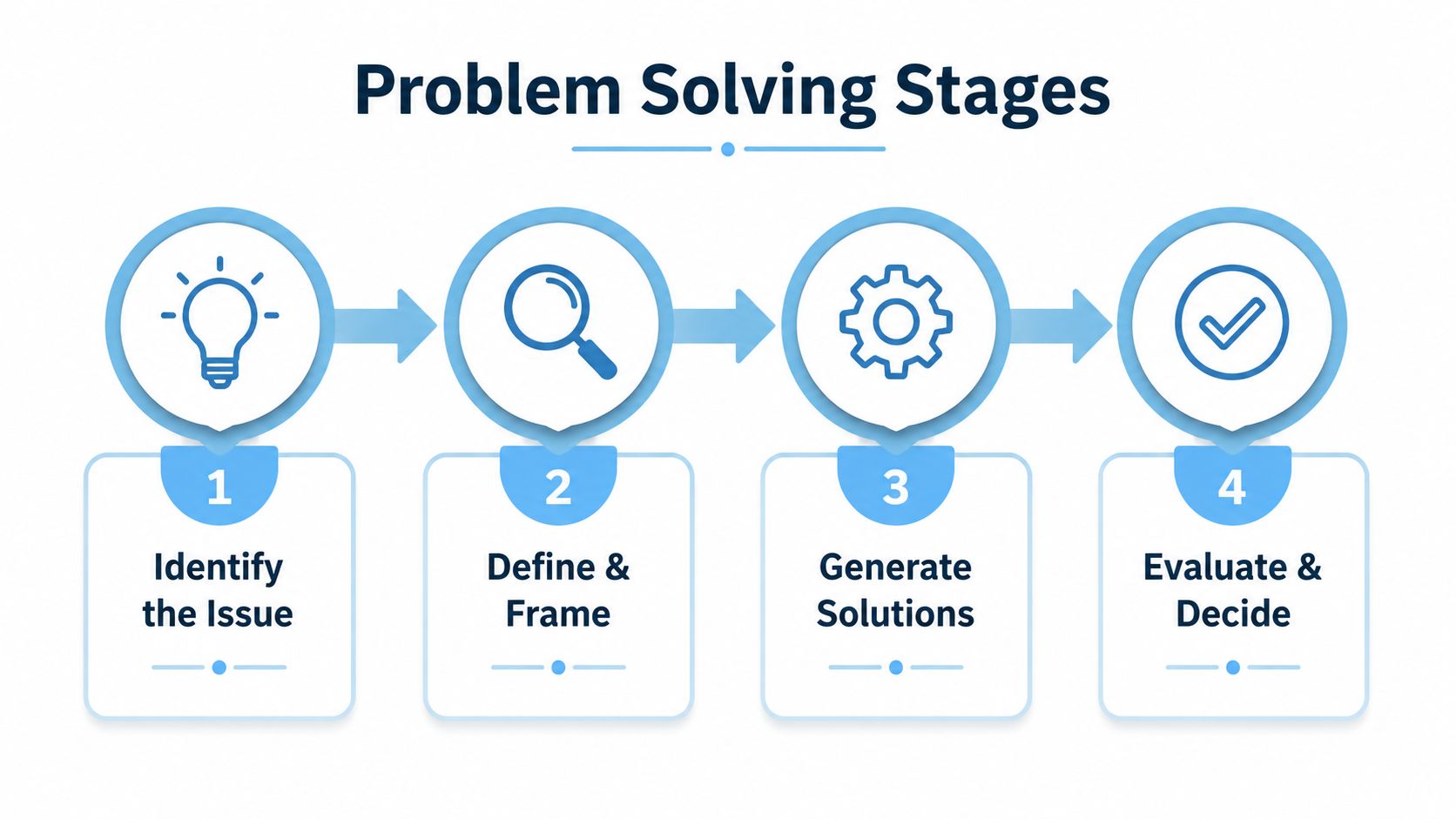
Notice the issue
Start by identifying the difference between what's happening and what should be happening. A journey has been delayed, a customer hasn't received an order, or an assignment lacks a clear argument. Avoid jumping straight to a solution because the first description may only be a symptom.
Ask yourself, “What have I observed?” and “What information is missing?” In a care setting, unusual drowsiness might need further checks and a clear handover rather than an immediate assumption about its cause.
Frame the problem clearly
A vague statement such as “The project is going badly” gives you little to work with. A clearer version might be, “The team has conflicting instructions, so the next task can't begin safely.” Framing narrows the problem without pretending you already know the answer.
This stage is where developing critical thinking skills supports problem solving. You're separating evidence from interpretation, checking assumptions, and deciding which question needs answering.
Generate options
List possible actions before choosing one. Some options may be impractical, but writing them down can reveal a better route. If a road is closed, you might take public transport, delay the journey, use a different road, or contact the destination.
At work, ask who else could contribute useful information. A colleague may have seen the same issue before, or a customer may explain a cause that internal records don't show.
Decide, act, and review
Compare options according to safety, time, resources, and likely consequences. Choose an action, explain it to the people affected, and record what you expect to happen.
Afterwards, review the result. Did the action solve the original problem, or did it only reduce the immediate pressure? What would you repeat next time? England's adaptive problem solving result suggests a strong national average, but the lower-performing group shows why structured practice still matters, particularly for adults rebuilding confidence.
The Main Types of Problem Solving Skills You Will Rely On
Problem solving isn't one isolated ability. It combines several ways of thinking, and different degree or career pathways bring different combinations to the front.
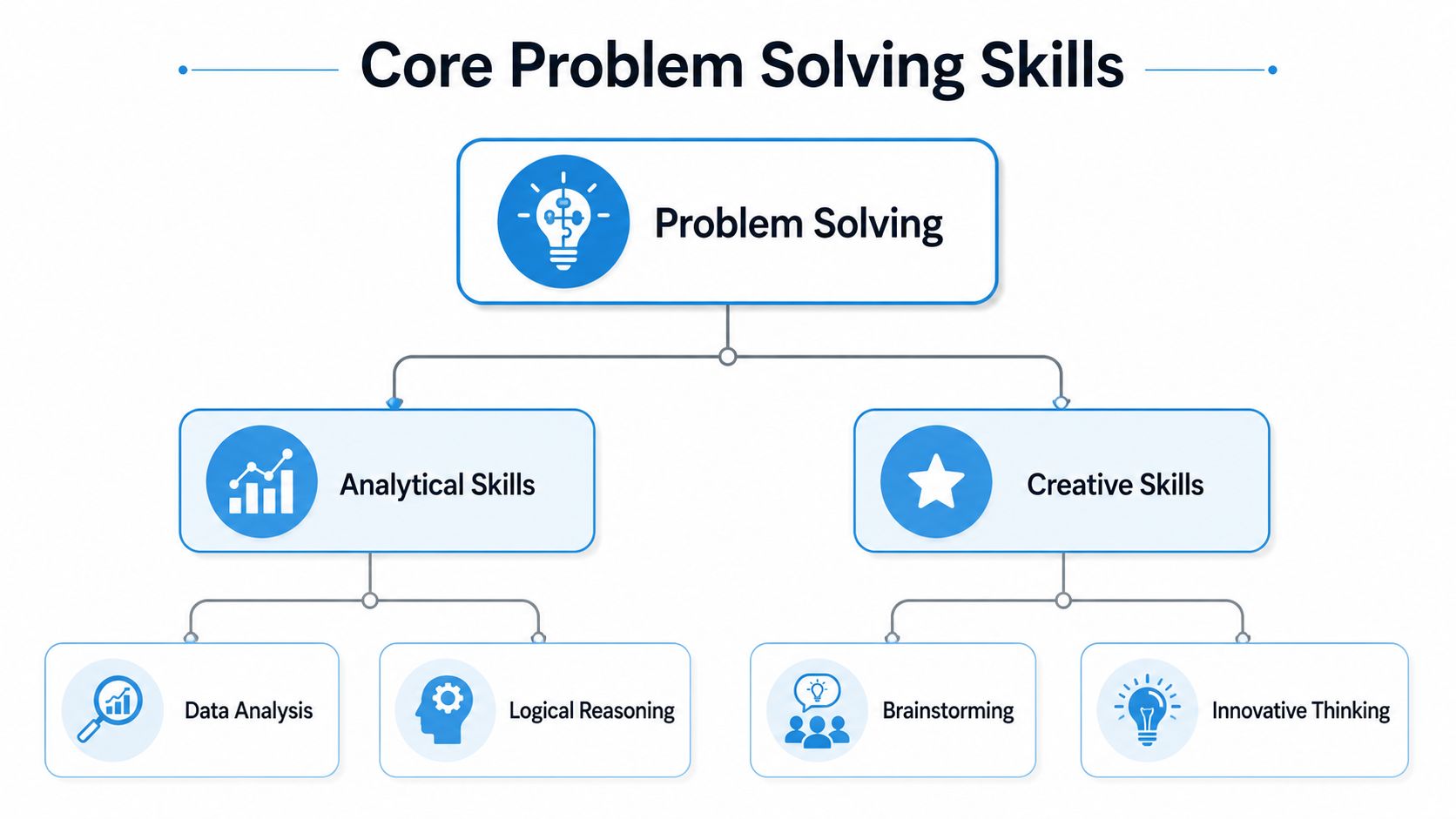
Analytical problem solving
Analytical thinking breaks a complicated issue into smaller parts. A nursing learner might examine a dosage calculation by checking the units, the information provided, and the required result. A business learner might compare sales records, stock information, and customer demand before recommending action.
You're looking for relationships and causes, not merely collecting facts.
Creative problem solving
Creative thinking helps when the usual approach no longer fits. A student designing a care plan might need to adapt activities to a patient's preferences, mobility, or support network. In music technology, creative troubleshooting may involve testing a different recording arrangement rather than repeating the same technical fix.
Creativity doesn't mean producing a wild idea without evidence. It means widening the options before you judge them.
Collaborative problem solving
Some decisions need several perspectives. In a group assignment, one person may understand the research, another may organise the work, and someone else may notice a weakness in the argument. Collaboration involves listening, clarifying, sharing responsibility, and reaching a decision the group can act on.
A quiet group member may hold important information, so effective collaboration isn't the same as allowing the most confident speaker to decide everything.
Critical problem solving
Critical thinking tests whether information is reliable, relevant, and sufficient. This matters in health and social care, where a learner may need to compare sources before supporting a recommendation. It also matters in business, where an attractive proposal may contain hidden assumptions.
Ask, “What supports this conclusion?” and “What would change my mind?”
Adaptive problem solving
Adaptive problem solving matters when circumstances shift. New software, hybrid working, automation, and AI-assisted tools can change how people gather information and complete tasks. Skills England's 2026 annual skills report identifies problem solving and decision making among the higher-level capabilities required in priority occupations, alongside learning, investigating, planning, organising, and digital literacy.
For practical ideas beyond a simple list of traits, explore these better problem solving methods and then consider your own profile. Which two types do you already use at work or home? Which two would support your chosen degree?
Problem Solving Skills in Real Nursing, Health, Computing, and Business Situations
The same process looks different in each workplace. The underlying habits remain recognisable, but professional knowledge changes what you notice and which actions are safe.
Nursing and care
A junior carer notices that a patient is unusually drowsy. They don't dismiss it as tiredness or make an unsupported diagnosis. They record the observation, check relevant information within their role, consider what has changed, and report it through the appropriate handover process.
The problem solving happens in the sequence. Observation comes first, followed by careful communication and escalation. The learner must distinguish what they know from what they suspect, then give the next professional enough information to act.
Health and midwifery
A student working through a health scenario finds that two sources appear to give conflicting information. A rushed response would select the source that confirms their first impression. A stronger response checks the date, context, terminology, and purpose of each source, then asks whether the apparent conflict comes from different situations being compared.
Critical and analytical problem solving meet here. The student may need to explain why one source is more appropriate for the question, rather than just naming a preferred answer.
Computing
A new coder runs a program and receives an error. They could change several lines at once, but that makes it harder to know which change helped. Instead, they reproduce the error, read the message, inspect the nearby code, and test a small section at a time.
A missing bracket, incorrect variable, or misunderstood input can cause the visible failure. Good debugging narrows the search before it changes the system. The learner also reviews the fix by running the program again and checking that the correction hasn't created another issue. The information and communication technology skills guide can help connect this type of reasoning with broader digital study.
Business and management
A manager discovers a stock shortage on the day of a launch. The immediate temptation is to promise every customer the original delivery date. A more reliable response separates urgent actions from longer-term causes: confirm available stock, identify affected orders, contact suppliers, communicate openly, and review the ordering process afterwards.
The manager may compare several options, such as partial fulfilment, substitutions, revised scheduling, or a different sales message. Each has consequences for customers, colleagues, cost, and reputation. A decision becomes stronger when the manager states those trade-offs clearly.
These scenarios resemble the applied reasoning adults meet through Access to HE study. Whether your destination is nursing, midwifery, health professions, computing, science, or business, tutors can assess not only the answer you reach but also how you reached it.
How Problem Solving Skills Are Assessed
An admissions task, workplace test, or Access to HE assignment may present an unfamiliar problem. Assessors are rarely expecting an instant perfect answer. They want to see whether you understand the situation, select relevant information, explain your reasoning, take responsibility, and respond to feedback.
| Setting | Typical format | What assessors look for |
|---|---|---|
| University interview or admissions task | Scenario question, written response, or discussion | Clear interpretation, relevant evidence, sensible judgement |
| Employer situational judgement test | Workplace scenario with possible responses | Prioritisation, professionalism, communication, and awareness of consequences |
| Workplace performance review | Reflective conversation or example from your role | Ownership, action taken, learning, and future improvement |
| Access to HE portfolio | Assignment, project, or reflective account | Structured thinking, use of sources, and connection between evidence and conclusion |
Interviews and admissions tasks
A question may ask how you would respond to a disagreement, an error, or an unexpected change. Explain what you understand first, then identify the information you would seek, the people you would involve, and the action you would recommend.
Use these checks before submitting an answer:
- Evidence: Have I separated what I know from what I'm assuming?
- Reasoning: Have I explained why my proposed action fits the situation?
- Responsibility: Have I stated what I would do, rather than only describing what others should do?
In health and social-care assessments, accurate, discipline-specific terminology matters. You may use an anatomy reference for researchers to check terminology, while also explaining why that source is suitable and how the information supports your conclusion. This demonstrates source selection as well as subject knowledge.
Employer tests and performance reviews
Situational judgement questions describe a workplace difficulty and ask you to rank or select possible responses. Look for actions that protect safety, communicate early, follow appropriate procedures, and address the underlying issue rather than concealing it.
For a review example, the STAR method gives your answer a clear order: describe the situation, task, action, and result, then focus on the evidence, reasoning, and responsibility behind your decisions.
An employer may also assess whether you recognise consequences. A response that solves an immediate difficulty but creates a safety, customer, or team problem is weaker than one that considers the wider effect.
Portfolios and reflective writing
A portfolio shows how your thinking developed over time. Include the original challenge, relevant evidence, the options considered, the reason for your decision, and what changed after review. You do not need to present every attempt as successful. Explaining a revised approach can show honest evaluation and growing judgement.
Assessors are looking for reasoning another person can follow. That standard is achievable even if you left school without traditional qualifications. Clear steps, relevant evidence, and a willingness to explain your choices can show readiness for nursing, health, computing, science, or business study.
Practical Exercises and Step-by-Step Practices to Build Your Skills
You can practise without waiting for a formal course or a dramatic workplace crisis. Use small tasks that make your thinking visible.
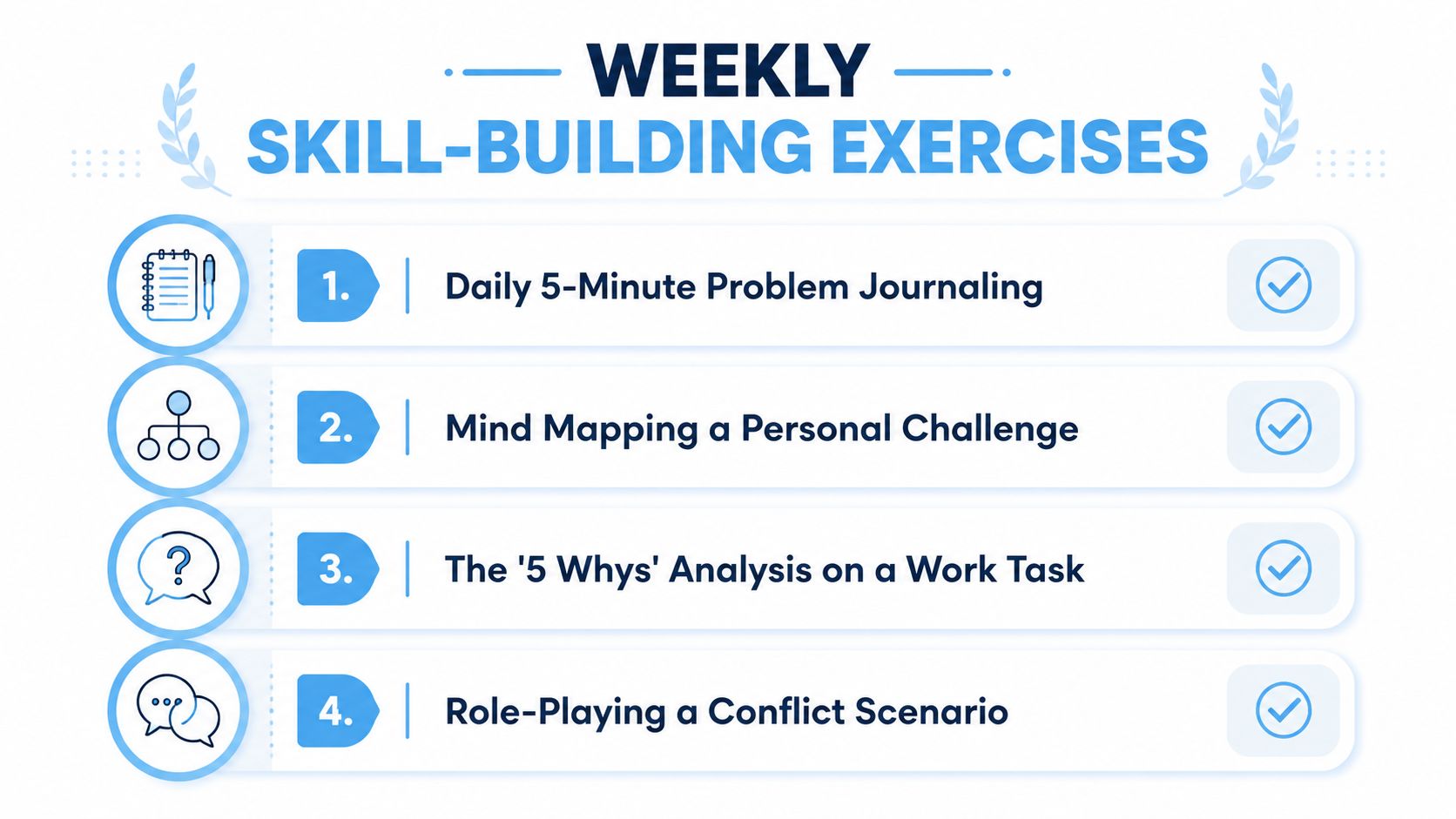
Daily reflection
At the end of a working or study day, write three short lines:
- What problem did I notice?
- What action did I take?
- What did I learn?
This takes only a few minutes and trains you to recognise decisions you might otherwise forget.
The decision log
Choose a task that made you hesitate. Record the problem, the information available, two possible options, your decision, and the result. Don't judge the decision only by whether everything went perfectly. Review whether the reasoning was sensible with the information you had.
The weekly problem
Choose an ordinary challenge, such as organising a journey, managing a household purchase, or planning revision around shifts. Write the desired outcome, list constraints, generate alternatives, and explain your choice to someone you trust.
Paired questioning
Ask a friend or study partner to question your assumptions. They might ask, “What makes you think that's the cause?” or “What else could you try?” Your task isn't to defend the first answer. It's to practise staying curious when someone sees the situation differently.
Post-action review
After completing a task, use this compact template:
- Expected: What did I think would happen?
- Observed: What happened?
- Difference: Where did the result vary?
- Next step: What will I retain or change?
When you describe an example in an application or interview, turn those notes into STAR. Focus on your actions, include relevant context, and finish with what the experience taught you. A strong example might come from resolving a rota problem, improving a customer process, supporting a colleague, or correcting a study mistake.
The short video below can offer another prompt for practising structured thinking.
Keep your practice realistic. You're not trying to sound like a textbook. You're learning to explain your decisions clearly enough that a tutor, manager, or admissions interviewer can see the thinking behind them.
How Access Courses Online Helps You Build These Skills Step by Step
Access to HE study gives problem solving a practical setting. Assignments ask you to interpret information, compare viewpoints, plan an answer, and review your conclusions. Tutor feedback then helps you notice where your reasoning is strong and where a clearer step would improve it.
Access Courses Online, a trading name of Cambridge Online Education Ltd, offers fully online Access to HE Diplomas in areas including Nursing, Midwifery, Health Professions, Computer Science, Science, Social Science, Business and Management, and Music Technology. Coursework, reflective writing, project work, and tutor guidance can help you practise the same habits in a pathway connected to your intended degree.
The study model is designed for adults managing other commitments. The provider states that learners can study flexibly online, access guidance from experienced tutors, receive advice by email, phone, and WhatsApp, and use interest-free payment plans over 12 months. Taster days provide an opportunity to experience the approach before committing. You can also read about how Access Courses can help you prepare for university.
You don't need traditional qualifications to start rebuilding your academic confidence. Choose a course connected to your career direction, ask how the assessments work, and begin with one structured problem solving habit.
Access Courses Online offers flexible online Access to HE Diplomas that help adults practise research, analysis, reflection, and decision making while preparing for university. Visit Access Courses Online to explore a relevant course, book a taster day, or speak with an advisor about your next step.