

So, you're trying to figure out what a diploma is actually worth. It’s a common question, and the answer isn't a simple one-liner. It all hinges on its level within the UK's Regulated Qualifications Framework (RQF).
Think of it this way: a Level 3 diploma, like an Access to HE Diploma, is on par with A-levels. Go a step higher, and you’ll find diplomas at Level 4, 5, or 6, which line up with the first, second, and final years of a university degree, respectively.
Decoding UK Diploma Equivalency
Getting your head around where your diploma sits in the UK education system is the first step to planning your future, whether you’re aiming for university or jumping into the job market. The RQF is essentially a ladder, with each rung representing a more advanced stage of learning. It’s a brilliant system for standardising qualifications, so universities and employers can instantly grasp what you know and what you can do.
A diploma isn’t just a certificate; it’s proof of focused, practical learning. While A-levels give you a broad academic base, diplomas often deliver specialised, career-focused training that gets you ready for a specific industry.
The Educational Ladder Visualised
This diagram breaks down how different qualification levels stack up, showing the path from A-level equivalents right up to a full university degree.
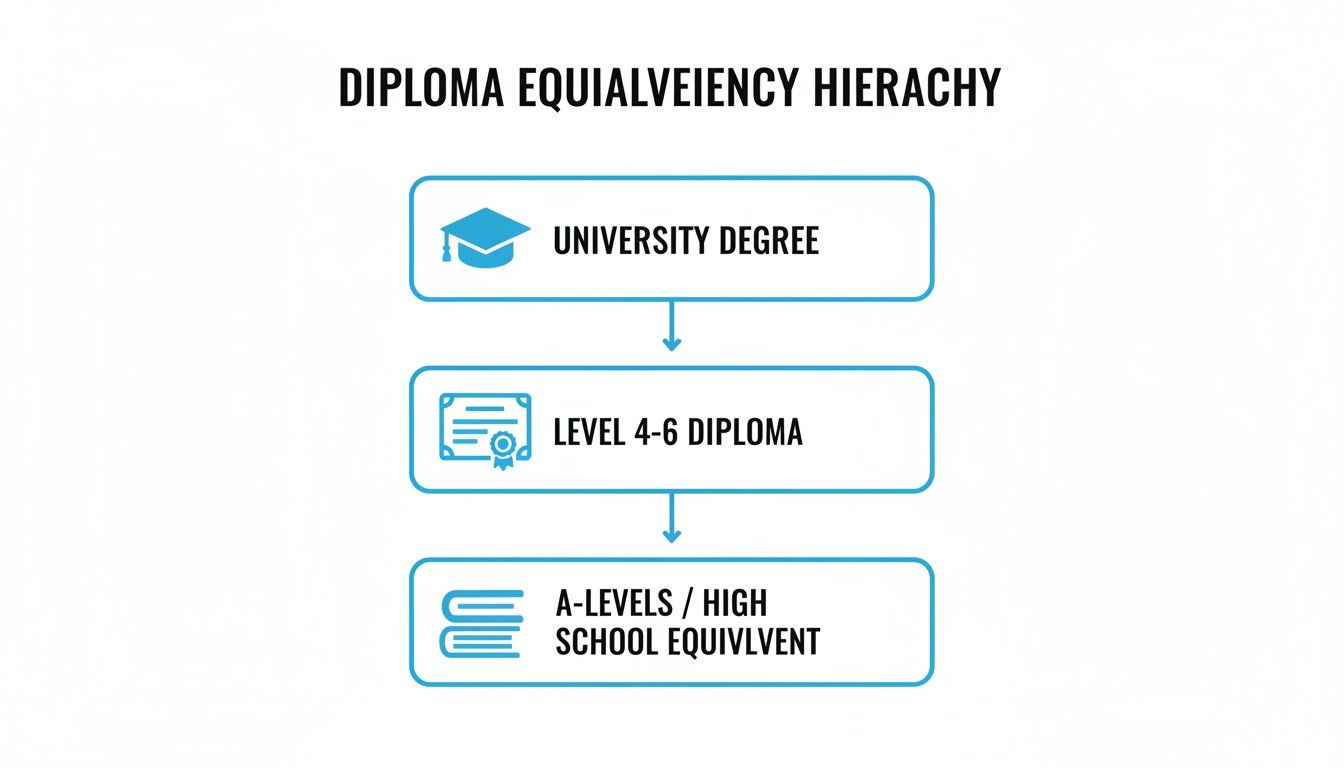
As you can see, diplomas from Level 4 to 6 are designed to bridge the gap between A-levels and a full degree, marking major milestones in higher education. It’s a really clear way to see exactly where your qualification fits in.
To make things even clearer, here’s a quick guide to how the most common diploma levels compare.
Diploma Equivalency Quick Guide
| RQF Level | Common Qualification Name | Broadly Equivalent To |
|---|---|---|
| Level 3 | Access to HE Diploma, BTEC National | 3 A-Levels |
| Level 4 | Higher National Certificate (HNC) | Year 1 of an undergraduate degree |
| Level 5 | Higher National Diploma (HND), Foundation Degree | Year 2 of an undergraduate degree |
| Level 6 | Graduate Diploma, Level 6 NVQ | Bachelor's Degree (without honours) |
| Level 7 | Postgraduate Diploma | Master's Degree level |
This table shows just how versatile diplomas are, offering a structured pathway right through higher education.
How Diplomas Fit into the UK Workforce
Diplomas aren't a niche qualification; they’re a core part of the UK's educational fabric. Official government stats show that 68% of adults aged 19-64 hold a qualification at Level 3 or above—a group that includes these powerful A-level alternatives.
What’s more, 50% of that same group are qualified to Level 4 or higher, showing that diplomas and similar credentials make up a huge chunk of the UK workforce's qualifications. You can dig deeper into the numbers by exploring the official UK education and training statistics.
This isn't just a trend; it's proof that practical, diploma-based routes are a well-trodden and respected path to achieving both academic and professional goals. They offer a fantastic alternative to the traditional A-level-to-degree pipeline.
The Access to HE Diploma as an A-Level Alternative

For many adults thinking about university, the lack of traditional qualifications like A-levels can feel like a roadblock. But it absolutely doesn't have to be. This is exactly where the Access to Higher Education (HE) Diploma steps in, acting as a powerful and widely recognised key to unlocking your potential. It’s a Level 3 qualification specifically created for learners who have been out of the classroom for a while.
So, how does it stack up? Put simply, a successfully completed Access to HE Diploma is accepted by most UK universities as being equivalent to three A-levels. This isn’t just a loose comparison; it's a structural equivalence built right into the UK’s education framework. It’s there to create a level playing field for every university applicant, no matter their background.
Understanding the Credit and Grading System
The real weight of the diploma comes from its structure. The whole qualification is made up of 60 credits. Think of these credits like building blocks—each one you earn gets you closer to the complete diploma.
These credits are split into two important types:
- 45 Graded Credits: These are the heart of your course. They’re the academic units directly related to your chosen subject, whether that’s Nursing, Social Science, or Business. For these, you’ll be awarded a Pass, Merit, or Distinction.
- 15 Ungraded Credits: These units are all about getting you university-ready. They focus on essential academic skills like research, referencing, and essay writing, so you can hit the ground running when you start your degree.
This combination ensures you’re not just gaining specialist subject knowledge but also developing the crucial study skills you need to thrive. You can learn more about how it all works in our detailed guide to the Access to Higher Education Diploma.
How Grades Translate to University Offers
Those grades—Pass, Merit, and Distinction—are more than just letters on a certificate. They are the currency you’ll use when applying to university because they convert directly into UCAS Tariff points. It’s the very same system used for A-level grades, and a strong performance can generate a serious number of points.
For example, achieving 45 credits at Distinction level is equivalent to 144 UCAS points. That's the exact same number of points you'd get for achieving three A* grades at A-level, proving just how powerful this equivalency is.
This conversion process is what makes everything work. It allows university admissions tutors to easily and fairly compare your achievements with those of students who took the A-level route. By understanding what a diploma is equivalent to in terms of UCAS points, you can confidently aim for university courses that match your abilities, knowing your qualification holds real, measurable value. It puts you right in the mix with everyone else.
Translating Your Diploma into UCAS Tariff Points

When you're applying to university, you'll hear a lot about UCAS Tariff points. Think of them as a universal currency for qualifications. It’s a clever system that converts your grades from various Level 3 qualifications—whether that’s a diploma or A-levels—into a straightforward numerical value.
This levels the playing field, making sure every applicant is assessed fairly, no matter which path they took to get there.
If you’ve completed a vocational award like a BTEC National or an Access to HE Diploma, this system is your best friend. It’s how your hard-earned grades are measured directly against the A-level results of other applicants, proving you're just as ready for degree-level study.
How Grades Convert to Points
It’s actually quite simple: the number of points you get is tied directly to your final grades. The better you do in your diploma, the more points you rack up, and the stronger your university application becomes.
Admissions tutors look at your points total to quickly see if you meet the entry requirements for their courses. It’s a clear, transparent way of demonstrating the academic weight of your achievements and understanding what a diploma is equivalent to in the eyes of a university.
It’s a common myth that vocational diplomas are somehow "less than" A-levels. The UCAS Tariff system completely debunks this. For example, achieving top grades in a BTEC Extended Diploma can earn you the same number of points as someone with three A*s at A-level.
To give you a clearer picture, let’s put them side-by-side.
UCAS Tariff Points Comparison A-Levels vs Level 3 Diplomas
Here’s a table showing how grades from some popular Level 3 diplomas stack up against A-level results in the UCAS system.
| Qualification Type | Grade Achieved | UCAS Tariff Points |
|---|---|---|
| A-level | A* | 56 |
| A-level | A | 48 |
| A-level | B | 40 |
| BTEC Extended Diploma | D*D*D* | 168 (equal to 3 x A*) |
| BTEC Extended Diploma | DDD | 144 (equal to 3 x A) |
| BTEC Extended Diploma | DDM | 128 (equal to AAB) |
| Access to HE Diploma | 45 Distinctions, 15 Merits | 144 |
| Access to HE Diploma | 30 Distinctions, 15 Merits | 120 |
| Access to HE Diploma | 15 Distinctions, 30 Merits | 96 |
As you can see, the comparison makes it obvious that your diploma carries serious weight. The points system is a fantastic tool for proving your academic ability and readiness for higher education.
If you want to work out your own total, check out this handy UCAS point calculator to see exactly where you stand.
How Employers and Universities View Your Diploma
It’s one thing to know the technical details of your diploma, but what really matters is how it’s seen by the people making decisions—the admissions tutors and hiring managers. The true value of any qualification isn’t just about its RQF level or UCAS points. It’s about what it tells them about your skills, your focus, and your readiness for whatever comes next.
For universities, a qualification like an Access to HE Diploma is a powerful signal. It shows immense dedication and a focused academic mindset. Admissions teams know that these courses demand rigorous, self-directed study, which is one of the best predictors of success at degree level.
The University Perspective
Most UK universities are more than happy to accept Level 3 diplomas for entry into their undergraduate courses. But, as with most things, context is everything. For hyper-competitive degrees like medicine, veterinary science, or law at top-tier institutions, you might find they have a preference for certain A-level subjects.
This isn’t because they see the diploma as "lesser". It’s usually because those specific degrees have rigid knowledge prerequisites that A-levels in subjects like Chemistry or Biology are built to deliver.
The single most important thing you can do is check the specific entry requirements for the exact course you want to study. Never assume anything; doing your homework is the best way to set yourself up for a successful application.
Data from educational bodies consistently shows how well students with diploma-equivalent qualifications perform. For instance, recent figures from the Scottish Qualifications Authority (SQA) showed that at the Higher level, there were 202,490 entries achieving a 75.9% pass rate (A to C). At the even more specialised Advanced Higher level, there were 28,610 entries with an incredible 76.7% pass rate, proving how robust these qualifications are.
The Employer Perspective
Once you step into the job market, the conversation changes. It’s less about academic theory and more about what you can actually do. This is where vocational diplomas often shine, giving you a real edge over A-levels in certain industries.
Employers in practical, hands-on sectors want people who can contribute from day one. A diploma in engineering, healthcare, or creative media is concrete proof that you have job-ready skills. It tells a hiring manager that you haven’t just learned the theory—you’ve been trained to apply it in the real world.
To make sure this value comes across, you need to know how to effectively list your education on a resume. Clearly highlighting the practical skills and projects from your diploma can make your application jump out from the pile. And if you're weighing up your options, understanding whether you can get a job with an Access course is a fantastic place to start.
Ultimately, there's no single "best" qualification. An A-level might be the perfect path for a future theoretical physicist, while a BTEC Diploma could be the ideal launchpad for a graphic designer. Think of your qualification as a tool—your job is to choose the right one for the job you want to do.
Navigating International Diploma Comparisons
If you earned your diploma outside the UK, figuring out what it’s worth here can feel like trying to translate a language without a dictionary. There's no simple, one-to-one conversion chart. Instead, each international qualification is looked at individually to understand its academic weight in the UK system.
This personal assessment is so important because education systems can be wildly different from one country to another. A ‘diploma’ in one nation might be on par with A-levels, while in another, it could be closer to the first year of a university degree. The real goal is to find its official UK counterpart.
Finding Your UK Equivalent
To get a concrete answer, you need an official benchmark. This is where UK ENIC comes in. You might have known it as UK NARIC, but it’s the official national agency that provides expert advice on how international qualifications stack up.
For a fee, UK ENIC will give you a Statement of Comparability. This is a formal document that assesses your international qualifications and maps them against the UK’s Regulated Qualifications Framework (RQF).
Think of this statement as your academic passport. It’s not just a helpful guide; it’s the official document universities and many employers will ask for to understand your qualification level. It takes away all the guesswork and provides a clear, trusted answer to the question, "what is my diploma equivalent to?" when your credentials are from overseas.
Of course, if you're thinking about studying elsewhere, the same principles apply. For example, you’d need to get your qualifications assessed to meet the requirements to Study in Australia. The idea of verification and comparison is the same everywhere, even if the agencies have different names.
A Clear Action Plan for International Applicants
Getting this sorted doesn’t have to be a headache. If you take a few proactive steps, you can present your qualifications with confidence and clarity. Here’s a simple plan to get the answers you need:
- Get Your Official Statement: The first and most critical step is to apply for a Statement of Comparability from the UK ENIC website. This document is your foundation.
- Check University International Pages: Most UK universities have dedicated sections on their websites for international students. These pages often give you a good idea of how common qualifications from your home country are viewed.
- Contact Admissions Teams Directly: Once you have your ENIC statement, don’t be afraid to reach out to the admissions offices of the universities you’re interested in. You can send them a copy and ask them to confirm how your qualifications align with their specific course entry requirements.
This direct, evidence-based approach removes any doubt, making sure you know exactly where you stand long before you even submit your application.
Right, so you've got a handle on what your diploma might be equivalent to. That's the first big hurdle cleared. Now, it's time to turn that understanding into a solid, practical plan. Let's walk through how you can verify exactly what your qualification means for your future, so you can move forward with total confidence.
Whether you're aiming for university or a new career, taking these steps will remove any lingering doubts and show you exactly where you stand.
First Things First: Find Your Diploma's RQF Level
Before you do anything else, you need to pinpoint where your diploma sits on the Regulated Qualifications Framework (RQF). This is the official government-recognised standard for your achievement, and it's the language that universities and employers understand.
Is it a Level 3, putting it on par with A-levels? Or maybe it's a Level 5, which lines up with the second year of a university degree? You can usually find this information on your certificate or the official course details from your provider. Honestly, this one piece of information is the foundation for everything that follows.
This step is so important because qualifications like yours are a major pathway into higher education and skilled work in the UK. Government statistics show there were 1,246,010 total enrolments in regulated qualifications in a single academic year. That's a huge number of people relying on these exact routes. You can dig into more of this data on the official UK government site for further education statistics.
Your Four-Step Verification Checklist
Once you know your RQF level, you're ready to get some concrete answers. Follow this simple checklist to find out exactly how your chosen university or employer sees your qualification.
-
Check Your UCAS Points: Head over to the official UCAS Tariff Calculator. Pop in your exact qualification and the grades you achieved. It will give you a clear points value, which is the number you'll use to compare against the entry requirements for different degree courses.
-
Dig into University Entry Requirements: Don't just stop at the headline UCAS points total. You need to read the fine print on the course pages of the universities you're interested in. Do they specifically mention your type of diploma, like a BTEC or an Access to HE Diploma? Some courses are very specific about the qualifications they accept.
-
Talk to the Admissions Team: If you find any grey areas or feel unsure, the best thing you can do is get in touch with them directly. Send an email or give the admissions office a call. Be direct and ask them, "I have a [Your Qualification] with [Your Grades]. Do you accept this for entry onto the [Course Name] programme?" It’s the quickest way to get a definite answer.
-
Get Your Documents Ready: Make your life easier by having everything organised. Get digital copies of your certificates and transcripts ready to go. If you're an international student, you'll also need your UK ENIC Statement of Comparability. Being prepared makes the whole process feel much less stressful.
Common Questions About Diploma Equivalence
Trying to figure out how different diplomas stack up can feel a bit confusing. To make things clearer, let's walk through some of the most common questions we hear from learners trying to understand the real value of their qualifications.
Is a Level 5 Diploma a Full Degree?
Not quite, but it gets you most of the way there. Think of a Level 5 Diploma as completing two-thirds of the journey to a full bachelor's degree.
Qualifications like a Foundation Degree or a Higher National Diploma (HND) are set at Level 5, which is equivalent to finishing the first two years of a standard three-year university degree. It's a fantastic achievement on its own and often gives you a direct ticket to the final year of a related degree through what's known as a 'top-up' course.
Can I Get into Any University with an Access to HE Diploma?
While the Access to HE Diploma is a powerful and widely respected A-level equivalent, accepted by the vast majority of UK universities, it isn't a magic key for every single course out there.
Some of the most competitive universities or highly specialised programmes—think medicine, veterinary science, or law at certain top-tier institutions—might still have a strict preference for specific A-level subjects. It really comes down to the individual course.
The most crucial step is to always check the specific entry requirements listed on the university's website for your chosen course. This eliminates any guesswork and ensures you are on the right track from the start.
Do Employers Value Diplomas as Much as A-Levels?
This one really depends on the industry you're aiming for. There isn't a single rule for how employers see qualifications; it’s all about context and what's relevant for the job.
For roles that are heavily academic or research-focused, an employer might lean towards the theoretical grounding that A-levels provide. But for more hands-on, vocational sectors, the opposite is often true.
In fields like engineering, digital media, construction, or health and social care, employers frequently place a higher value on diplomas like BTECs. Why? Because these qualifications prove you have practical, hands-on experience and job-ready skills—exactly what they need from day one.
Ready to take the next step towards university? Access Courses Online provides accredited, fully online Access to HE Diplomas that are your proven pathway to a degree. Start your journey today at https://accesscoursesonline.com.