

Think of a Level 3 qualification as the master key to unlocking university education in the UK. It's essentially the direct equivalent of A-Levels, the standard benchmark universities look for. Whether you earned it through traditional A-Levels, a BTEC, or an Access to Higher Education Diploma, it tells universities you’re ready for degree-level study.
Mapping Your Qualifications to University Entry Standards

Figuring out what is a Level 3 qualification equivalent to can feel like navigating a maze, but it’s more straightforward than you might think. This level simply shows you’ve gained advanced knowledge beyond GCSEs, giving you the foundation needed to succeed in higher education.
This is exactly why qualifications like the Access to HE Diploma are so powerful. They are specifically designed for adults returning to education, getting them up to the university entry standard. In fact, these diplomas are a major pathway to higher education and are generally considered equivalent to two full A-Levels at grades A*-C. If you want to see just how successful they are, you can find more insights on the official QAA website.
The Common Level 3 Qualifications
So, what other qualifications sit at this level? To help you get a clear picture, here are some of the most common ones:
- A-Levels: The classic academic route students take after their GCSEs.
- Access to Higher Education (HE) Diplomas: A qualification specifically created to help adults get into university.
- BTEC Nationals: Hands-on, vocational qualifications that build practical skills for a specific industry.
- NVQ Level 3: Work-based qualifications that prove your competence and skills in a particular job.
Each of these acts as a recognised passport, either to university or to a skilled career.
Level 3 Qualifications and A-Level Equivalents at a Glance
To make things even clearer, this table compares common Level 3 qualifications, showing their direct A-Level equivalence and the typical range of UCAS Tariff Points they carry. It's a quick way to see where you stand or what your options are.
| Level 3 Qualification | Equivalent to... | Typical UCAS Points Range |
|---|---|---|
| Access to HE Diploma | 2-3 A-Levels | 48 – 144 |
| BTEC National Extended Diploma (3 A-Levels) | 3 A-Levels | 48 – 168 |
| A-Level | 1 A-Level | 16 – 56 (per subject) |
| NVQ Level 3 | 2 A-Levels | Varies (often not point-based) |
This should give you a solid reference point as you plan your path towards achieving your academic and career goals.
Navigating the UK Qualifications Framework
To get your head around what a Level 3 qualification is equivalent to, it helps to see where it fits into the bigger picture. Think of the UK's Regulated Qualifications Framework (RQF) as a national ladder for learning. Each rung represents a clear step up in what you’ve achieved.
This framework is the official system used to map out all recognised qualifications in the country. It’s there to ensure consistency, so an award from one place is understood and respected everywhere else. For you, this means employers and universities have a common language to reliably figure out your knowledge and skills.
Placing Level 3 on the Framework
The RQF organises qualifications all the way from an Entry Level up to a Level 8 (which is a PhD). If you’re aiming for university, these are the rungs that matter most:
- Level 2: This is GCSE level (grades 9 to 4, or A* to C in the old system). It’s the foundation you build on from secondary school.
- Level 3: This is the crucial bridge between school-level study and university. It's the same standard as A-Levels.
- Level 4: This marks the first year of an undergraduate degree or a qualification like a Higher National Certificate (HNC).
So, a Level 3 qualification is essentially the launchpad that takes you from that foundational knowledge right into degree-level study. It’s the step that proves you’re ready for the challenges of university.
Why This Matters for You
The RQF’s standardised approach is what gives all these different qualifications equal weight. It doesn’t matter if you studied A-Levels at a sixth form college, did a BTEC National, or took an Access to Higher Education Diploma online. The framework confirms they all meet the same demanding Level 3 criteria.
This unified system means that universities can confidently look at your application, knowing your qualification meets a specific national standard. It validates all your hard work and puts you on a level playing field with every other applicant.
This is especially important for adult learners. An Access to HE Diploma, for instance, isn't just a 'good enough' alternative; it is a fully recognised and respected qualification designed specifically to get you into university. For a deeper dive, you can explore our detailed guide on what a diploma is equivalent to. The framework guarantees that your path to higher education is just as valid and credible as any other.
Comparing Your Level 3 Qualification Options
Not all paths to university are the same, and when you’re figuring out what is a Level 3 qualification equivalent to, it’s useful to think of the different options as a toolkit. Each tool is designed for a specific job, and picking the right one comes down to your goals, how you like to learn, and your life circumstances.
This visual guide shows how Level 3 qualifications really act as a bridge, connecting the foundational learning you do at Level 2 with university-level study at Level 4 and beyond.
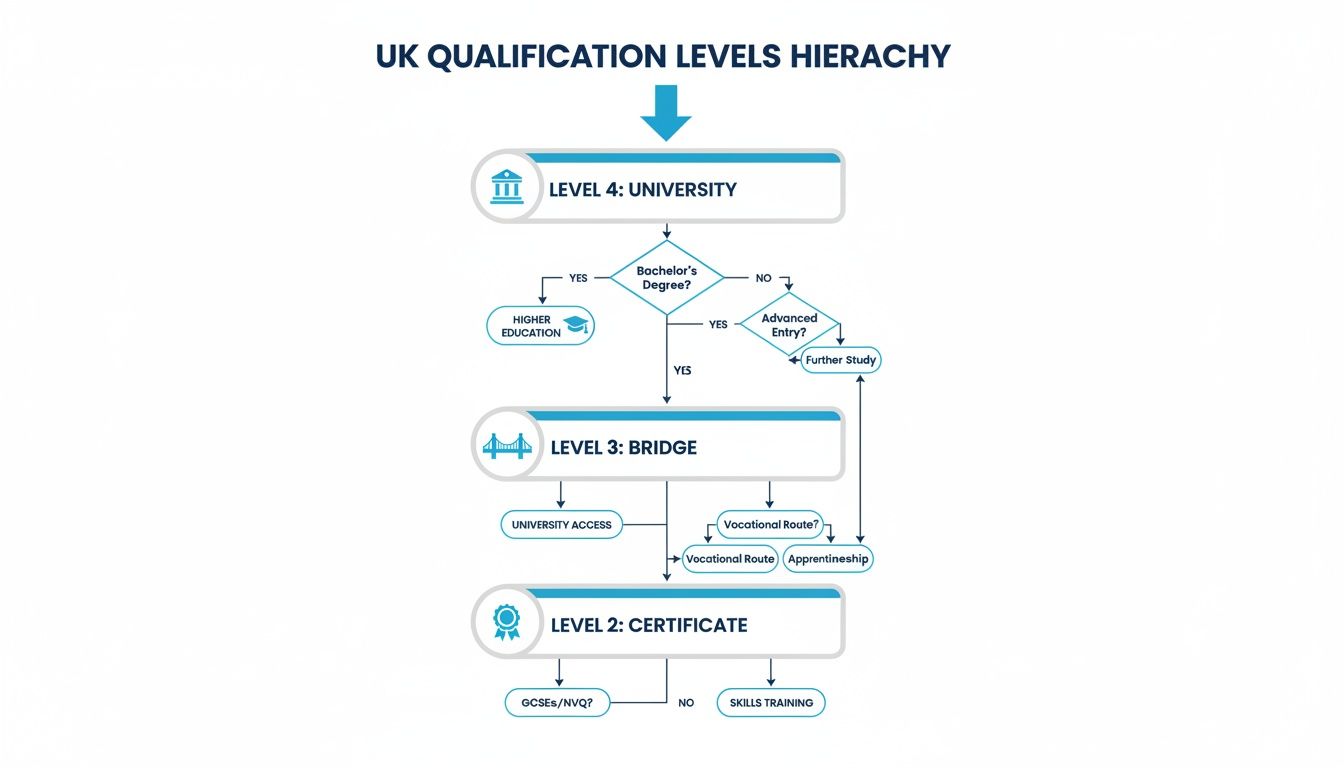
As you can see, Level 3 is that critical step that gets you ready for higher education, which is why it’s the main focus for university entry.
A-Levels: The Traditional Academic Tool
A-Levels are the route most people have heard of. They’re typically studied over two years at a college or sixth form and are heavily focused on final exams. The main goal is to build a deep, theoretical understanding of a few chosen subjects.
This path is a great fit for anyone who thrives in a structured classroom and enjoys the challenge of end-of-year exams. They are the classic choice for younger students progressing straight from school to university, often leading to degrees in subjects like History, English, or Physics.
BTEC Nationals: The Hands-On Vocational Tool
BTEC Nationals, on the other hand, offer a much more practical, career-focused approach. Instead of broad academic subjects, they zoom in on specific industries like Health and Social Care, Engineering, or Business.
The assessment style is completely different from A-Levels. It’s based almost entirely on coursework, projects, and practical tasks you complete throughout the course. This method is brilliant for learners who prefer to apply their knowledge as they go. BTECs provide a direct route into specialised degrees and skilled jobs—for instance, a BTEC in Health and Social Care is a very common stepping stone to a nursing degree.
Choosing a qualification isn't just about the certificate you get at the end; it's about finding a learning style that fits you. Whether you excel in exams or shine in practical assignments, there is a Level 3 option built for your strengths.
The Access to HE Diploma: The Master Key for Adult Learners
The Access to Higher Education (HE) Diploma is a unique Level 3 qualification engineered specifically for adults who are returning to education. Think of it as the perfect tool if you’ve been out of the classroom for a while and need a direct, focused route back to learning and on to university.
Unlike A-Levels, an Access to HE Diploma is usually completed in just 9-12 months and is assessed entirely through coursework, with no final exams. This structure is a lifesaver for managing studies around work, family, and other commitments.
These diplomas are tailored to specific degree paths, combining subject knowledge with the essential academic skills you’ll need to thrive at uni. So, if you want to become a nurse, a social worker, or a computer scientist, there's an Access to HE Diploma designed to get you there. It’s recognised by over 140 UK universities as a leading A-Level equivalent for mature students, making it a powerful and efficient master key for unlocking your ambitions.
The Access to HE Diploma: Your University Fast Track

For adult learners, the Access to Higher Education (HE) Diploma isn't just another Level 3 qualification—it’s a purpose-built superhighway to university. While A-Levels are typically designed for school leavers, this diploma is engineered from the ground up for people returning to education after a break.
This unique focus is exactly why over 140 UK universities don't just accept it, they actively welcome it. They know that Access to HE students arrive with valuable life experience and a powerful motivation to succeed, making the qualification a trusted green light for academic readiness.
A Blend of Knowledge and Practical Skills
So, what really sets the Access to HE Diploma apart? It’s all about its dual focus. It doesn't just teach you the specific subject knowledge needed for your degree; it arms you with the essential academic skills to hit the ground running from day one at uni.
This means you’ll get practical experience in how to research, write academic essays, reference sources correctly, and manage your time like a pro. It’s this skills-based training that bridges the gap for so many adult learners, building the confidence needed for a smooth transition into higher education.
The Access to HE Diploma is not about catching up; it’s about gearing up. It provides the exact combination of subject depth and study skills that mature students need to thrive in a university environment.
This targeted preparation is the secret to the diploma's success and explains why it's a primary route into some of the most demanding fields. Many aspiring healthcare professionals, for instance, find an Access to HE Diploma is the most direct and effective pathway to a degree in Nursing, Midwifery, or Paramedic Science. Our comprehensive guide to the Access to Higher Education Diploma breaks down exactly how it gets you ready for these careers.
Proven Success in University Progression
The power of Level 3 qualifications as a whole is undeniable. Fresh data from the Department for Education shows they are a powerful gateway to higher learning, with 65.0% of students moving on to a Level 4 or higher destination—like a university degree—within just two years. You can review the full statistics on progression to higher education in the UK.
The Access to HE Diploma is a vital part of this success story, especially for adult learners. This high progression rate proves that it is a highly respected Level 3 qualification equivalent to A-Levels in the eyes of university admissions teams.
- Tailored Content: Modules are designed to align with specific degree courses, giving you a relevant head start.
- No Final Exams: Assessment is based on continuous coursework, which is a much better fit for adult learners juggling other commitments.
- Fast Completion: Most students complete the diploma in just 9-12 months, creating a much quicker route to university than traditional two-year A-Levels.
Ultimately, this qualification offers a focused, efficient, and supportive route to achieving your academic ambitions, transforming a long-held dream of getting a degree into a realistic and attainable goal.
Turning Your Qualification into a University Offer
Getting your Level 3 qualification is a massive achievement, but what comes next? The real goal is turning all that hard work into an acceptance letter from your dream university. That’s where the UCAS Tariff Point system comes into play.
Think of it as a universal currency for qualifications. It translates every grade you get—whether it's an A* in an A-Level or a Distinction in an Access to HE Diploma—into a straightforward numerical value. Universities use these points to set their entry requirements, making it crystal clear what you need to aim for to secure a place on their course.
From Grades to UCAS Points
For adult learners, the Access to Higher Education (HE) Diploma is a perfect example of this system in action. The diploma is built from 60 credits, with 45 of those being graded as either a Pass, Merit, or Distinction.
Each of these grades is worth a certain number of UCAS points. So, the more credits you earn at the higher grades of Distinction and Merit, the more UCAS points you’ll rack up. It puts you firmly in the driver's seat, making the whole university application process much more transparent.
A university offer of "112 UCAS points" suddenly stops being an abstract target. It becomes a concrete goal you can hit with a specific mix of Distinction and Merit grades from your Access to HE Diploma.
To figure out exactly how your potential grades translate into points, it's a great idea to use a UCAS point calculator. It takes the mystery out of the process and shows you the tangible outcome of all your effort.
Now, let's look at how this plays out in the real world. Many universities specify a particular combination of grades needed for their courses. For an Access to HE Diploma, they might ask for a certain number of credits at Distinction, Merit, or Pass.
Below is a table showing a few examples of how your grades can be converted into UCAS points, giving you a clearer picture of what you might need to achieve for your chosen degree.
Example UCAS Points from an Access to HE Diploma
| Number of Credits at Distinction | Number of Credits at Merit | Total UCAS Points |
|---|---|---|
| 45 | 0 | 144 |
| 30 | 15 | 120 |
| 24 | 21 | 112 |
| 15 | 30 | 96 |
| 6 | 39 | 72 |
As you can see, different combinations of grades lead to different point totals, giving you a flexible way to meet the university's requirements.
A Real World Example
Let’s imagine a student named Sarah who is passionate about becoming a nurse. The university she has her heart set on requires 120 UCAS points for its BSc Nursing (Adult) course.
Sarah is studying an Access to HE Diploma in Nursing. To meet that offer, she could aim for a profile like this:
- 30 credits at Distinction
- 15 credits at Merit
This mix of grades would give her exactly 120 UCAS points, ticking the box for the university’s entry requirements. This clear, mathematical link shows how a Level 3 qualification provides a direct pathway to your chosen degree and career.
Understanding the different routes available is also key. For instance, exploring the various pathways when you want to study education can provide invaluable insight. When you can see exactly how your qualification converts into points, you can apply with confidence, knowing you have a solid, recognised route to achieving your goals.
Your Questions Answered: Level 3 Qualifications
As you think about taking this big step, it’s completely normal to have a few questions. We get it. Let’s tackle some of the most common ones we hear from adult learners, so you can move forward feeling clear and confident.
How Long Does an Online Level 3 Qualification Take?
Most of our students wrap up their studies in about 9-12 months, but the real beauty of learning online is that you're in the driver's seat. You set the schedule.
This means you can fit your course around your job, family, and everything else life throws at you—not the other way around. This flexibility is a huge reason why so many adult learners thrive with us.
Do All Universities Accept Access to HE Diplomas?
Absolutely. The vast majority of UK universities not only accept but welcome the Access to Higher Education Diploma. It’s a nationally recognised Level 3 qualification equivalent to A-Levels, designed from the ground up to get you into university.
It’s always a smart move to double-check the specific entry requirements for your dream course and university. Our experienced tutors are here to help you navigate this and make sure your chosen diploma is the perfect fit for your ambitions.
Getting this sorted early gives you a clear target to aim for from day one.
Can I Get Funding for an Access to HE Course?
Yes, and the funding options are fantastic. Many students are eligible to cover their course fees with an Advanced Learner Loan. It’s a government-backed loan, which means you don’t have to pay a penny upfront to get started.
Here’s the best part: if you successfully complete your Access to HE Diploma and then go on to finish a university degree, the government will write off your entire loan balance. This brilliant incentive means your qualification can be effectively free if you progress, making higher education more accessible than ever. It’s a powerful investment in your future.
Ready to take that next step towards your degree? At Access Courses Online, we provide accredited, flexible diplomas designed to fit into your life.