
So, what exactly is academic integrity? Think of it as the moral compass for your learning journey. It’s a commitment to being honest, fair, and responsible in your studies. It's about making sure the work you hand in is truly your own, which is what gives your qualification real-world value and sets you up for success down the line.
Your Foundation for Success in Higher Education
Imagine academic integrity as the professional code of conduct for your education. A doctor follows a strict ethical code to earn their patients' trust; in the same way, students follow the principles of academic integrity. This ensures your qualification is respected, meaningful, and a genuine reflection of what you’ve learned.
It’s not just a set of restrictive rules. It’s the very framework that gives your future degree credibility and power.
Without this solid foundation, a qualification loses its meaning. How could a university or an employer trust that your certificate represents real skill and knowledge? For adult learners coming back to education, embracing academic integrity is particularly important. It guarantees that your Access to Higher Education Diploma is a trustworthy passport to a university degree and the new career you’re working towards.
The Six Fundamental Values
Academic integrity isn’t a vague idea; it’s built on six core values that should guide how you approach every single assignment. Mastering these principles now will help you become the capable, trusted professional you want to be.
To break it down, here’s a quick overview of these core values and what they mean for you as an online student.
The Six Pillars of Academic Integrity Explained
| Core Value | What It Means for Your Studies |
|---|---|
| Honesty | Being truthful about your work. You present your own ideas and always give credit where it's due when you use information from other sources. |
| Trust | Building a reliable learning environment. Your tutors need to trust that your work is yours, and you can trust that their feedback is fair. |
| Fairness | Making sure everyone has an equal opportunity to succeed. No student should have an unfair advantage, and every assignment should be marked equitably. |
| Respect | Valuing other people's work and ideas. You show respect by referencing properly and engaging thoughtfully with different perspectives. |
| Responsibility | Owning your learning journey. This means managing your time well, understanding what’s expected in your assignments, and seeking help when you need it. |
| Courage | Doing the right thing, even when it’s tough. This could mean reporting misconduct or simply resisting the temptation to take a shortcut on a difficult assignment. |
These six pillars work together to create a culture of genuine learning and achievement. By putting them into practice, you're not just ticking boxes – you're building a strong ethical foundation that will serve you well beyond your studies.
Academic integrity is what you do when no one is watching. It’s the personal commitment to honest learning that forms the bedrock of your education and your future professional life.
This visual map helps to show how central pillars like honesty, trust, and fairness all connect and support one another.
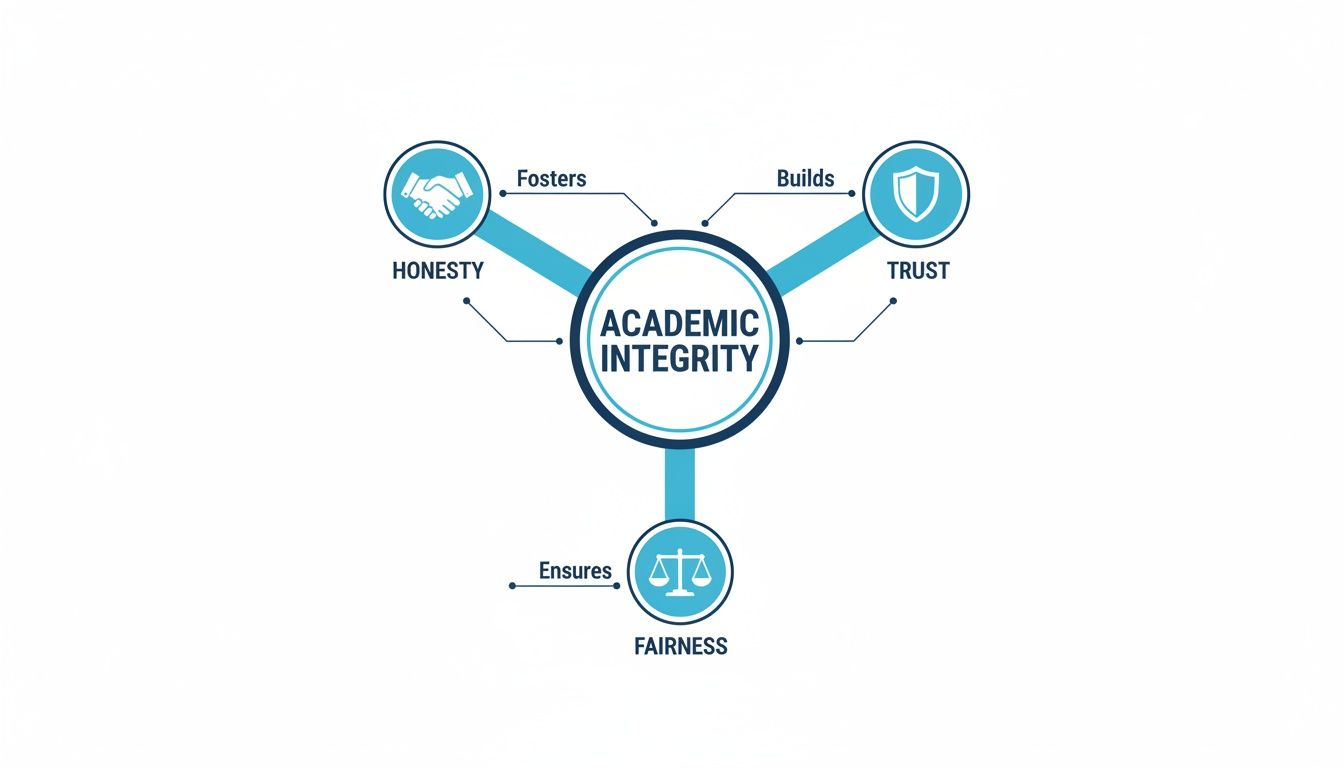
Ultimately, each element reinforces the same core idea: your work should be a genuine product of your own effort and understanding.
A UK-Wide Commitment to Upholding Standards
Academic integrity is the backbone of the UK’s higher education system, ensuring that qualifications earned here are authentic and respected globally. As cases of academic misconduct began to rise, the Quality Assurance Agency for Higher Education (QAA) took action, launching its Academic Integrity Charter in 2020.
Today, over 200 UK higher education providers have signed up, showing a shared commitment to protecting academic standards. You can learn more about the QAA's Academic Integrity Charter and why it matters for UK students. This unified effort shows just how seriously universities take this issue, making it a central part of your journey into higher education.
Understanding Common Academic Integrity Breaches

Knowing the principles of academic integrity is one thing, but putting them into practice means spotting the common pitfalls. Navigating these rules can feel a bit tricky, especially when you’re studying online where the lines can sometimes seem blurry. This section is here to clear up the confusion around the most common mistakes, helping you recognise and avoid them with confidence.
We'll break things down using practical, real-world scenarios that you might face as an adult learner in the UK. The goal isn't to scare you, but to build your awareness so you can avoid accidental slip-ups. When you understand what constitutes misconduct, you empower yourself to produce work that is genuinely your own.
Plagiarism Unpacked
At its core, plagiarism is simply presenting someone else's work, words, or ideas as your own without giving them proper credit. It's one of the most common academic mishaps, and it often happens by accident through sloppy note-taking or rushed referencing.
Imagine you're writing an essay for a psychology module and find a fantastic journal article. If you copy a sentence or even just a unique phrase from that article into your assignment without using quotation marks and adding a citation, that's plagiarism. This is still true even if you change a few words – a practice sometimes called "patchwriting," which is still considered a form of plagiarism.
To steer clear of this, you must always acknowledge where your information comes from. This includes:
- Direct Quotes: Using someone's exact words. You need to pop them in quotation marks and follow up with a citation.
- Paraphrasing: Rewriting an idea from a source in your own words. You still have to include a citation to credit the original author.
- Summarising: Giving a brief overview of a source's main points. You guessed it – this also needs a citation.
Collusion vs Collaboration
The line between working together and cheating together is a really important one, especially in an online course where student forums and study groups are a fantastic resource.
Collaboration is brilliant, and we encourage it. It’s when you chat about course materials with your peers to get a better grip on things. For instance, two students on an Access to HE Nursing course might discuss a complex biological concept on a forum to help each other understand it.
Collusion, on the other hand, is when students secretly work together on an assignment that is supposed to be done individually. This is a serious no-go.
Scenario: Imagine two students, Sarah and Tom, are working on the same case study analysis.
- Collaboration (Good Practice): They jump on a video call to discuss the key theories they could use and share links to helpful articles. After the call, they both write their own analyses from scratch.
- Collusion (Misconduct): Sarah writes the introduction and conclusion, Tom writes the main body, and they stitch it all together to submit two very similar assignments. This is completely forbidden.
The key takeaway is this: the final piece of work you submit must always be your own, written in your own words, and reflecting your own understanding.
Contract Cheating and Essay Mills
A particularly serious form of misconduct is contract cheating. This is where you pay or ask someone else to produce work for you, which you then hand in as if you wrote it. This includes using "essay mills"—websites that sell pre-written or custom essays.
Submitting work you didn't write is a fundamental breach of honesty. Universities have become very good at spotting this, and the consequences are severe. Using an essay mill doesn't just devalue your education; it also means you miss out on learning the critical skills the assignment was designed to teach you in the first place.
The Modern Challenge of AI Misuse
Artificial Intelligence (AI) tools like ChatGPT can be useful for brainstorming ideas or checking your grammar, but they also open up a new world of potential academic slip-ups. Think of AI as a calculator for a maths exam—it's a tool to help you with the process, not to do the work for you.
Using AI to generate entire sentences, paragraphs, or essays for your assignment is a form of plagiarism. Tutors and universities use sophisticated software that can often detect AI-generated text. The safest bet is to use AI sparingly as a study aid and make absolutely sure that every word you submit is your own.
The Real-World Impact of Academic Misconduct
It can be tempting to see academic integrity as just a set of abstract rules, but breaking them has very real consequences that can seriously impact your future. Understanding what’s at stake is key to realising why doing your own, honest work is so important for your educational journey and the career you’re working towards.
When misconduct is flagged, the penalties aren't there to be unnecessarily harsh. They exist to protect the value of the qualification for every single student who earns it fairly.
The Spectrum of Penalties
Facing an academic misconduct investigation is a stressful experience, and the outcome can throw up major roadblocks on your path to university. While each institution has its own process, the penalties tend to follow a clear pattern.
Common consequences can include:
- Receiving a zero for the assignment: The most immediate penalty is that all your work on that piece is dismissed, meaning you have to start again or accept a failing grade.
- Failing the entire module: For more serious breaches, you could fail the whole unit. This often means retaking it, which can delay your progress.
- Suspension from your course: In cases of repeated or severe misconduct, like contract cheating, you could be temporarily removed from your studies.
- Permanent removal from the course: The toughest penalty is expulsion. This ends your enrolment and your journey with that institution for good.
These formal sanctions are serious enough on their own, but the damage can often stretch far beyond a single assignment.
Putting Your University Ambitions at Risk
For anyone studying an Access to HE Diploma, getting into university is the ultimate goal. A record of academic misconduct can put that dream in serious jeopardy. When you apply to universities, especially for competitive degrees, your entire academic history is looked at closely.
Imagine you’re applying for a sought-after place in Midwifery, Paramedic Science, or Computer Science. Universities aren't just looking for good grades; they want candidates who show the ethical character needed for their chosen profession. A note about academic misconduct on your record is a huge red flag. It suggests you might not be a trustworthy or responsible student and could lead to your application being rejected flat-out, closing the door on your career before it’s even begun.
The Impact on Your Future Career
Perhaps the most crucial consequence of academic dishonesty is how it affects your future professional skills. Every assignment is designed to build the specific knowledge you’ll need to do your job well.
If you take shortcuts, you aren't just cheating the system; you are cheating your future self out of essential learning. A nurse who doesn't truly understand anatomy or a programmer who can't write their own code is not just unqualified—they can be dangerous.
Student views on this can be complicated. A study at a London university found some learners felt misconduct processes were demotivating, while others were relieved by the clear standards. This really highlights how important it is for institutions to respond fairly, ensuring your path to a career in Health Professions or Management is secure and respected. You can find more insights in this academic integrity report.
Ultimately, academic integrity isn't just about following rules to pass a course. It's about becoming the capable, skilled, and trustworthy professional that future employers and clients can count on.
Practical Strategies to Uphold Academic Integrity
Knowing the theory behind academic integrity is one thing, but putting it into practice day-to-day is what really sets you up for success. As a busy adult learner, you’re often juggling studies with work, family, and a million other things. Developing honest and efficient study habits isn’t just about ticking boxes – it’s about creating a realistic path to your goals.
Think of this section as your hands-on toolkit. It's packed with real, actionable strategies to make sure the work you submit is always, authentically, yours. These aren't just academic hurdles; they're the professional habits that will help you shine at university and in your future career.
Master the Art of Referencing and Citation
Getting your referencing right is the bedrock of academic honesty. It’s how you show respect for the original thinkers whose work you’re building on, and it lets your tutor see the research journey you’ve been on. Anytime you use an idea, a quote, or a piece of data that you didn’t create yourself, you have to cite it.
It can feel a bit daunting at first, but understanding how to cite sources correctly is the best way to avoid accidental plagiarism. Getting the hang of it early on will save you a world of stress later.
A citation is your way of saying, "I've done my research, and this is where this specific idea comes from." It strengthens your work and demonstrates your engagement with the subject.
Just remember that different courses require different referencing styles (like Harvard or APA). Your first job is to find out which one you need to use and then stick to its guidelines like glue for every single assignment.
Develop Effective Paraphrasing Skills
Paraphrasing is so much more than just swapping out a few words. It’s about truly understanding an idea, digesting it, and then explaining it in your own unique voice and sentence structure. It's a skill that proves to your tutor that you haven't just copied something – you've actually understood it.
A common pitfall is "patchwriting," where you just use a thesaurus to change a few words but keep the original sentence structure. This is a big no-no and is still considered plagiarism.
To get it right, try this four-step process:
- Read and Absorb: Read the original text until you can confidently say you get what it means.
- Look Away and Write: Put the original source out of sight and write down the idea in your own words. Imagine you're explaining it to a friend.
- Compare and Refine: Now, look back at the original. Have you accidentally copied any unique phrases or followed the structure too closely? Tweak your version until it’s truly yours.
- Cite Your Source: Even though the words are now yours, the idea came from somewhere else. You must always add a citation.
This definitely takes practice, but it's a non-negotiable skill. For more tips on building your arguments from the ground up, our guide on how to write academic essays is a great place to start.
Implement Smart Time Management
Let's be honest: most breaches of academic integrity happen under pressure. When a deadline is breathing down your neck, the temptation to cut corners can feel immense. The best defence you have against making a bad decision is planning your time properly.
As an adult learner, your time is gold. Break down those big, intimidating assignments into smaller, bite-sized tasks. Set up a study schedule that carves out specific slots for research, writing, and proofreading. Even 30 minutes of focused work a day can make an incredible difference and keep that last-minute panic at bay.
Do's and Don'ts for Maintaining Academic Integrity
Here's a quick checklist to help you stay on the right track with your assignments and online learning.
| Do | Don't |
|---|---|
| Plan Your Time: Create a detailed schedule for each assignment, setting mini-deadlines along the way. | Leave It Until the Last Minute: Rushing leads to sloppy work, accidental plagiarism, and unnecessary stress. |
| Keep Detailed Notes: Always record where your information comes from as you research. | Mix Your Notes with Copied Text: This is a common cause of unintentional plagiarism. Keep source material separate. |
| Ask for Help: If you're unsure about referencing or a concept, reach out to your tutor for clarification. | Guess or Assume: Never assume it's okay to borrow text or work with a friend on an individual task. |
| Double-Check Your Work: Before submitting, review your citations and ensure all paraphrased content is truly in your own words. | Submit Work You Haven't Written: This includes work from friends, family, or online sources. It is always considered serious misconduct. |
By making these strategies part of your routine, you’re doing more than just avoiding penalties. You’re building the discipline, skills, and ethical foundation that define not only a successful student but a trusted professional.
Using AI Tools Ethically in Your Studies

The arrival of generative AI tools like ChatGPT has certainly shaken up the world of education. These powerful platforms offer new ways to learn and study, but they also bring fresh risks to academic integrity. Knowing how to use them responsibly is a crucial skill for any modern student.
Think of an AI tool like a sophisticated calculator for a maths exam. It’s a fantastic resource for checking your work, exploring complex problems from a different angle, or even helping you grasp a tricky formula. But you'd never let the calculator sit the exam for you, would you? The same idea applies here: AI can be a helpful assistant, but it can never replace your own critical thinking and hard work.
At the end of the day, the core principle of academic integrity remains the same: the work you submit must be your own. Using AI to generate text that you then pass off as your own is a serious breach of this rule and is treated just like plagiarism by universities.
Drawing a Clear Line
To use AI tools ethically, you need to understand the difference between what's acceptable and what isn't. It all comes down to using AI to support your learning, not to outsource it.
Here’s a practical way to think about it:
-
Acceptable Use (The Green Zone): Think of these as tasks where AI acts as a helpful study partner. This could be brainstorming initial ideas for an essay topic, asking for a simplified explanation of a complex theory, or checking your grammar and spelling. Using it this way helps you learn more effectively.
-
Unacceptable Use (The Red Zone): This is any activity where the AI does the actual thinking for you. This includes generating entire sentences, paragraphs, or essays for your assignments, asking it to complete your homework, or using it to write code you don't understand. Submitting this kind of work is dishonest and a clear violation of academic rules.
Understanding the Real Risks of AI Misuse
The temptation to use AI as a shortcut can be strong, especially when deadlines are looming, but the risks are significant. The consequences can have a lasting impact on your academic future, and it's not just about getting caught; it's about the quality of your learning.
A major danger is that AI models can, and often do, produce information that is factually incorrect or biased. They are designed to generate text that sounds plausible, not to verify facts. Submitting an assignment filled with these AI "hallucinations" will not only earn you a poor grade but also shows a lack of genuine engagement with your subject.
Additionally, universities now use advanced detection software specifically designed to identify AI-generated content. Being flagged by these systems can lead to the same severe penalties as traditional plagiarism, putting your place on your course at risk.
The rise of generative AI has led to a sharp increase in academic misconduct cases across UK universities. One institution, Abertay University, saw a staggering 411% jump in reported incidents. The financial impact is also huge, with an estimated annual cost of £12.4 million to UK public universities just for investigations. For those aiming for careers in healthcare, this really highlights why integrity is so important; breaches can erode the trust placed in your qualifications.
Ultimately, navigating the world of AI responsibly comes down to honesty and a commitment to genuine learning. When working on group assignments, for example, understanding what is collaborative learning and its ethical rules is vital. Our guide on how to cite a website can also help ensure you credit all your sources correctly, whether human or digital.
Answering Your Questions About Academic Integrity
When you’re deep in your studies, it’s easy to get tangled up in the finer points of academic integrity. Some situations feel a bit grey, and it’s completely normal to have questions.
Let’s clear things up. Below, we’ll tackle some of the most common queries students have, giving you the confidence to navigate your coursework and stay on the right track.
Is It Plagiarism If I Reuse My Own Work?
Surprisingly, yes. This is often called self-plagiarism, and it’s something most universities consider academic misconduct. Think of it this way: every assignment you submit is meant to show new learning for that specific module.
Handing in work you’ve already been graded on doesn’t demonstrate that fresh understanding. If you want to expand on an idea from a previous essay, have a chat with your tutor first. They can show you how to properly reference your own past work, just as you would any other source.
What Is The Difference Between Collaboration and Collusion?
This is a really important one, especially in an online learning environment.
Collaboration is brilliant. It’s when you discuss ideas and concepts with fellow students to help deepen your own understanding. It’s a healthy part of the learning process.
Collusion, on the other hand, is when that teamwork crosses a line. It’s when you and another student work together on an assignment that’s supposed to be an individual effort. This could mean sharing answers, writing sections of each other's essays, or submitting work that is nearly identical. The key difference is that collaboration supports your individual learning, while collusion means the final piece isn’t entirely your own.
Can I Get In Trouble for Accidental Plagiarism?
Unfortunately, the answer is yes. Universities and colleges hold students responsible for their submissions, whether the plagiarism was intentional or not. Accidents often happen when you’re rushing, paraphrasing incorrectly, or simply forget a citation. It's still seen as a breach of integrity.
This is exactly why building strong study habits from the start is so vital. Getting the hang of managing your sources and giving credit where it's due is your best defence against making an unintentional mistake. For a closer look, check out our guide on how to reference a journal article using the Harvard style.
How Can I Check My Work Before Submitting It?
Giving your work a final once-over is your most powerful tool. It doesn’t have to take long, but it can save you a lot of stress.
First, go back to the assignment brief and read it carefully. Have you ticked every box and met all the requirements?
Next, scan through your work and make sure every quote, idea, or piece of data that isn’t yours has a clear citation in the correct referencing style. Finally, try reading your essay out loud. This simple trick helps you spot awkward phrasing that might be a sign of poor paraphrasing. If you’re ever in doubt, just reach out to your tutor before you hit submit.
At Access Courses Online, we are committed to providing you with the support and guidance needed to succeed with integrity. Discover our range of Access to HE Diplomas and start your journey to university today.