

Academic writing is really just a way of presenting a clear, logical argument to an audience that knows its stuff. Think of it less like creative writing and more like a detective laying out a case. Every claim you make must be backed up by solid proof from credible sources. It's a formal conversation built on facts, not feelings.
Decoding Academic Writing for University Success

For many people heading back to education, the term "academic writing" can sound pretty intimidating. It often brings to mind complicated jargon and a stuffy, unfamiliar set of rules. But honestly, it’s just a specific style of communication—a style that anyone can learn.
The main goal is to share your ideas and research in a way that’s clear, concise, and trustworthy. To really get it, it helps to understand what is formal writing in general, as this sets the professional tone you'll need for higher education. This structured approach isn’t there to limit your creativity. It’s all about building a convincing argument that others in your field can understand, check, and even build on themselves.
Why This Skill Is So Important
Getting this right is absolutely crucial because it’s the backbone of how you’re assessed at university. It’s how you show you understand a topic, can think critically about it, and have engaged with the material. Unfortunately, building these skills early is becoming a bigger challenge. Recent stats from the UK Department for Education show a worrying trend:
In 2023/24, only 72% of pupils met the expected standard in writing. That's a noticeable drop from the pre-pandemic figure of 78%. Even more telling is that just 13% achieved greater depth, showing that very few are excelling in the kind of structured expression needed for university.
This data really highlights a skills gap that catches many new university students out. It's precisely why our Access courses focus so heavily on building these writing skills from the ground up. We’re here to methodically teach you the rules of the game, making sure you arrive at university not just prepared, but genuinely confident in your ability to succeed. This is a skill you learn, not a talent you’re born with.
The Four Pillars of Persuasive Academic Writing
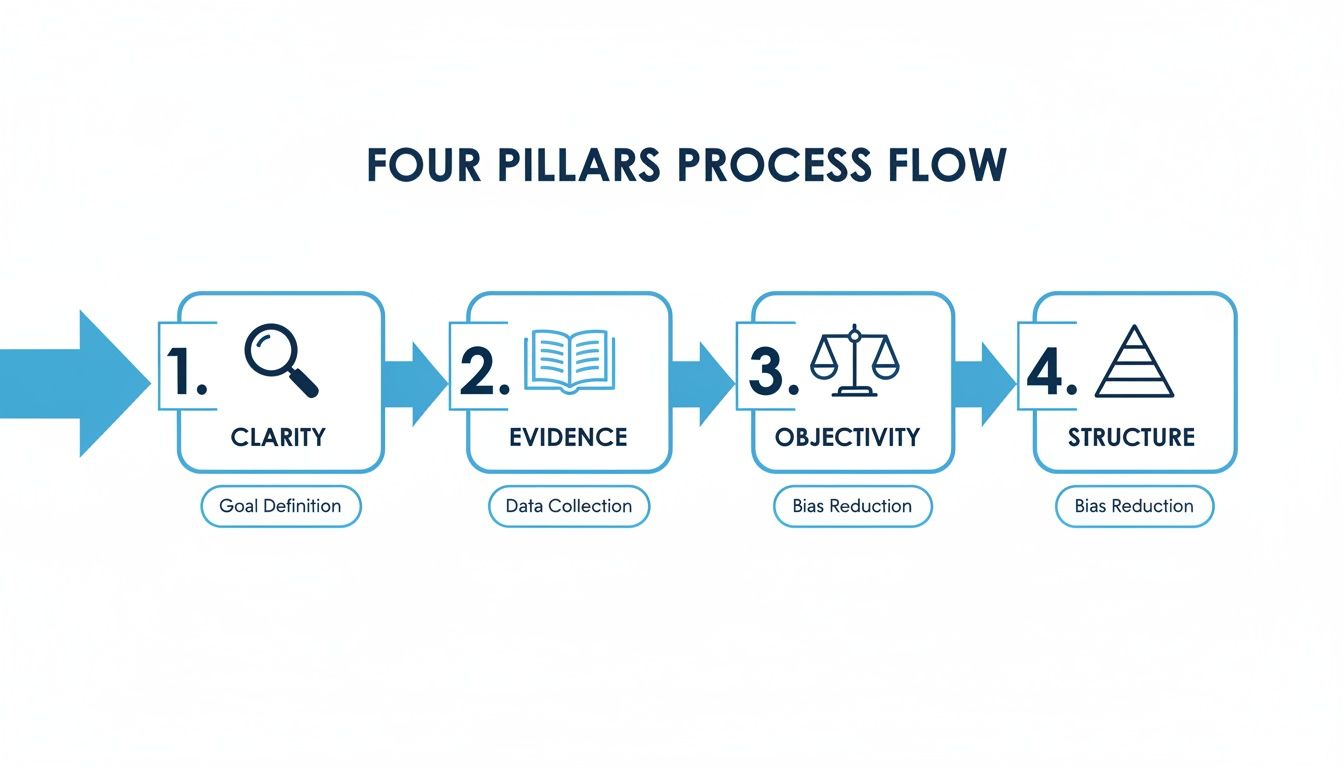
Making the leap from everyday writing to academic writing can feel like learning a new language. But it helps to think of it less as a set of rigid rules and more like building something solid. Just like a house needs a strong foundation, a convincing academic argument is built on four essential pillars: Clarity, Evidence, Objectivity, and Structure.
Get these four in place, and your writing won't just be correct—it will be persuasive, credible, and ready to make an impact. Think of them as your toolkit for turning good ideas into a powerful piece of work that will be taken seriously at university.
Let's break down exactly what each of these pillars means and how you can start using them in your own writing.
Pillar One: Clarity
First and foremost, your writing has to be crystal clear. The main goal of academic writing isn't to sound clever by using the most complicated words you can find; it’s about getting your point across without any room for misunderstanding. Every single sentence should have a clear purpose, guiding your reader through your argument one logical step at a time.
Imagine giving someone directions. If you say, "turn left somewhere up the road," they're going to get lost. But if you're precise—"in 200 metres, turn left at the traffic lights onto Oak Street"—the path is obvious. Your writing needs that same level of precision.
To nail this, focus on:
- Specific Language: Instead of writing that a policy had a "good effect," explain what that was. For example, "the policy reduced hospital readmission rates by 15%."
- Simple Sentence Structure: Don't tie your ideas up in long, rambling sentences. If a thought is complex, break it down into shorter, more digestible sentences.
- Defining Key Terms: If you’re using a technical term your reader might not know, just give a quick explanation the first time you use it.
Pillar Two: Evidence
An academic argument without evidence is just an opinion. At university, your personal feelings or gut instincts aren't enough to make a point stick. Every claim you make needs to be backed up by credible, solid proof. This is the single biggest difference between academic writing and a blog post or a chat with a friend.
Think of your evidence as the proof you show the reader to say, "See? This isn't just me saying this; it's grounded in real research." It shows you've done your homework and are joining a much bigger academic conversation.
Strong evidence usually comes from sources like:
- Peer-reviewed journal articles
- Academic books and textbooks
- Official statistics from government agencies or trusted organisations
- Primary sources, like historical documents or interview transcripts
The strength of your argument is directly tied to the quality of your evidence. Using weak, biased, or outdated sources is like building a house with dodgy materials—it just won’t stand up to scrutiny.
Pillar Three: Objectivity
Next up is objectivity. This means presenting your argument in a balanced and impartial way, led by the evidence rather than your own emotions or biases. An objective tone builds trust, showing your reader that you’ve looked at the issue from all sides before reaching a conclusion.
This doesn't mean your argument can't be strong. In fact, the most powerful arguments are the ones that calmly acknowledge other viewpoints before explaining why your position makes the most sense based on the evidence.
Adopting an objective tone means steering clear of emotional language and sweeping statements. For example, instead of writing, "I think it's a terrible idea," you would rephrase it as, "The evidence suggests this approach has several significant drawbacks." The second version is detached, professional, and focuses on the facts. This is a crucial part of the analytical mindset you’ll need in higher education, and you can learn more about it in our guide on how to develop critical thinking skills.
Pillar Four: Structure
Finally, we have structure. A well-structured essay takes the reader on a logical journey. Without a clear path, even the most brilliant ideas can feel confusing and lose all their power. Every piece of academic work, whether it’s a short essay or a long dissertation, follows a reliable pattern.
This structure almost always includes:
- An Introduction: This is where you set the scene, introduce your topic, and state your main argument (your thesis). Think of it as a roadmap for your reader.
- The Body Paragraphs: Each paragraph should tackle one main point that supports your overall argument. Here, you'll present your evidence, explain it, and link it back to your central idea.
- A Conclusion: This is where you pull everything together. You'll summarise your key points, restate your argument in a fresh way, and leave the reader with a final thought on why it all matters.
Master these four pillars—Clarity, Evidence, Objectivity, and Structure—and you'll have the foundation you need to succeed in all your academic work. They are the essential ingredients for turning your knowledge into powerful, persuasive writing.
Building the Blueprint of an Academic Paper
Every strong piece of academic writing, whether it's a short essay or a hefty report, is built on a clear, logical blueprint. Thinking about this structure before you start writing is a bit like an architect designing a building before the first brick is laid; it ensures every single part has a purpose and contributes to the strength of the whole. Without that solid plan, even the most brilliant ideas can end up feeling confusing or weak.
The classic academic structure isn’t just a stuffy set of rules someone made up. It’s a tried-and-tested method for guiding your reader through a complex argument in the clearest way possible. It breaks down into three core components that work together beautifully.
The Introduction: Your Map for the Journey
You could argue the introduction is the most important part of your entire paper. It's your one and only chance to grab the reader's attention, set the scene, and tell them exactly where you're about to take them. A powerful introduction acts like a map, giving your reader the confidence to follow your argument from start to finish.
A really solid introduction usually does three things:
- Provides Context: It kicks off with a broad statement to introduce the general topic and get your reader settled.
- Narrows the Focus: It then zooms in on the specific issue or question your paper is going to tackle.
- States the Thesis: It finishes with a crystal-clear thesis statement—a single sentence that declares your main argument or position.
That final part is the absolute linchpin. Your thesis statement is a promise you make to your reader about what you intend to prove. Everything that follows has to directly support this central claim.
The Body Paragraphs: Building Your Argument Brick by Brick
The body of your paper is where you make good on the promise you made in your thesis. Each paragraph is like a new floor being added to the building, carefully constructed on top of the one before it. The key is that each one should focus on a single main idea that directly supports your overall argument.
Think of each paragraph as a mini-essay with its own simple structure:
- Topic Sentence: Start with a clear topic sentence that introduces the paragraph's main point and links back to your thesis.
- Evidence and Analysis: This is where you bring in your evidence from credible sources—a quote, a statistic, or a key finding. But—and this is crucial—you must then explain what this evidence means in your own words and how it proves your point.
- Concluding Link: Wrap up the paragraph with a sentence that summarises the point and smoothly leads into the next idea.
This repeatable structure ensures your argument is built on a solid foundation of evidence and logical reasoning, which makes it far more persuasive. Getting this right will make a huge difference to your writing, and you can find more detailed guidance in our post on how to write academic essays.
The Conclusion: Bringing It All Together
Finally, your conclusion is your chance to leave a lasting impression. This isn't the place to introduce new information or evidence. Instead, its job is to tie everything together neatly and reinforce why your argument matters.
Your conclusion should be more than just a summary; it should be the final, satisfying destination of the journey you’ve taken your reader on. It answers the crucial "So what?" question.
A well-crafted conclusion will:
- Restate the Thesis: Remind the reader of your main argument, but rephrase it using fresh and confident language.
- Summarise Key Points: Briefly run through the main evidence you presented in the body paragraphs.
- Provide Final Thoughts: End with a powerful closing thought on the broader implications of your argument, why it's important, or what could be explored next.
This diagram shows how these structural elements are held up by the core principles of academic writing we looked at earlier.
As you can see, a strong structure is the vehicle that delivers your clear, objective, and evidence-based argument with real impact.
Mastering Citations and Academic Integrity

Let’s be honest: referencing can feel like the most technical and intimidating part of academic writing. For many students, it feels like a chore—just a fussy set of rules you have to follow to avoid losing marks.
But it’s so much more than that. Think of it as a professional skill that shows you’re part of a wider academic conversation. When you cite a source, you’re giving credit where it's due, but you're also showing your reader the evidence that backs up your arguments. Getting this right turns referencing from a tedious task into a powerful tool for building a credible, convincing case.
Why The Rules Matter
Every single citation you pop into your work has a purpose. It's a signpost, allowing your tutor or anyone else reading your work to find the exact source you used and check the information for themselves. This transparency is the absolute bedrock of academic honesty.
Properly citing your sources also proves you’ve done the reading and really understand the key debates in your subject. It shows you’re not just sharing random opinions, but building your arguments on the foundations laid by other experts. This entire process is central to maintaining academic integrity.
Academic integrity is the moral code of scholarship. It’s all about a commitment to honesty, trust, fairness, and responsibility in everything you do. Accurate referencing is how you put those values into practice.
We dive deeper into this in our detailed guide on what is academic integrity and why it's so crucial for success at university.
Making Sense of Citation Styles
One of the first things that can throw new students is the sheer variety of referencing styles out there—Harvard, APA, MLA, and the list goes on. While the formatting details change, they all share the same core ingredients:
- In-Text Citations: A short reference inside your paragraph (like Smith, 2021) that points the reader to the full details.
- Reference List: A complete A-Z list at the very end of your essay, giving all the information needed for someone to find every source you mentioned.
For instance, a Harvard in-text citation might look like this: "Recent studies show a significant shift in public opinion (Jones, 2023)." Then, in your reference list, you'd have the full details of Jones's work. Learning how to add citation correctly is a true cornerstone of academic writing, and there are some great practical examples out there to help.
This skill has become even more important for adults returning to education. A 2023 National Literacy Trust survey found that just 34.6% of young people enjoy writing in their free time—the lowest level recorded since 2010. This points to a growing gap in writing confidence, making structured training in skills like referencing essential, especially for those aiming for careers in healthcare or social sciences.
Getting hands-on feedback from a supportive tutor is the best way to master these skills before you have to face the pressure of university deadlines.
How to Avoid Common Academic Writing Mistakes
Stepping into the world of academic writing feels a bit like learning a new language. It has its own rules and rhythms, and it’s completely normal to make a few mistakes as you get the hang of it.
Think of these common slip-ups not as failures, but as signposts showing you where to sharpen your skills. By spotting them early, you can learn to edit your own work with confidence, ensuring your brilliant ideas are presented with the clarity and credibility they deserve. Let's break down some of the most frequent errors and, more importantly, how to fix them.
Problem 1: Using Overly Casual Language
One of the quickest ways to lose credibility is to write in a tone that’s too informal. Slang, contractions (like "don't" or "it's"), and conversational phrases might be fine for a text message, but they can make a well-researched argument sound weak and unprofessional. Academic writing demands a formal, objective voice.
Before: "I reckon the government's plan to sort out the problem won't work out because it's just not good enough."
This sentence feels more like an opinion shared over a cup of tea than a serious academic point. Phrases like "I reckon" and "sort out" are too casual, and "not good enough" is vague and subjective.
After: "The proposed government policy is unlikely to be effective. The evidence suggests it fails to address the root causes of the issue, such as socioeconomic inequality and a lack of community resources."
See the difference? The corrected version is formal and specific. It replaces personal feelings with precise terminology, making the argument sound far more authoritative and convincing right away.
Problem 2: Making Sweeping Generalisations
Another classic mistake is making big, bold statements without any evidence to back them up. Phrases like "everyone knows," "it is obvious that," or "throughout history" are major red flags for any tutor. In academic writing, every single claim you make needs proof from a credible source.
Before: "Everyone knows that social media is bad for young people's mental health."
This is a huge generalisation. Who is "everyone"? And what does "bad" actually mean here? An academic reader will immediately question this because it’s an unsupported opinion.
After: "Several studies indicate a correlation between high usage of social media and increased rates of anxiety among adolescents (Smith, 2022). For example, a 2021 survey of 2,000 teenagers found that those spending over three hours per day on social platforms reported significantly lower self-esteem."
This revised version is precise and evidence-based. It points to specific studies, uses cautious language ("correlation," "indicate"), and even provides a concrete statistic, making the point much more powerful.
Remember, in academic writing, your argument is only as strong as the evidence you use to support it. Vague claims weaken your position, while specific, cited evidence builds a powerful and persuasive case.
Problem 3: Constructing Weak Paragraphs
Think of a good paragraph as a mini-essay. It should introduce a single main idea, back it up with evidence, and then connect back to your overall argument. A common error is either cramming too many ideas into one paragraph or not developing a single idea enough.
This often happens when paragraphs are missing a clear topic sentence – that crucial opening line that tells the reader exactly what the paragraph is about.
Before: "The NHS is under a lot of pressure. There are not enough nurses. Funding has been cut for years. Also, an ageing population means more people need care. This is a big problem for the UK."
This paragraph is just a shopping list of related points. It lacks focus, and the ideas aren't properly explained or linked together, leaving the reader to do all the hard work.
After: "Significant financial strain is a primary challenge facing the National Health Service (NHS). Decades of budget constraints, coupled with a rising demand for services driven by an ageing demographic, have created a critical shortage of resources. For instance, reports from the Royal College of Nursing (2023) highlight that insufficient funding is a direct cause of the current staffing crisis, which in turn impacts the quality of patient care."
This corrected paragraph is much stronger. It has a clear topic sentence about financial strain, then it uses specific details and evidence to build a coherent, focused, and compelling point.
Building Your Writing Skills for University Success
Knowing the rules of academic writing is one thing. Actually putting them into practice with confidence? That’s a whole different ball game.
This is especially true if you're an adult returning to education. When you're juggling work, family, and a hundred other things, you need a learning path that works with your life, not against it. A structured, supportive environment is what turns abstract writing rules into skills you can actually use.
That’s where modern online courses, like an Access to HE Diploma, really shine. They're built to bridge that gap. Instead of throwing you in at the deep end, they build your skills piece by piece. You’ll start with the fundamentals—like how to structure a solid paragraph or find a trustworthy source—before tackling bigger assignments. It’s a step-by-step approach that prevents you from feeling overwhelmed and helps you build real momentum.
The Power of Personalised Feedback
One of the most valuable parts of this journey is getting guidance from experienced tutors. Generic, one-size-fits-all feedback doesn't help much. What really makes a difference is personalised advice that hones in on exactly where you can improve.
Think of our tutors as your academic mentors. They give you detailed feedback on your work, pointing out where your argument could be stronger, suggesting ways to write more clearly, or helping you get to grips with referencing. This one-to-one support is priceless because it helps you understand not just what needs fixing, but why it matters. It’s the perfect preparation for the standards you’ll meet at university.
For so many of our students, this personalised guidance is the key that unlocks their potential. We’ve seen learners go from feeling unsure about their writing to achieving degrees in competitive fields like Midwifery, Social Science, and Computer Science. It just goes to show that with the right support, anyone can master these skills.
Preparing for High-Demand Fields
Getting good at academic writing isn't just about passing your degree; it's a vital professional skill, especially in today's fastest-growing sectors. Just look at the latest UK higher education statistics. They show a huge number of students are enrolling in fields where strong writing is absolutely essential.
In 2023/24, Business and Management was the most popular subject area with 595,620 students, followed closely by Subjects Allied to Medicine with 365,850 students. And with mature learners aged 30 and over now making up 15% of all first-degree students, a flexible diploma has become a crucial stepping stone into these competitive careers. You can dive deeper into the numbers with these UK higher education trends on domyessay.com.
Ultimately, becoming a confident academic writer is about building a solid foundation for your future. A well-designed online course gives you the tools, the feedback, and the flexible structure you need to succeed, allowing you to prepare for the next exciting chapter in your education and career without putting your life on hold.
Got Questions? We’ve Got Answers
As you get ready to dive into your studies, it's completely normal to have a few questions buzzing around your head about academic writing. We get it. This final section is here to tackle some of the most common queries we hear from students just like you.
Think of it as your go-to guide for quick, clear answers that will help you feel confident and prepared for the journey ahead.
Can I Use 'I' in My Writing?
This is a classic, and the answer is a very common one in academia: it depends! For a long time, the first-person perspective ("I think," "I believe") was a no-go, as the focus was on pure objectivity. But times are changing, and so are the rules in many fields.
In reflective essays, which you’ll definitely come across in subjects like nursing or social work, using 'I' is not just allowed—it's essential. Some social sciences also encourage it as a way of acknowledging your own position as a researcher. The golden rule? Always check your assignment guidelines. If you're ever in doubt, just ask your tutor. They're there to help.
How Formal Do I Really Need to Be?
You should aim for language that is professional, precise, and objective. The goal isn’t to sound overly stuffy or use the biggest words you can find; it’s about communicating complex ideas with absolute clarity. A good rule of thumb is to write like you would for a professional report, not a text to a mate.
This means you’ll want to consistently:
- Ditch the slang and clichés: Opt for specific, formal vocabulary instead.
- Avoid contractions: Always write out the full words, like "do not" instead of "don't," and "it is" instead of "it's."
- Keep it clear and concise: Choose direct language over flowery, ambiguous phrasing.
What's the Difference Between Summarising and Paraphrasing?
This is a really important one. While both involve putting someone else's ideas into your own words, they do different jobs. Getting this right is crucial for using evidence effectively in your work.
Summarising is about boiling down the main argument or key findings of a whole book or article into a brief overview. It’s the big picture. In contrast, paraphrasing is about restating a specific point, sentence, or short passage using your own words and sentence structure, while keeping a similar level of detail.
Both are vital skills for university-level writing, and—most importantly—both always need a citation to give full credit to the original author.
How Can I Build My Academic Vocabulary?
Growing a strong academic vocabulary doesn't happen overnight; it’s a gradual process that comes from really getting stuck into your subject. The single best way to improve is to read widely within your discipline. Pay attention to how the experts and top researchers use specific terms in their work.
Here’s a practical tip: keep a vocabulary journal. When you come across a new word, jot it down with its precise meaning and an example sentence to lock it in. A thesaurus can be handy, but always double-check that the synonym you pick fits the exact academic context you’re writing for.
Feeling ready to build these skills and take that next step towards university? At Access Courses Online, we provide accredited online diplomas designed to prepare you for success in fields like Nursing, Business, and Social Science. Learn more about how we can help you achieve your goals at https://accesscoursesonline.com.