

If you’re looking at applying to university, you’ll quickly come across the term UCAS tariff points. Essentially, they’re a way of turning your A-level grades into a numerical value. This helps universities compare different qualifications easily. For instance, an A* is worth 56 points, an A gets you 48, and a B is 40. Your final score is simply the sum of the points from your subjects.
What Are UCAS Tariff Points and How Do They Work?
Think of UCAS tariff points as a kind of universal currency for your qualifications. It’s a system set up by the Universities and Colleges Admissions Service (UCAS) to create a level playing field. It allows universities to fairly compare applicants who’ve studied different things, like A-Levels, BTECs, or an Access to HE Diploma.
The system works by assigning a number to every grade you get, turning your results into a simple, cumulative score. It's straightforward: a better grade means more points. It makes it easy to see the value of all your hard work at a glance.
The Purpose of a Standardised System
So, why have this system at all? The main goal is to standardise the application process. Instead of an admissions tutor trying to figure out how a B in an A-Level stacks up against a Merit in a BTEC, they can just look at the tariff point equivalent. This is especially useful for adult learners who might have a mix of qualifications or are coming back to education through a non-traditional route. It validates different educational journeys.
The tariff point system isn't just about crunching numbers. It's about recognising and valuing the effort and achievement across a huge range of UK qualifications. It creates a common language for both students and universities to understand academic success.
This chart shows you exactly how the top A-Level grades translate into points.
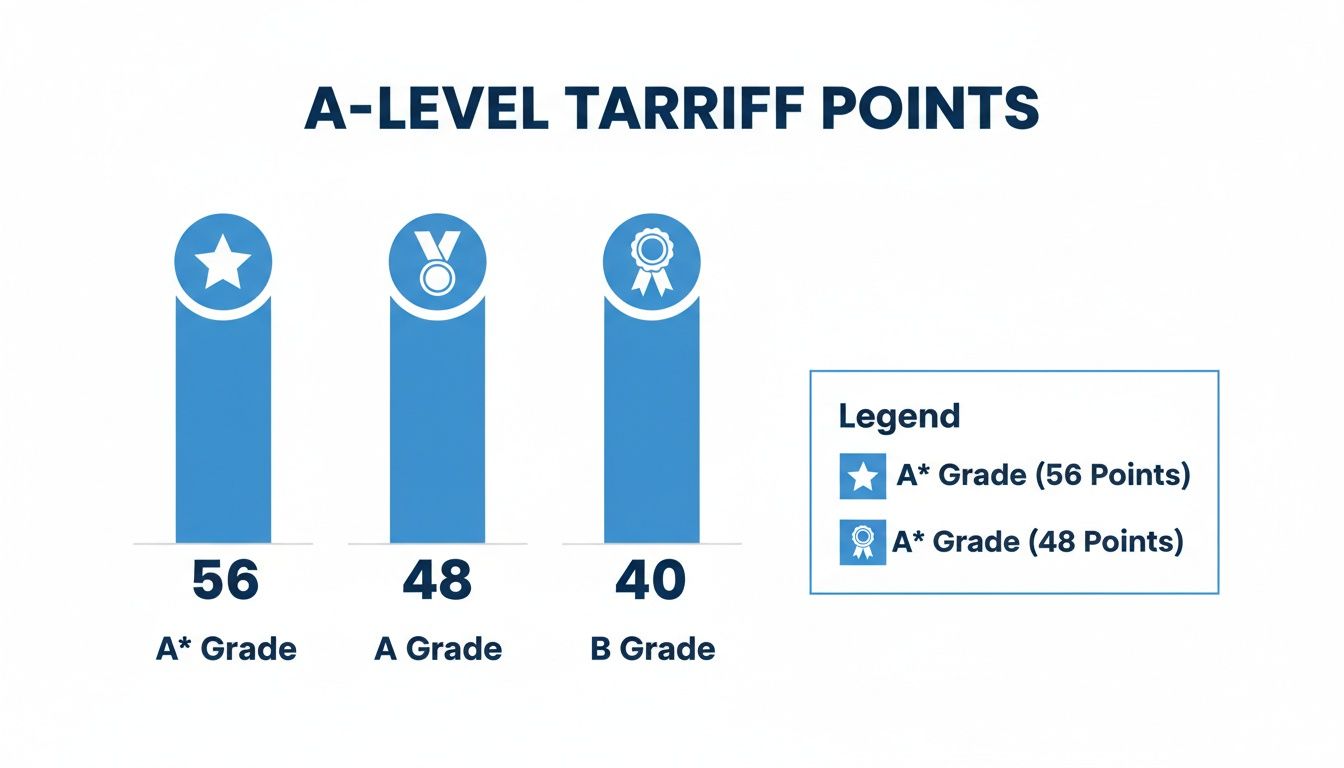
As you can see, there’s a big jump in points between each grade. It really shows how pushing for that higher grade can give your total score a massive boost.
A-Level Grades to UCAS Tariff Points Conversion Table
To make things even clearer, here’s a quick-reference table that breaks down the official tariff points for each A-Level grade.
| A-Level Grade | UCAS Tariff Points |
|---|---|
| A* | 56 |
| A | 48 |
| B | 40 |
| C | 32 |
| D | 24 |
| E | 16 |
These values have been the standard for university entry since they were updated back in 2017 alongside the A-level reforms.
Points vs Grades in University Offers
While lots of universities will make offers based on tariff points (like, "achieve 112 UCAS points"), it’s really important to know that not all of them do. Some of the most competitive universities or courses will still ask for specific A-Level grades, such as ‘AAB’, often in particular subjects.
So, based on the official values, a student who nails A*A*A* can rack up a maximum of 168 points. Someone with three A grades would total 144 points. You can find more insights on these official stats over on the UK government's education portal.
How to Calculate Your A-Level Tariff Points

So, how do you actually work out your final score? It’s much simpler than it sounds. Think of it as cashing in your academic achievements for a clear, numerical value that universities can easily understand. This takes the guesswork out of your application and gives you a solid figure to aim for when looking at different courses.
The calculation is just a matter of adding up the points from your Level 3 qualifications, which for most people means A-Levels. Universities typically look at your best three A-Level results, though it’s always a good idea to double-check the specific requirements for the course you’re interested in.
Let’s break down exactly how you get to that final number.
A Step-by-Step Calculation Guide
Working out your total is really straightforward. Just follow these simple steps to turn your grades into a total you can use on your UCAS application.
- List Your Qualifications: Start by writing down all your A-Level subjects and the grades you achieved (or are predicted to get).
- Assign Points to Each Grade: Using the A-Level conversion table from the previous section, find the tariff points that correspond to each of your grades.
- Add Them All Up: Simply sum the points from each subject to get your final UCAS tariff points total.
That final number is what you’ll compare against the entry requirements listed on university course pages. Easy!
Real-World Calculation Examples
Sometimes, seeing it in action makes all the difference. Let’s walk through a couple of common A-Level grade combinations to see how the points really add up.
Example One: A Student with AAB
Let’s say a student named Sarah has just received her results. She took Biology, Chemistry, and English Literature and achieved the following grades:
- Biology: A (which is worth 48 points)
- Chemistry: A (also 48 points)
- English Literature: B (worth 40 points)
To get her total, we just add the points together: 48 + 48 + 40 = 136 UCAS points. Sarah can now start looking for courses with entry requirements around the 136-point mark.
Example Two: A Student with BCC
Now, let’s imagine another student, Tom, who studied Maths, Physics, and History. His grades are:
- Maths: B (which is 40 points)
- Physics: C (which is 32 points)
- History: C (another 32 points)
Tom's total tariff points would be: 40 + 32 + 32 = 104 UCAS points. This score opens up a fantastic range of university courses for him to explore.
If you want an even easier way to check your numbers, you can always use a handy UCAS tariff points calculator to do the maths for you.
Common Pitfalls to Avoid
While the process is simple, a few common misunderstandings can trip people up. Keeping these in mind will help make sure your calculation is spot on.
A crucial rule to remember is that you cannot combine points from qualifications in the same subject. For example, if you took an AS-Level in Psychology and then continued to the full A-Level, only the final A-Level grade counts. The AS-Level is essentially replaced.
This rule prevents "double-counting" and keeps the system fair for everyone. The tariff only ever considers your highest level of achievement in a single subject. So, always use your final A-Level grades for the most accurate and valid calculation when getting your university application ready.
How Universities Use Tariff Points for Admissions

So, you’ve worked out your points total. The big question now is: what does that number actually mean for getting a place at university? Think of your UCAS points as a vital part of your application, giving admissions teams a clear snapshot of your academic achievements.
Universities use this score to set a baseline for who gets onto their courses. It’s a bit like a filter. If a degree requires 112 points, the admissions team can instantly see which applicants meet that minimum standard. This helps them manage a huge volume of applications fairly and efficiently.
Ultimately, the points system creates a level playing field. It ensures every accepted student has reached a similar level of academic attainment, whether they studied A-Levels, BTECs, or other Level 3 qualifications.
Typical Tariff Point Requirements for Degrees
The number of points you’ll need can vary massively. A university’s reputation, how popular a subject is, and the technical skills involved all play a part in setting the entry requirements. Getting a handle on these ranges will help you aim for the right courses.
Here’s a rough guide to what you can expect:
- Highly Competitive Courses (128 - 168 points): Subjects like Medicine, Law, and Veterinary Science, or courses at top-tier universities, often demand the highest scores. A total of 144 points (the same as AAA at A-Level) is a common benchmark here.
- Popular Academic Courses (112 - 128 points): Many mainstream degrees at well-regarded universities fall into this bracket. Think Psychology, Business Studies, and English Literature. This is roughly equivalent to grades like ABB or BBB.
- Standard Entry Courses (96 - 112 points): A huge number of fantastic degree programmes across the UK will have requirements in this range. A score like this, equal to grades like BCC or CCC, opens up a world of higher education opportunities.
Remember, these are just guidelines. It's so important to research the specific course you're interested in, as the exact tariff points for A-Levels can be different even for the same subject at another university.
More Than Just a Number
It's easy to fall into the trap of thinking it’s all about hitting a specific number, but that's only part of the story. Your UCAS points might get your foot in the door, but it’s the other parts of your application that will truly make you stand out.
Your personal statement, references, and any interview or portfolio are just as important as your grades. They provide the context behind the numbers, showing admissions tutors who you are, what motivates you, and why you are a perfect fit for their course.
This is especially true for vocational degrees. A course in Nursing, for instance, needs more than just academic ability. Admissions tutors will be looking for proof of empathy, resilience, and relevant experience in your personal statement. Your points show you can handle the academic work; the rest of your application proves you have the personal qualities to thrive in the profession.
You can learn more about how it all fits together in our detailed guide on what UCAS is and how the application process works.
When Grades Matter More Than Points
Finally, it’s crucial to know that not all universities make offers based on a total points score. Many of the most selective institutions will make a grade-specific offer instead.
For example, a university might ask for ‘AAB in Biology, Chemistry, and Maths’ rather than the equivalent 136 UCAS points. This is common for science, engineering, and maths-based degrees where a deep understanding of specific subjects is essential. It ensures applicants have the exact foundational knowledge they need to succeed.
This brings us to the single most important rule of applying to uni: always check the exact entry requirements for each course. Whether they ask for points, grades, or a bit of both, knowing what you need to achieve is the first step toward securing your place.
Access to HE Diplomas: A Powerful Alternative Path
While A-Levels are often seen as the traditional route to university, they're far from the only way in. For adult learners, the Access to Higher Education (HE) Diploma is a highly respected and powerful alternative, specifically designed to prepare you for the demands of a degree. It's a qualification that truly understands the ambitions of someone returning to education.
Instead of juggling multiple, separate subjects like you would with A-Levels, an Access to HE Diploma provides a focused, year-long curriculum tailored to a specific field, like Nursing, Computer Science, or Law. This structure doesn't just fill you with academic knowledge; it builds your confidence and sharpens your study skills, getting you ready for what's ahead.
How Access to HE Diplomas Translate to UCAS Points
The grading for an Access to HE Diploma looks a little different from A-Levels, but it translates perfectly into the UCAS tariff point system. The entire qualification is made up of 60 credits. Of these, 45 are graded at Level 3, while the other 15 are ungraded units focused on essential study skills.
It’s those 45 graded credits that count towards your UCAS total. They are awarded at three levels: Pass, Merit, or Distinction. The specific combination of these grades you achieve determines your final UCAS points. A strong profile, packed with Distinction and Merit grades, can easily equal top A-Level results, opening doors to competitive courses at fantastic universities.
The beauty of the Access to HE Diploma is its directness. It's a purpose-built qualification that speaks the same language as university admissions teams. Achieving a high number of Distinction grades is your passport to earning the 144 UCAS points needed for the most demanding degree programmes.
So, let's break down how these credits convert into the UCAS tariff points everyone talks about.
Access to HE Diploma Grades to UCAS Tariff Points
The table below clearly shows how different combinations of Distinction and Merit grades translate into UCAS points and their A-Level equivalents. This makes it easy to see how your hard work on an Access to HE Diploma stacks up against traditional qualifications.
| Distinction Credits | Merit Credits | Total UCAS Tariff Points | Equivalent A-Level Grades |
|---|---|---|---|
| 45 | 0 | 144 | AAA |
| 30 | 15 | 128 | AAB |
| 24 | 21 | 122 | ABB |
| 15 | 30 | 112 | BBB |
| 6 | 39 | 101 | BBC |
| 0 | 45 | 96 | CCC |
As you can see, getting 45 credits at Distinction is worth 144 UCAS points—exactly the same as getting three A* grades at A-Level. This is so important because it proves that the Access to HE Diploma isn't a lesser option; it's an equally valid and respected pathway to higher education. For a deeper dive, you can learn more about the Access to HE Diploma in our comprehensive guide.
A Widely Recognised and Valued Qualification
One of the biggest worries for adult learners is whether their qualification will be accepted. You can put that fear to rest. The Access to HE Diploma is welcomed by over 140 universities across the UK. This isn't just for a few niche courses; it’s a key that unlocks a huge range of degrees in fields from Social Work and Business to Midwifery and Engineering.
The proof is in the numbers. Access Diplomas can earn you up to 144 UCAS points, making them a direct equivalent to top-tier A-level results in the eyes of admissions tutors. This widespread acceptance makes the Access to HE Diploma a flexible and reliable choice. It gives you the freedom to apply to a broad range of institutions, confident that your qualification will be understood and valued. You can focus on what really matters: choosing the right degree for your future.
Your Action Plan for University Entry

So, you've got your head around how your grades translate into numbers. That's the first hurdle cleared. Now, it's time to turn that knowledge into a solid, practical plan that gets you from where you are today to where you want to be.
This is the point where you take back control of your journey to university. It can feel a bit intimidating, especially if you're worried your points won't quite cut it. But having a clear roadmap takes the guesswork out of the equation and empowers you to make smart decisions for your future. Let’s build that strategy together.
Step 1: Verify Your Current Tariff Points
First things first, you need to know exactly where you stand. While our tables give you a good idea, using the official UCAS tariff calculator is the best way to get a precise, official count of your current tariff points for A levels or any other Level 3 qualifications you hold.
Think of this as establishing your starting line. It gives you a concrete number to work with, so there’s no more estimating or wondering. Once you have this figure, you can start comparing it directly against the entry requirements for the courses that have caught your eye.
Step 2: Meticulously Research Course Requirements
With your points total confirmed, it's time to get down to some detailed research. Head over to university websites and look up the specific degree courses you’re interested in. Don't just skim the homepage; you need to dig into the detailed entry requirements for your year of entry.
Pay close attention to these details:
- Points vs. Grades: Does the university want a certain tariff score, or are they looking for specific A-Level grades in key subjects? This is a crucial distinction.
- Subject Requirements: Are there any non-negotiable subjects you need to have studied? A Computer Science degree, for example, will almost certainly require a good grade in Maths.
- GCSE Requirements: Don’t overlook the basics! Most courses will still want to see at least a grade 4 or 5 (the old grade C) in GCSE English and Maths.
Doing this homework properly will help you build a realistic shortlist of universities where you're a strong candidate.
Step 3: Identify and Address Any Gaps
After comparing your points total with your dream courses, you might find you’re right on track – fantastic! However, it’s very common to discover a gap between what you have and what you need. If that's you, don't panic. This isn't a dead end; it's just a sign that you need a clear plan to strengthen your application.
Realising you need more points isn't a setback; it's a clear signal to take decisive action. For adult learners, this is often the moment when a dedicated qualification like an Access to HE Diploma becomes the most logical and effective next step.
Developing a robust study plan is crucial for success. Exploring various AI study guide strategies can provide an edge in preparing for exams and maximising your final grade.
If you’re a few points short, an Access to HE Diploma is an ideal solution. It’s a focused, one-year pathway designed to get you completely university-ready, providing the exact tariff points you need to secure a place on your dream course. Instead of the hassle of resitting individual A-Levels, the Diploma offers a comprehensive and highly respected route forward.
This qualification is built for adult learners, allowing you to gain the equivalent of three A-Levels in a single, streamlined programme. For example, achieving top grades in an Access to HE Diploma can earn you 144 UCAS points, making you a very competitive applicant for a huge range of degrees.
The flexibility of online study means you can fit your learning around your existing commitments, whether that’s work, family, or both. With dedicated tutor support and manageable payment options to spread the cost, taking control of your educational future has never been more achievable. This is your chance to build the academic profile you need to make your degree aspirations a reality.
Common Questions About UCAS Tariff Points
Diving into the world of university applications can feel like learning a new language. As you start figuring out how your A-Levels or other qualifications add up, it’s completely normal for a few questions to pop up. This final section is here to clear up any of those lingering doubts.
We’ve pulled together the most common questions we hear about the UCAS tariff system and answered them simply. The goal is to make sure you feel confident and ready to move forward, whether you're coming straight from college with A-Levels or an adult learner starting an exciting new chapter.
Do All Universities Use UCAS Tariff Points?
This is a really important one, and the short answer is no. While the tariff system is a handy tool used by most UK universities, it’s not a one-size-fits-all approach. Some of the most competitive universities and courses do things a bit differently.
Institutions like Oxford and Cambridge, plus many in the Russell Group, often prefer to make offers based on specific A-Level grades. For instance, instead of asking for 144 UCAS points, they might require ‘A*AA’ in certain subjects.
Why do they do this? For degrees like engineering or medicine, they need to be sure you have a deep, specific knowledge base to build on from day one. An offer of ‘AAB in Chemistry, Biology, and Maths’ is their way of guaranteeing that an applicant has the exact foundation needed to succeed on their demanding course.
The key takeaway is to never assume. Always, always check the specific entry requirements on the university's course page. Many will list both a tariff point score and a grade-based offer, giving you the clearest possible picture of what to aim for.
Can I Combine Points From A-Levels and an Access to HE Diploma?
This question comes up a lot, especially from adult learners who might have some older A-Levels tucked away. The simple answer is that you typically wouldn't combine points from these two qualifications for a single university offer.
Think of the Access to HE Diploma as a complete, self-contained qualification designed to get you fully university-ready. In effect, it takes the place of A-Levels. When you apply with an Access to HE Diploma, universities will make an offer based on your performance within that course alone—looking at your profile of Distinction, Merit, and Pass credits, not a combined total.
While having previous A-Levels can definitely strengthen your personal statement by showing a history of academic study, the university's conditional offer will almost always be tied directly to your Diploma results. They want to see what you've achieved most recently.
How Many UCAS Points Is a GCSE Worth?
Let’s clear this one up quickly: GCSEs do not award any UCAS tariff points at all. The tariff system is only for Level 3 qualifications, which are the ones you study post-16, like A-Levels, BTECs, and the Access to HE Diploma.
However, that absolutely does not mean your GCSEs are unimportant! They are a vital, non-negotiable part of your application for most universities. Almost every degree course in the UK will require you to have at least a grade 4 (what used to be a C) in both GCSE English and Maths.
On top of that, specific courses often have extra GCSE requirements. For example:
- Nursing and Midwifery: Often require a grade 4 or 5 in a Science subject.
- Primary Teaching: Will almost certainly want to see a grade 4 or 5 in Science.
- Computer Science: May look for a higher grade, like a 6 or 7, in GCSE Maths.
Think of your GCSEs as the essential foundation. You have to have them in place before your Level 3 qualifications can even be considered.
What Happens If I Miss My Required Tariff Points?
Realising you’ve missed your offer can be a gut-wrenching moment, but it is not necessarily the end of your university dream. You still have several fantastic options to explore.
First, if you were very close to the required points, the university might still accept you, especially if the course isn't oversubscribed. This is often called a 'near-miss' offer.
If that doesn't happen, your next port of call is UCAS Clearing. This service is designed to match applicants who don't have a place with universities that still have empty seats. Every single year, thousands of students find a brilliant course through Clearing.
For adult learners, this can also be a moment to pause, reassess, and strengthen your position for next time. If you’ve realised your qualifications aren’t quite strong enough for your dream course, enrolling in an Access to HE Diploma can be a brilliant strategic move. It gives you a direct and focused path to gaining a robust, relevant qualification that will get you the tariff points for A-Levels equivalent you need. You can then re-apply the following year as a much stronger, more confident candidate.
Ready to take control of your educational journey? At Access Courses Online, we provide accredited Access to HE Diplomas that are your direct route to university. With flexible online study, dedicated tutor support, and interest-free payment plans, we make your degree aspirations achievable. Explore our courses today at https://accesscoursesonline.com.