

Ever wondered how universities compare an A-Level in History with a BTEC in Engineering? A UCAS tariff points calculator is the tool that makes it happen. It turns your grades into a simple numerical score, showing you exactly how you stack up against a course's entry requirements.
This is especially useful when you're applying with a range of qualifications, like an Access to HE Diploma, as it puts everything on a level playing field.
Understanding UCAS Tariff Points And Why They Matter

Getting your head around the university application process can feel like learning a new language, and the UCAS Tariff is a big part of that. Put simply, it’s a points system that helps universities and colleges make sense of the huge variety of qualifications people apply with.
Think of it as a conversion chart. Whether you've just finished your A-Levels or you’re returning to education with an Access to HE Diploma, the Tariff assigns a clear numerical value to your grades. This ensures admissions tutors can assess everyone fairly, no matter their background.
Creating a Standard for Comparison
The main job of the UCAS Tariff is to standardise qualifications. Without it, comparing an A* in A-Level Maths to a Distinction in a BTEC would be almost impossible. The points system creates that essential common ground.
For adult learners, this is a game-changer. Your educational journey might look a bit different, perhaps mixing older qualifications with new ones. The Tariff system makes sure your hard-earned grades are properly valued right alongside those from recent school leavers. It’s built on the idea that achievement comes in many different forms.
The UCAS Tariff isn't just about crunching numbers; it’s about recognising diverse educational journeys. It ensures that qualifications like an Access to HE Diploma are given the same weight as A-Levels, opening up opportunities for adult learners.
How the Tariff System Evolved
This system has been a cornerstone of UK university admissions for years. First introduced back in 2002, the UCAS Tariff was completely updated in 2016 to better reflect the wide range of Level 3 qualifications available today.
For example, an A* at A-Level used to be worth 140 points, but this was recalibrated to 56 points in the new system. This wasn't about devaluing the grade, but creating a more balanced and nuanced scale.
This evolution shows how vital the system is for keeping up with changes in education, making sure it stays relevant for qualifications like:
- A-Levels and AS Levels
- Access to HE Diplomas
- BTEC Nationals
- Scottish Highers and Advanced Highers
Ultimately, figuring out how your qualifications translate into points is the very first step toward making a confident and successful university application.
Getting to Grips with the UCAS Tariff Points Calculator
Knowing the theory behind UCAS points is a great start, but the real magic happens when you start applying it to your own qualifications. This is where your university journey really starts to feel real.
The simplest, most direct way to translate your grades into a clear numerical score is by using the official online UCAS tariff points calculator. It’s a brilliant tool that completely removes the guesswork, giving you an accurate total in just a few clicks.
The calculator is designed to be incredibly user-friendly. You just find your qualifications from a huge list, pop in the grades you’ve achieved (or are predicted), and it does the hard work for you. Suddenly, that confusing mix of grades and credits becomes a single, straightforward number, giving you the clarity you need to start shortlisting university courses.
Using The Official Calculator
Getting started is a simple affair. First, you’ll select your country of study—for instance, England—and then pick your specific qualification from the dropdown menu. This could be anything from an A-Level to a BTEC National or, for many of our students, an Access to HE Diploma.
Once you’ve found your qualification, you’ll be asked to enter your grade. If you’re an Access to HE student, this is where you’ll input the total number of Pass, Merit, and Distinction credits you’ve earned. The tool instantly calculates the corresponding tariff points. It’s that easy.
Don't worry if you're juggling multiple qualifications. The calculator lets you add each one separately and automatically keeps a running total. This is perfect for applicants who might be combining an Access to HE Diploma with a GCSE or a Functional Skills qualification.
If you’re still studying, you can use your predicted grades to get a provisional score. This is incredibly helpful for planning ahead, giving you a clear academic target to aim for to meet the entry requirements for your dream degree.
What Your Results Mean
After entering all your details, you’ll see a total points figure. This number is your key to unlocking university course pages and figuring out if you meet their entry criteria. You'll notice many universities list their requirements in two ways: as specific grades (e.g., ABB at A-Level) and as a total tariff score (e.g., 128 UCAS points).
It's vital to remember that this number is just one part of your application. Admissions tutors are also looking at your personal statement, references, and any relevant work or life experience—something that’s especially important for adult learners.
What If My Qualification Isn’t Listed?
Now and then, you might find that a specific or older qualification isn't on the calculator. If this happens, don’t panic. The best thing to do is contact the admissions departments of the universities you’re interested in directly.
They’re the experts and can give you specific guidance on how they assess qualifications that don't fall under the tariff system. They can often advise you on a case-by-case basis. Showing this kind of initiative helps build a strong case for your admission.
If you want a deeper dive into the whole system, our guide on what UCAS is can give you some extra background.
Turning Your Hard-Earned Grades Into UCAS Points
Okay, so you’ve got the theory down. Now for the important part: seeing exactly what your qualifications are worth in the language universities speak—UCAS Tariff points. This is where your hard work starts to translate into real numbers.
For many adult learners, this step can feel a bit intimidating. If you’re working with qualifications like an Access to HE Diploma, which uses credits instead of simple letter grades, it's easy to feel lost. But don't worry, breaking it down is much simpler than it looks.
Let’s get straight to it with some clear, easy-to-read tables for the most common qualifications you’ll be using.
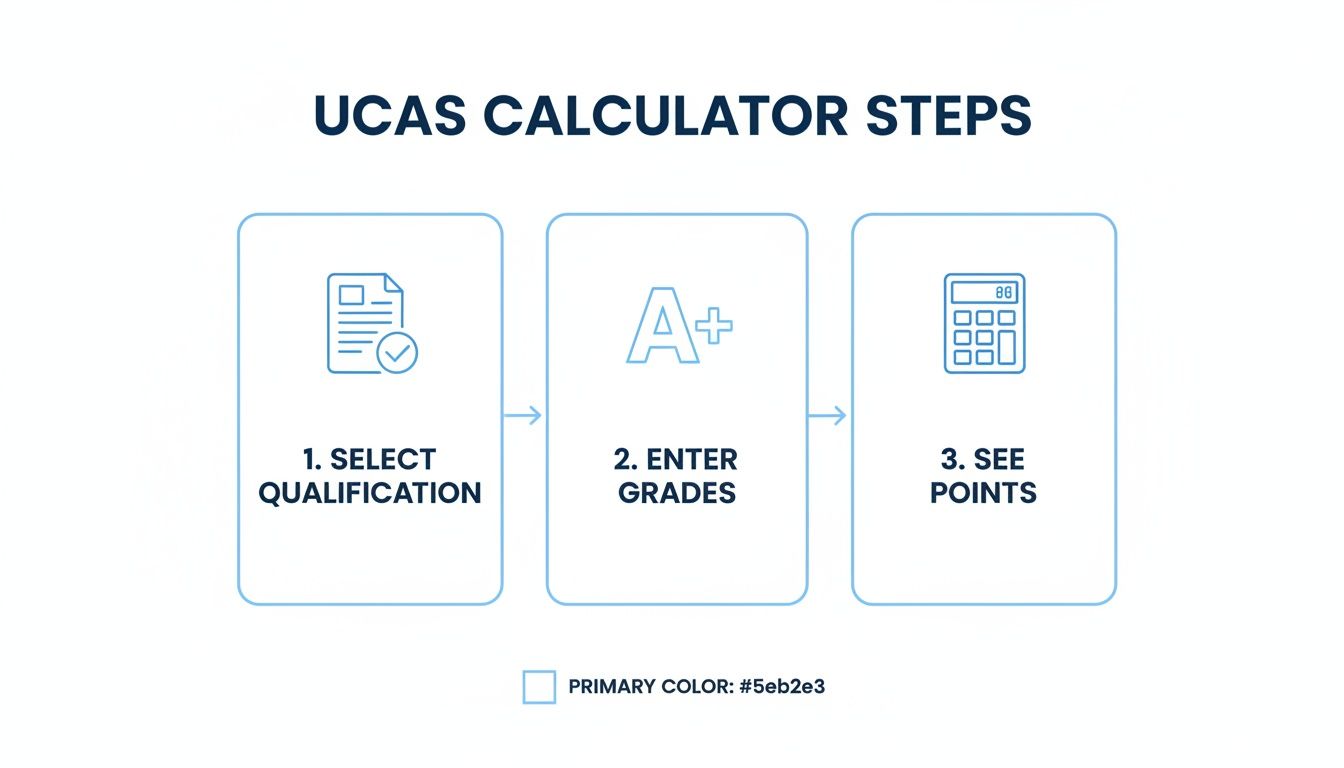
As you can see, it really is a straightforward journey: pick your course, pop in your grades, and get your total.
A-Level and AS-Level Points Breakdown
A-Levels are still seen as a gold standard in UK education, and their tariff values are pretty direct. Whether you have older A-Levels or you're topping up existing qualifications, knowing their value is crucial.
Points are awarded based on the grade you get, from A* down to E. A good rule of thumb is that an AS-Level is worth about 40% of a full A-Level.
| A-Level Grade | UCAS Points | AS-Level Grade | UCAS Points |
|---|---|---|---|
| A* | 56 | A | 20 |
| A | 48 | B | 16 |
| B | 40 | C | 12 |
| C | 32 | D | 10 |
| D | 24 | E | 6 |
| E | 16 |
This table is a handy reference, making it simple to add up your points if you're bringing a few A-Level or AS-Level qualifications to your application.
Understanding BTEC National Points
BTEC Nationals are career-focused qualifications that universities really value. Unlike A-Levels, their points value is based on two things: the grade you achieve and the size of the qualification.
BTECs come in a few different sizes, including:
- Extended Diploma (the big one, equivalent to three A-Levels)
- Diploma (equivalent to two A-Levels)
- Extended Certificate (equivalent to one A-Level)
The grading is Distinction (D), Merit (M), and Pass (P), with a starred Distinction (D*) being the top grade. Here’s how the points for the largest BTEC, the Extended Diploma, stack up.
| BTEC Extended Diploma Grade | UCAS Points |
|---|---|
| D*D*D* | 168 |
| D*D*D | 160 |
| D*DD | 152 |
| DDD | 144 |
| DDM | 128 |
| DMM | 112 |
| MMM | 96 |
It’s clear that top BTEC grades carry a massive number of points, often adding up to more than the total from three top-grade A-Levels.
Decoding The Access to HE Diploma
Now for the qualification that matters most to many adult learners: the Access to HE Diploma. It's unique because your tariff points are calculated from the number of credits you earn at Pass, Merit, and Distinction.
An Access to HE Diploma is made up of 60 credits. Of those, 45 are graded at Level 3 (this is where your Pass, Merit, or Distinction grades come from), while the other 15 are ungraded. Your final UCAS points total is based entirely on that block of 45 graded credits.
The best thing about the Access to HE Diploma is its flexibility. You can hit the required tariff points through different combinations of Distinction, Merit, and Pass credits, letting you play to your own academic strengths.
For example, a course asking for 112 UCAS points doesn't just have one path. You could get there with 15 credits at Distinction, 24 at Merit, and 6 at Pass. Or, you could achieve it with 21 credits at Distinction, 12 at Merit, and 12 at Pass. That flexibility is really empowering.
To help you plan your studies, here’s a detailed breakdown showing how different credit combinations add up to a final UCAS score.
Access to HE Diploma UCAS Tariff Points Breakdown
This table shows how the combination of Distinction, Merit, and Pass credits from an Access to HE Diploma translates into total UCAS Tariff points, helping you set clear academic goals.
| Total Credits (Distinction) | Total Credits (Merit) | Total Credits (Pass) | UCAS Points Awarded |
|---|---|---|---|
| 45 | 0 | 0 | 144 |
| 39 | 6 | 0 | 136 |
| 30 | 15 | 0 | 128 |
| 24 | 21 | 0 | 120 |
| 15 | 30 | 0 | 112 |
| 9 | 36 | 0 | 104 |
| 6 | 30 | 9 | 96 |
| 0 | 45 | 0 | 96 |
| 0 | 21 | 24 | 72 |
| 0 | 9 | 36 | 48 |
This is essential information for anyone using a ucas tariff points calculator for an Access to HE Diploma. It shows you exactly what to aim for in your assignments to get into degrees like Nursing, Social Work, or Business.
The system is designed to open doors. In recent years, UCAS data has shown that 18-year-olds from the lowest participation areas entered university at rates 20-30% below national averages, often with fewer than 96 points. This is why flexible qualifications like Access to HE Diplomas are such game-changers. For instance, Access Courses Online's Nursing and Health Professions pathways typically help students achieve 48-56 points, enabling career-switchers to meet those crucial university requirements. You can explore the full dataset on the Office for Students website to see these trends for yourself.
What About Other Qualifications?
The UCAS tariff covers a huge range of qualifications, not just the ones we’ve detailed here. If you have any of the following, the official calculator will give you a quick points value:
- T Levels: These new technical qualifications are becoming more common. A top grade Distinction* is worth a massive 168 points.
- Scottish Highers/Advanced Highers: These are widely recognised and have their own clear tariff values.
- Music Grades: Believe it or not, graded music exams from bodies like ABRSM can add to your total, especially from Grade 6 upwards.
- Extended Project Qualification (EPQ): An A* in an EPQ is worth 28 points, which can be a valuable boost to your overall score.
By using these tables and the official ucas tariff points calculator, you can build a complete, accurate picture of where you stand. Having that clarity is the foundation of a confident and well-planned university application.
Putting It All Together With Real Scenarios

The tables and tools are great, but the real magic of a ucas tariff points calculator happens when you apply it to actual people with real ambitions. Figuring out how different qualifications add up to meet a university's offer can give you a massive confidence boost, making your goals feel so much more within reach.
Let's step away from the abstract numbers and look at the journeys of two typical adult learners. Their stories show how different educational paths can all lead to the same destination: a place at university.
Sarah’s Journey To A Midwifery Degree
Sarah is a parent who has decided it’s finally time to chase her long-held dream of becoming a midwife. She left school over a decade ago and has been working in admin since. The university course she has her eye on has a typical offer of 120 UCAS points.
She's got a mix of qualifications from different times in her life:
- An Access to HE Diploma in Nursing and Midwifery (which she's currently studying).
- A GCSE in Maths at grade C (the equivalent of a grade 4 today).
- A BTEC First Certificate in Health and Social Care from years back, which she passed with a Merit.
Sarah’s first move is to work out which qualifications actually carry tariff points. Her GCSE in Maths is a non-negotiable entry requirement for the course, but it doesn't add to her UCAS points total. The uni will check she has it, but it won't be part of the points calculation.
Her older BTEC First Certificate isn't on the current UCAS Tariff either. This is pretty common for qualifications completed before the tariff system was updated. The admissions team will likely see it as a plus on her overall profile—showing her long-term interest in the field—but it won’t add any points.
This means her entire application for tariff points rests on her Access to HE Diploma. To hit the required 120 points, she needs to get a specific combination of credits.
A quick look at the tariff tables gives Sarah a clear path forward. She needs to achieve at least 24 credits at Distinction and 21 credits at Merit from her 45 graded credits. Suddenly, she has a concrete academic goal to work towards with her tutor.
By focusing her efforts on nailing those grades in her diploma, Sarah can feel confident about meeting the entry requirements for her dream course.
David’s Career Change Into Computer Science
David has spent eight years in retail management but is ready to switch to a career in tech. He's aiming for a Computer Science degree that asks for 112 UCAS points. His educational background is a little different from Sarah's.
Here’s what he's working with:
- An Access to HE Diploma in Computer Science and Maths, which he is studying online.
- An old A-Level in Business Studies, for which he got a grade C.
- A recent Level 2 Functional Skills qualification in English.
Just like Sarah, David needs to sort out which qualifications will count towards his total. His Functional Skills qualification is essential for meeting the university's English language requirement, but like a GCSE, it doesn't carry any tariff points.
His A-Level in Business Studies, however, does. A grade C at A-Level is worth 32 UCAS points. That's a fantastic start and gives him a solid foundation.
To figure out what he needs from his Access to HE Diploma, he just subtracts his existing points from the target: 112 (Target) - 32 (A-Level) = 80 points
David now knows he needs to earn 80 UCAS points from his Access Diploma. A quick check of the conversion table shows that 80 isn't a listed total, so he smartly aims for the next one up: 96 points. This is well within reach, achievable with 9 credits at Distinction and 36 at Merit, or even with 45 credits all at Merit.
This simple calculation lets David build a proper strategy with his tutors, making sure he focuses on the modules where he can lock in the highest grades. Combining his older A-Level with a new Access Diploma makes his application strong and shows he’s serious.
Recent UCAS data really shows how valuable this approach is. Historical entry patterns reveal that around 60% of accepted students fall within the 120-152 point range. While the top-tier universities often ask for more, many brilliant mid-tier courses welcome applicants with 96-120 points—a range that's a perfect match for those with Access to HE Diplomas. This is exactly why flexible, online programmes work so well; they're designed to get learners into the vast majority of UK universities. You can discover more about historical entry requirements on the UCAS website.
These stories prove there’s no single "right" way to get into university. By using a ucas tariff points calculator and understanding how your unique qualifications stack up, you can turn a vague ambition into a clear, actionable plan.
What To Do After Calculating Your UCAS Points
Figuring out your UCAS points is a massive step forward. It’s the moment a vague goal becomes a concrete number, giving you a proper sense of where you stand. But what now? Think of this score as your starting line, not the finish. It’s time to use it to build a powerful and successful university application.
Your first move is to dive into some serious research. Use your points total to start filtering through courses on the UCAS website and in university prospectuses. This is a game-changer—it instantly narrows your options to realistic and achievable targets, saving you from wasting time and letting you focus on degrees that are genuinely within reach.
But don't just stop at that headline number. You’ve got to dig a little deeper into the specific entry requirements for each course you’re interested in.
Looking Beyond the Total Score
While a total tariff score gives you a brilliant overview, most universities have other requirements that are just as important. Admissions tutors aren't just ticking a points box; they’re trying to build a community of passionate, prepared students.
Make sure you’re checking for these things:
- Specific Subject Requirements: Many degrees, especially in science or healthcare, will need a certain number of credits in specific subjects from your Access to HE Diploma or a particular grade in an A-Level.
- GCSEs or Equivalents: A grade 4/C or above in Maths and English is a standard requirement for the vast majority of UK university courses.
- Work Experience: For vocational degrees like Nursing, Midwifery, or Social Work, relevant hands-on experience is often mandatory. Honestly, it can be just as crucial as your academic qualifications.
Treat these as a checklist. Meeting the points target is only one piece of the puzzle. You need to build a complete and compelling application that admissions tutors will take seriously. You can explore a full breakdown of the system in our detailed guide on what UCAS is and how it works.
Crafting an Application That Shines
Your UCAS points get your foot in the door, but it's your personal statement that makes you memorable. This is especially true for adult learners, whose life and work experience adds incredible value. This is your chance to connect the dots between your qualifications, your practical experience, and your genuine passion for the subject.
Your journey back into education is a strength. Use your personal statement to tell your story—explain what motivated your career change or return to study. This narrative is something a recent school leaver simply can't offer.
Once you’ve got your UCAS points sorted, you might even broaden your horizons and look into international options, like the various study opportunities in Australia.
Our experienced tutors here at Access Courses Online are experts at helping you frame this narrative. They provide guidance not just on hitting the right grades but on crafting an application that truly stands out from the crowd. They can help you highlight the transferable skills you've picked up from previous careers and articulate exactly why you are a dedicated and mature candidate.
By combining your calculated tariff score with a standout personal statement and relevant experience, you transform from just another applicant into a candidate they really want on their course. And we’re here to help you turn that number into a successful plan.
Common Questions About UCAS Points
Trying to get your head around the UCAS system can feel a bit overwhelming, especially if you're coming back to education after a break. It's totally normal to have a lot of questions. We get it.
Here, we're going to tackle some of the most common queries we hear. The goal is to give you clear, straightforward answers so you can move forward with confidence.
Do All Universities Use The Tariff System?
This is a massive point of confusion, so let's clear it up right away: no, not all universities use the UCAS Tariff.
While it's a handy system for comparing different qualifications, many of the UK's most competitive universities (think Oxford and Cambridge) don't make offers based on tariff points. They'll ask for specific grades instead. For example, they might want to see ‘AAA’ at A-Level or a particular number of Distinction and Merit grades in your Access to HE Diploma.
That said, about a third of UK universities do use tariff points. You'll often see it used for offers made during UCAS Clearing, as it gives them a more flexible way to assess applicants.
The most important thing you can do is check the specific entry requirements for every single course you're interested in. Never assume! Just head to the university's website and look for the 'entry requirements' tab. It will tell you whether they want a total tariff score or specific grades.
Can I Combine Points From Different Qualifications?
Yes, absolutely! This is one of the best things about the tariff system, especially for adult learners who often come with a more varied educational background. You can definitely pool points from different qualifications to meet a university's offer.
For instance, you could combine the points from:
- An Access to HE Diploma and an older A-Level.
- A BTEC National Diploma and an Extended Project Qualification (EPQ).
- Scottish Highers and graded Music Exams (from Grade 6 and above).
The UCAS tariff points calculator is built for this. You can add each of your qualifications one by one, and it will keep a running total for you. It’s exactly what David did in our earlier example when he combined his A-Level with his Access Diploma to secure his university place.
What If My Qualification Is Not On The Calculator?
It can be a bit disheartening to search for your qualification and find it’s not listed, but don't panic. This usually happens with older qualifications (from before 2017), international awards, or some professional certifications.
If your qualification isn't on the list, it doesn’t mean it's worthless. It just means it hasn't been assigned an official tariff value. When this happens, it's up to the university admissions teams to look at it and decide how it fits.
The best thing to do is be proactive:
- Contact Admissions Directly: Drop an email or call the admissions office for the universities you’re applying to.
- Give Them the Details: Make sure you provide the full name of the qualification, who awarded it, the year you got it, and your final grade.
- Ask for Their View: Politely ask them how they would factor this qualification into your application.
Admissions tutors see all sorts of qualifications and will appreciate you taking the initiative. To get a better feel for how different grades compare, have a read of our guide on what grades are equivalent to 104 UCAS points. It'll help you get a sense of the benchmarks.
At the end of the day, remember that your tariff score is just one part of the puzzle. Your life experience, your passion for the subject, and your personal statement are what really make your application shine.
At Access Courses Online, our experienced tutors are dedicated to helping you navigate every step of this journey. We provide personalised support to ensure you not only achieve the right grades but also craft an application that truly reflects your potential. Explore our range of accredited Access to HE Diplomas and take the next step towards your university dream today. Find out more at https://accesscoursesonline.com.