
Ever found yourself diving down an internet rabbit hole, clicking from one link to another? We’ve all been there. But when it comes to your studies, especially at university level, that kind of casual browsing won't cut it. You need something far more rigorous: a literature search.
So, what is it? Put simply, a literature search is a systematic and organised process of finding, evaluating, and really getting to grips with all the published academic work on a specific topic. It's a focused, methodical investigation into what experts have already discovered, debated, and proven in your field.
What Is a Literature Search? Your Academic Blueprint
Think of it like building a house. A quick Google search might give you a random pile of bricks, wood, and glass—useful, maybe, but chaotic. A literature search, on the other hand, is your architectural blueprint. It gives you the structure, the plan, and the high-quality materials you need to build an argument that will stand up to scrutiny.
For adult learners returning to education, mastering this skill is what separates a surface-level assignment from a deep, university-level analysis. This isn't about aimless scrolling; it’s a deliberate strategy to map out the entire academic conversation around your subject.
The whole point is to help you:
- Understand what’s already out there: What are the key theories? What have researchers already found?
- Spot the gaps: What hasn't been studied yet? Where could your own work add something new to the conversation?
- Build your credibility: When you ground your arguments in solid, established research, you’re showing you’ve done your homework.
More Than Just Finding Sources
A common mistake is thinking a literature search just means gathering a list of books and articles. It’s so much more than that. It's an active, critical process where you question the information you find. You're not just collecting sources; you're building a complete picture of your topic's intellectual landscape.
This methodical approach ensures your work is built on a solid foundation of credible evidence—something that's absolutely essential for success in higher education.
To really see the difference, let’s compare the two approaches.
Casual Google Search vs Academic Literature Search
This table breaks down how a structured, academic search is worlds apart from your everyday Googling.
| Aspect | Quick Google Search | Academic Literature Search |
|---|---|---|
| Purpose | Find quick, everyday answers or general information. | Uncover in-depth, scholarly evidence to support an academic argument. |
| Sources | Blogs, news sites, forums, commercial websites, Wikipedia. | Peer-reviewed journals, academic books, conference papers, dissertations. |
| Method | Casual, often using simple phrases or questions. | Systematic, using specific keywords, Boolean operators, and filters. |
| Evaluation | Minimal. Information is often taken at face value. | Critical. Sources are evaluated for credibility, bias, and relevance. |
| Outcome | A surface-level understanding. | A deep, comprehensive map of the academic conversation on a topic. |
As you can see, the academic approach is far more deliberate. It's a skill that, once learned, will serve you throughout your entire university journey and beyond.
For many returning to their studies, this is the first real step toward thinking like a university student. For instance, imagine you're an adult in the UK juggling work and family, aiming to become a nurse via an Access to Higher Education Diploma. Your journey starts with a literature search, methodically scouring academic databases for evidence on healthcare pathways. This skill is vital. The Office for Students' 2023 review shows that of the 411,650 UK-domiciled students who enrolled in 2018-19, those with solid research abilities were far more likely to continue their studies. You can see a full statistical overview of higher education trends in England from the Office for Students.
The Search vs. The Review
It’s also important not to get the literature search mixed up with the literature review. They sound similar, but they're two different things.
The search is the action—the process of finding and evaluating your sources. The review is the final written piece where you synthesise, analyse, and critique what you found to build your own argument. Mastering the search is the essential first step to writing a brilliant review.
You can learn more in our detailed guide on how to write a literature review.
A literature search transforms your assignment from a simple opinion piece into a credible, evidence-based argument. It’s the process of joining an ongoing academic conversation, understanding what others have said, and then finding your own unique voice within it.
Planning Your Search: A Strategic Approach
A great literature search doesn’t start with a frantic Google search. In fact, it begins long before you even touch a keyboard. Just jumping in without a map can lead to hours of frustration, sifting through pages of irrelevant results. Instead, a successful search starts with a solid, strategic plan that acts as your compass.
This initial planning stage is where you turn a vague interest into a sharp, answerable question. It’s arguably the most important step in the entire process because it sets the direction for all your work, making sure you stay focused on what really matters.
From Broad Topic to Focused Question
Many students begin with a huge topic, like ‘mental health’ or ‘social care’. While that’s a decent starting point, it’s far too wide to research effectively. To get anywhere meaningful, you need to narrow that down into a focused research question.
Think of it like using a zoom lens. You start with a wide shot and gradually zoom in on the details that truly interest you. This means adding layers of detail to your initial idea.
- Initial Idea: Mental health.
- Narrowing it down: Mental health in older adults.
- Getting more specific: The impact of community support on mental health in older adults.
- A focused research question: What is the impact of community support services on the mental health of adults over 50 in the UK?
This final question is crystal clear, focused, and—most importantly—answerable. It gives you precise concepts to search for: "community support," "mental health," and "adults over 50."
Brainstorming Your Keywords
Once you have a focused question, the next step is to brainstorm keywords. These are the search terms you'll plug into academic databases. Don't just stick to the exact words in your question; think about synonyms, related concepts, and different ways of phrasing things.
For our example question, we could brainstorm:
- For "Community Support": Social services, support groups, local charities, community programmes.
- For "Mental Health": Wellbeing, psychological health, emotional resilience, depression, anxiety.
- For "Adults over 50": Older adults, elderly, seniors, ageing population.
Building this list gives you flexibility and massively expands your chances of finding relevant sources. A key study might use the term 'psychological wellbeing' instead of 'mental health', and without these synonyms, you could easily miss it.
Key Takeaway: Think of your keyword list as a toolkit for your search. It lets you adapt your strategy on the fly, uncovering a much wider range of scholarly work and giving you a richer understanding of your topic.
Mastering Boolean Operators
Now that you have your keywords, you need a way to combine them to give search engines precise instructions. This is where Boolean operators come in. They are simple commands that act like filters for your search. The three you need to know are AND, OR, and NOT.
-
AND Narrows Your Search: Use AND when you want to find sources that contain all of your keywords. A search for nursing AND palliative care will only show you results that mention both terms.
-
OR Broadens Your Search: Use OR when you want to find sources that contain at least one of your keywords. This is perfect for your list of synonyms. A search for wellbeing OR "mental health" will return articles containing either phrase.
-
NOT Excludes Terms: Use NOT to weed out irrelevant results. If you’re researching adult nursing, you could search for nursing AND "palliative care" NOT paediatrics to filter out articles about children's care.
This whole process of planning is about moving from a simple idea to a structured, arguable blueprint. It’s exactly how a literature search builds a solid foundation for your academic work.
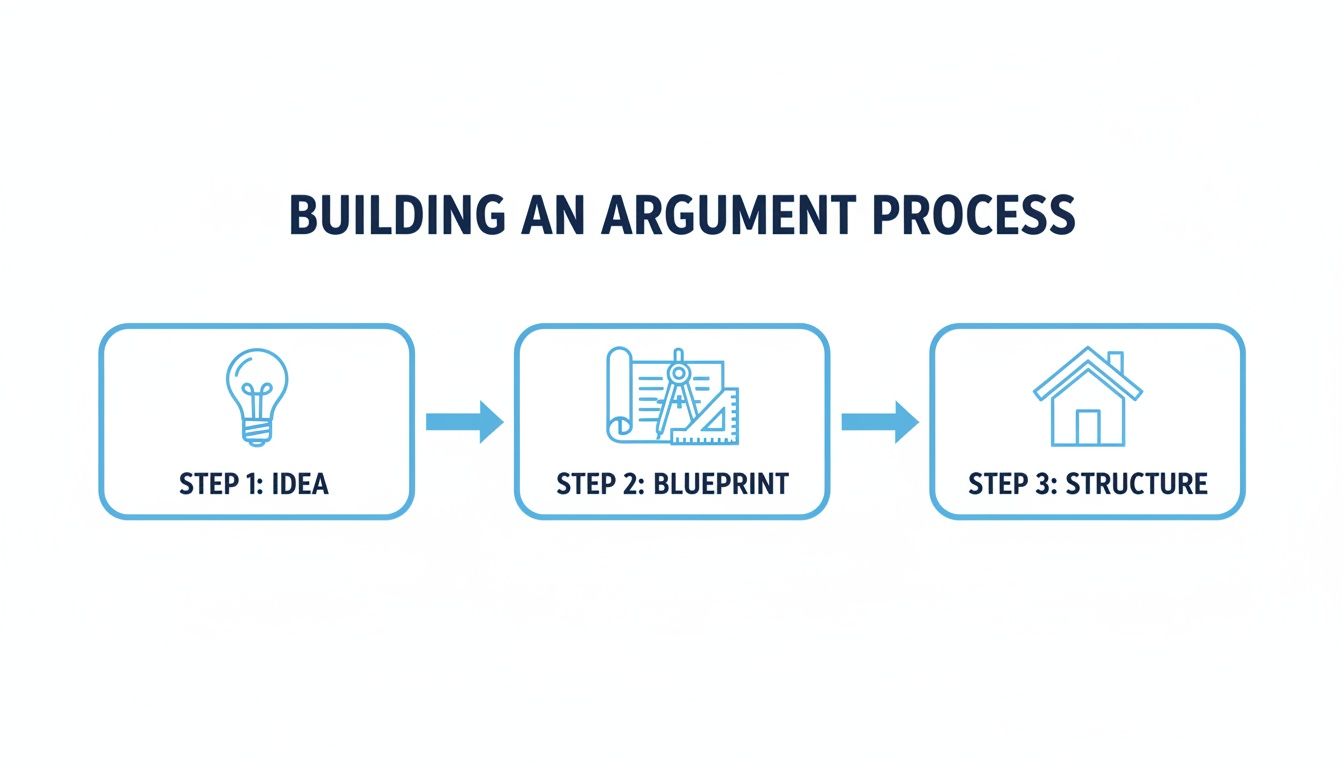
As the visual shows, a strong final structure is impossible without a detailed blueprint. This really highlights just how critical the planning stage is.
Taking the time to plan your search pays off. Understanding the subtle differences between things like semantic search vs keyword search can also help you fine-tune your strategy and get much better results. A strategic approach saves time, cuts down on frustration, and ultimately leads to much higher-quality research.
Where to Find High-Quality Academic Sources
With a solid plan in hand, you're ready to start your treasure hunt for knowledge. But where exactly do you look? While a quick Google search is fine for everyday questions, your academic work needs sources with a lot more substance. This means stepping into the world of academic databases—the digital libraries of scholarly research.
Think of it this way: Google searches the entire public internet, a vast and chaotic city with no quality control. Academic databases are like exclusive, members-only libraries within that city, meticulously curated to contain only high-quality, credible, and rigorously checked information. This is where you’ll find the gold-standard sources your university assignments demand.
Understanding the Gold Standard: Peer Review
Before diving into the databases, you need to get familiar with the term peer-reviewed. This is the academic seal of approval. When a researcher submits an article to a peer-reviewed journal, it doesn’t just get published. Instead, it’s sent out to a panel of other anonymous experts in the same field.
These experts (the "peers") rigorously scrutinise the research for:
- Validity: Is the methodology sound? Do the conclusions actually make sense based on the evidence?
- Originality: Does this work bring something new to the table?
- Significance: Is the research important and relevant to the field?
Only after passing this intense review process is the article published. This is why peer-reviewed sources are considered the most reliable and authoritative evidence you can use. It's a built-in quality-control system that filters out weak or unsubstantiated claims.
Navigating Key Academic Databases
As a UK student, you have access to a wealth of powerful databases, often for free through your local or future university library. Knowing which database to use for your subject can save you a huge amount of time and frustration.
Here are a few of the most important ones for Access to HE subjects:
- JSTOR: A fantastic starting point for humanities and social sciences. It’s an enormous digital library packed with academic journals, books, and primary sources.
- Web of Science: A comprehensive, multi-disciplinary database that is excellent for science and health subjects. It’s particularly useful for seeing how different research papers are connected through citations.
- Scopus: Another massive database that is strong across science, technology, medicine, and social sciences. It's especially good for finding conference papers and trade publications.
For UK adult learners preparing for health or social science degrees, getting the hang of a systematic search is key. Specialist resources like Biosis, which you can often get to via Web of Science, are invaluable for midwifery and nursing topics. Likewise, databases like JSTOR are essential for social science journals. You can find excellent video tutorials and search tips to improve your skills; discover more insights about UCL's database resources on their library guides website.
This is an example of the clean, powerful interface you'll find on a database like JSTOR.

Notice how the search bar is front and centre, but there are also options to browse by subject, title, or publisher. This gives you multiple ways to discover the information you need.
How to Access These Resources
You might be wondering how you can get into these "members-only" libraries. The great news is that access is usually much more straightforward than you think.
Key Takeaway: Your public library card or your future university student login is the key that unlocks these powerful academic databases. Don't be afraid to ask a librarian for help—they are experts at navigating these resources and love to share their knowledge.
Most local councils in the UK provide free online access to some of these databases with a library membership. Once you enrol in your Access to HE course or at university, you'll get full access to an even wider range of specialist databases through your institution’s online library portal. This access is a valuable part of your course fees, so be sure to make the most of it
How to Critically Evaluate Your Sources
Finding a source is just the beginning. Once you’ve gathered your initial materials from those academic databases, your role shifts from researcher to detective.
Every article, book, or report you find needs to be properly interrogated to see if it’s strong enough to support your arguments. Let’s be honest, not all information is created equal, and learning to spot the difference is a skill that will serve you well beyond your Access course.
This process is called critical evaluation. Think of it as a methodical way of checking the quality, credibility, and relevance of your sources. Without it, you risk building your entire assignment on a shaky foundation of biased, outdated, or just plain wrong information.
Introducing the CRAAP Test Framework
To keep things straightforward, you can use a simple but powerful framework known as the CRAAP test. It's a handy acronym that stands for Currency, Relevance, Authority, Accuracy, and Purpose.
By asking a few targeted questions under each of these headings, you can systematically vet any source you come across.
Let’s break down what each part of the test means for you:
- Currency: How timely is the information? A study on social media trends from 2010 is obviously out of date, but a historical analysis from that same year might still be perfectly fine.
- Relevance: How does this source actually relate to your specific research question? Is it giving you a broad overview, or does it tackle your topic head-on?
- Authority: Who is the author or publisher? Do they have the credentials and expertise to be writing on this topic? Are they a recognised expert in their field?
- Accuracy: Is the information backed up by evidence? Can you verify their claims in other credible sources? Are there citations or a reference list?
- Purpose: Why was this information created in the first place? Is the goal to inform, persuade, or sell you something? Understanding the motive is key.
Applying this framework helps you move beyond simply collecting information and towards actively questioning it. The ability to do this is a core part of building your critical thinking skills. You can explore this further by reading our guide on how to develop critical thinking skills for your studies.
Putting the CRAAP Test into Action
Let’s imagine you're a working professional in Cambridge aiming for a computer science or business degree via a flexible online Access course. Your initial literature search is a vital first step. The Department for Education’s 2023/24 participation data highlights just how important this targeted preparation is for success in higher education. You can explore the government's latest higher education statistics to see these trends for yourself.
When you're evaluating a source, a key skill to develop is the art of writing clear, unbiased summaries. This forces you to accurately represent the information you've found and ensures you properly understand the author's argument before you start to critique it.
By consistently applying a critical lens, you learn to distinguish between strong, scholarly evidence and weak, unsubstantiated opinion. This is the hallmark of university-level research and a skill that will serve you throughout your career.
Organizing Your Research and Citing Sources Correctly
 So, you’ve dived into the academic databases, sifted through countless articles, and found some real gems for your assignment. Brilliant! But now you’re facing a new challenge: a growing mountain of PDFs and notes that can quickly spiral into chaos.
Getting your research organised is the vital step that links finding great sources to writing a fantastic, well-argued assignment. Without a system, it’s easy to feel overwhelmed.
Think of it like preparing a big meal. You wouldn’t just throw all your ingredients on the counter and hope for the best. You’d get everything chopped, measured, and laid out neatly first. Organising your research is your academic ‘mise en place’—it sets you up for a smooth, stress-free writing process.
Effective Note-Taking and Tracking Methods
A solid method for tracking your sources and the notes you take from them is an absolute must. It’s not just about avoiding that last-minute panic; a good system helps you spot connections between different ideas and authors as you go.
Here are a couple of tried-and-tested methods that really work:
-
The Annotated Bibliography: This is so much more than a simple list of books and articles. For each source, you’ll write a short paragraph summarising its core argument, weighing up its strengths and weaknesses, and jotting down how it connects to your own research question. It forces you to think critically from the very beginning.
-
The Research Spreadsheet: Don't underestimate the power of a simple spreadsheet! You can create columns for the author, title, year, key findings, useful quotes (with page numbers!), and your own thoughts. It gives you an amazing at-a-glance overview of everything you've read, and you can easily sort and filter it.
Whichever you choose, the goal is to actively engage with the material, not just passively collect it. This is how you start to truly understand the academic conversation you’re about to join.
The Why and How of Citing Sources
Referencing can seem a bit daunting at first, but its purpose is actually quite simple—and incredibly important. When you cite your sources, you’re giving credit where it's due, acknowledging the researchers and thinkers whose work you’re building on.
It’s the academic way of saying, “This brilliant point was made by this person, and here’s where you can read it for yourself.”
Proper referencing also makes your own work much stronger. It shows your tutor that your arguments aren’t just opinions, but are grounded in solid, credible research. For most UK Access to HE courses, you’ll be asked to use a specific style, like Harvard. We’ve put together a handy guide on how to reference a journal article using the Harvard style to help you get it right.
Think of citations as the signposts in your academic argument. They show your reader the path you took through the existing research, proving that your conclusions are well-informed and trustworthy.
Let Tech Handle the Hard Work: Essential Tools
Manually typing out a bibliography is a tedious job, and it’s painfully easy to make small mistakes. This is where reference management software comes in to save the day, especially for busy adult learners juggling multiple commitments. These tools are designed to streamline the whole process for you.
To get you started, here’s a quick rundown of some of the best tools out there—many of which are completely free.
Essential Tools for Your Literature Search
| Tool Category | Example Tools | What It Helps You Do |
|---|---|---|
| Reference Managers | Zotero, Mendeley | Store all your sources in one place, insert citations as you write, and automatically generate a perfect bibliography in seconds. A real time-saver! |
| Note-Taking Apps | Evernote, OneNote | Organise your notes, thoughts, and article summaries digitally. You can clip web pages, tag your notes, and sync across all your devices. |
| PDF Readers & Annotators | Adobe Acrobat Reader, Kami | Highlight key passages, add comments, and make notes directly onto your PDF articles, keeping your thoughts connected to the source text. |
Learning to use a reference manager like Zotero or Mendeley might take an hour or two upfront, but it will save you countless hours of frustration down the line. They take care of the formatting headache so you can focus on what really matters: developing your ideas and writing a brilliant assignment.
Common Pitfalls in a Literature Search and How to Avoid Them
Starting a literature search can feel a bit like exploring a new city; it’s exciting, but it’s also surprisingly easy to get lost. Even seasoned researchers can take a wrong turn. Getting to know the common pitfalls early on will save you a ton of time, cut down on frustration, and lead to a much stronger assignment in the end.
A lot of students make the mistake of treating the literature search like a one-off task—something you just tick off the list before getting to the "real work" of writing. This is a big misunderstanding of what a literature search is really all about.
A literature search isn't a single event; it's a living, breathing process. Your understanding of the topic deepens as you read, which then helps you sharpen your keywords and ask better questions. The search grows as your knowledge grows.
Let's break down some of the most frequent mistakes and, more importantly, how you can sidestep them.
Pitfall 1: Sticking to One Search Engine
Relying only on Google Scholar or a single database is like trying to understand a whole topic by reading just one book. You’ll get a very narrow, and possibly biased, picture of the conversation. Different databases hold different journals and articles, so if you limit yourself to just one, you’re almost certainly missing out on crucial research.
- How to Avoid It: Take a multi-database approach. You can start with a broad engine like Web of Science or JSTOR, but make sure you also dive into databases specific to your subject. Think Biosis for health sciences or PsycINFO for social sciences. This way, you’re casting a wide, yet targeted, net.
Pitfall 2: Using Keywords That Are Too Broad
Searching for a term like "social care" or "nursing" is a recipe for disaster. You’ll get millions of results, leaving you completely swamped. This usually happens when your research question isn't focused enough, making it nearly impossible to find what you actually need. It's a classic mistake that can waste hours.
- How to Avoid It: Go back to your research question. Break it down into its core ideas and use Boolean operators (AND, OR, NOT) to string them together. For example, a search for ("social care" AND "older adults" AND "community support") NOT "hospital" will give you a much more manageable and relevant list of results.
Pitfall 3: Keeping Disorganised Records
So, you've found ten fantastic articles. A week later, you can't remember which PDF had that perfect quote or where you saw that key statistic. This always leads to a last-minute panic when it's time to write your bibliography, and you could even risk accidentally plagiarising if you can't retrace your steps.
- How to Avoid It: Set up a simple tracking system from day one. A spreadsheet is a great start—just log each source, its main points, and any useful quotes (with page numbers!). Even better, get comfortable with a free reference manager like Zotero or Mendeley. They’ll save your sources, notes, and PDFs all in one tidy, organised place.
Frequently Asked Questions About Literature Searches
Diving into your first proper academic research project can feel a bit overwhelming, and it's bound to bring up a lot of questions. Don't worry, that’s completely normal. Getting to grips with what a literature search actually is and how it all works is the first step to building your confidence.
To help you get past those initial wobbles, we’ve put together some straightforward answers to the questions we hear most often from students.
How Many Sources Do I Need for My Literature Search?
There’s no magic number here. The right amount of sources really depends on your specific assignment and how big it is. Your tutor will almost always give you guidance on this, so the first place to look is your module handbook.
The real goal is to show that you’ve properly explored the key ideas and major debates around your topic. And remember, quality always trumps quantity. Five highly relevant, peer-reviewed articles that you really get stuck into are far more valuable than twenty dodgy web pages you've only skimmed. Your focus should be on finding the best evidence, not just the most.
What Is the Difference Between a Literature Search and a Literature Review?
This is a brilliant question and something that trips a lot of people up. The easiest way to think about it is to imagine you're cooking a meal.
- The literature search is you going out and gathering all your ingredients. It's the active, hands-on work of finding, checking, and picking your sources from academic databases, journals, and the library.
- The literature review is the finished dish you create with those ingredients. It’s the written part of your essay where you mix, analyse, and critique the sources you found to build your own strong argument.
Basically, the search is the practical "how you find it" part, while the review is the intellectual "what you do with it" part. A great search is the foundation for a brilliant review.
Key Takeaway: Think of the literature search as the investigation and the literature review as the final report. You can't write the report without first doing a thorough investigation.
Can I Use Wikipedia for My Literature Search?
Believe it or not, Wikipedia can be a useful tool, but only if you use it smartly. It’s a fantastic starting point for getting a quick overview of a new topic and spotting potential keywords you might not have thought of. It helps you get your bearings.
However, you should never, ever cite Wikipedia as a source in your academic work. Because anyone can edit its content, it just doesn't meet the standards for academic credibility.
Instead, use it like a detective. Scroll right down to the bottom of the page to the "References" section. This is an absolute goldmine. It often lists the original, credible academic books and journal articles the page is based on. You can then hunt down these original sources in your university library or database, read them for yourself, and cite them directly.
At Access Courses Online, we provide the tools and support you need to master essential academic skills like the literature search, setting you up for success at university and beyond.
Ready to take the next step towards your degree? Explore our accredited online Access to HE Diplomas at https://accesscoursesonline.com.